
Rotablation or Balloon Immediate and 6 month results
Rotablation or Balloon Immediate and 6 month results of a trial in patients with chronic total coronary occlusion Layth A. Mimish, M. Bakhshi, J. Buraiki, F. Nozha, K. Niazi, Dunn, B. Dajani, M. E. Fawzy B.
The Goal of the Study u PTCA of chronic total occlusion carries high restenosis rate u Main mechanism of GOBA is controlled dissection/++Trauma u Smoother lumen is created by debulking with rotablation u Does that reflect on restenosis rates?
Study Patients/Design u All patients undergoing percutaneous revascularization of occluded coronary artery of more than 3 months duration u Informed Consent u After crossing the lesion with the wire patients are randomized to one limb of the study

Study Patient/Design u For rotablator patients the wire is exchanged to 0. 009 Rota wire using Buchbinder exchange catheter u All rotablations are chased with low atmospheric inflations to achieve residual stenosis of less than 20%
Study Patient/Design u Multiple angiographic views with assessment of collaterals, length of lesion, LVEF, Segmental analysis u 10, 000 U I. V. Heparin followed by check of ACT u I. C. NTG and/or Verapamil as required
Study Patient/Design u Balloon size is judged by the size of the artery in the immediate proximity of the lesion u Preferably single balloon of matching size is used u Only if failure to cross with deep throating with the guider, a pre dilation with 1. 5 mm balloon is used
Study Patient/Design u Smallest Burr size available is used followed by larger size/s Burrs aiming to achieve at least 30% residual stenosis u All rotablated cases are chased with balloon dilatation u Stenting is used only for dissection or for residual narrowing of more than 30%
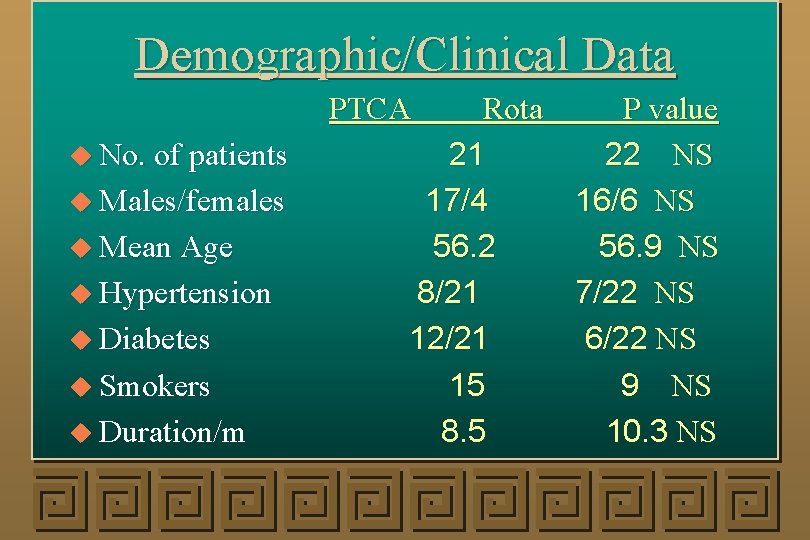
Demographic/Clinical Data PTCA u No. of patients u Males/females u Mean Age u Hypertension u Diabetes u Smokers u Duration/m Rota P value 21 22 NS 17/4 16/6 NS 56. 2 56. 9 NS 8/21 7/22 NS 12/21 6/22 NS 15 9 NS 8. 5 10. 3 NS
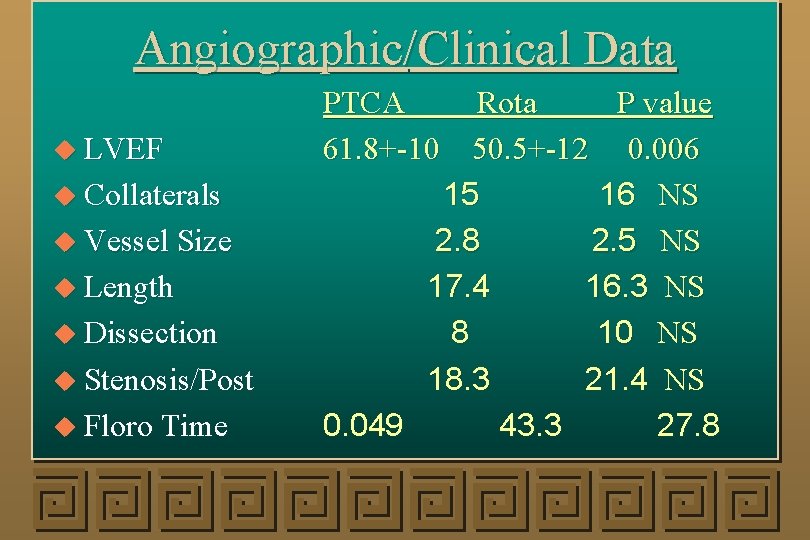
Angiographic/Clinical Data u LVEF u Collaterals u Vessel Size u Length u Dissection u Stenosis/Post u Floro Time PTCA Rota P value 61. 8+-10 50. 5+-12 0. 006 15 16 NS 2. 8 2. 5 NS 17. 4 16. 3 NS 8 10 NS 18. 3 21. 4 NS 0. 049 43. 3 27. 8
Shortcomings & Pitfalls u. Small number of patients u. Visual assessment u. Contamination with stenting u. Ballooning post rotablations
Months Follow Up 6 u Angiographic follow up showed significant restenosis in 10 patients in each group i. e. 45% Vs 47% ( P=N. S(. u Stenting ( 1 in PTCA group and 7 in Rotablator group ) did not affect the restenosis rates
Conclusions u Rotablation does not significantly decrease the rate of restenosis u It definitely increases the cost and the time of the procedure u It exposes the team and the patient to higher dose of radiation
- Slides: 12