
Ross Operation Seoul National University Hospital Department of
- Slides: 20
Ross Operation Seoul National University Hospital Department of Thoracic & Cardiovascular Surgery
Pulmonary Autograft ØAdvantages • Autograft is superior to the allograft in terms of clinical or hemodynamic outcomes. • Favorable qualities of the autograft, including 1. Excellent immediate hemodynamics, even in small sizes 2. Freedom from a need for anticoagulation 3. Resistance to infection 4. Suitability for use despite congenital or acquired distortions of cardiac anatomy. • Better hemodynamics over time, growth of the autograft, which has been well described and which does not occur in allografts
Pulmonary Autograft ØIdea of choice • The Ross procedure is not a cure for aortic valve disease. • Beyond its technical demands, which are formidable, there are legitimate concerns about long-term growth and durability of the autograft, dilatation of the neoaortic root, and fate of the pulmonary allograft. • Ultimately, the decision to perform the Ross procedure or an alternative operation must be tempered to some degree by what that alternative operation is.
Pulmonary Autograft ØAortic root tailoring Aim To overcome the size mismatch (2 mm over sized) 2 Adjust aortic anulnus to 2 mm smaller than that of the pulmonary autograft 1 Method 1 Circumferential strips 2 Purse-string sutures around the annular 3 Noncircumferential removal of tissue posteriorly at the level of anterior leaflet (Triangular excision between left & noncoronary cusp)
Aortic Root Replacement ØUse of allograft I. Advantages 1. Simplicity Younger patient 1) Annulus is large & noncoronary cusp is deep. 2) Commissures may not be symmetric. 3) Sinuses may have variable diameter. 4) Transverse orifice in a bicuspid valve 2. Decrease in structural degeneration over time II. Principles 1. The allograft should not be made to fit the host. 2. The allograft valve should maintain its inherent symmetry. 3. The size of the allograft becomes less critical.
Pulmonary Autograft ØCauses of failure • Technical errors during dissection and implantation of pulmonary autograft • Geometric mismatch between the two semilunar valves • Late endocarditis • Immunologically mediated injury • Structural changes in the autograft that predispose to dilatation of the autograft
Ross Procedure ØDisadvantages • • • Technical demands, which are formidable Legitimate concerns of long-term growth Durability of the autograft Dilatation of the neoaortic root Fate of the pulmonary allograft
Ross Procedure ØContraindications • The pulmonary valve may be congenitally absent or deformed • The pulmonary valve may be damaged by acquired disease, or compromised by previous surgical procedures • Certain connective tissue disorders, such as Marfan syndrome, probably affect pulmonary valve & disqualify it from consideration
Ross Procedure ØFactors of late results 1 Cellularity of the semilunar valve decreases with age, Ross operation may not be appropriate for elderly. 2 Adjust diameter of the aortic annulus and of the sinotubular junction to those diameters of the pulmonary autograft 3 Pulmonary homograft is more durable than the aortic homogaft 4 Neither the diameter of aortic annulus, nor sinotubular junction should exceed the length of the free margin of the leaflet
Ross Procedure 1. Arrhythmia 2. 1. Underlying potential for ventricular arrhythmia 3. because of pressure & volume overload 4. 2. Damage the septal branches of the LAD causes 5. myocardial ischemia & ventricular ectopy 6. 3. Coronary artery transfer may lead to the areas of 7. myocardial ischemia & rhythm abnormalities. 8. 4. Annular-enlarging procedures or muscle resection 9. in subaortic area damage the conduction system.
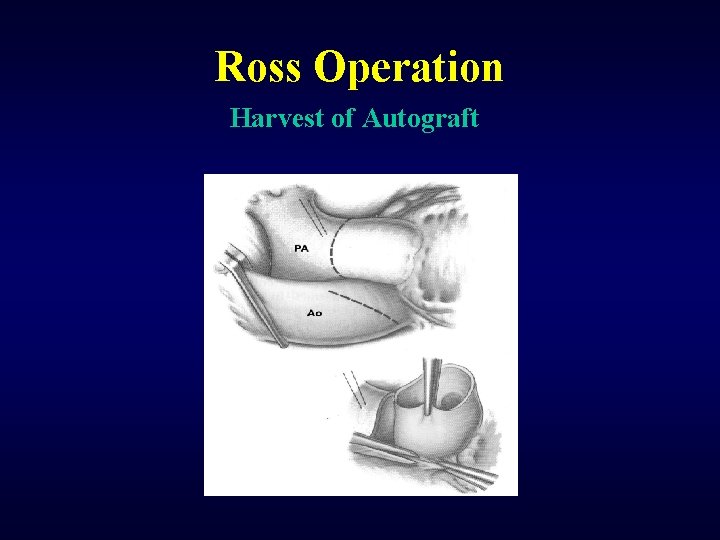
Ross Operation Harvest of Autograft
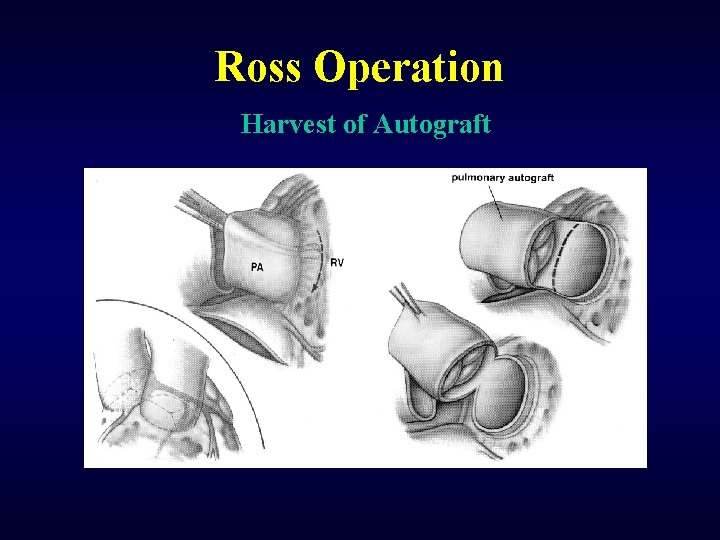
Ross Operation Harvest of Autograft
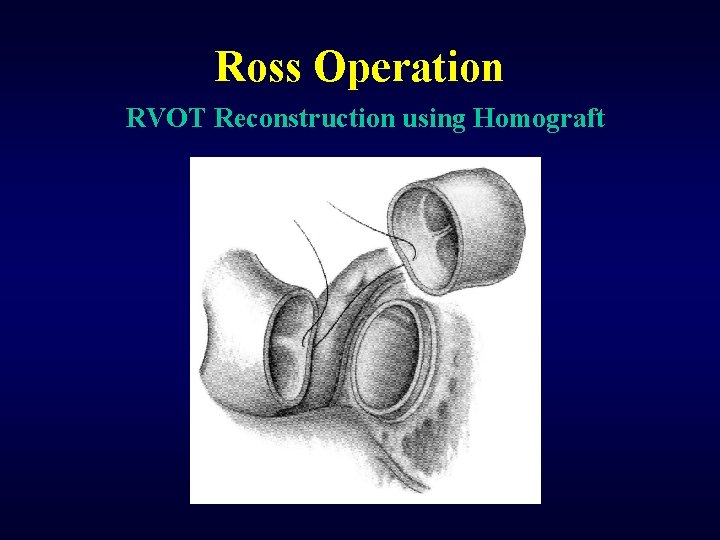
Ross Operation RVOT Reconstruction using Homograft
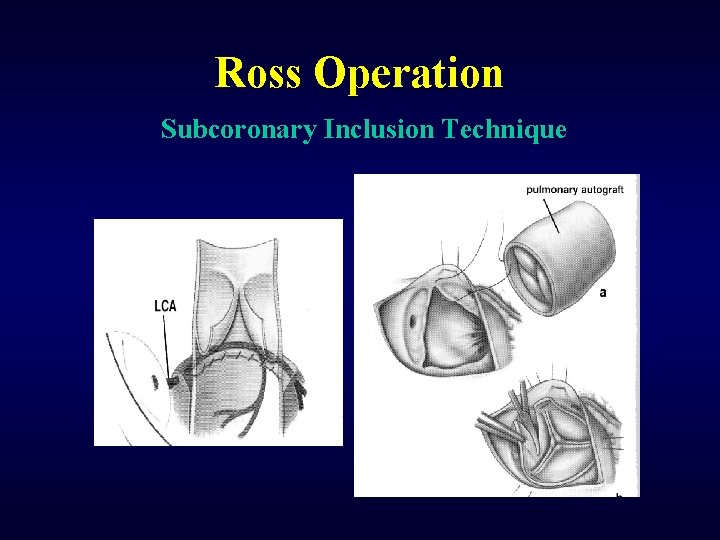
Ross Operation Subcoronary Inclusion Technique
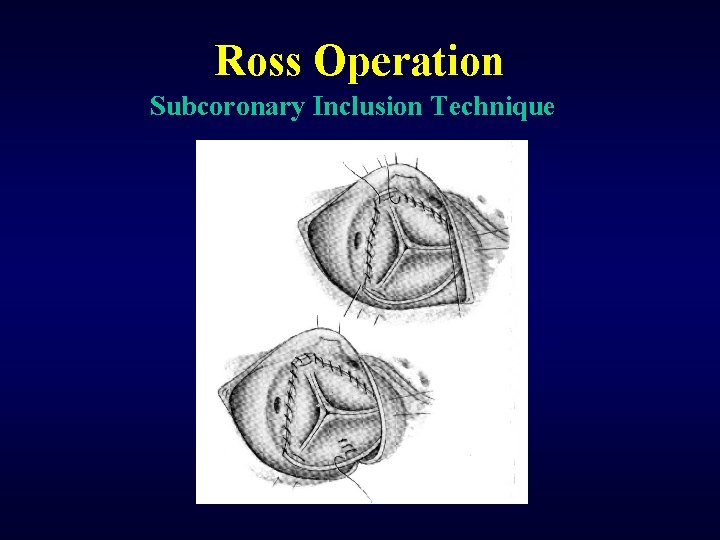
Ross Operation Subcoronary Inclusion Technique
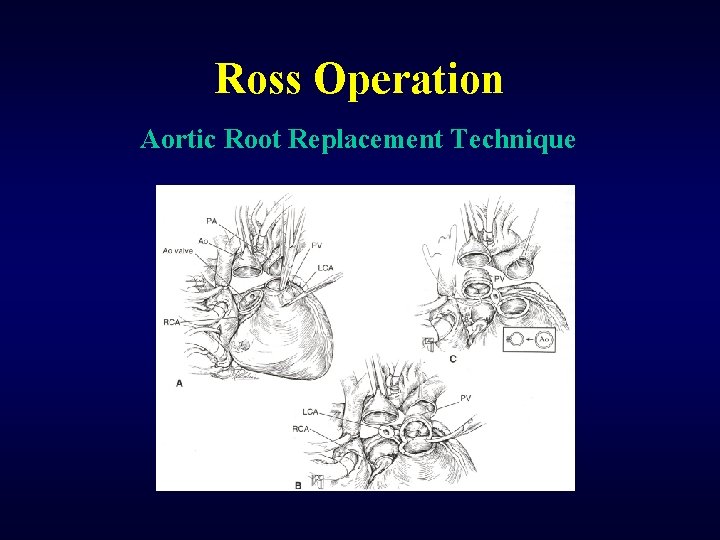
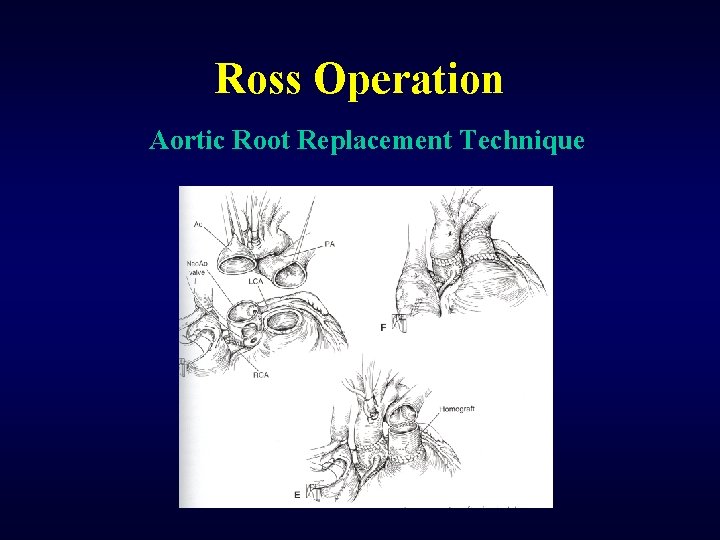
Ross Operation Aortic Root Replacement Technique
Ross Operation Aortic Root Replacement Technique
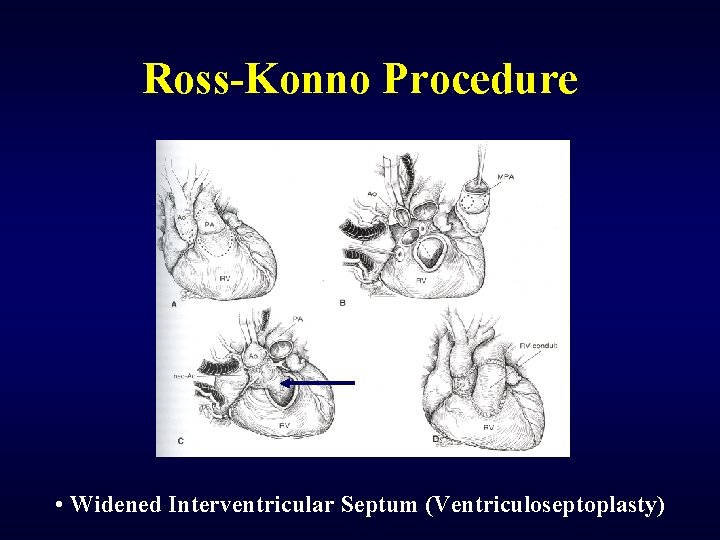
Ross-Konno Procedure • Widened Interventricular Septum (Ventriculoseptoplasty)
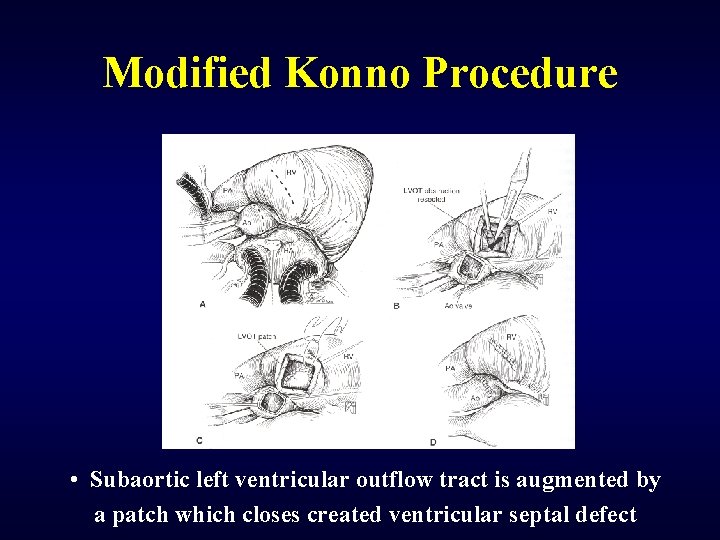
Modified Konno Procedure • Subaortic left ventricular outflow tract is augmented by a patch which closes created ventricular septal defect
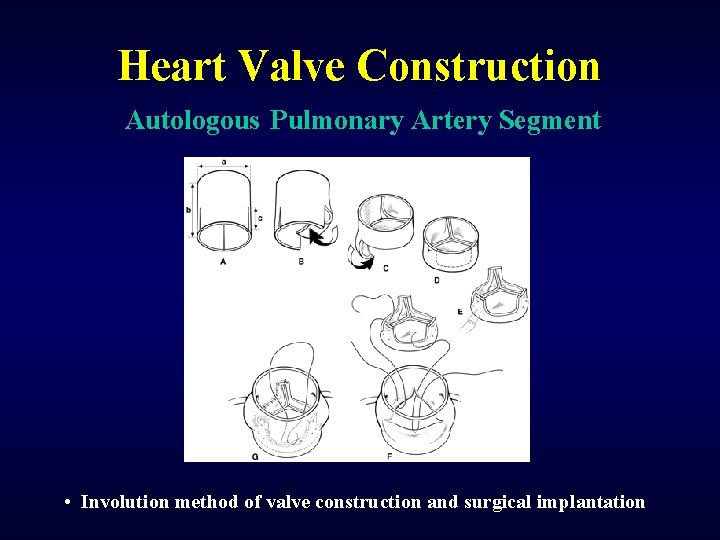
Heart Valve Construction Autologous Pulmonary Artery Segment • Involution method of valve construction and surgical implantation