
Rosids Part 1 Basal Rosids and Eurosids I
Rosids – Part 1: Basal Rosids and Eurosids I Spring 2011
Figure 9. 3 from the text “Lower” Core tricolpates “Basal” rosids (Eurosids I) (Eurosids II) Rosids
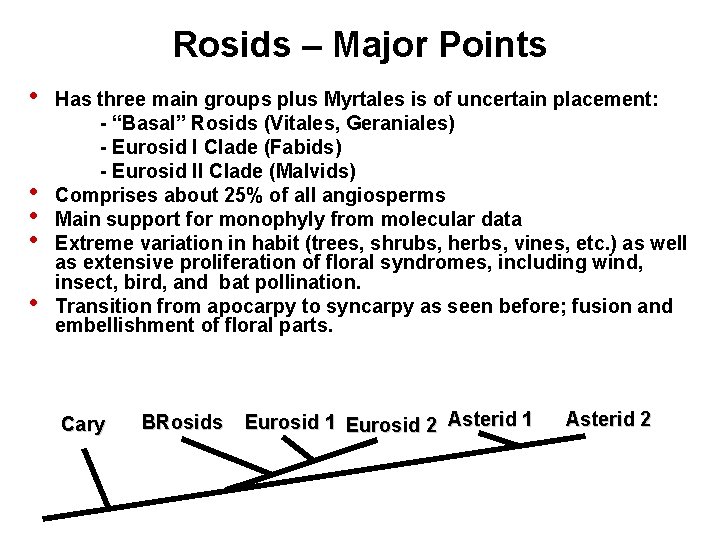
Rosids – Major Points • • • Has three main groups plus Myrtales is of uncertain placement: - “Basal” Rosids (Vitales, Geraniales) - Eurosid I Clade (Fabids) - Eurosid II Clade (Malvids) Comprises about 25% of all angiosperms Main support for monophyly from molecular data Extreme variation in habit (trees, shrubs, herbs, vines, etc. ) as well as extensive proliferation of floral syndromes, including wind, insect, bird, and bat pollination. Transition from apocarpy to syncarpy as seen before; fusion and embellishment of floral parts. Cary BRosids Eurosid 1 Eurosid 2 Asterid 1 Asterid 2
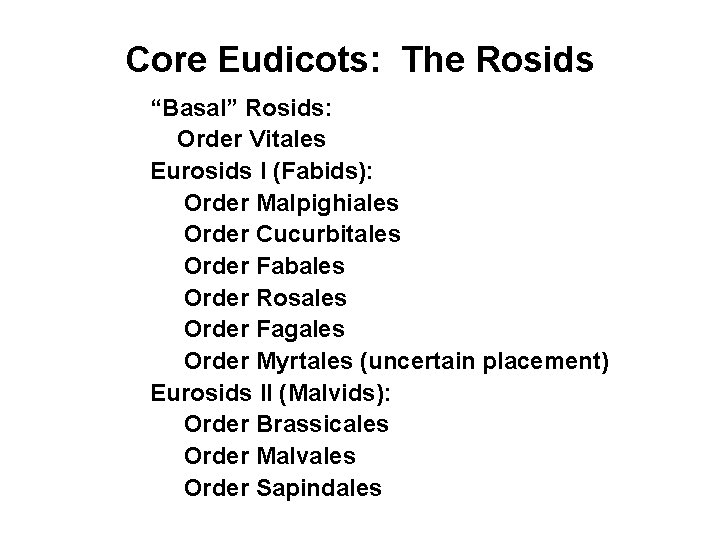
Core Eudicots: The Rosids “Basal” Rosids: Order Vitales Eurosids I (Fabids): Order Malpighiales Order Cucurbitales Order Fabales Order Rosales Order Fagales Order Myrtales (uncertain placement) Eurosids II (Malvids): Order Brassicales Order Malvales Order Sapindales
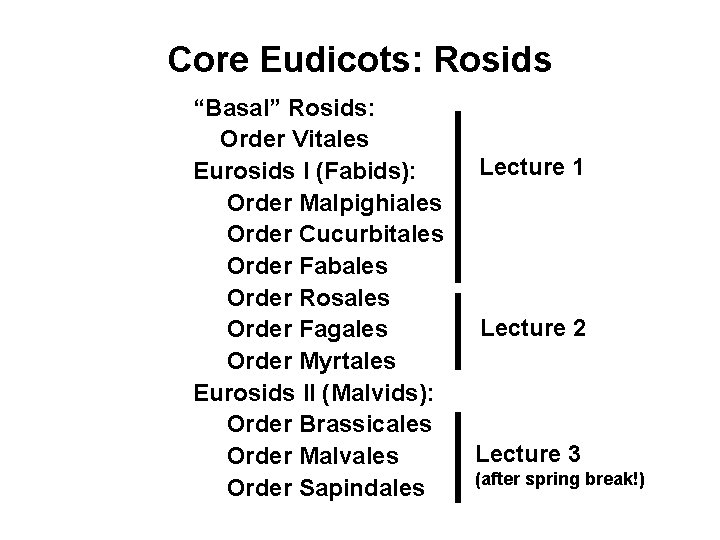
Core Eudicots: Rosids “Basal” Rosids: Order Vitales Eurosids I (Fabids): Order Malpighiales Order Cucurbitales Order Fabales Order Rosales Order Fagales Order Myrtales Eurosids II (Malvids): Order Brassicales Order Malvales Order Sapindales Lecture 1 Lecture 2 Lecture 3 (after spring break!)
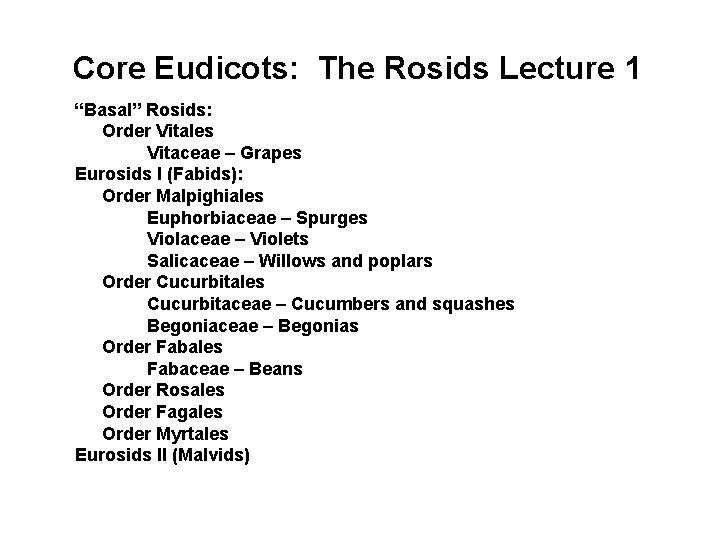
Core Eudicots: The Rosids Lecture 1 “Basal” Rosids: Order Vitales Vitaceae – Grapes Eurosids I (Fabids): Order Malpighiales Euphorbiaceae – Spurges Violaceae – Violets Salicaceae – Willows and poplars Order Cucurbitales Cucurbitaceae – Cucumbers and squashes Begoniaceae – Begonias Order Fabales Fabaceae – Beans Order Rosales Order Fagales Order Myrtales Eurosids II (Malvids)
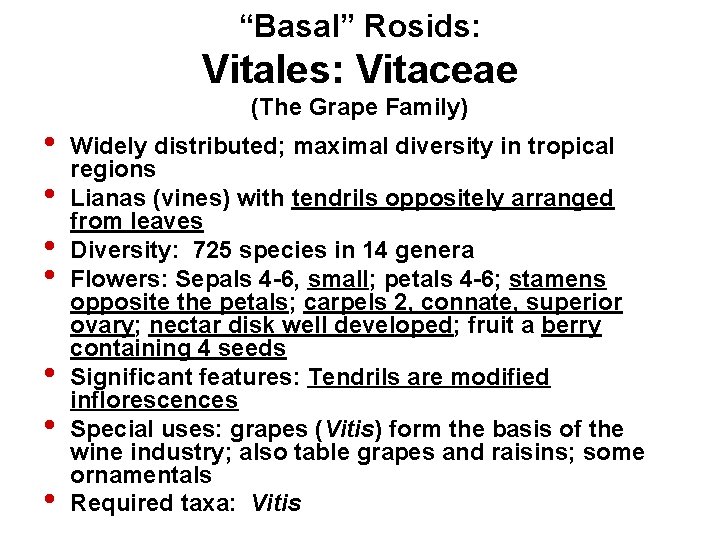
“Basal” Rosids: Vitales: Vitaceae (The Grape Family) • • Widely distributed; maximal diversity in tropical regions Lianas (vines) with tendrils oppositely arranged from leaves Diversity: 725 species in 14 genera Flowers: Sepals 4 -6, small; petals 4 -6; stamens opposite the petals; carpels 2, connate, superior ovary; nectar disk well developed; fruit a berry containing 4 seeds Significant features: Tendrils are modified inflorescences Special uses: grapes (Vitis) form the basis of the wine industry; also table grapes and raisins; some ornamentals Required taxa: Vitis
Vitaceae
Vitaceae: Vitis -bark without lenticels -pith brown -leaves simple, mostly rounded/cordate -inflorescence cymose, compound -flowers 5 -merous -petals separating at the base and falling without expanding as a cap -seeds usually pyriform
Eurosids I: Malpighiales: Euphorbiaceae (The Spurge Family) • • Widespread, but most diverse in tropical regions Trees, shrubs, herbs, or vines, sometimes succulent; leaves usually alternate Diversity: ca. 6, 100 species in 222 genera Flowers: Unisexual; sepals 2 -6; petals 0 -5; carpels usually 3, ovule 1 per locule; styles usually 3 and each usually divided; inflorescences often highly modified; fruit a schizocarp, seeds usually arillate Significant features: Often with latex/laticifers (toxic) Special uses: rubber (Hevea), cassava/manioc (Manihot), poinsettia (Euphorbia), ornamentals Required taxa: Euphorbia
Euphorbiaceae: Euphorbia • Ca. 2, 400 species • White latex (usually) • One female and few to many male flowers aggregated into a cyathium (false flower or pseudanthium) • Cyathium subtended by modified leaves (cyathophylls)
Euphorbiaceae: Euphorbia cyathium http: //www. euphorbiaceae. org/pages/about_euphorbia. html
Euphorbiaceae • Castor oil (Ricinus; extracted from foliage) Ricinus communis castor bean ~ poisonous seeds
Euphorbiaceae • Rubber (Hevea)
Euphorbiaceae • Tapioca, Cassava (Manihot) Manihot esculenta cassava, tapioca
Euphorbiaceae • Tung oil (Aleurites) Aleurites fordii tung-oil tree
Eurosids I: Malpighiales: Violaceae (The Violet Family) • Widespread, but predominantly herbs of temperate regions • Herbs, shrubs, or trees • Diversity: 950 species in 22 genera • Flowers: Sepals 5; petals 5; modified • • • androecium; carpels usually 3, connate, superior ovary; fruit usually a loculicidal capsule Significant features: Zygomprphy, nectar spurs; floral cleistogamy Special uses: Violets grown primarily as ornamentals Required taxa: Viola
Violaceae: modified androecium
Violaceae: Viola -mostly herbs, some shrubs -flowers zygomorphic -lower petal spurred -spring flowers open-pollinated, summer flowers remaining closed (cleistogamous)
Violaceae: Hybanthus
Eurosids I: Malpighiales: Salicaceae • • (The Willow or Poplar Family) Widespread, from tropical to north temperate and boreal regions Trees or shrubs Diversity: 1, 210 species in 58 genera Flowers: bisexual or unisexual; sepals 3 -8; petals 38; stamens 2 -∞; carpels 2 -4, connate, in superior ovary; fruit variable Significant features: leaves simple, teeth salicoid; salicin in most; includes what was formerly called the “Flacourtiaceae” Special uses: lumber, shade trees, ornamentals Required taxa: Populus, Salix
Salicaceae: Salix -bud scale single -catkins usually erect or ascending -flowers unisexual -each flower with 1 -4 basal nectar glands -stamens 1 -12
Salicaceae: Populus -bud scales several, overlapping -catkins arching or drooping -each flower with a basal cup-like disk -stamens 8 -numerous
Eurosids I: Cucurbitales: Cucurbitaceae (The Cucumber or Squash Family) • • Widespread in the tropics and subtropics, a few in temperate regions Herbaceous or soft woody vines with scabrous stems and leaves and usually with tendrils Diversity: 825 species in 118 genera Flowers: hypanthium present; sepals & petals 5, usually connate; stamens 3 -5; carpels usually 3; ovary half-inferior or inferior; fruit a berry (with hardened rind a pepo); seeds flattened, the seed coat with several layers Significant features: wide range of floral diversity, “toothed” leaves lacking stipules Special uses: cucumbers (Cucumis), pumpkins, gourds, and squashes (Cucurbita), watermelons (Citrullus) etc. are eaten for fruits and seeds; Luffa, some ornamentals Required taxa: family only
Cucurbitaceae: Cucurbita -trailing herbs -leaves large, cordateangled or lobed -flowers large, solitary in axils -corolla campanulate, deeply 5 -lobed -ovaries and fruits smooth or hairy, not prickly -fruits large, with a firm rind -gourds, squashes, pumpkin
Eurosids I: Cucurbitales: Begoniaceae • • (The Begonia Family) Widely distributed in the tropics and subtropics Herbs or soft woody shrubs Diversity: 920 in 2 genera Flowers: Unisexual; tepals petaloid, 2 -10 but usually 4 in 2 whorls (staminate) and 5 in 1 whorl (pistillate); carpels usually 3, connate; inferior ovary; fruit a loculicidal capsule, usually winged Significant features: Soft herbs, typically of shaded habitats; stigmas elongated, twisted, yellow, papillose Special uses: primarily ornamentals Required taxa: Begonia
Begoniaceae: Begonia Carpellate Flowers Staminate Flowers -winged ovaries
Eurosids I: Fabales: Fabaceae (The Legume Family) • • Nearly cosmopolitan Herbs, vines, trees, shrubs with usually alternate, pinnately to palmately compound leaves Diversity: 18, 000 species in 630 genera – THIRD LARGEST FAMILY of angiosperms Flowers: a short, cup-like hypanthium present; sepals & petals usually 5, more commonly connate; petals all alike or the uppermost 1 differentiated (banner), the lower 2 forming a keel or flaring apart; stamens usually 10, if connate then monadelphous or diadelphous; carpel 1, on a short stalk (gynophore); fruit is a legume (Duh!) but sometimes modified Significant features: High nitrogen metabolism w/ unusual amino acids, often with root nodules with N-fixing bacteria; leaf and leaflet pulvinuses well developed; endosperm often lacking; wide range of floral diversity; 3 subfamilies but 1 is not monophyletic Special uses: Many!! Beans, peanuts, soybean, clover, ornamentals (Mimosa, Bauhinia); lumber, dyes, resins Required taxa: Glycine, Trifolium, Mimosa, Cercis, Gleditsia
Fabaceae vegetative characters root nodules pulvinus pinnately to palmately compound leaves
Fabaceae floral characters Perigynous flower, short hypanthium Diadelphous stamens: 9+1 Parietal placentation
Fabaceae fruit and seed characters non-endospermous seeds legumes, loments, etc.
Table 9. 2 from the text: Subfamilies of Fabaceae
Fabaceae: Mimosoideae Actinomorphic tubular flowers in heads Albizia julibrissin mimosa, silktree many stamens, not fused
Fabaceae: Mimosoideae: Mimosa -woody or herbaceous -often armed (with prickles) -leafstalk without glands -flowers in heads or rarely racemes or spikes -stamens 10 or fewer -fruits
Fabaceae: Caesalpinioideae zygomorphic flower pulvinus Stamens not fused -10 or fewer Senna obtusifolia sicklepod
Fabaceae: “Cesalpinoideae”: Cercis -unarmed -leaves simple, palmately veined -flowers clustered, appearing before leaves -corolla rose to pink-purple Cercis canadensis - redbud
Fabaceae: “Caesalpinioideae”: Gleditsia -armed (with thorns) -leaves 1 - or 2 -pinnate -flowers small, unisexual or bisexual -staminate inflorescences catkin-like, pendent -fertile inflorescences with bisexual or carpellate flowers Honey locust
Fabaceae: Faboideae Petals unequal: • banner • wings • keel monadelphous stamens or more commonly diadelphous stamens bacterial root nodule Crotalaria spectabilis showy rattlebox
Fabaceae: Faboideae Petals unequal: • banner • wings • keel Crotalaria spectabilis showy rattlebox
Fabaceae: Faboideae: Glycine -leaves pinnately 3 -foliolate -inflorescence a raceme -stamens diadelphous -seeds few per pod
Fabaceae: Faboideae: Trifolium -leaves palmately (or pinnately) foliolate with usually 3 leaflets -inflorescences racemose but often appearing head-like -stamens diadelphous -fruits enclosed by the persistent corolla -seeds 1 -6 per pod
Next time: More Eurosids…
- Slides: 42