
Rosalind Franklin Her Lifes Work Created by Emily
Rosalind Franklin Her Life’s Work Created by Emily Leonard
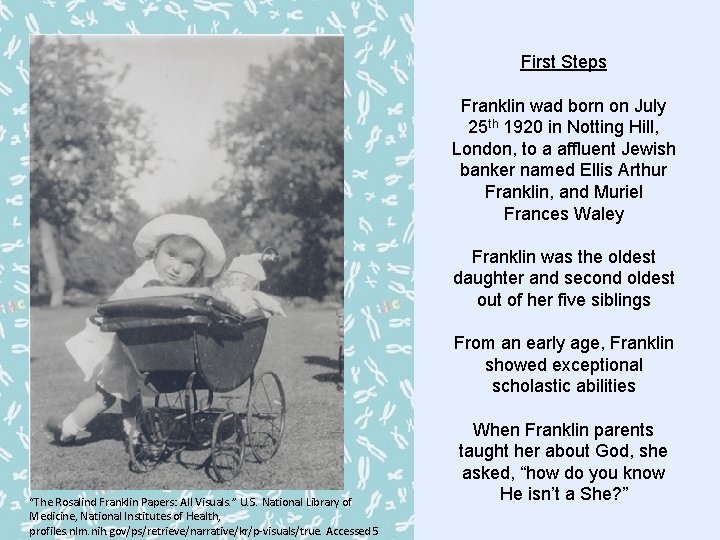
First Steps Franklin wad born on July 25 th 1920 in Notting Hill, London, to a affluent Jewish banker named Ellis Arthur Franklin, and Muriel Frances Waley Franklin was the oldest daughter and second oldest out of her five siblings From an early age, Franklin showed exceptional scholastic abilities “The Rosalind Franklin Papers: All Visuals. ” U. S. National Library of Medicine, National Institutes of Health, profiles. nlm. nih. gov/ps/retrieve/narrative/kr/p-visuals/true. Accessed 5 When Franklin parents taught her about God, she asked, “how do you know He isn’t a She? ”
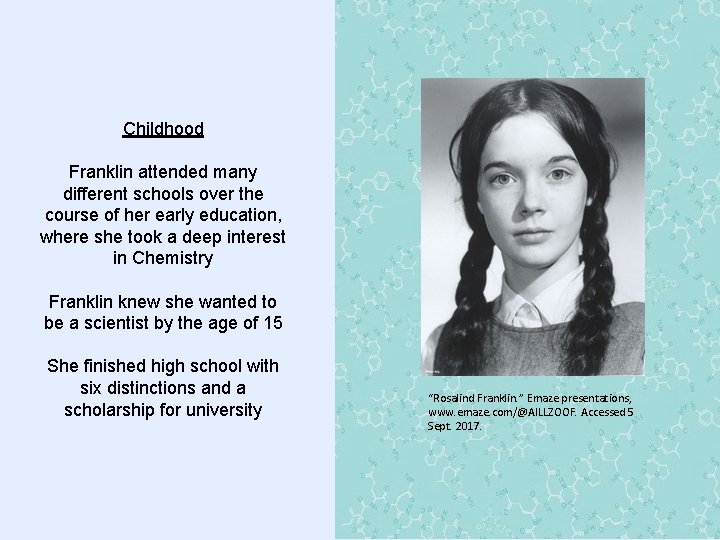
Childhood Franklin attended many different schools over the course of her early education, where she took a deep interest in Chemistry Franklin knew she wanted to be a scientist by the age of 15 She finished high school with six distinctions and a scholarship for university “Rosalind Franklin. ” Emaze presentations, www. emaze. com/@AILLZOOF. Accessed 5 Sept. 2017.
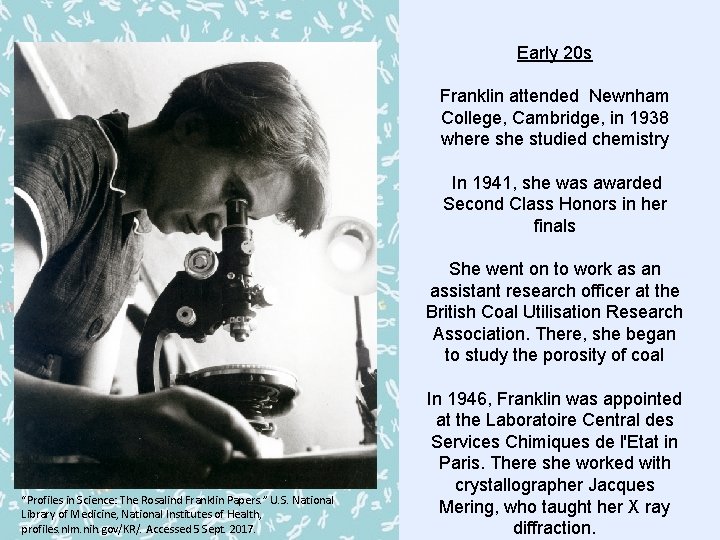
Early 20 s Franklin attended Newnham College, Cambridge, in 1938 where she studied chemistry In 1941, she was awarded Second Class Honors in her finals She went on to work as an assistant research officer at the British Coal Utilisation Research Association. There, she began to study the porosity of coal “Profiles in Science: The Rosalind Franklin Papers. ” U. S. National Library of Medicine, National Institutes of Health, profiles. nlm. nih. gov/KR/. Accessed 5 Sept. 2017. In 1946, Franklin was appointed at the Laboratoire Central des Services Chimiques de l'Etat in Paris. There she worked with crystallographer Jacques Mering, who taught her X ray diffraction.
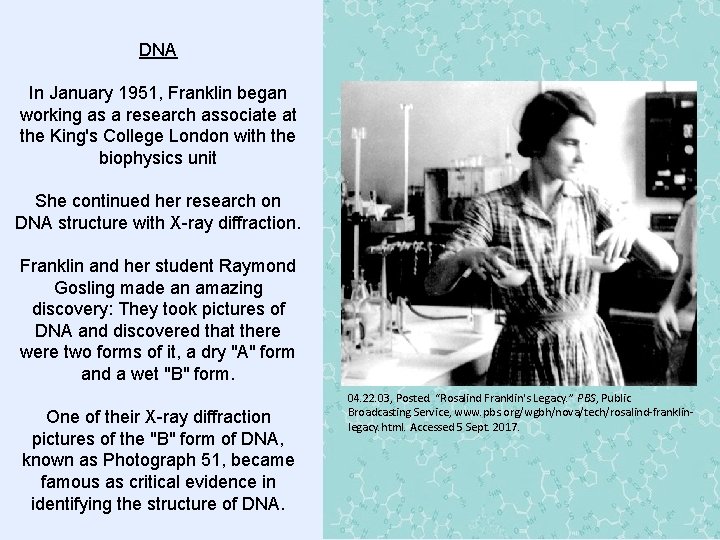
DNA In January 1951, Franklin began working as a research associate at the King's College London with the biophysics unit She continued her research on DNA structure with X-ray diffraction. Franklin and her student Raymond Gosling made an amazing discovery: They took pictures of DNA and discovered that there were two forms of it, a dry "A" form and a wet "B" form. One of their X-ray diffraction pictures of the "B" form of DNA, known as Photograph 51, became famous as critical evidence in identifying the structure of DNA. 04. 22. 03, Posted. “Rosalind Franklin's Legacy. ” PBS, Public Broadcasting Service, www. pbs. org/wgbh/nova/tech/rosalind-franklinlegacy. html. Accessed 5 Sept. 2017.
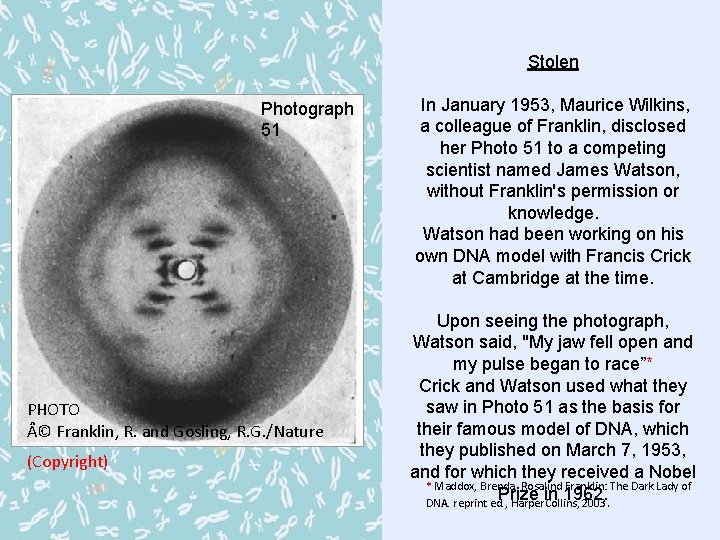
Stolen Photograph 51 PHOTO © Franklin, R. and Gosling, R. G. /Nature (Copyright) In January 1953, Maurice Wilkins, a colleague of Franklin, disclosed her Photo 51 to a competing scientist named James Watson, without Franklin's permission or knowledge. Watson had been working on his own DNA model with Francis Crick at Cambridge at the time. Upon seeing the photograph, Watson said, "My jaw fell open and my pulse began to race”* Crick and Watson used what they saw in Photo 51 as the basis for their famous model of DNA, which they published on March 7, 1953, and for which they received a Nobel * Maddox, Brenda. Rosalind Franklin: The Dark Lady of Prize in 1962. DNA. reprint ed. , Harper. Collins, 2003.
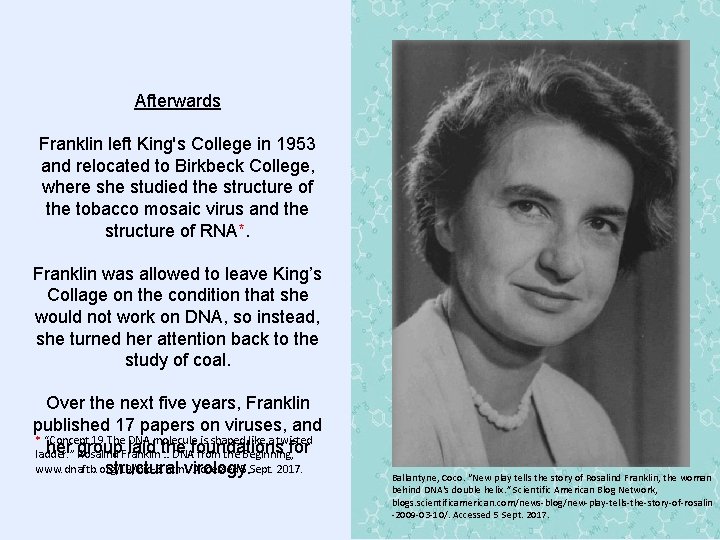
Afterwards Franklin left King's College in 1953 and relocated to Birkbeck College, where she studied the structure of the tobacco mosaic virus and the structure of RNA*. Franklin was allowed to leave King’s Collage on the condition that she would not work on DNA, so instead, she turned her attention back to the study of coal. Over the next five years, Franklin published 17 papers on viruses, and * “Concept 19 The DNA molecule is shaped like a twisted her group laid the ladder. ” Rosalind Franklin : : DNAfoundations from the Beginning, for www. dnaftb. org/19/bio-3. html. Accessed 5 Sept. 2017. structural virology. Ballantyne, Coco. “New play tells the story of Rosalind Franklin, the woman behind DNA's double helix. ” Scientific American Blog Network, blogs. scientificamerican. com/news-blog/new-play-tells-the-story-of-rosalin -2009 -03 -10/. Accessed 5 Sept. 2017.
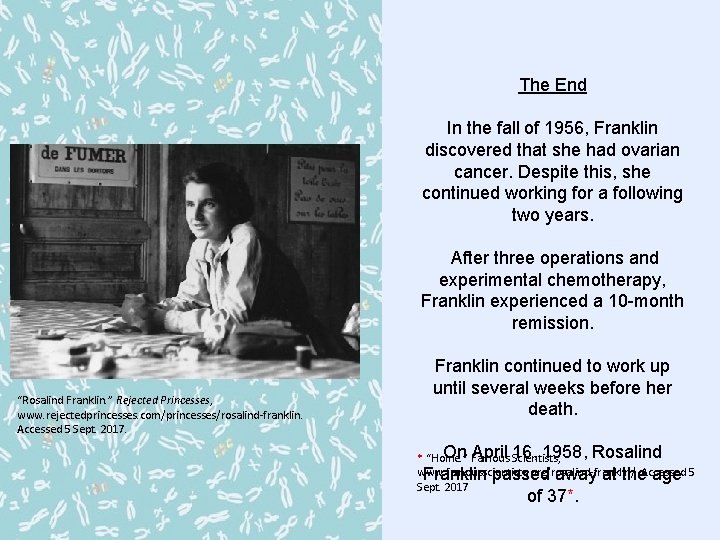
The End In the fall of 1956, Franklin discovered that she had ovarian cancer. Despite this, she continued working for a following two years. After three operations and experimental chemotherapy, Franklin experienced a 10 -month remission. “Rosalind Franklin. ” Rejected Princesses, www. rejectedprincesses. com/princesses/rosalind-franklin. Accessed 5 Sept. 2017. Franklin continued to work up until several weeks before her death. On Famous April Scientists, 16, 1958, Rosalind * “Home. ” www. famousscientists. org/rosalind-franklin/. Franklin passed away at the. Accessed age 5 Sept. 2017 of 37*.
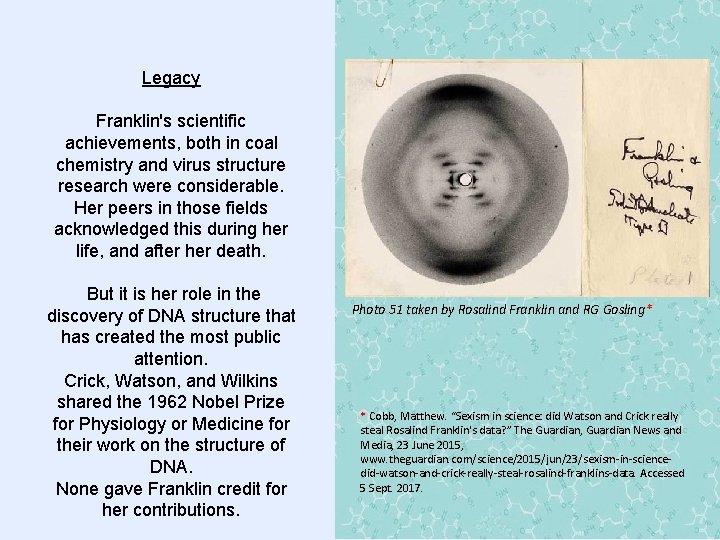
Legacy Franklin's scientific achievements, both in coal chemistry and virus structure research were considerable. Her peers in those fields acknowledged this during her life, and after her death. But it is her role in the discovery of DNA structure that has created the most public attention. Crick, Watson, and Wilkins shared the 1962 Nobel Prize for Physiology or Medicine for their work on the structure of DNA. None gave Franklin credit for her contributions. Photo 51 taken by Rosalind Franklin and RG Gosling* * Cobb, Matthew. “Sexism in science: did Watson and Crick really steal Rosalind Franklin's data? ” The Guardian, Guardian News and Media, 23 June 2015, www. theguardian. com/science/2015/jun/23/sexism-in-sciencedid-watson-and-crick-really-steal-rosalind-franklins-data. Accessed 5 Sept. 2017.
- Slides: 9