
Roots of Science Before 1500 scholars generally decided
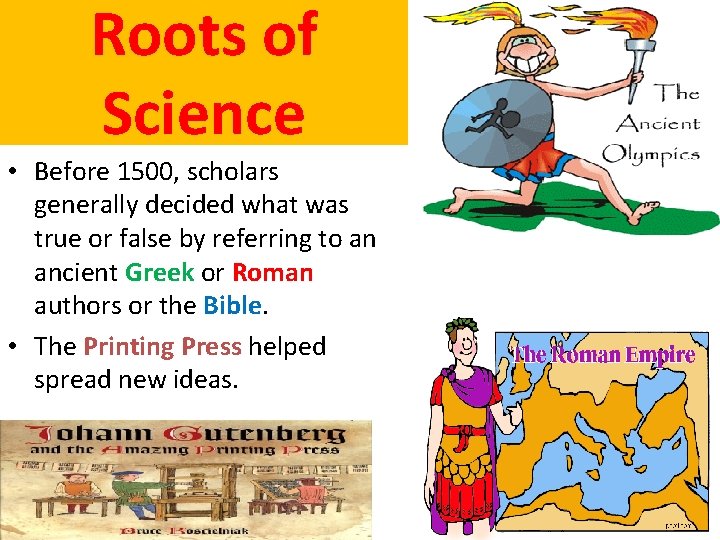
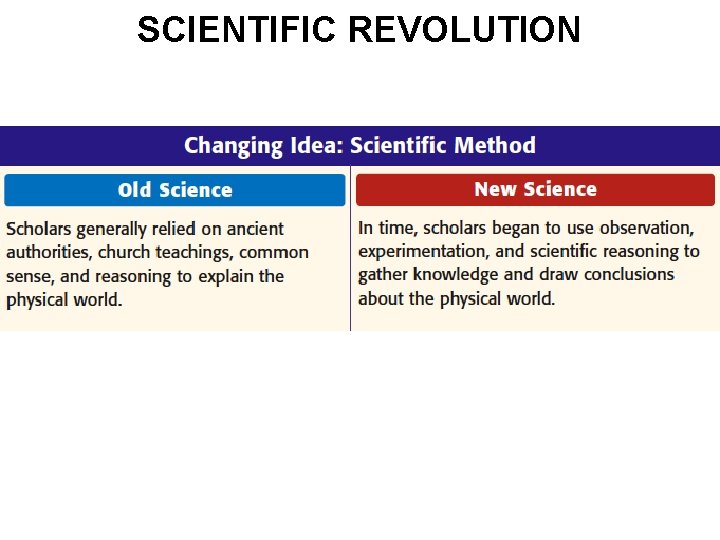
Roots of Science • Before 1500, scholars generally decided what was true or false by referring to an ancient Greek or Roman authors or the Bible. • The Printing Press helped spread new ideas.
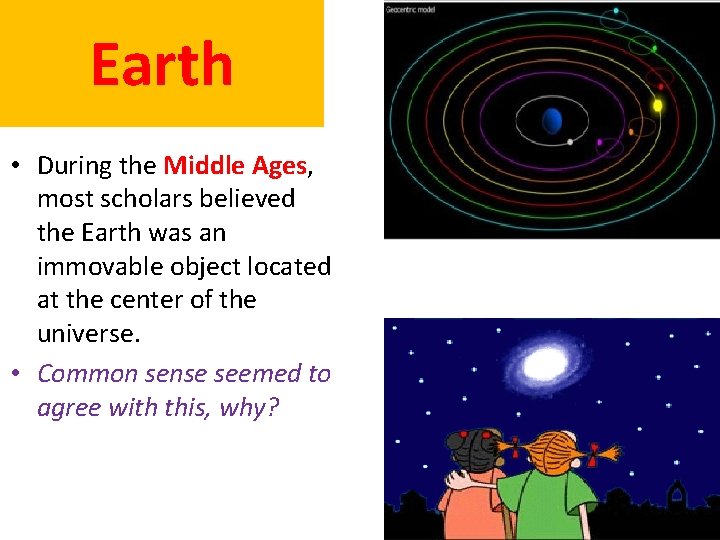
Earth • During the Middle Ages, most scholars believed the Earth was an immovable object located at the center of the universe. • Common sense seemed to agree with this, why?
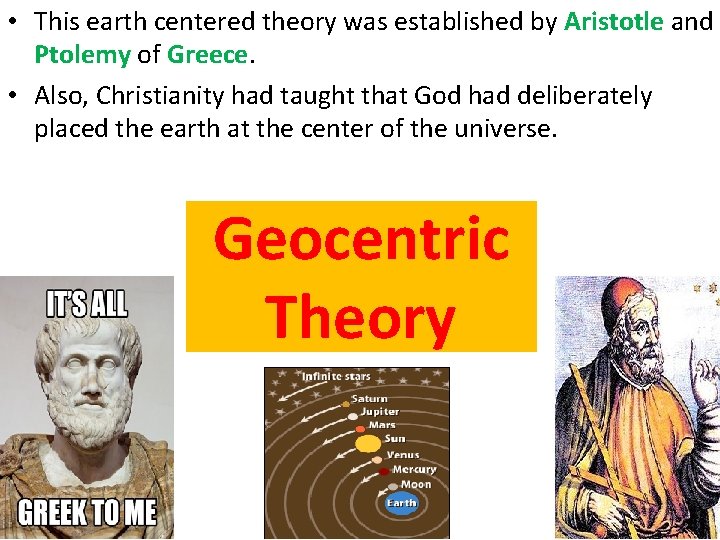
• This earth centered theory was established by Aristotle and Ptolemy of Greece. • Also, Christianity had taught that God had deliberately placed the earth at the center of the universe. Geocentric Theory
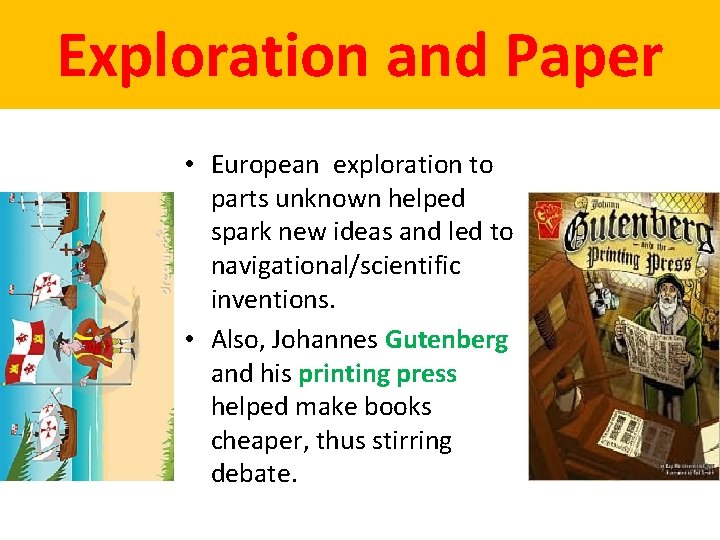
Exploration and Paper • European exploration to parts unknown helped spark new ideas and led to navigational/scientific inventions. • Also, Johannes Gutenberg and his printing press helped make books cheaper, thus stirring debate.
SCIENTIFIC REVOLUTION BIG IDEA From the 1500 s-1700 s, Europeans • Experienced the Scientific Revolution, which caused people to change their views about the universe.
SCIENTIFIC REVOLUTION
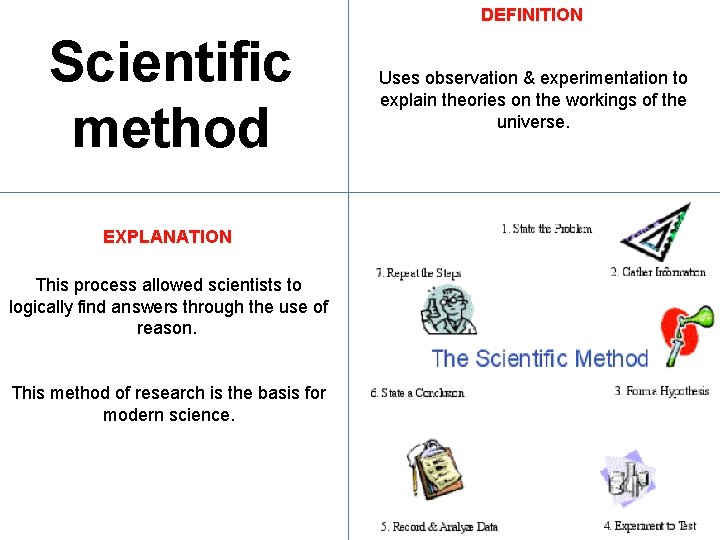
DEFINITION Scientific method EXPLANATION This process allowed scientists to logically find answers through the use of reason. This method of research is the basis for modern science. Uses observation & experimentation to explain theories on the workings of the universe.
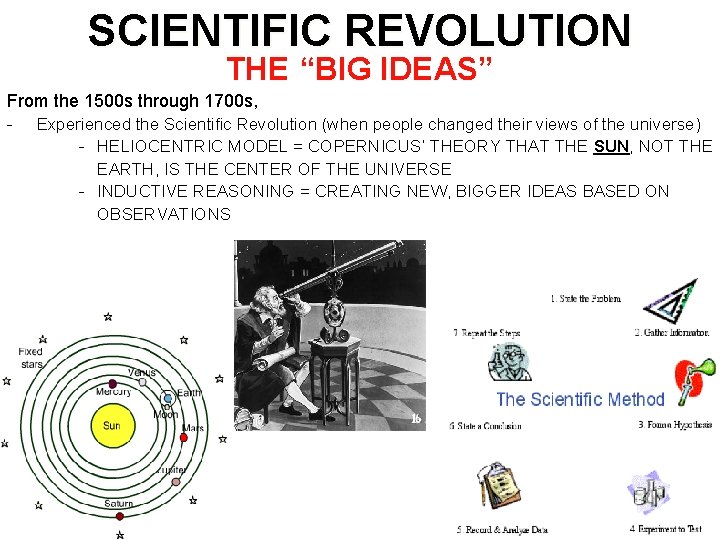
SCIENTIFIC REVOLUTION THE “BIG IDEAS” From the 1500 s through 1700 s, - Experienced the Scientific Revolution (when people changed their views of the universe) - HELIOCENTRIC MODEL = COPERNICUS’ THEORY THAT THE SUN, NOT THE EARTH, IS THE CENTER OF THE UNIVERSE - INDUCTIVE REASONING = CREATING NEW, BIGGER IDEAS BASED ON OBSERVATIONS
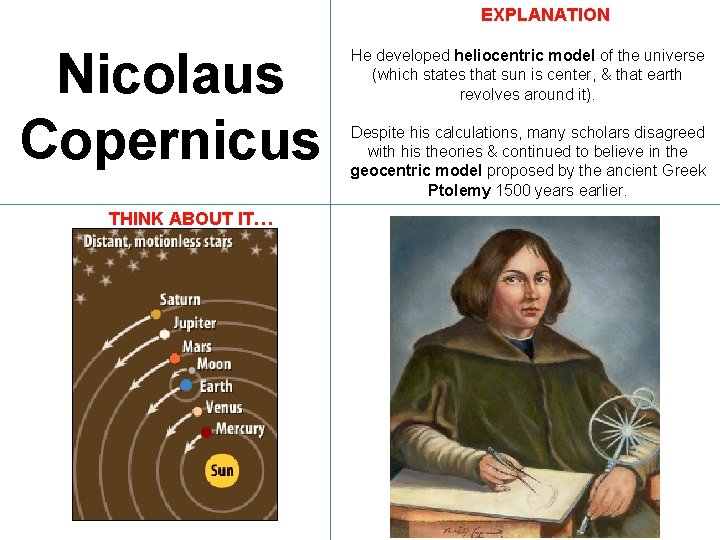
EXPLANATION Nicolaus Copernicus THINK ABOUT IT… He developed heliocentric model of the universe (which states that sun is center, & that earth revolves around it). Despite his calculations, many scholars disagreed with his theories & continued to believe in the geocentric model proposed by the ancient Greek Ptolemy 1500 years earlier.
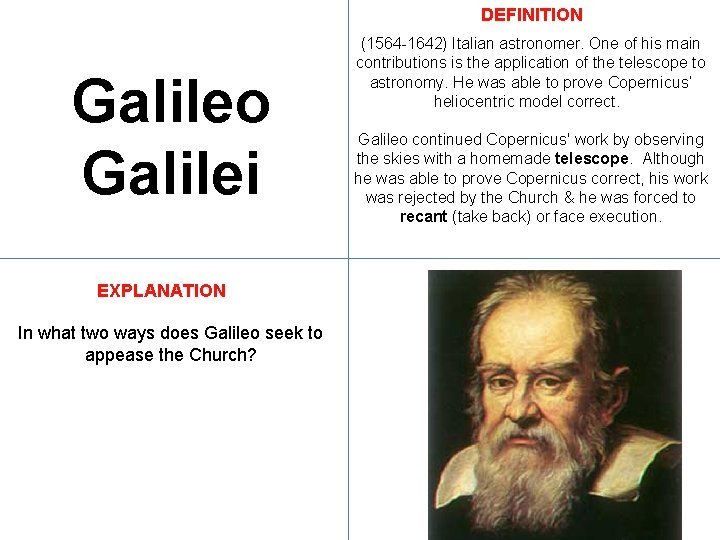
DEFINITION Galileo Galilei EXPLANATION In what two ways does Galileo seek to appease the Church? (1564 -1642) Italian astronomer. One of his main contributions is the application of the telescope to astronomy. He was able to prove Copernicus’ heliocentric model correct. Galileo continued Copernicus' work by observing the skies with a homemade telescope. Although he was able to prove Copernicus correct, his work was rejected by the Church & he was forced to recant (take back) or face execution.
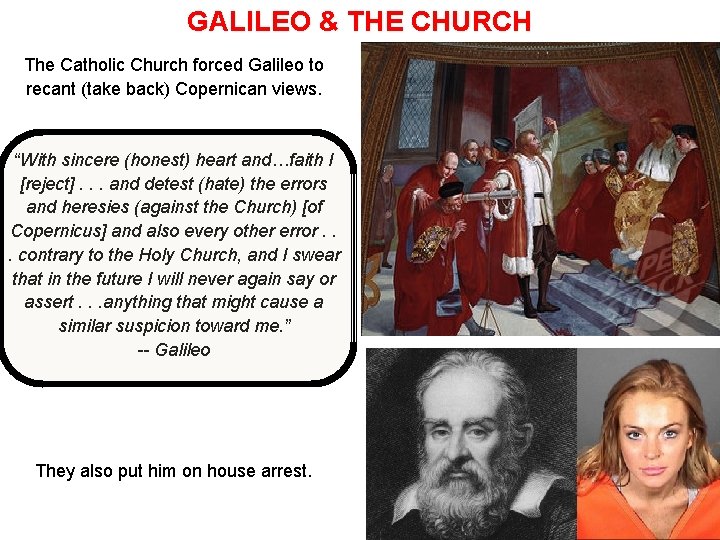
GALILEO & THE CHURCH The Catholic Church forced Galileo to recant (take back) Copernican views. “With sincere (honest) heart and…faith I [reject]. . . and detest (hate) the errors and heresies (against the Church) [of Copernicus] and also every other error. . . contrary to the Holy Church, and I swear that in the future I will never again say or assert. . . anything that might cause a similar suspicion toward me. ” -- Galileo They also put him on house arrest.
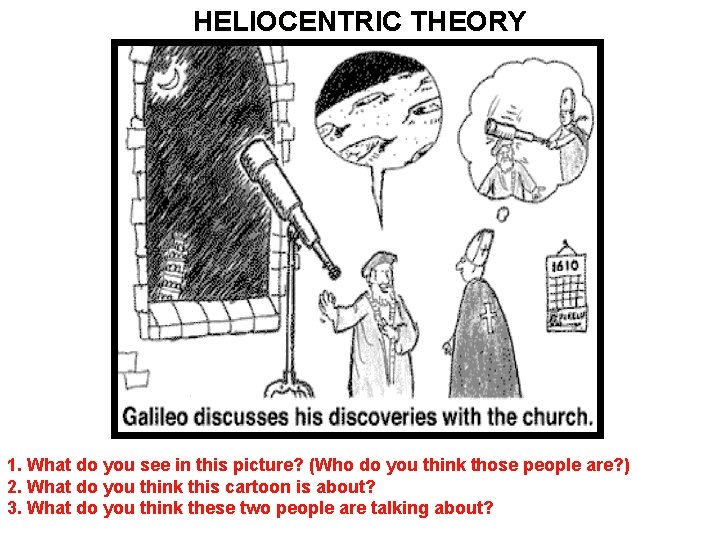
HELIOCENTRIC THEORY 1. What do you see in this picture? (Who do you think those people are? ) 2. What do you think this cartoon is about? 3. What do you think these two people are talking about?
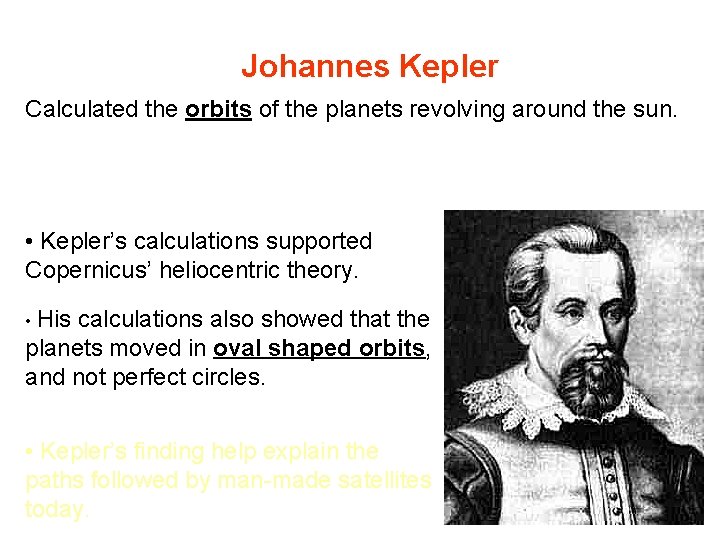
Johannes Kepler Calculated the orbits of the planets revolving around the sun. • Kepler’s calculations supported Copernicus’ heliocentric theory. • His calculations also showed that the planets moved in oval shaped orbits, and not perfect circles. • Kepler’s finding help explain the paths followed by man-made satellites today.
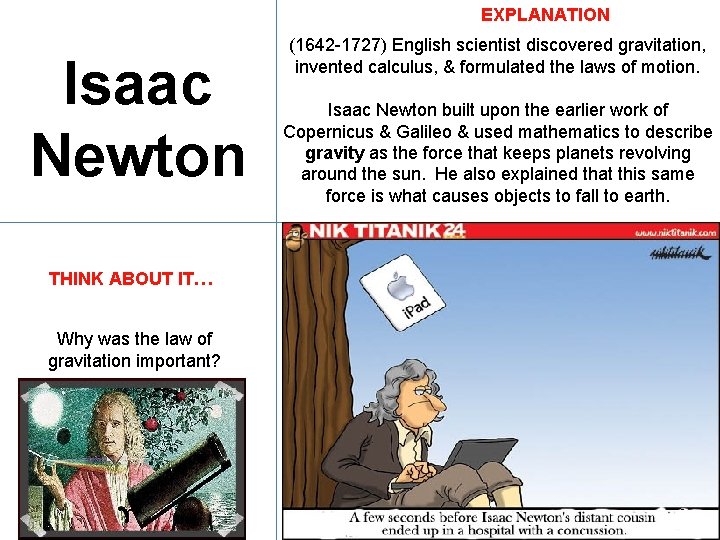
EXPLANATION Isaac Newton THINK ABOUT IT… Why was the law of gravitation important? (1642 -1727) English scientist discovered gravitation, invented calculus, & formulated the laws of motion. Isaac Newton built upon the earlier work of Copernicus & Galileo & used mathematics to describe gravity as the force that keeps planets revolving around the sun. He also explained that this same force is what causes objects to fall to earth.
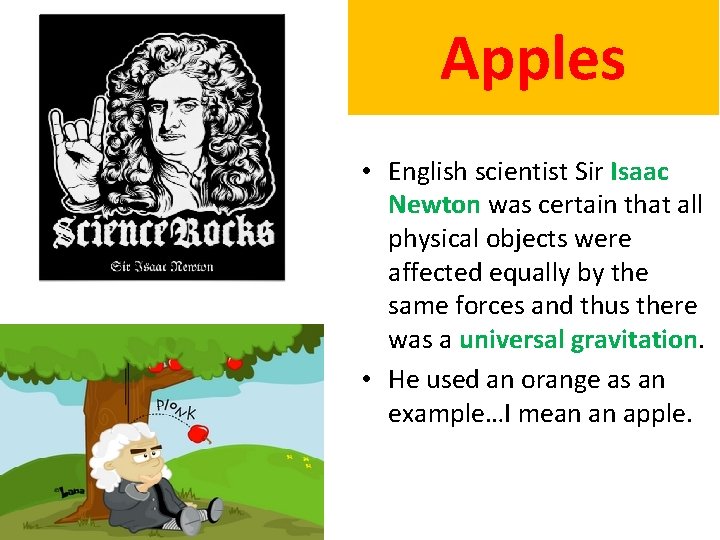
Apples • English scientist Sir Isaac Newton was certain that all physical objects were affected equally by the same forces and thus there was a universal gravitation. • He used an orange as an example…I mean an apple.
- Slides: 15