
ROOTS Interprocedural Analysis Aleksandra Biresev s 6 albirecs
ROOTS Interprocedural Analysis Aleksandra Biresev s 6 albire@cs. uni-bonn. de
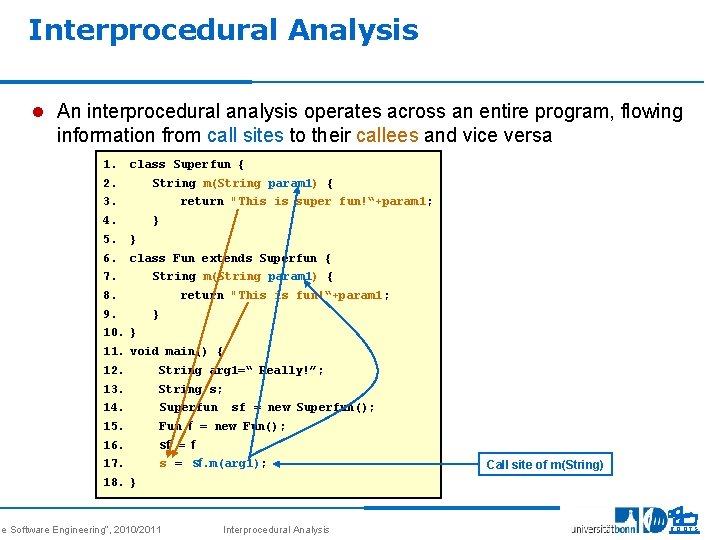
Interprocedural Analysis l An interprocedural analysis operates across an entire program, flowing information from call sites to their callees and vice versa 1. 2. 3. 4. 5. 6. 7. 8. 9. 10. 11. 12. 13. 14. 15. 16. 17. 18. class Superfun { String m(String param 1) { return "This is super fun!“+param 1 ; } } class Fun extends Superfun { String m(String param 1) { return "This is fun!“+param 1; } } void main() { String arg 1=“ Really!”; String s; Superfun sf = new Superfun(); Fun f = new Fun(); sf = f s = sf. m(arg 1); Call site of m(String) } se Software Engineering“, 2010/2011 Interprocedural Analysis 2 ROOTS
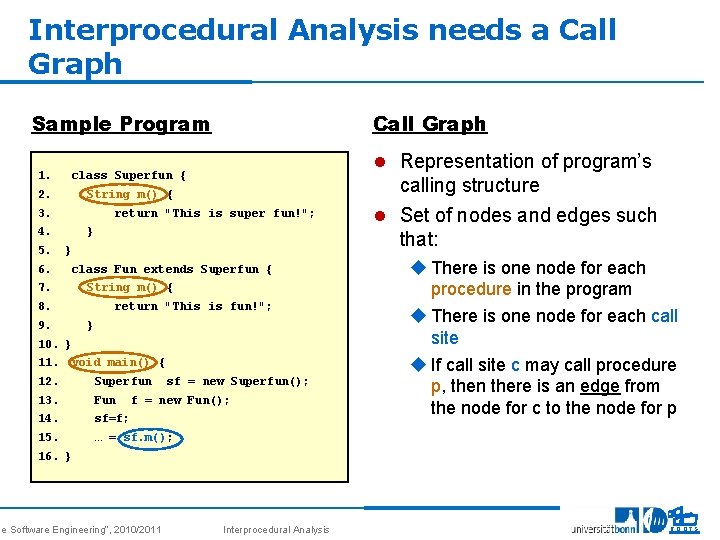
Interprocedural Analysis needs a Call Graph Sample Program 1. 2. 3. 4. 5. 6. 7. 8. 9. 10. 11. 12. 13. 14. 15. 16. Call Graph l Representation of program’s class Superfun { calling structure String m() { return "This is super fun!"; } l Set of nodes and edges such that: } class Fun extends Superfun { String m() { return "This is fun!"; } } void main() { Superfun Fun sf = new Superfun(); f = new Fun(); sf=f; u There is one node for each procedure in the program u There is one node for each call site u If call site c may call procedure p, then there is an edge from the node for c to the node for p … = sf. m(); } se Software Engineering“, 2010/2011 Interprocedural Analysis 3 ROOTS
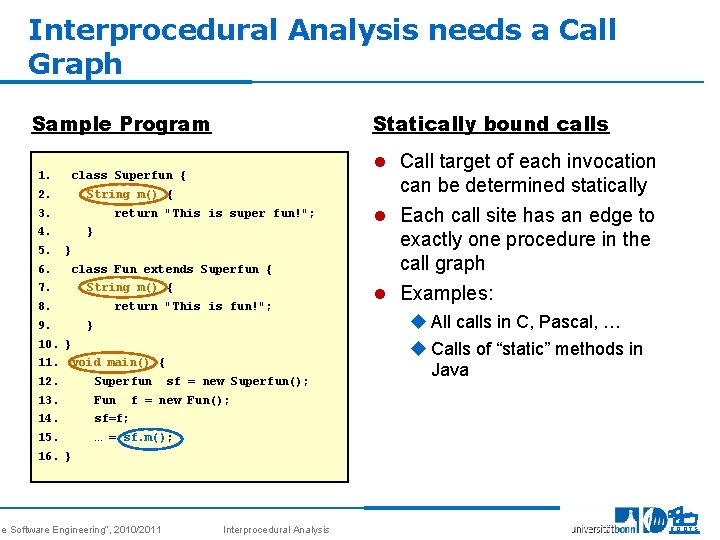
Interprocedural Analysis needs a Call Graph Sample Program 1. 2. 3. 4. 5. 6. 7. 8. 9. 10. 11. 12. 13. 14. 15. 16. Statically bound calls l Call target of each invocation class Superfun { can be determined statically String m() { return "This is super fun!"; } } class Fun extends Superfun { String m() { return "This is fun!"; } } void main() { Superfun Fun sf = new Superfun(); l Each call site has an edge to exactly one procedure in the call graph l Examples: u All calls in C, Pascal, … u Calls of “static” methods in Java f = new Fun(); sf=f; … = sf. m(); } se Software Engineering“, 2010/2011 Interprocedural Analysis 4 ROOTS
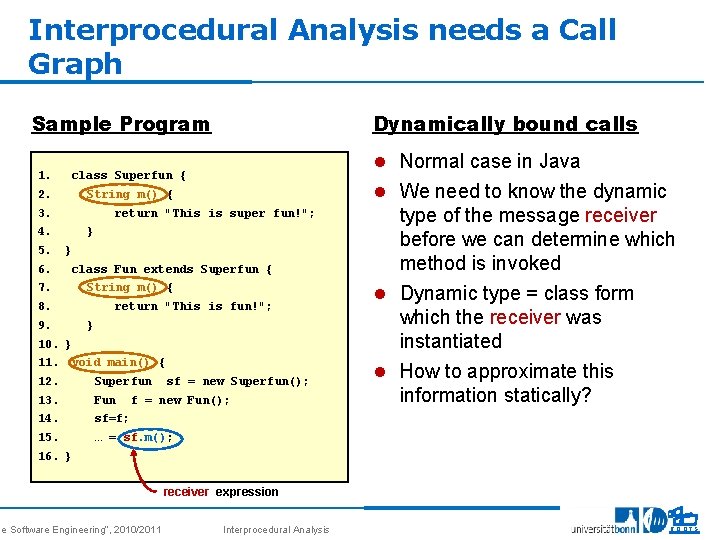
Interprocedural Analysis needs a Call Graph Sample Program 1. 2. 3. 4. 5. 6. 7. 8. 9. 10. 11. 12. 13. 14. 15. 16. Dynamically bound calls l Normal case in Java class Superfun { l We need to know the dynamic String m() { return "This is super fun!"; } } class Fun extends Superfun { String m() { return "This is fun!"; } } void main() { Superfun Fun sf = new Superfun(); f = new Fun(); type of the message receiver before we can determine which method is invoked l Dynamic type = class form which the receiver was instantiated l How to approximate this information statically? sf=f; … = sf. m(); } se Software Engineering“, 2010/2011 receiver expression Interprocedural Analysis 5 ROOTS
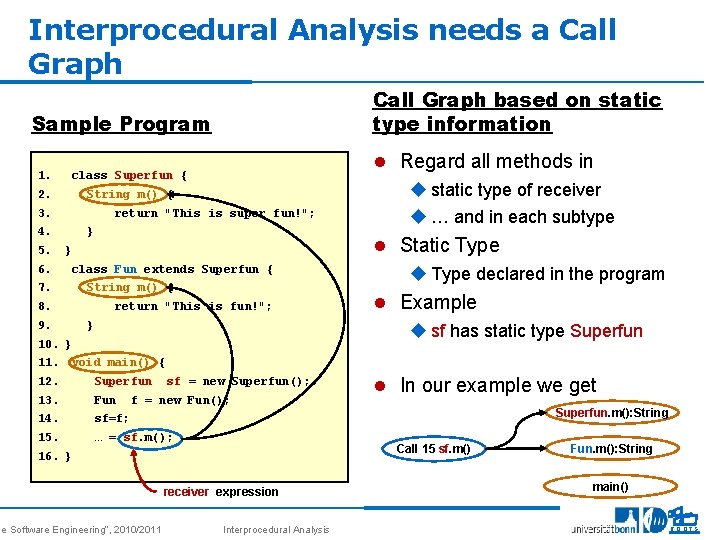
Interprocedural Analysis needs a Call Graph based on static type information Sample Program 1. 2. 3. 4. 5. 6. 7. 8. 9. 10. 11. 12. 13. 14. 15. 16. l Regard all methods in class Superfun { String m() { return "This is super fun!"; } u static type of receiver u … and in each subtype l Static Type } class Fun extends Superfun { String m() { return "This is fun!"; } u Type declared in the program l Example u sf has static type Superfun } void main() { Superfun Fun sf = new Superfun(); f = new Fun(); l In our example we get Superfun. m(): String sf=f; … = sf. m(); Call 15 sf. m() } se Software Engineering“, 2010/2011 receiver expression Interprocedural Analysis Fun. m(): String main() 6 ROOTS
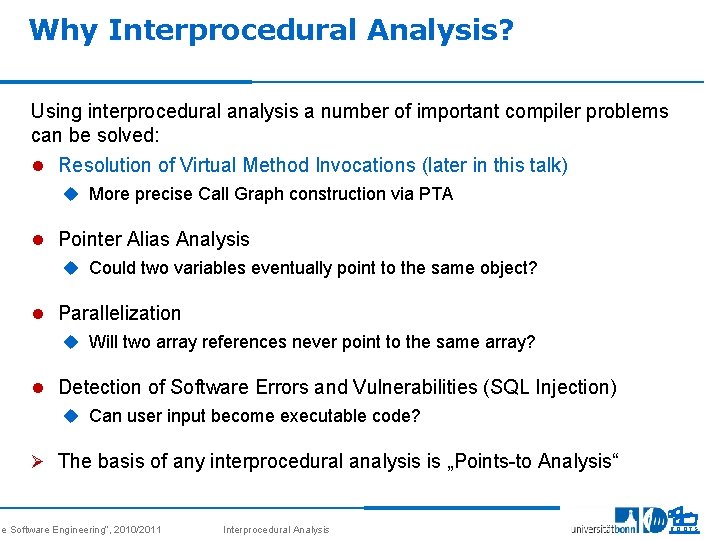
Why Interprocedural Analysis? Using interprocedural analysis a number of important compiler problems can be solved: l Resolution of Virtual Method Invocations (later in this talk) u More precise Call Graph construction via PTA l Pointer Alias Analysis u Could two variables eventually point to the same object? l Parallelization u Will two array references never point to the same array? l Detection of Software Errors and Vulnerabilities (SQL Injection) u Can user input become executable code? Ø The basis of any interprocedural analysis is „Points-to Analysis“ se Software Engineering“, 2010/2011 Interprocedural Analysis 7 ROOTS
Outline ü Interprocedural Analysis ü Call Graphs Ø Variants of Interprocedural Analysis Ø Approaches to Context-Sensitive Interprocedural Analysis Ø Points-To-Analysis (PTA) Ø Logic programming as an implementation framework se Software Engineering“, 2010/2011 Interprocedural Analysis 8 ROOTS
Interprocedural Analysis Variants of Interprocedural Analysis Context-insensitive Context-sensitive Cloning-based Inline-based Summary-based ROOTS
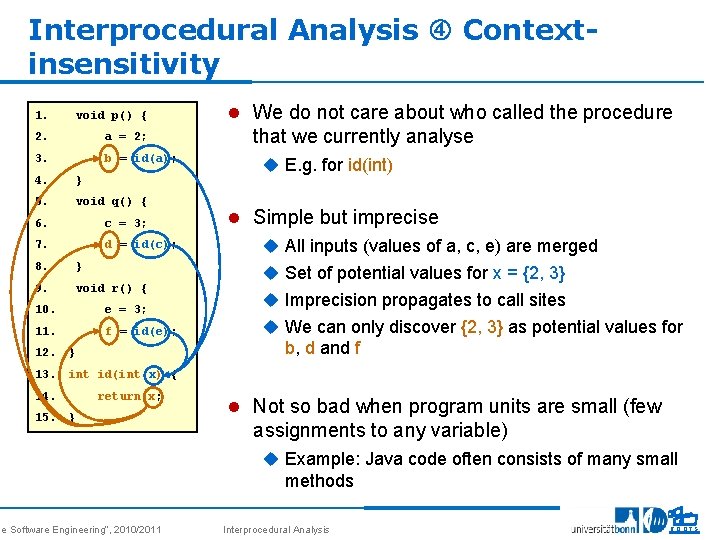
Interprocedural Analysis Contextinsensitivity 1. void p() { 2. a = 2; 3. b = id(a); 4. } 5. void q() { 6. c = 3; 7. d = id(c); 8. } 9. void r() { 10. e = 3; 11. f = id(e); 12. } l We do not care about who called the procedure that we currently analyse u E. g. for id(int) l Simple but imprecise u All inputs (values of a, c, e) are merged u Set of potential values for x = {2, 3} u Imprecision propagates to call sites u We can only discover {2, 3} as potential values for b, d and f 13. int id(int x) { 14. return x; 15. } se Software Engineering“, 2010/2011 l Not so bad when program units are small (few assignments to any variable) u Example: Java code often consists of many small methods Interprocedural Analysis 10 ROOTS
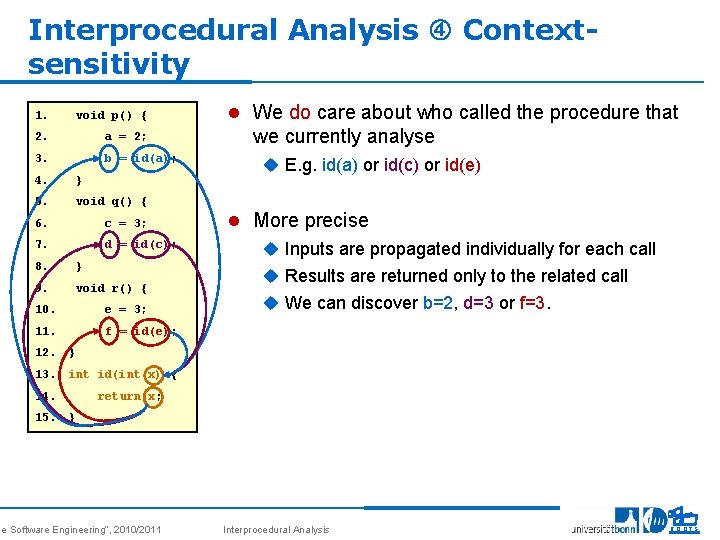
Interprocedural Analysis Contextsensitivity 1. void p() { 2. a = 2; 3. b = id(a); 4. } 5. void q() { 6. c = 3; 7. d = id(c); 8. } 9. void r() { 10. e = 3; 11. f = id(e); l We do care about who called the procedure that we currently analyse u E. g. id(a) or id(c) or id(e) l More precise u Inputs are propagated individually for each call u Results are returned only to the related call u We can discover b=2, d=3 or f=3. 12. } 13. int id(int x) { 14. return x; 15. } se Software Engineering“, 2010/2011 Interprocedural Analysis 11 ROOTS
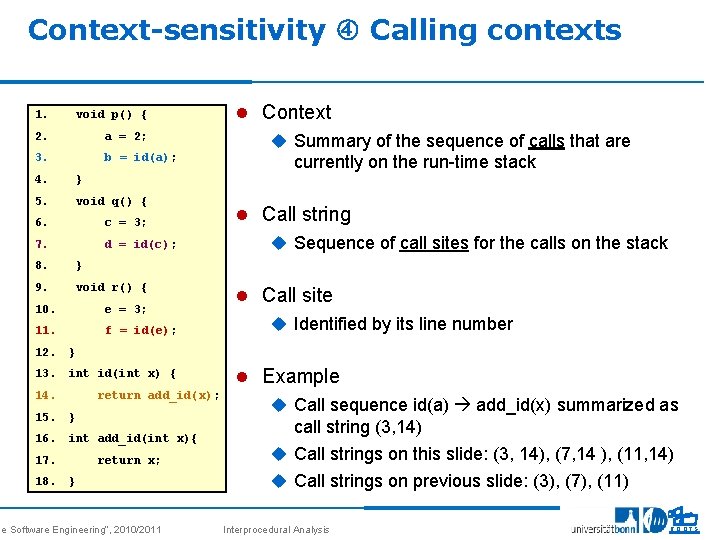
Context-sensitivity Calling contexts 1. void p() { 2. a = 2; 3. b = id(a); 4. } 5. void q() { 6. c = 3; 7. d = id(c); 8. } 9. void r() { 10. e = 3; 11. f = id(e); l Context u Summary of the sequence of calls that are currently on the run-time stack l Call string u Sequence of call sites for the calls on the stack l Call site u Identified by its line number 12. } 13. int id(int x) { 14. return add_id(x); 15. } 16. int add_id(int x){ 17. return x; 18. } se Software Engineering“, 2010/2011 l Example u Call sequence id(a) add_id(x) summarized as call string (3, 14) u Call strings on this slide: (3, 14), (7, 14 ), (11, 14) u Call strings on previous slide: (3), (7), (11) Interprocedural Analysis 12 ROOTS
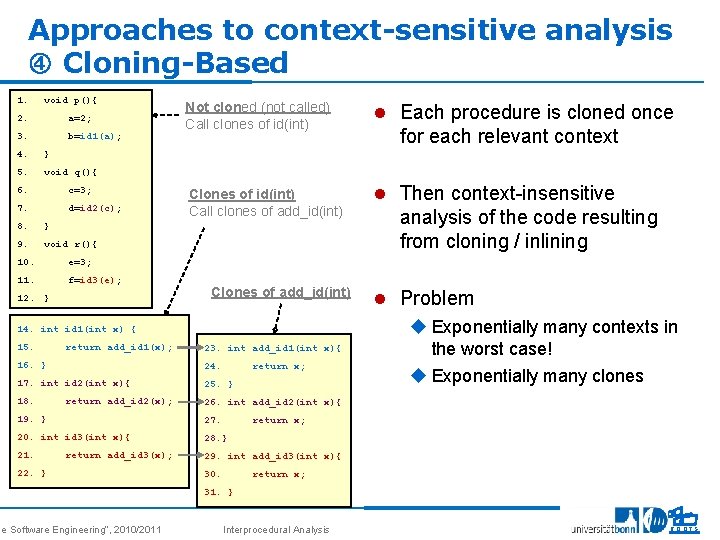
Approaches to context-sensitive analysis Cloning-Based 1. void p(){ 2. a=2; 3. b=id 1(a); 4. } 5. void q(){ 6. c=3; 7. d=id 2(c); 8. } 9. void r(){ 10. e=3; 11. f=id 3(e); 12. } Not cloned (not called) Call clones of id(int) l Each procedure is cloned once Clones of id(int) Call clones of add_id(int) l Then context-insensitive Clones of add_id(int) 14. int id 1(int x) { 15. return add_id 1(x); 23. int add_id 1(int x){ 16. } 24. 17. int id 2(int x){ 25. } 18. 26. int add_id 2(int x){ return add_id 2(x); return x; 19. } 27. 20. int id 3(int x){ 28. } 21. 29. int add_id 3(int x){ return add_id 3(x); 22. } se Software Engineering“, 2010/2011 for each relevant context analysis of the code resulting from cloning / inlining l Problem u Exponentially many contexts in the worst case! u Exponentially many clones return x; 30. return x; 31. } Interprocedural Analysis 13 ROOTS
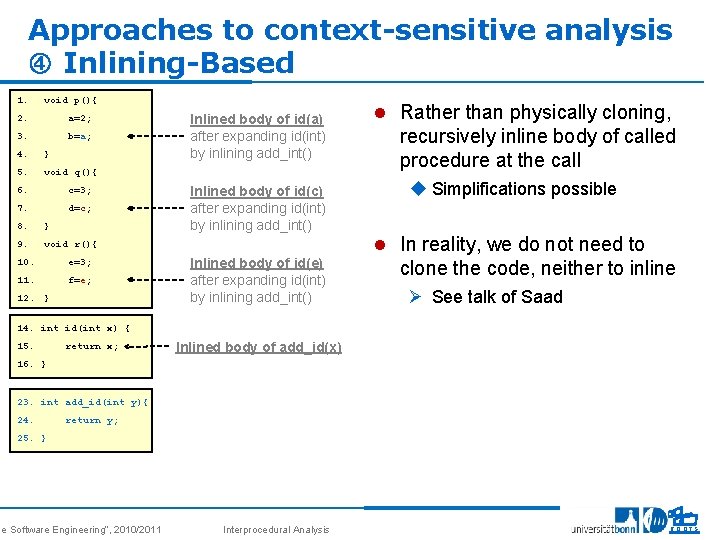
Approaches to context-sensitive analysis Inlining-Based 1. void p(){ 2. a=2; 3. b=a; 4. } 5. void q(){ 6. c=3; 7. d=c; 8. } 9. void r(){ 10. e=3; 11. f=e; 12. } Inlined body of id(a) after expanding id(int) by inlining add_int() Inlined body of id(c) after expanding id(int) by inlining add_int() Inlined body of id(e) after expanding id(int) by inlining add_int() l Rather than physically cloning, recursively inline body of called procedure at the call u Simplifications possible l In reality, we do not need to clone the code, neither to inline Ø See talk of Saad 14. int id(int x) { 15. return x; Inlined body of add_id(x) 16. } 23. int add_id(int y){ 24. return y; 25. } se Software Engineering“, 2010/2011 Interprocedural Analysis 14 ROOTS
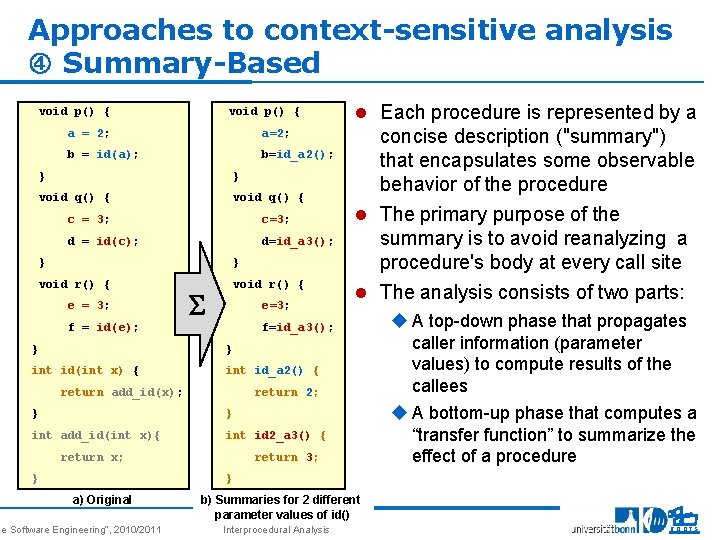
Approaches to context-sensitive analysis Summary-Based void p() { a = 2; a=2; b = id(a); b=id_a 2(); } } void q() { c = 3; c=3; d = id(c); d=id_a 3(); } } void r() { e = 3; S e=3; f = id(e); concise description ("summary") that encapsulates some observable behavior of the procedure l The primary purpose of the summary is to avoid reanalyzing a procedure's body at every call site l The analysis consists of two parts: f=id_a 3(); } } int id(int x) { int id_a 2() { return add_id(x); return 2; } } int add_id(int x){ int id 2_a 3() { return x; } l Each procedure is represented by a return 3; u A top-down phase that propagates caller information (parameter values) to compute results of the callees u A bottom-up phase that computes a “transfer function” to summarize the effect of a procedure } a) Original se Software Engineering“, 2010/2011 b) Summaries for 2 different parameter values of id() Interprocedural Analysis 15 ROOTS
Interprocedural Analysis Points-to Analysis (PTA) Also known as „Pointer Analysis“ ROOTS
Pointer Analysis / Points-to Analysis (PTA) l Special form of data flow analysis u Not interested in primitive values but only in object references / pointers l Question: „To which objects can a variable refer? “ l PTA is at the heart of any interprocedural analysis u Because it improves the precision of the call graph se Software Engineering“, 2010/2011 Interprocedural Analysis 17 ROOTS
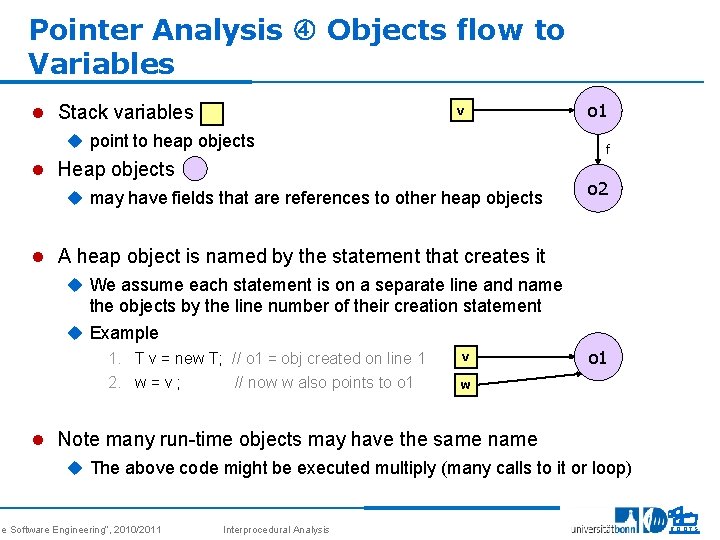
Pointer Analysis Objects flow to Variables l Stack variables v u point to heap objects o 1 f l Heap objects u may have fields that are references to other heap objects o 2 l A heap object is named by the statement that creates it u We assume each statement is on a separate line and name the objects by the line number of their creation statement u Example 1. T v = new T; // o 1 = obj created on line 1 2. w = v ; // now w also points to o 1 v o 1 w l Note many run-time objects may have the same name u The above code might be executed multiply (many calls to it or loop) se Software Engineering“, 2010/2011 Interprocedural Analysis 18 ROOTS
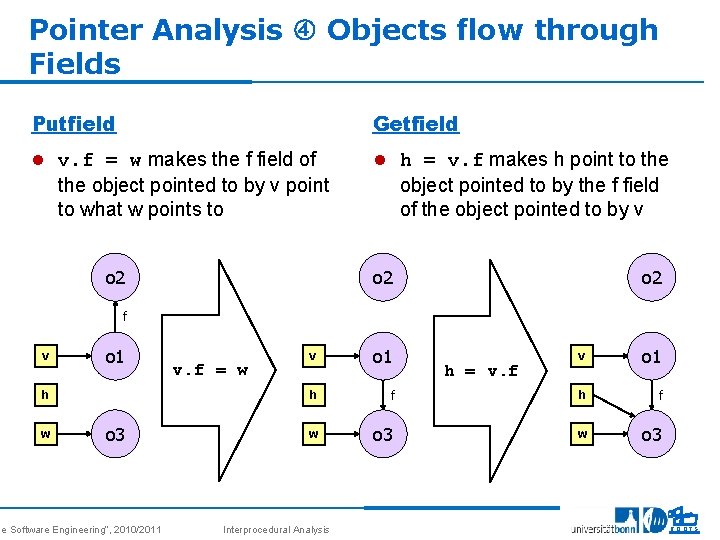
Pointer Analysis Objects flow through Fields Putfield Getfield l v. f = w makes the f field of l h = v. f makes h point to the object pointed to by v point to what w points to o 2 object pointed to by the f field of the object pointed to by v o 2 f v o 1 h w o 3 se Software Engineering“, 2010/2011 v. f = w v o 1 h w Interprocedural Analysis v o 1 f h f o 3 w o 3 h = v. f 19 ROOTS
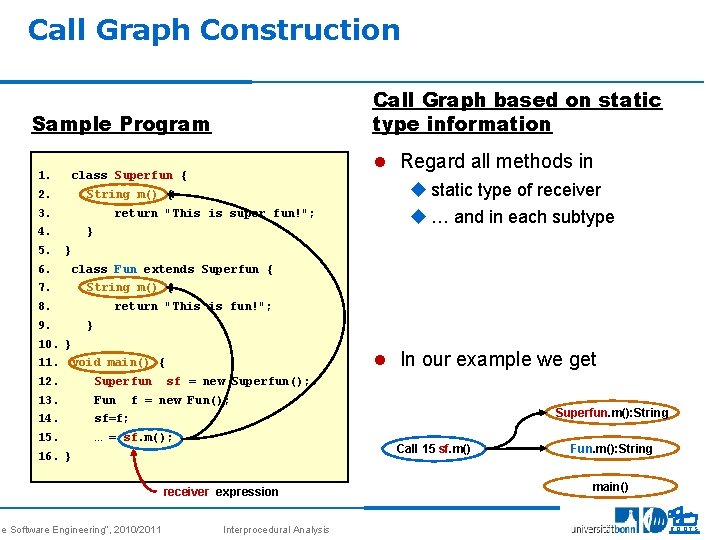
Call Graph Construction Call Graph based on static type information Sample Program 1. 2. 3. 4. 5. 6. 7. 8. 9. 10. 11. 12. 13. 14. 15. 16. l Regard all methods in class Superfun { String m() { return "This is super fun!"; } u static type of receiver u … and in each subtype } class Fun extends Superfun { String m() { return "This is fun!"; } } l In our example we get void main() { Superfun Fun sf = new Superfun(); f = new Fun(); Superfun. m(): String sf=f; … = sf. m(); Call 15 sf. m() } se Software Engineering“, 2010/2011 receiver expression Interprocedural Analysis Fun. m(): String main() 20 ROOTS
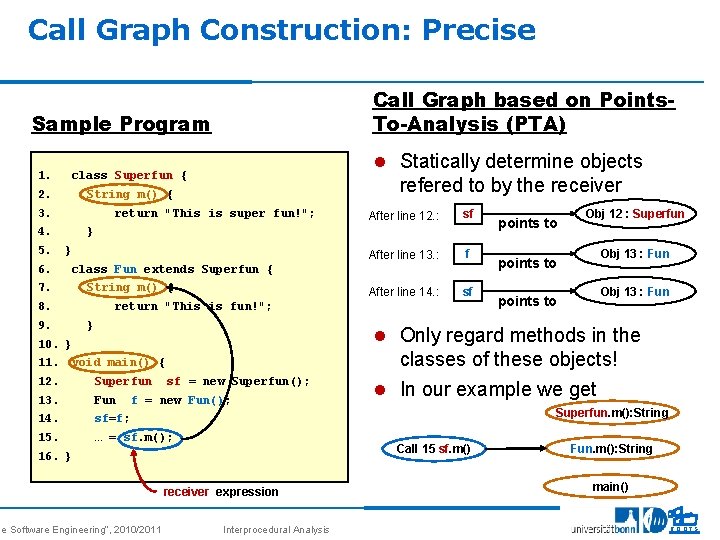
Call Graph Construction: Precise Call Graph based on Points. To-Analysis (PTA) Sample Program 1. 2. 3. 4. 5. 6. 7. 8. 9. 10. 11. 12. 13. 14. 15. 16. l Statically determine objects class Superfun { refered to by the receiver String m() { return "This is super fun!"; After line 12. : sf After line 13. : f After line 14. : sf } } class Fun extends Superfun { String m() { return "This is fun!"; } points to Obj 12 : Superfun Obj 13 : Fun l Only regard methods in the } void main() { Superfun Fun sf = new Superfun(); f = new Fun(); classes of these objects! l In our example we get Superfun. m(): String sf=f; … = sf. m(); Call 15 sf. m() } se Software Engineering“, 2010/2011 receiver expression Interprocedural Analysis Fun. m(): String main() 21 ROOTS
Interprocedural Analysis Logic-based Points-to Analysis Expressing analyses as Prolog rules ROOTS
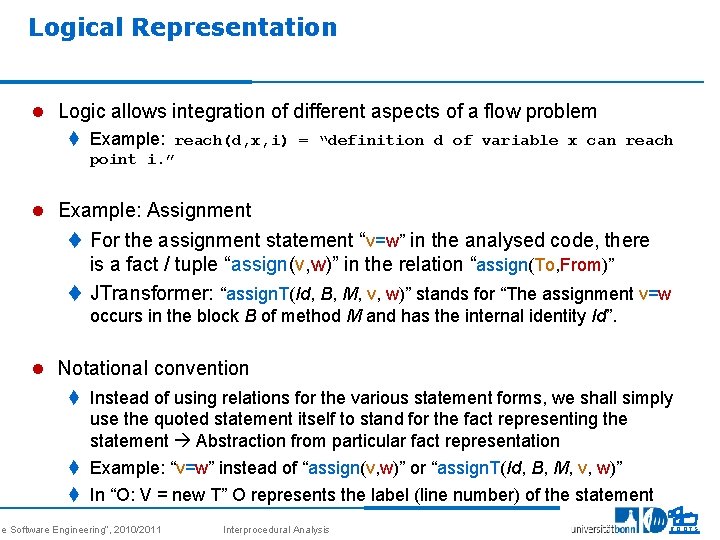
Logical Representation l Logic allows integration of different aspects of a flow problem t Example: reach(d, x, i) = “definition d of variable x can reach point i. ” l Example: Assignment t For the assignment statement “v=w” in the analysed code, there is a fact / tuple “assign(v, w)” in the relation “assign(To, From)” t JTransformer: “assign. T(Id, B, M, v, w)” stands for “The assignment v=w occurs in the block B of method M and has the internal identity Id”. l Notational convention t Instead of using relations for the various statement forms, we shall simply use the quoted statement itself to stand for the fact representing the statement Abstraction from particular fact representation t Example: “v=w” instead of “assign(v, w)” or “assign. T(Id, B, M, v, w)” t In “O: V = new T” O represents the label (line number) of the statement se Software Engineering“, 2010/2011 Interprocedural Analysis 23 ROOTS
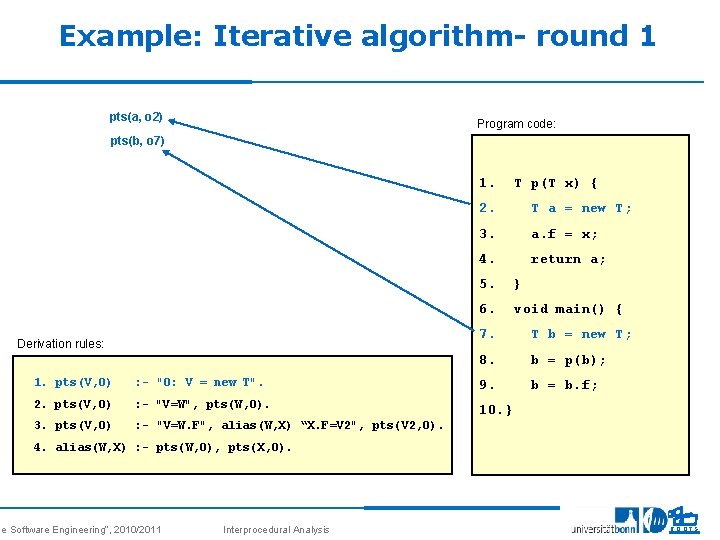
Example: Iterative algorithm- round 1 pts(a, o 2) Program code: pts(b, o 7) 1. Derivation rules: T p(T x) { 2. T a = new T; 3. a. f = x; 4. return a; 5. } 6. void main() { 7. T b = new T; 8. b = p(b); b = b. f; 1. pts(V, O) : - "O: V = new T". 9. 2. pts(V, O) : - "V=W", pts(W, O). 10. } 3. pts(V, O) : - "V=W. F", alias(W, X) “X. F=V 2", pts(V 2, O). 4. alias(W, X) : - pts(W, O), pts(X, O). se Software Engineering“, 2010/2011 Interprocedural Analysis 25 ROOTS

Example: Iterative algorithm- round 2 pts(a, o 2) Program code: pts(b, o 7) pts(x, o 7) 1. Derivation rules: T p(T x) { 2. T a = new T; 3. a. f = x; 4. return a; 5. } 6. void main() { 7. T b = new T; 8. b = p(b); b = b. f; 1. pts(V, O) : - "O: V = new T". 9. 2. pts(V, O) : - "V=W", pts(W, O). 10. } 3. pts(V, O) : - "V=W. F", alias(W, X) “X. F=V 2", pts(V 2, O). 4. alias(W, X) : - pts(W, O), pts(X, O). se Software Engineering“, 2010/2011 Interprocedural Analysis 26 ROOTS
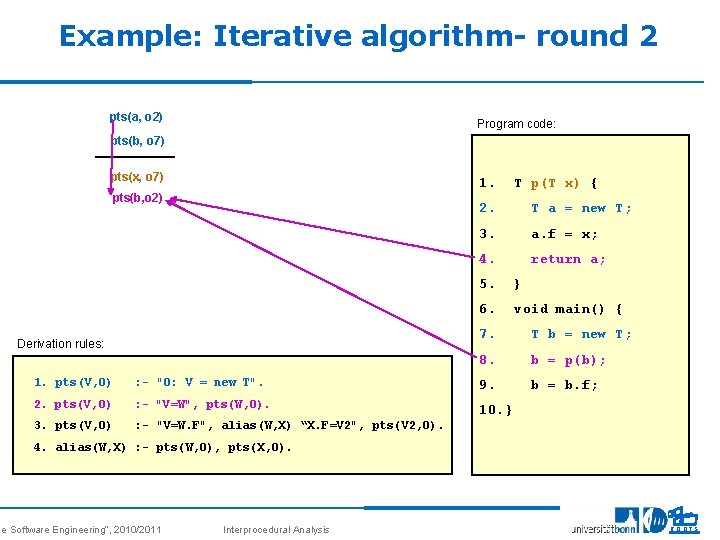
Example: Iterative algorithm- round 2 pts(a, o 2) Program code: pts(b, o 7) pts(x, o 7) 1. pts(b, o 2) Derivation rules: T p(T x) { 2. T a = new T; 3. a. f = x; 4. return a; 5. } 6. void main() { 7. T b = new T; 8. b = p(b); b = b. f; 1. pts(V, O) : - "O: V = new T". 9. 2. pts(V, O) : - "V=W", pts(W, O). 10. } 3. pts(V, O) : - "V=W. F", alias(W, X) “X. F=V 2", pts(V 2, O). 4. alias(W, X) : - pts(W, O), pts(X, O). se Software Engineering“, 2010/2011 Interprocedural Analysis 27 ROOTS
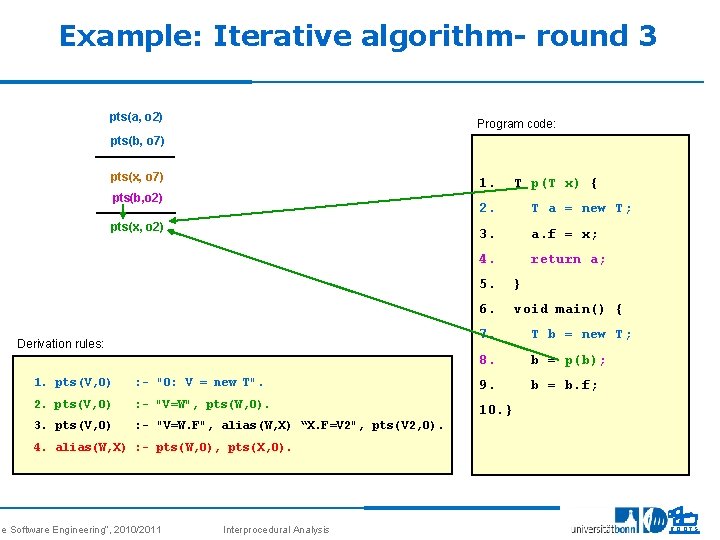
Example: Iterative algorithm- round 3 pts(a, o 2) Program code: pts(b, o 7) pts(x, o 7) 1. pts(b, o 2) pts(x, o 2) Derivation rules: T p(T x) { 2. T a = new T; 3. a. f = x; 4. return a; 5. } 6. void main() { 7. T b = new T; 8. b = p(b); b = b. f; 1. pts(V, O) : - "O: V = new T". 9. 2. pts(V, O) : - "V=W", pts(W, O). 10. } 3. pts(V, O) : - "V=W. F", alias(W, X) “X. F=V 2", pts(V 2, O). 4. alias(W, X) : - pts(W, O), pts(X, O). se Software Engineering“, 2010/2011 Interprocedural Analysis 28 ROOTS
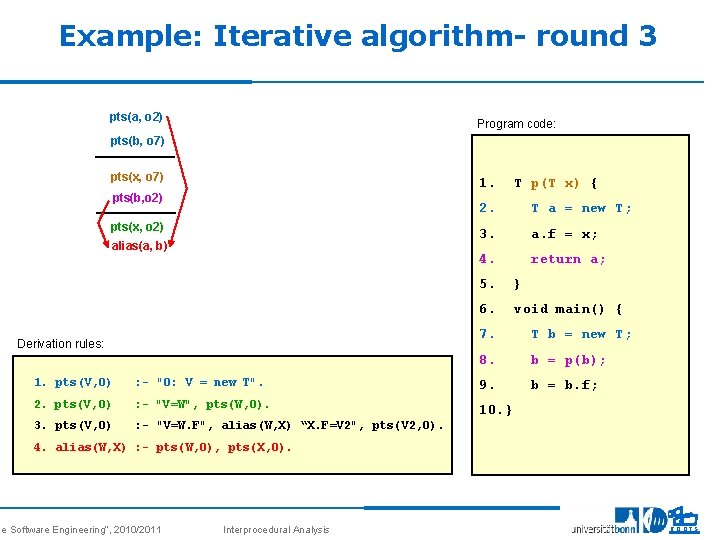
Example: Iterative algorithm- round 3 pts(a, o 2) Program code: pts(b, o 7) pts(x, o 7) 1. pts(b, o 2) pts(x, o 2) alias(a, b) Derivation rules: T p(T x) { 2. T a = new T; 3. a. f = x; 4. return a; 5. } 6. void main() { 7. T b = new T; 8. b = p(b); b = b. f; 1. pts(V, O) : - "O: V = new T". 9. 2. pts(V, O) : - "V=W", pts(W, O). 10. } 3. pts(V, O) : - "V=W. F", alias(W, X) “X. F=V 2", pts(V 2, O). 4. alias(W, X) : - pts(W, O), pts(X, O). se Software Engineering“, 2010/2011 Interprocedural Analysis 29 ROOTS
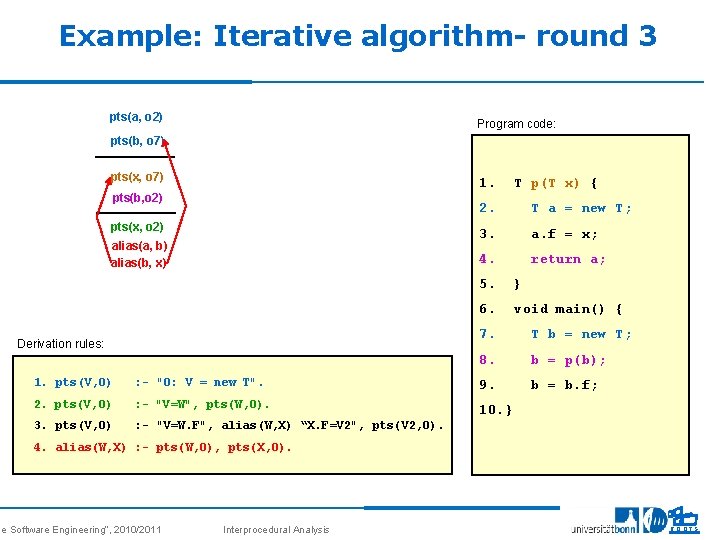
Example: Iterative algorithm- round 3 pts(a, o 2) Program code: pts(b, o 7) pts(x, o 7) 1. pts(b, o 2) pts(x, o 2) alias(a, b) alias(b, x) Derivation rules: T p(T x) { 2. T a = new T; 3. a. f = x; 4. return a; 5. } 6. void main() { 7. T b = new T; 8. b = p(b); b = b. f; 1. pts(V, O) : - "O: V = new T". 9. 2. pts(V, O) : - "V=W", pts(W, O). 10. } 3. pts(V, O) : - "V=W. F", alias(W, X) “X. F=V 2", pts(V 2, O). 4. alias(W, X) : - pts(W, O), pts(X, O). se Software Engineering“, 2010/2011 Interprocedural Analysis 30 ROOTS
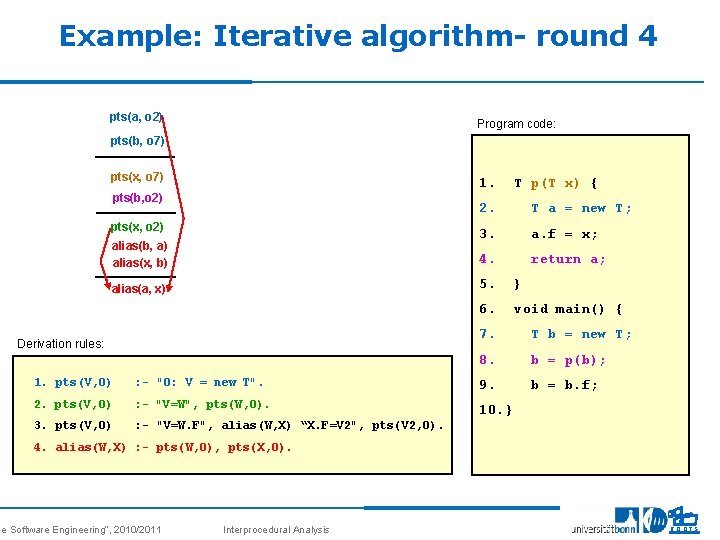
Example: Iterative algorithm- round 4 pts(a, o 2) Program code: pts(b, o 7) pts(x, o 7) 1. pts(b, o 2) pts(x, o 2) alias(b, a) alias(x, b) alias(a, x) Derivation rules: T p(T x) { 2. T a = new T; 3. a. f = x; 4. return a; 5. } 6. void main() { 7. T b = new T; 8. b = p(b); b = b. f; 1. pts(V, O) : - "O: V = new T". 9. 2. pts(V, O) : - "V=W", pts(W, O). 10. } 3. pts(V, O) : - "V=W. F", alias(W, X) “X. F=V 2", pts(V 2, O). 4. alias(W, X) : - pts(W, O), pts(X, O). se Software Engineering“, 2010/2011 Interprocedural Analysis 31 ROOTS
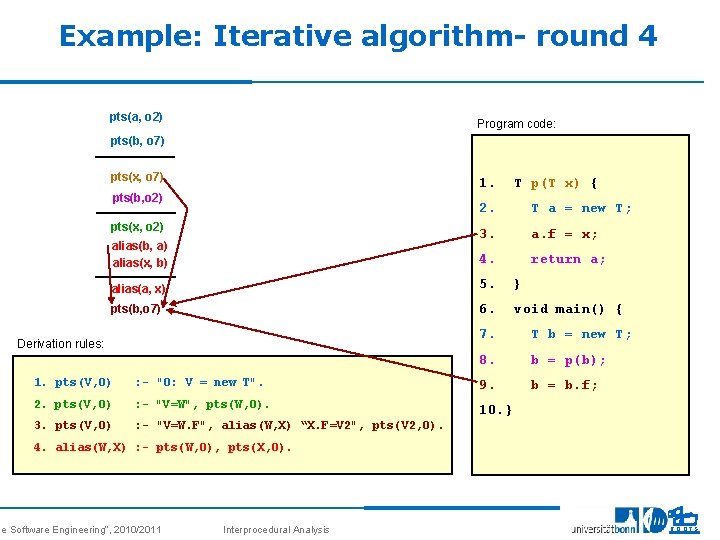
Example: Iterative algorithm- round 4 pts(a, o 2) Program code: pts(b, o 7) pts(x, o 7) 1. pts(b, o 2) pts(x, o 2) alias(b, a) alias(x, b) T p(T x) { 2. T a = new T; 3. a. f = x; 4. return a; alias(a, x) 5. } pts(b, o 7) 6. void main() { Derivation rules: 7. T b = new T; 8. b = p(b); b = b. f; 1. pts(V, O) : - "O: V = new T". 9. 2. pts(V, O) : - "V=W", pts(W, O). 10. } 3. pts(V, O) : - "V=W. F", alias(W, X) “X. F=V 2", pts(V 2, O). 4. alias(W, X) : - pts(W, O), pts(X, O). se Software Engineering“, 2010/2011 Interprocedural Analysis 32 ROOTS
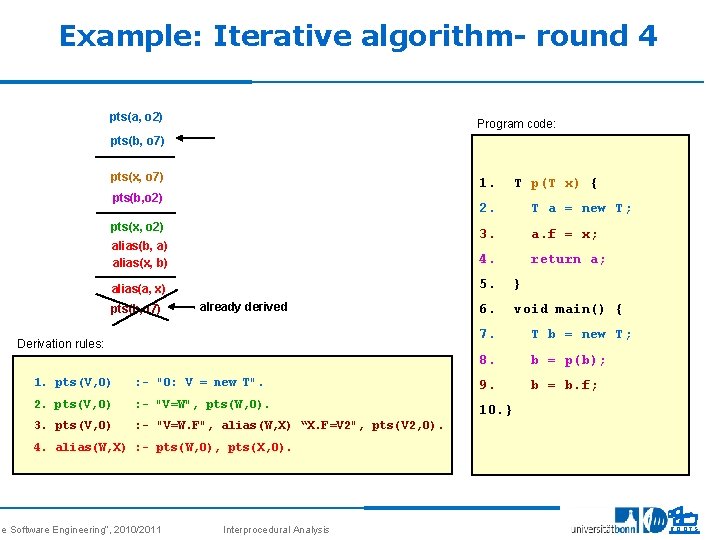
Example: Iterative algorithm- round 4 pts(a, o 2) Program code: pts(b, o 7) pts(x, o 7) 1. pts(b, o 2) pts(x, o 2) alias(b, a) alias(x, b) alias(a, x) pts(b, o 7) already derived Derivation rules: T p(T x) { 2. T a = new T; 3. a. f = x; 4. return a; 5. } 6. void main() { 7. T b = new T; 8. b = p(b); b = b. f; 1. pts(V, O) : - "O: V = new T". 9. 2. pts(V, O) : - "V=W", pts(W, O). 10. } 3. pts(V, O) : - "V=W. F", alias(W, X) “X. F=V 2", pts(V 2, O). 4. alias(W, X) : - pts(W, O), pts(X, O). se Software Engineering“, 2010/2011 Interprocedural Analysis 33 ROOTS
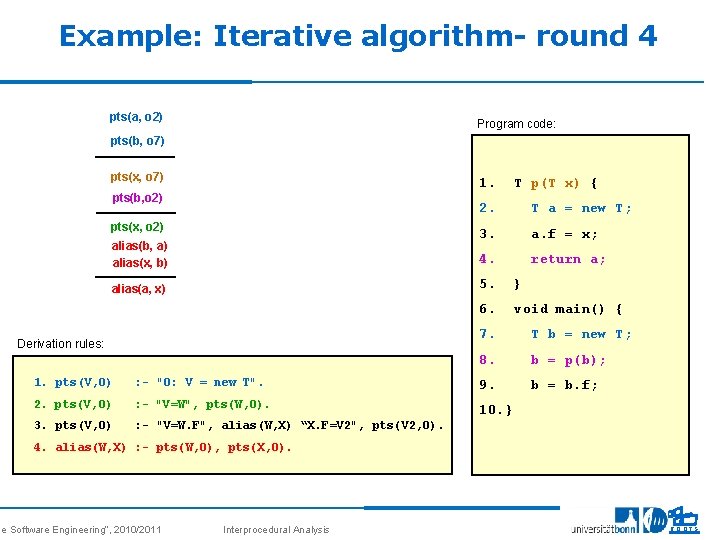
Example: Iterative algorithm- round 4 pts(a, o 2) Program code: pts(b, o 7) pts(x, o 7) 1. pts(b, o 2) pts(x, o 2) alias(b, a) alias(x, b) alias(a, x) Derivation rules: T p(T x) { 2. T a = new T; 3. a. f = x; 4. return a; 5. } 6. void main() { 7. T b = new T; 8. b = p(b); b = b. f; 1. pts(V, O) : - "O: V = new T". 9. 2. pts(V, O) : - "V=W", pts(W, O). 10. } 3. pts(V, O) : - "V=W. F", alias(W, X) “X. F=V 2", pts(V 2, O). 4. alias(W, X) : - pts(W, O), pts(X, O). se Software Engineering“, 2010/2011 Interprocedural Analysis 34 ROOTS
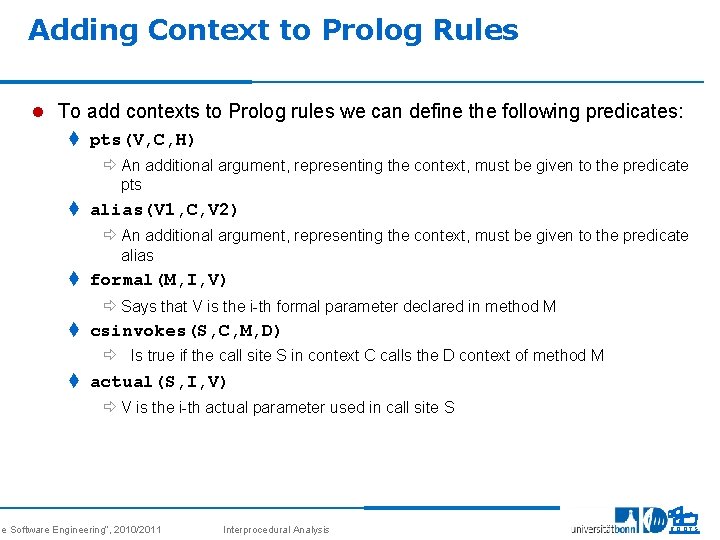
Adding Context to Prolog Rules l To add contexts to Prolog rules we can define the following predicates: t pts(V, C, H) ð An additional argument, representing the context, must be given to the predicate pts t alias(V 1, C, V 2) ð An additional argument, representing the context, must be given to the predicate alias t formal(M, I, V) ð Says that V is the i-th formal parameter declared in method M t csinvokes(S, C, M, D) ð Is true if the call site S in context C calls the D context of method M t actual(S, I, V) ð V is the i-th actual parameter used in call site S se Software Engineering“, 2010/2011 Interprocedural Analysis 35 ROOTS
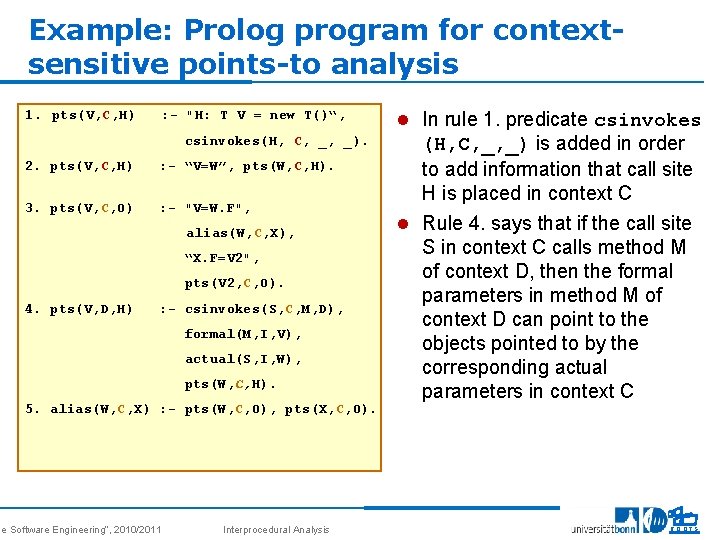
Example: Prolog program for contextsensitive points-to analysis 1. pts(V, C, H) : - "H: T V = new T()“, csinvokes(H, C, _, _). 2. pts(V, C, H) : - “V=W”, pts(W, C, H). 3. pts(V, C, O) : - "V=W. F", alias(W, C, X), “X. F=V 2", pts(V 2, C, O). 4. pts(V, D, H) : - csinvokes(S, C, M, D), formal(M, I, V), actual(S, I, W), pts(W, C, H). 5. alias(W, C, X) : - pts(W, C, O), pts(X, C, O). se Software Engineering“, 2010/2011 Interprocedural Analysis l In rule 1. predicate csinvokes (H, C, _, _) is added in order to add information that call site H is placed in context C l Rule 4. says that if the call site S in context C calls method M of context D, then the formal parameters in method M of context D can point to the objects pointed to by the corresponding actual parameters in context C 36 ROOTS
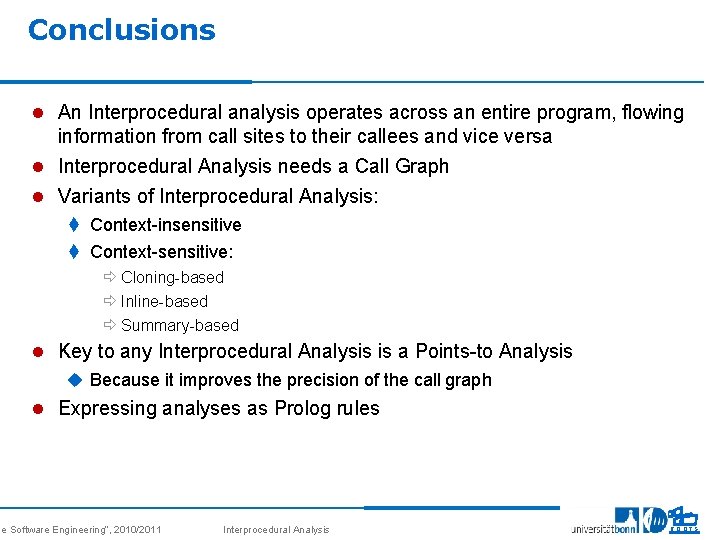
Conclusions l An Interprocedural analysis operates across an entire program, flowing information from call sites to their callees and vice versa l Interprocedural Analysis needs a Call Graph l Variants of Interprocedural Analysis: t Context-insensitive t Context-sensitive: ð Cloning-based ð Inline-based ð Summary-based l Key to any Interprocedural Analysis is a Points-to Analysis u Because it improves the precision of the call graph l Expressing analyses as Prolog rules se Software Engineering“, 2010/2011 Interprocedural Analysis 37 ROOTS
References l “Compilers Principles, Tehniques, & Tools” Second Edition, by Alfred Aho, Ravi Sethi, Monica Lam and Jeffrey Ullman, ISBN 0 -321 -48681– 1, Publisher Greg Tobin l “Everything Else About Data Flow Analysis” by Jeffrey Ullman, infolab. stanford. edu/~ullman/dragon/w 06/lectures/datalog. ppt l “Why Use Datalog to Analyze Programs? ” by Monica Lam, Stanford University, http: //www. springerlink. com/content/y 474887 q 446 g 5052/ se Software Engineering“, 2010/2011 Interprocedural Analysis 38 ROOTS
Next Talks l Eda: „Field-based and Field-Sensitive Analysis“ u Properly modelling the flow of objects through fields l Saad: „Context-Sensitive Analysis“ u Context sensitive analysis as an extension of field-sensitive analysis l Obaid: „On-the-fly call graph“ u Dilemma: PTA needs a CG and a precise CG needs PTA l Mohammad: „Shape analysis“ u More precise analyses using techniques we ignored so far the sake of efficiency se Software Engineering“, 2010/2011 Interprocedural Analysis 39 ROOTS
- Slides: 38