
ROOT in the Minos Experiment Presented at ROOT
- Slides: 24
ROOT in the Minos Experiment Presented at ROOT 2002 (CERN) October 14, 2002 George Irwin - Stanford University Contributions from: Robert Hatcher - FNAL Susan Kasahara - U. of Minnesota David Petit - U. of Minnesota Brett Viren - Brookhaven Lab Nick West - Oxford University October 14, 2002 ROOT 2002 Workshop at CERN 1
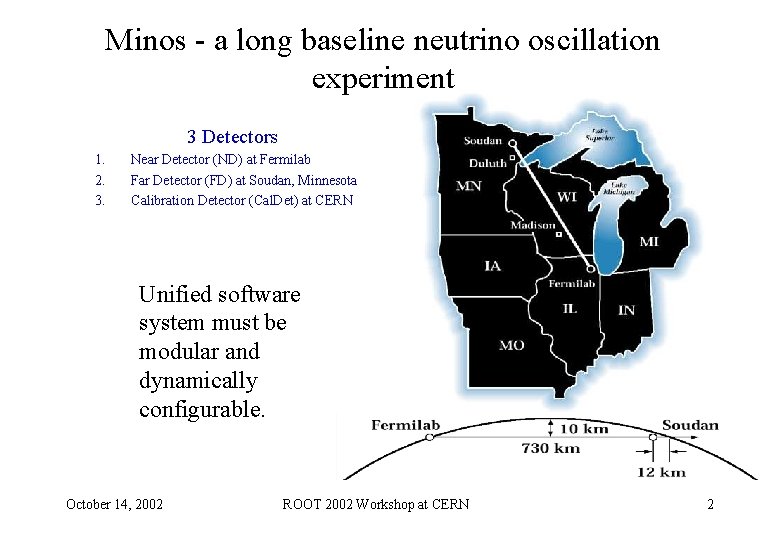
Minos - a long baseline neutrino oscillation experiment 3 Detectors 1. 2. 3. Near Detector (ND) at Fermilab Far Detector (FD) at Soudan, Minnesota Calibration Detector (Cal. Det) at CERN Unified software system must be modular and dynamically configurable. October 14, 2002 ROOT 2002 Workshop at CERN 2
Minos Status • • • Hardware Cal. Det taking data in CERN test beam Far Detector is 2/3 completed - taking cosmic data Near detector beginning construction Neutrino beam due from Fermilab in 2005 Planning for a 20 year experiment lifetime Software • ROOT-based reconstruction framework analysing data from Cal. Det and Far Detector • MC/Sim framework to be rewritten in C++ October 14, 2002 ROOT 2002 Workshop at CERN 3
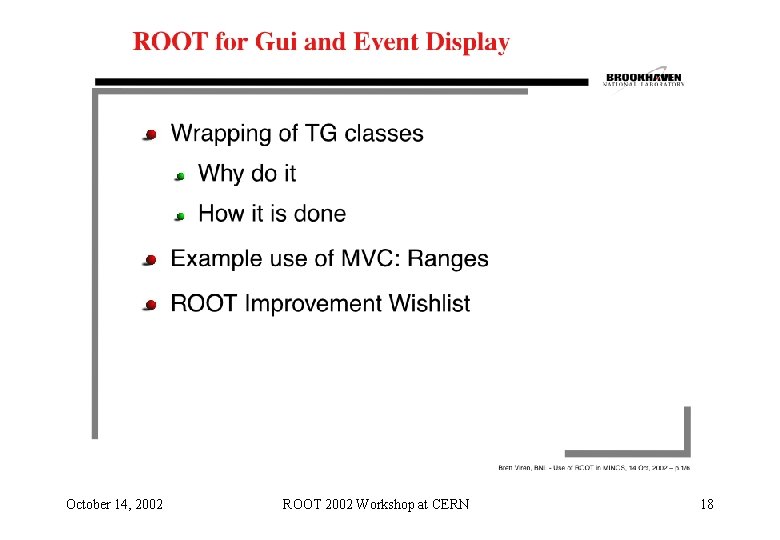
Remainder of Talk Highlights a few special ways that Minos uses ROOT: • Data Model • Data Dispatcher and its clients • Database Interface • TG wrappers October 14, 2002 ROOT 2002 Workshop at CERN 4
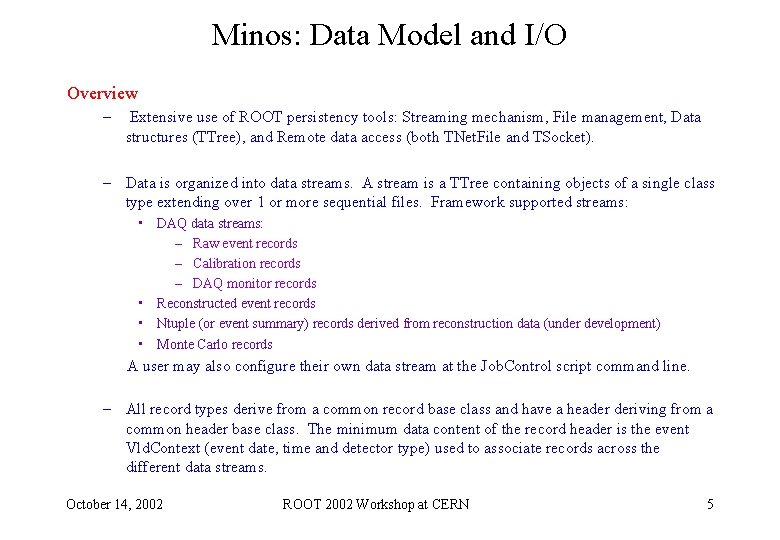
Minos: Data Model and I/O Overview – Extensive use of ROOT persistency tools: Streaming mechanism, File management, Data structures (TTree), and Remote data access (both TNet. File and TSocket). – Data is organized into data streams. A stream is a TTree containing objects of a single class type extending over 1 or more sequential files. Framework supported streams: • DAQ data streams: – Raw event records – Calibration records – DAQ monitor records • Reconstructed event records • Ntuple (or event summary) records derived from reconstruction data (under development) • Monte Carlo records A user may also configure their own data stream at the Job. Control script command line. – All record types derive from a common record base class and have a header deriving from a common header base class. The minimum data content of the record header is the event Vld. Context (event date, time and detector type) used to associate records across the different data streams. October 14, 2002 ROOT 2002 Workshop at CERN 5
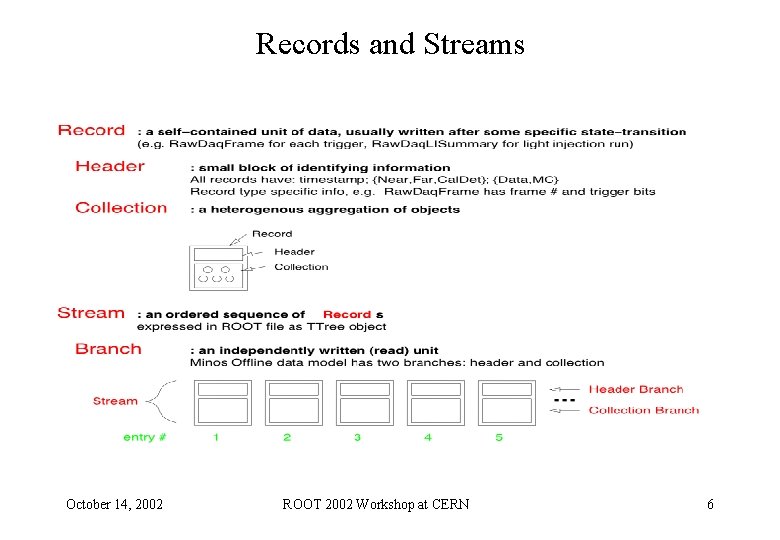
Records and Streams October 14, 2002 ROOT 2002 Workshop at CERN 6
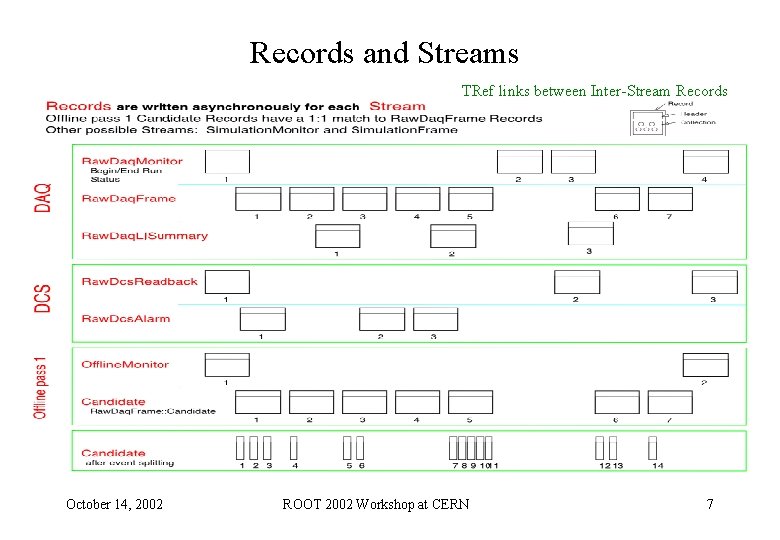
Records and Streams TRef links between Inter-Stream Records October 14, 2002 ROOT 2002 Workshop at CERN 7
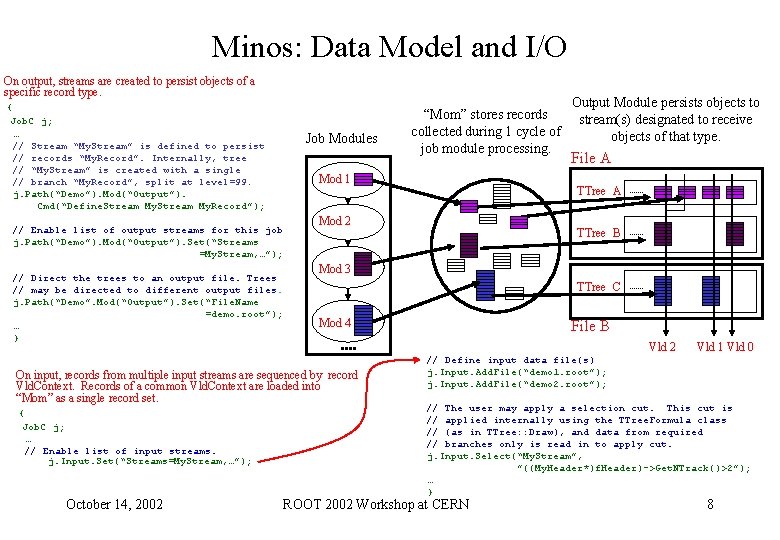
Minos: Data Model and I/O On output, streams are created to persist objects of a specific record type. { Job. C j; … // Stream “My. Stream” is defined to persist // records “My. Record”. Internally, tree // “My. Stream” is created with a single // branch “My. Record”, split at level=99. j. Path(“Demo”). Mod(“Output”). Cmd(“Define. Stream My. Record”); // Enable list of output streams for this job j. Path(“Demo”). Mod(“Output”). Set(“Streams =My. Stream, …”); // Direct the trees to an output file. Trees // may be directed to different output files. j. Path(“Demo”. Mod(“Output”). Set(“File. Name =demo. root”); … } Job Modules Mod 1 October 14, 2002 Output Module persists objects to stream(s) designated to receive objects of that type. File A TTree A Mod 2 TTree B Mod 3 TTree C Mod 4 File B Vld 2 On input, records from multiple input streams are sequenced by record Vld. Context. Records of a common Vld. Context are loaded into “Mom” as a single record set. { Job. C j; … // Enable list of input streams. j. Input. Set(“Streams=My. Stream, …”); “Mom” stores records collected during 1 cycle of job module processing. Vld 1 Vld 0 // Define input data file(s) j. Input. Add. File(“demo 1. root”); j. Input. Add. File(“demo 2. root”); // The user may apply a selection cut. This cut is // applied internally using the TTree. Formula class // (as in TTree: : Draw), and data from required // branches only is read in to apply cut. j. Input. Select(“My. Stream”, ”((My. Header*)f. Header)->Get. NTrack()>2”); … } ROOT 2002 Workshop at CERN 8
Minos: Data Model and I/O Recently, we have been working to remodel the record package and to design an Ntuple record class. The new record base record class makes use of a templated data member: template <class T> class Record. Imp: public Record { // Record is abc class inheriting from TNamed … T f. Header; }; Tests show that we can successfully I/O records from a ROOT TTree created with split level=99 to hold objects of this templated class type. Record. Imp<Rec. Header> *record = 0; f. TTree->Branch(“Rec. Record. Imp<Rec. Header>”, ”Rec. Record. Imp<Rec. Header>”, &record, 64000, 99); The Ntuple record class makes use of TClones. Arrays. It would be useful to have more flexibility in how these can be used. In particular, TClones. Arrays in a base class do not split properly when a derived class is used to create the main branch of the TTree. class Event: public TObject { … TClones. Array* array; }; class Special. Event: public Event{ … }; Special. Event* event = 0; f. TTree->Branch(“Special. Event”, ”Special. Event”, &event, 64000, 99); // fails to split base class TClones. Array October 14, 2002 ROOT 2002 Workshop at CERN 9
Minos: Data Model and I/O (Dispatcher) The Data Dispatcher serves data from the DAQ generated output file to near-online clients (local and remote). The data is served before the data file has been closed by the DAQ. Some features of the system: – The read of an open ROOT data file is accomplished without the use of file locks. The Daq regularly saves the TTree to file and updates the TDirectory keys, and the reader checks these keys as needed for the availability of a new TTree. When a collision between the writer and reader occurs, the reader recognizes that it has a corrupt data buffer, signaled by an error in ROOT’s internal unzipping method, and tries again. – The servers (parent and child) make use of ROOT’s TSocket to communicate with clients. – The client may subscribe to certain subsets of data and the client’s selection criteria will be applied server side. { Job. C j; j. Input. Set(“Format=DDS”); j. Input. Set(“DDSServer=ddsserver. host. address”); j. Input. Set(“Stream=Daq. Snarl”); // this tree only is read in by server j. Input. Select(“Daq. Snarl”, ”((Raw. Daq. Snarl. Header*)f. Header)->Get. Trig. Src()==2”); // applied on server side via TTree. Formula … October 14, 2002 ROOT 2002 Workshop at CERN } 10
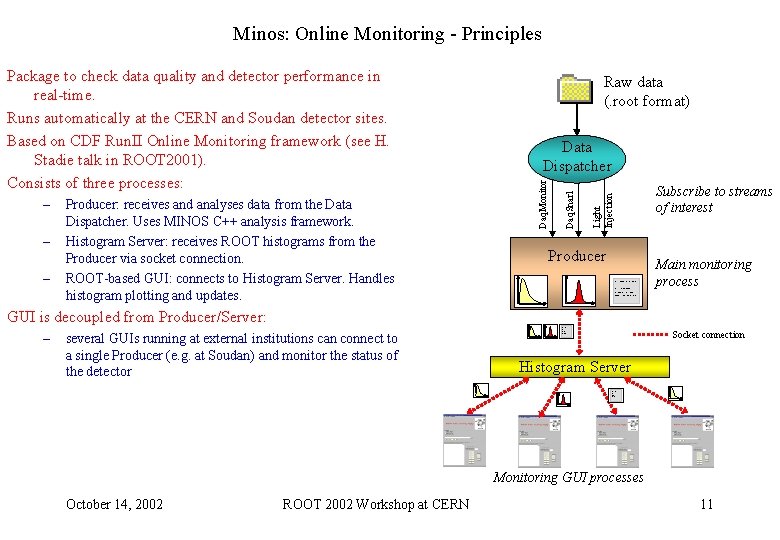
Minos: Online Monitoring - Principles – – Subscribe to streams of interest Light Injection Producer: receives and analyses data from the Data Dispatcher. Uses MINOS C++ analysis framework. Histogram Server: receives ROOT histograms from the Producer via socket connection. ROOT-based GUI: connects to Histogram Server. Handles histogram plotting and updates. Data Dispatcher Daq. Snarl – Raw data (. root format) Daq. Monitor Package to check data quality and detector performance in real-time. Runs automatically at the CERN and Soudan detector sites. Based on CDF Run. II Online Monitoring framework (see H. Stadie talk in ROOT 2001). Consists of three processes: Producer Online Monitoring Frame Run number: 8094 Main monitoring process Number of snarls: 175 Mean singles rate: 53 k. Hz GUI is decoupled from Producer/Server: Online Monitoring – Socket connection Run no: 5675 several GUIs running at external institutions can connect to a single Producer (e. g. at Soudan) and monitor the status of the detector Can You Read This? Histogram Server Online Monitoring Run no: 5675 Can You Read This? Monitoring GUI processes October 14, 2002 ROOT 2002 Workshop at CERN 11
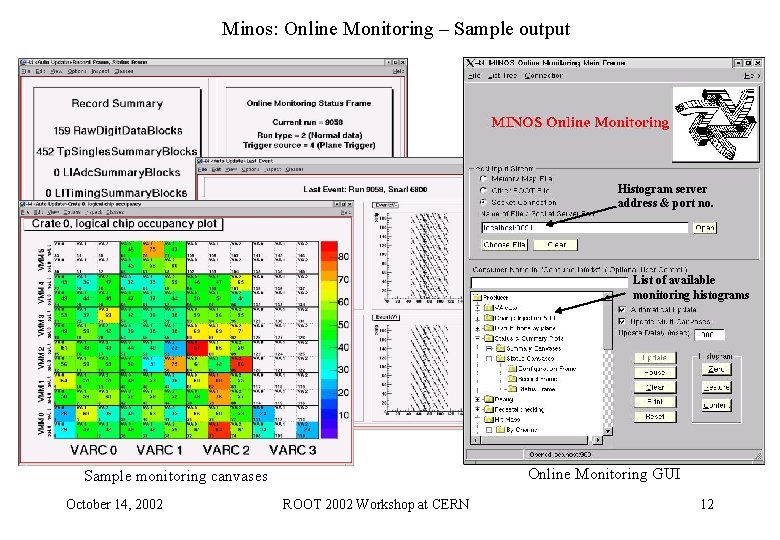
Minos: Online Monitoring – Sample output Histogram server address & port no. List of available monitoring histograms Online Monitoring GUI Sample monitoring canvases October 14, 2002 ROOT 2002 Workshop at CERN 12
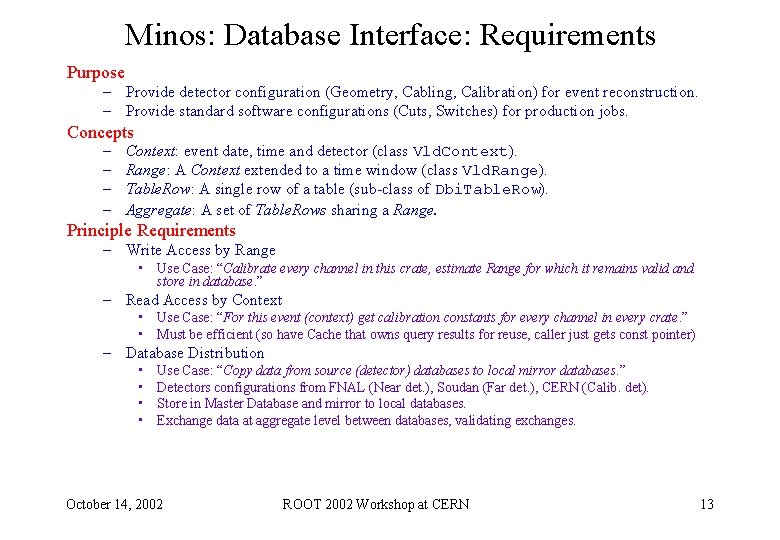
Minos: Database Interface: Requirements Purpose – Provide detector configuration (Geometry, Cabling, Calibration) for event reconstruction. – Provide standard software configurations (Cuts, Switches) for production jobs. Concepts – – Context: event date, time and detector (class Vld. Context). Range: A Context extended to a time window (class Vld. Range). Table. Row: A single row of a table (sub-class of Dbi. Table. Row). Aggregate: A set of Table. Rows sharing a Range. Principle Requirements – Write Access by Range • Use Case: “Calibrate every channel in this crate, estimate Range for which it remains valid and store in database. ” – Read Access by Context • Use Case: “For this event (context) get calibration constants for every channel in every crate. ” • Must be efficient (so have Cache that owns query results for reuse, caller just gets const pointer) – Database Distribution • • Use Case: “Copy data from source (detector) databases to local mirror databases. ” Detectors configurations from FNAL (Near det. ), Soudan (Far det. ), CERN (Calib. det). Store in Master Database and mirror to local databases. Exchange data at aggregate level between databases, validating exchanges. October 14, 2002 ROOT 2002 Workshop at CERN 13
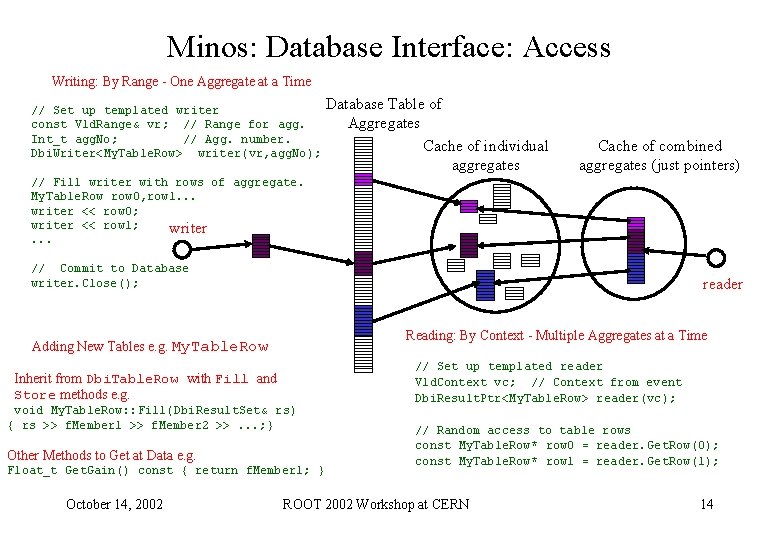
Minos: Database Interface: Access Writing: By Range - One Aggregate at a Time // Set up templated writer const Vld. Range& vr; // Range for agg. Int_t agg. No; // Agg. number. Dbi. Writer<My. Table. Row> writer(vr, agg. No); Database Table of Aggregates Cache of individual aggregates Cache of combined aggregates (just pointers) // Fill writer with rows of aggregate. My. Table. Row row 0, row 1. . . writer << row 0; writer << row 1; writer. . . // Commit to Database writer. Close(); reader Reading: By Context - Multiple Aggregates at a Time Adding New Tables e. g. My. Table. Row Inherit from Dbi. Table. Row with Fill and Store methods e. g. void My. Table. Row: : Fill(Dbi. Result. Set& rs) { rs >> f. Member 1 >> f. Member 2 >>. . . ; } Other Methods to Get at Data e. g. Float_t Get. Gain() const { return f. Member 1; } October 14, 2002 // Set up templated reader Vld. Context vc; // Context from event Dbi. Result. Ptr<My. Table. Row> reader(vc); // Random access to table rows const My. Table. Row* row 0 = reader. Get. Row(0); const My. Table. Row* row 1 = reader. Get. Row(1); ROOT 2002 Workshop at CERN 14
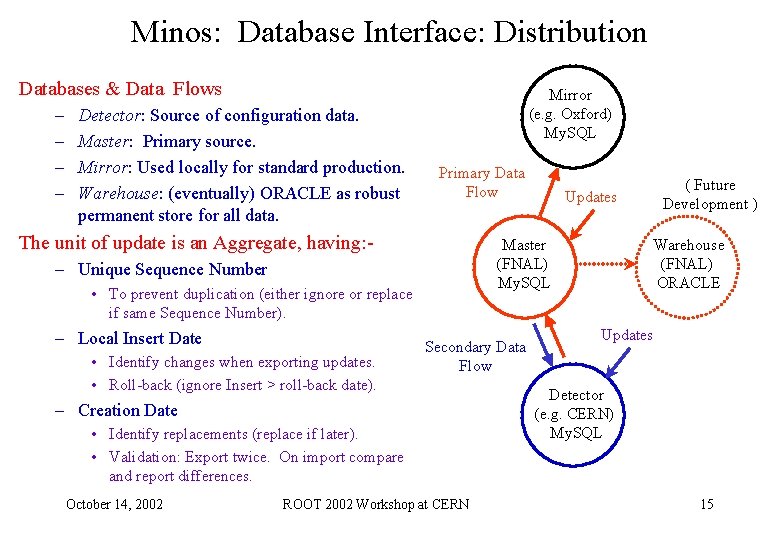
Minos: Database Interface: Distribution Databases & Data Flows – – Detector: Source of configuration data. Master: Primary source. Mirror: Used locally for standard production. Warehouse: (eventually) ORACLE as robust permanent store for all data. Mirror (e. g. Oxford) My. SQL Primary Data Flow The unit of update is an Aggregate, having: - Master (FNAL) My. SQL – Unique Sequence Number • To prevent duplication (either ignore or replace if same Sequence Number). – Local Insert Date • Identify changes when exporting updates. • Roll-back (ignore Insert > roll-back date). Secondary Data Flow – Creation Date • Identify replacements (replace if later). • Validation: Export twice. On import compare and report differences. October 14, 2002 ROOT 2002 Workshop at CERN ( Future Development ) Updates Warehouse (FNAL) ORACLE Updates Detector (e. g. CERN) My. SQL 15
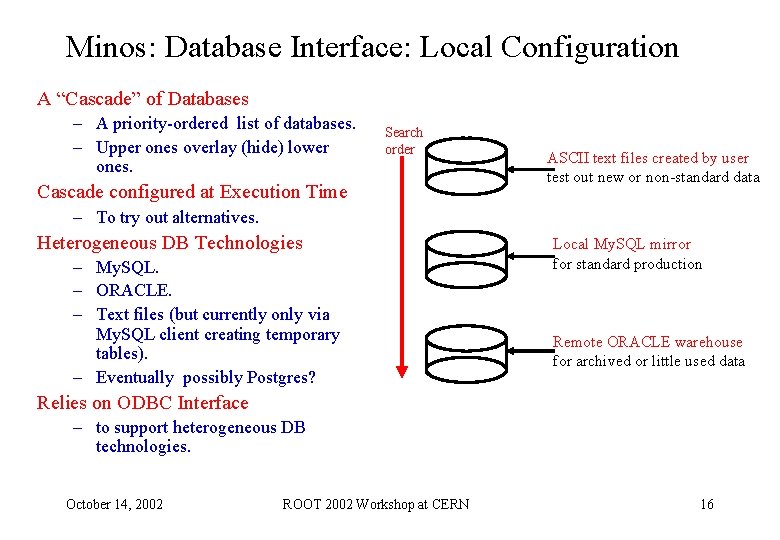
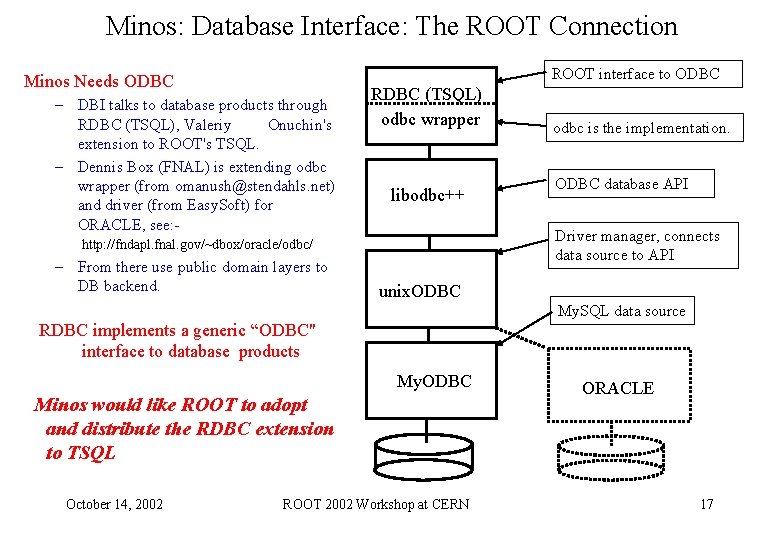
Minos: Database Interface: Local Configuration A “Cascade” of Databases – A priority-ordered list of databases. – Upper ones overlay (hide) lower ones. Search order Cascade configured at Execution Time ASCII text files created by user test out new or non-standard data – To try out alternatives. Heterogeneous DB Technologies – My. SQL. – ORACLE. – Text files (but currently only via My. SQL client creating temporary tables). – Eventually possibly Postgres? Local My. SQL mirror for standard production Remote ORACLE warehouse for archived or little used data Relies on ODBC Interface – to support heterogeneous DB technologies. October 14, 2002 ROOT 2002 Workshop at CERN 16
Minos: Database Interface: The ROOT Connection ROOT interface to ODBC Minos Needs ODBC – DBI talks to database products through RDBC (TSQL), Valeriy Onuchin's extension to ROOT's TSQL. – Dennis Box (FNAL) is extending odbc wrapper (from omanush@stendahls. net) and driver (from Easy. Soft) for ORACLE, see: - RDBC (TSQL) odbc wrapper libodbc++ ODBC database API Driver manager, connects data source to API http: //fndapl. fnal. gov/~dbox/oracle/odbc/ – From there use public domain layers to DB backend. odbc is the implementation. unix. ODBC My. SQL data source RDBC implements a generic “ODBC" interface to database products My. ODBC Minos would like ROOT to adopt and distribute the RDBC extension to TSQL October 14, 2002 ROOT 2002 Workshop at CERN ORACLE 17
October 14, 2002 ROOT 2002 Workshop at CERN 18
October 14, 2002 ROOT 2002 Workshop at CERN 19
October 14, 2002 ROOT 2002 Workshop at CERN 20
October 14, 2002 ROOT 2002 Workshop at CERN 21
October 14, 2002 ROOT 2002 Workshop at CERN 22
October 14, 2002 ROOT 2002 Workshop at CERN 23
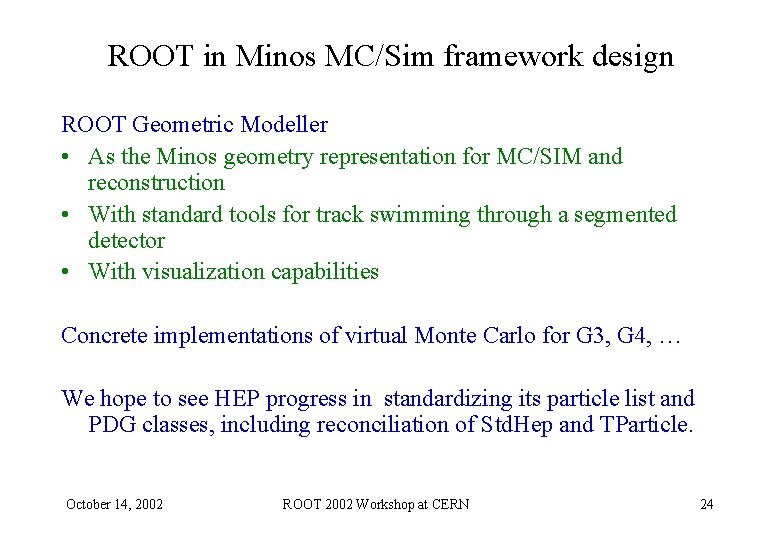
ROOT in Minos MC/Sim framework design ROOT Geometric Modeller • As the Minos geometry representation for MC/SIM and reconstruction • With standard tools for track swimming through a segmented detector • With visualization capabilities Concrete implementations of virtual Monte Carlo for G 3, G 4, … We hope to see HEP progress in standardizing its particle list and PDG classes, including reconciliation of Std. Hep and TParticle. October 14, 2002 ROOT 2002 Workshop at CERN 24