Root Cause Tutorial 2013 More on Hazard Identification


- Slides: 24
Root Cause Tutorial 2013
More on Hazard Identification Techniques One example of a system to proactively identify hazards is to establish groups to identify safety hazards by following five simple steps: 1. Identify potential hazards that could threaten the safety of your employees, customers, passengers, company facilities, company assets, customer property. 2. Rank the severity of hazards. 3. Identify current control measures. 4. Evaluate the effectiveness of each control measure. 5. Identify additional control measures. 1 Page 1
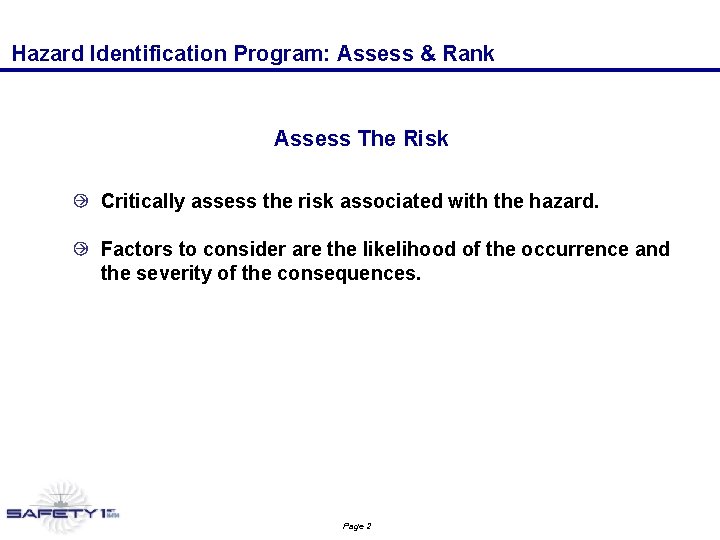
Hazard Identification Program: Assess & Rank Assess The Risk Critically assess the risk associated with the hazard. Factors to consider are the likelihood of the occurrence and the severity of the consequences. 2 Page 2
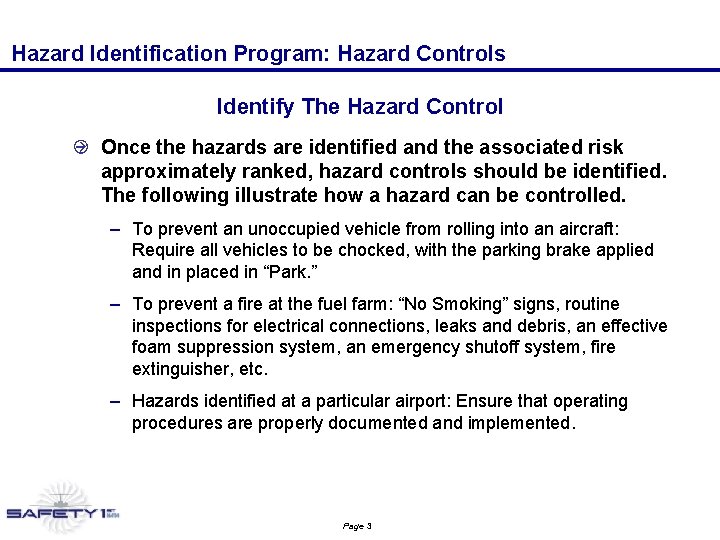
Hazard Identification Program: Hazard Controls Identify The Hazard Control Once the hazards are identified and the associated risk approximately ranked, hazard controls should be identified. The following illustrate how a hazard can be controlled. – To prevent an unoccupied vehicle from rolling into an aircraft: Require all vehicles to be chocked, with the parking brake applied and in placed in “Park. ” – To prevent a fire at the fuel farm: “No Smoking” signs, routine inspections for electrical connections, leaks and debris, an effective foam suppression system, an emergency shutoff system, fire extinguisher, etc. – Hazards identified at a particular airport: Ensure that operating procedures are properly documented and implemented. 3 Page 3
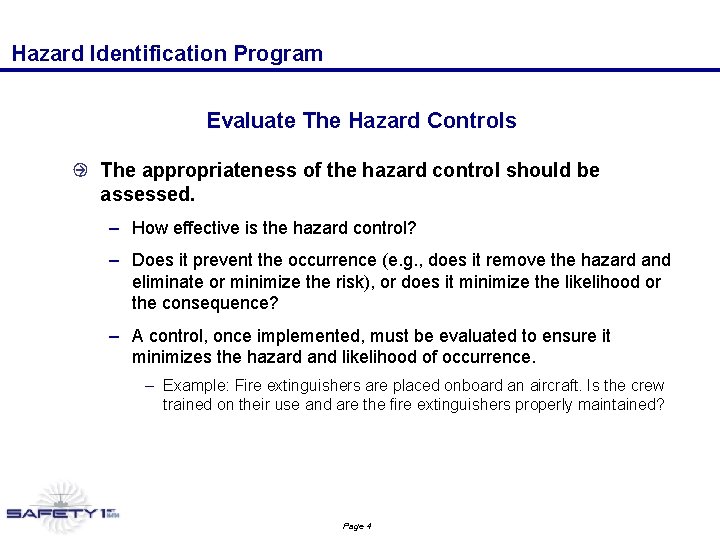
Hazard Identification Program Evaluate The Hazard Controls The appropriateness of the hazard control should be assessed. – How effective is the hazard control? – Does it prevent the occurrence (e. g. , does it remove the hazard and eliminate or minimize the risk), or does it minimize the likelihood or the consequence? – A control, once implemented, must be evaluated to ensure it minimizes the hazard and likelihood of occurrence. – Example: Fire extinguishers are placed onboard an aircraft. Is the crew trained on their use and are the fire extinguishers properly maintained? 4 Page 4
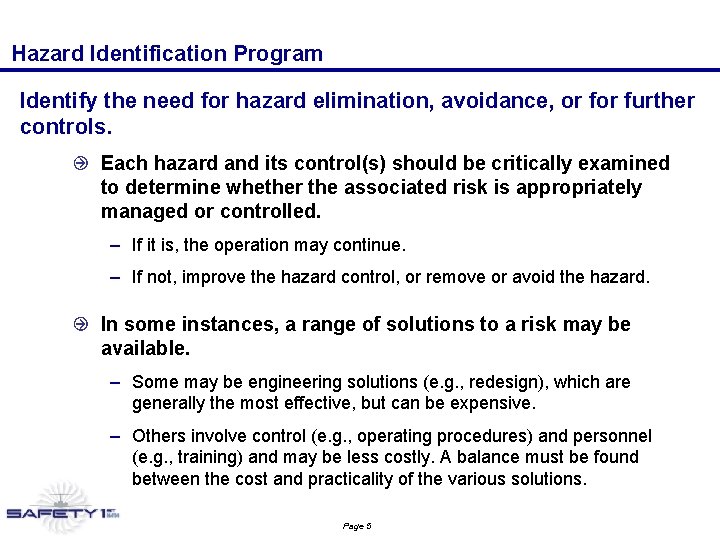
Hazard Identification Program Identify the need for hazard elimination, avoidance, or further controls. Each hazard and its control(s) should be critically examined to determine whether the associated risk is appropriately managed or controlled. – If it is, the operation may continue. – If not, improve the hazard control, or remove or avoid the hazard. In some instances, a range of solutions to a risk may be available. – Some may be engineering solutions (e. g. , redesign), which are generally the most effective, but can be expensive. – Others involve control (e. g. , operating procedures) and personnel (e. g. , training) and may be less costly. A balance must be found between the cost and practicality of the various solutions. 5 Page 5
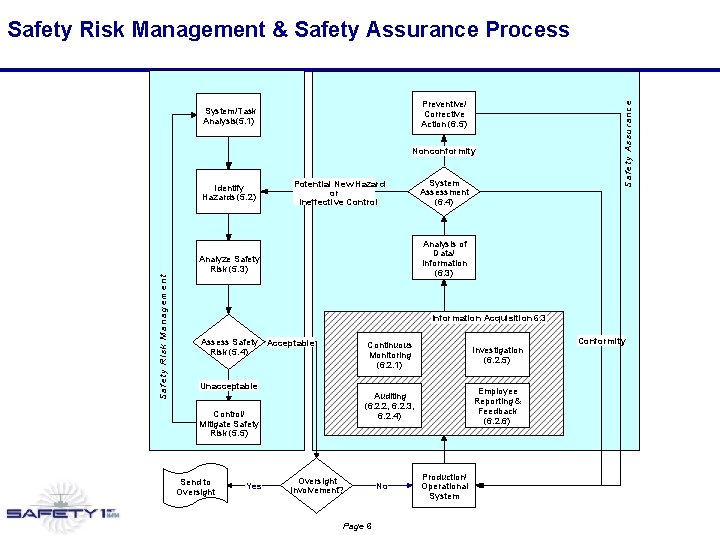
Preventive/ Corrective Action (6. 5) System/Task Analysis (5. 1) Nonconformity Identify Hazards (5. 2) Potential New Hazard or Ineffective Control Analysis of Data/ Information (6. 3) S a fe ty R is k M a n a g e m e n t Analyze Safety Risk (5. 3) Information Acquisition 6. 3 Assess Safety Acceptable Risk (5. 4) Continuous Monitoring (6. 2. 1) Investigation (6. 2. 5) Auditing (6. 2. 2, 6. 2. 3, 6. 2. 4) Employee Reporting & Feedback (6. 2. 6) Unacceptable Control/ Mitigate Safety Risk (5. 5) Send to Oversight 6 System Assessment (6. 4) S a f e ty A s su ra n c e Safety Risk Management & Safety Assurance Process Yes Oversight Involvement? Page 6 No Production/ Operational System Conformity
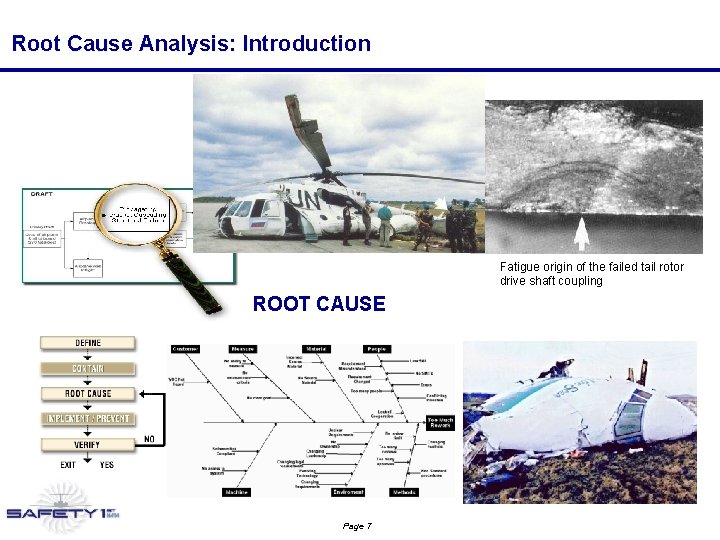
Root Cause Analysis: Introduction Fatigue origin of the failed tail rotor drive shaft coupling ROOT CAUSE 7 Page 7
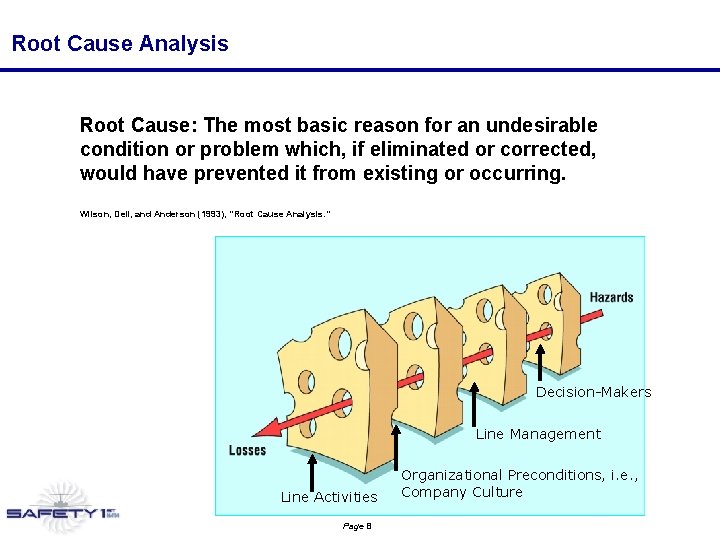
Root Cause Analysis Root Cause: The most basic reason for an undesirable condition or problem which, if eliminated or corrected, would have prevented it from existing or occurring. Wilson, Dell, and Anderson (1993), “Root Cause Analysis. ” Decision-Makers Line Management Line Activities 8 Page 8 Organizational Preconditions, i. e. , Company Culture
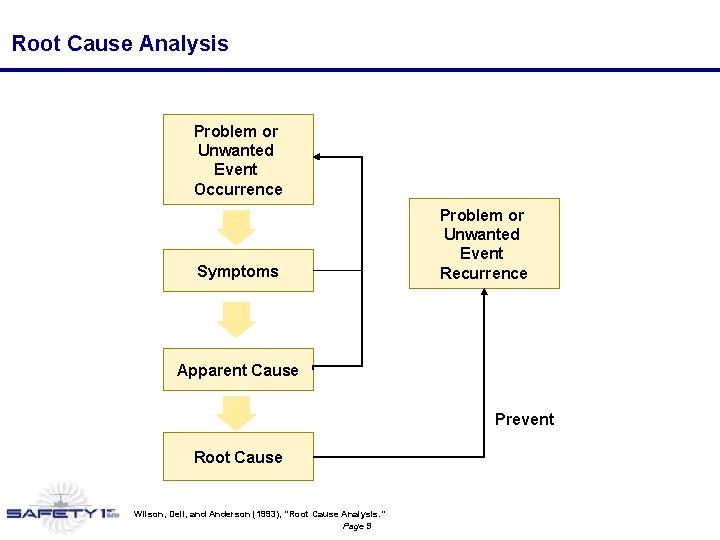
Root Cause Analysis Problem or Unwanted Event Occurrence Symptoms Problem or Unwanted Event Recurrence Apparent Cause Prevent Root Cause 9 Wilson, Dell, and Anderson (1993), “Root Cause Analysis. ” Page 9
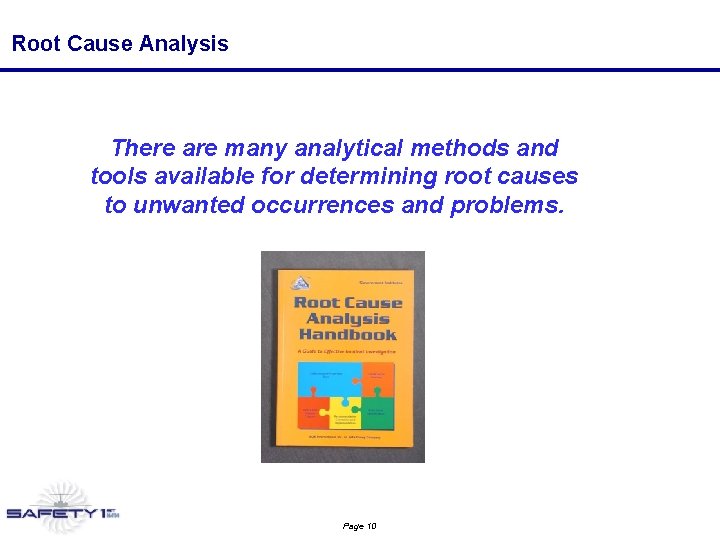
Root Cause Analysis There are many analytical methods and tools available for determining root causes to unwanted occurrences and problems. 10 Page 10
Root Cause Analysis Useful Tools for Determining Root Cause The “ 5 Whys” Model Fishbone Diagrams Failure Modes Effects Analysis (FMEA) Tap. Roo. T® Analysis 11 Page 11
Root Cause Analysis Suggested Tools For efficiency and ease of use, we will discuss: • “ 5 Whys” • Fishbone Method 12 Page 12
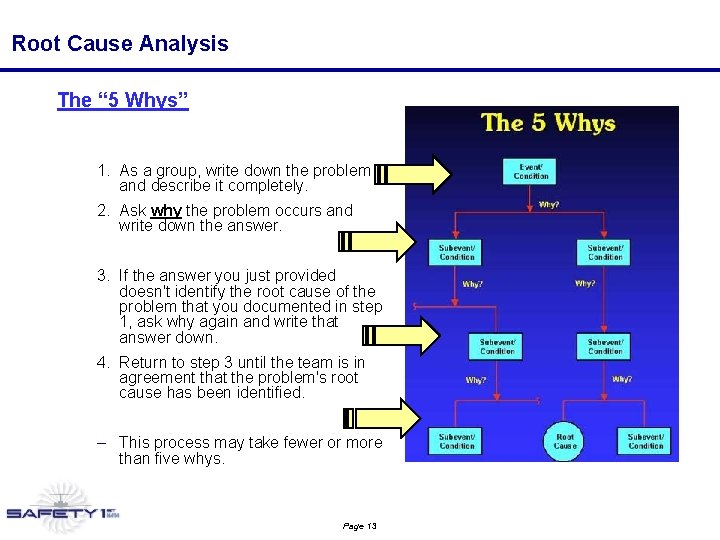
Root Cause Analysis The “ 5 Whys” 1. As a group, write down the problem and describe it completely. 2. Ask why the problem occurs and write down the answer. 3. If the answer you just provided doesn't identify the root cause of the problem that you documented in step 1, ask why again and write that answer down. 4. Return to step 3 until the team is in agreement that the problem's root cause has been identified. – This process may take fewer or more than five whys. 13 Page 13
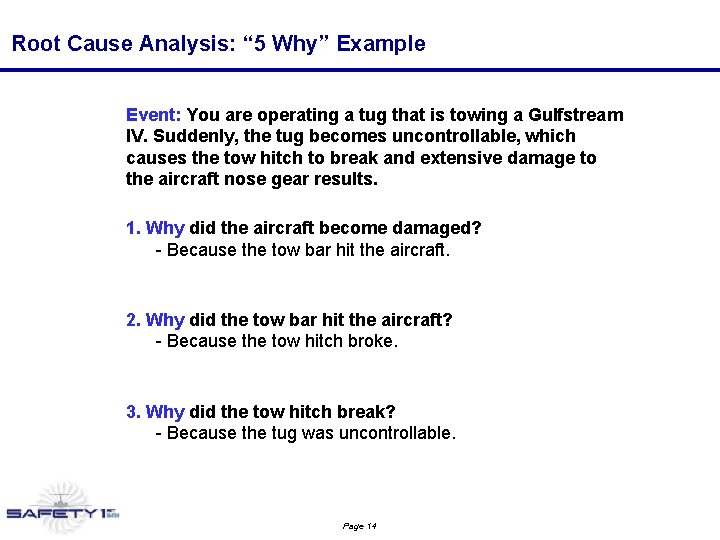
Root Cause Analysis: “ 5 Why” Example Event: You are operating a tug that is towing a Gulfstream IV. Suddenly, the tug becomes uncontrollable, which causes the tow hitch to break and extensive damage to the aircraft nose gear results. 1. Why did the aircraft become damaged? - Because the tow bar hit the aircraft. 2. Why did the tow bar hit the aircraft? - Because the tow hitch broke. 3. Why did the tow hitch break? - Because the tug was uncontrollable. 14 Page 14
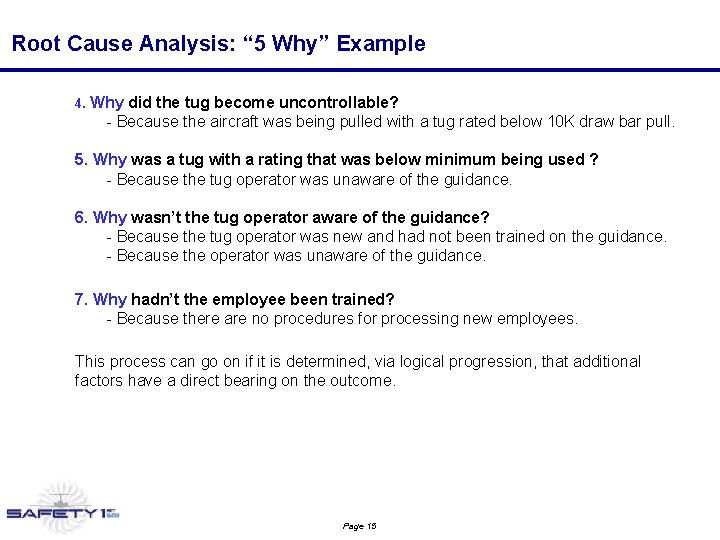
Root Cause Analysis: “ 5 Why” Example 4. Why did the tug become uncontrollable? - Because the aircraft was being pulled with a tug rated below 10 K draw bar pull. 5. Why was a tug with a rating that was below minimum being used ? - Because the tug operator was unaware of the guidance. 6. Why wasn’t the tug operator aware of the guidance? - Because the tug operator was new and had not been trained on the guidance. - Because the operator was unaware of the guidance. 7. Why hadn’t the employee been trained? - Because there are no procedures for processing new employees. This process can go on if it is determined, via logical progression, that additional factors have a direct bearing on the outcome. 15 Page 15
Root Cause Analysis: “ 5 Why” Example As you can see from the preceding example, asking why is an extremely simple and effective way to determine root cause. 16 Page 16
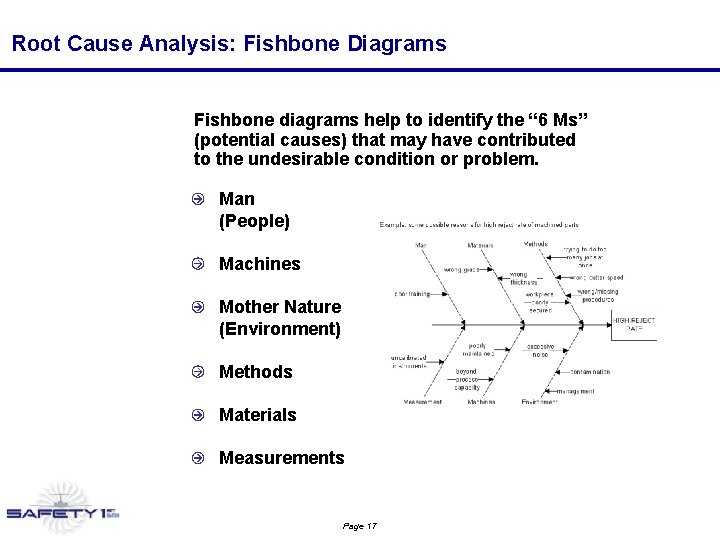
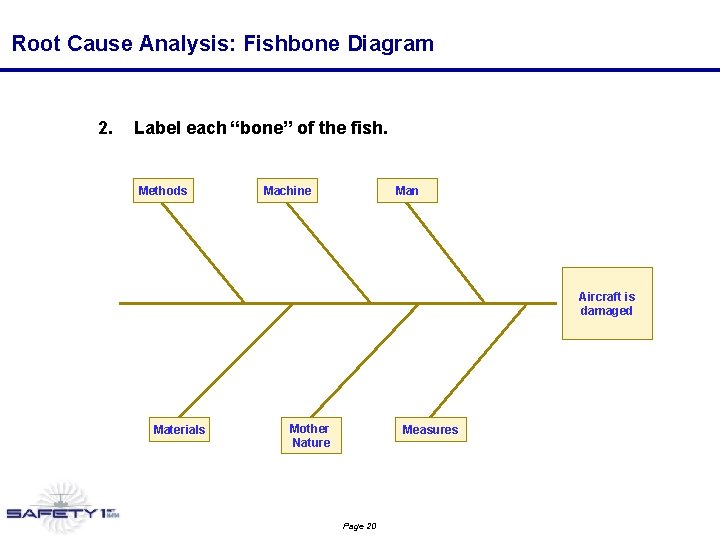
Root Cause Analysis: Fishbone Diagrams Fishbone diagrams help to identify the “ 6 Ms” (potential causes) that may have contributed to the undesirable condition or problem. Man (People) Machines Mother Nature (Environment) Methods Materials Measurements 17 Page 17
Root Cause Analysis: Fishbone Method Great brainstorming tool! Focuses on the cause, not the symptoms. Identifies areas that may need further investigation. Process can be enhanced by adding “ 5 whys. ” 18 Page 18
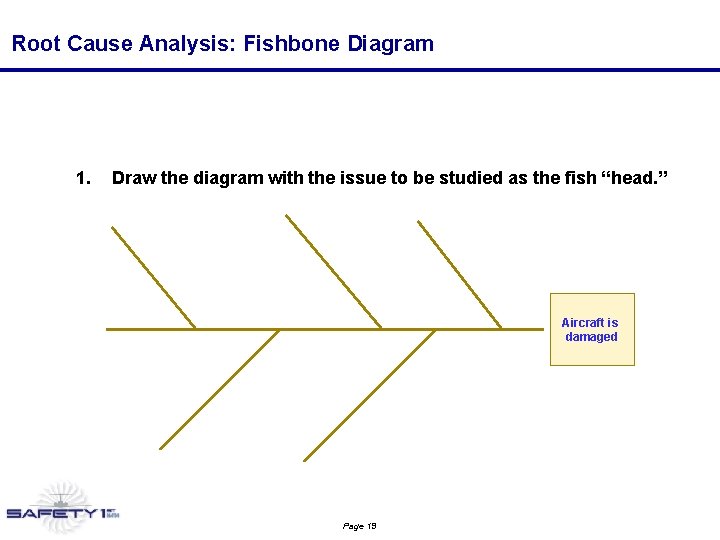
Root Cause Analysis: Fishbone Diagram 1. Draw the diagram with the issue to be studied as the fish “head. ” Aircraft is damaged 19 Page 19
Root Cause Analysis: Fishbone Diagram 2. Label each “bone” of the fish. Methods Machine Man Aircraft is damaged Materials 20 Mother Nature Measures Page 20
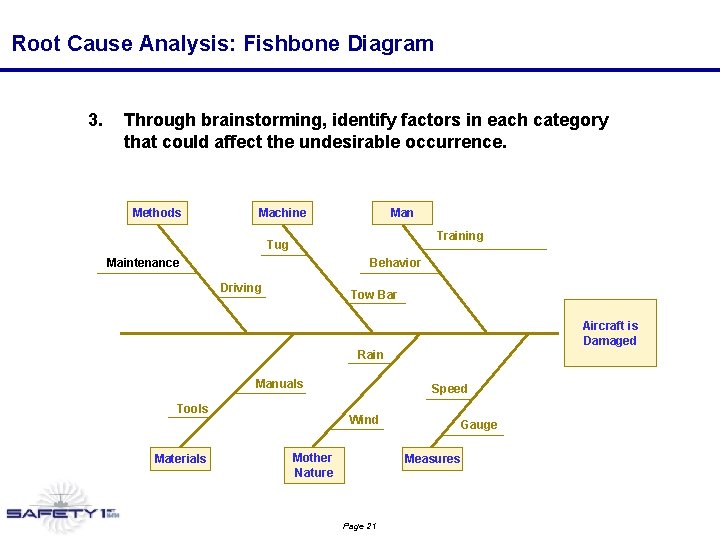
Root Cause Analysis: Fishbone Diagram 3. Through brainstorming, identify factors in each category that could affect the undesirable occurrence. Methods Machine Man Training Tug Behavior Maintenance Driving Tow Bar Aircraft is Damaged Rain Manuals Tools Materials 21 Speed Wind Mother Nature Gauge Measures Page 21
Root Cause Analysis: Fishbone Diagram 4. Upon completion of the fishbone, analyze the results. 5. Then, list the items that were identified in priority order. This brainstorming technique, when properly applied, can be helpful in determining a root cause to an undesirable condition or problem. 22 Page 22
Root Cause Analysis Remember, the objective of root cause analysis is to identify the real cause of a problem, not the symptoms. Hopefully, these simple tools will help you to do just that! 23 Page 23