
Root Cause and SMART Goals Samantha Haviland DPS

- Slides: 36
Root Cause and SMART Goals Samantha Haviland, DPS Amanda Burgess, SEBOCES Eve Pugh, CDE December, 2019 1
Counselor Corps Grant Checklist You have completed: ✓A vision/mission statement for your counseling program ✓Read your Counselor Corps Grant application ✓Needs Assessment - creating, distributing, collecting ✓Analyzed the data from our Needs Assessment ✓Reviewed other data available - UIP, Community Surveys, School Report Cards, ✓School Site Visit Reports, etc. ✓A knowledge base for systemic change ✓A Vision Still Working On: • • 2 Environmental Scan - all 4 quadrants - currently happening This Month: Root Cause SMART Goals
Agenda • Discover Your Root Causes • What are they? • What tools do you have to find out? • Creating SMART Goals • • • 3 What are they? How do I do it? When do I do it? Who do I involve? Where does it happen?
Takeaways • Root Causes - What, Tools • How to create a SMART Goal • By analyzing your school data and discussing ways in which you as educators can work together to uncover and address student needs 4
End of the Year Report Question #4: • What are three to five root causes your program plans to address over the next three years of the grant, (utilizing Counselor Corps Grant Program funds)? Question #5: • List SMART Goals (no more than three) for the remainder of the grant cycle. 5
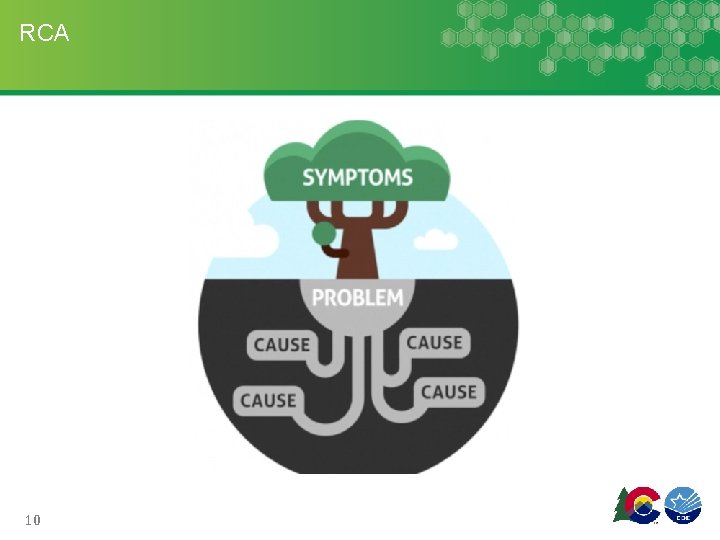
Root Cause Analysis (RCA) • This is a popular and often used technique that helps people answer the question of why the problem occurred in the first place. It seeks to identify the origin of a problem using a specific set of steps, with associated tools, to find the primary cause of the problem, so that you can: • Determine what happened • Determine why it happened. • Ask why another three times! • Look for researched best practices to reduce the likelihood that it will happen again. • CASEL, SCALE 6
RCA 1. Define the problem -- Done 2. Collect Data -- Done 3. Identify possible causes -- Done 4. Identify Root Causes 5. Implement Solutions 7
The Root of the Issue • You cannot start to develop strategies for addressing gaps or needs without getting to the “root of the issue. ” • Have you asked the students? Families? • If you are unable to identify and address the root of the issue, the issue will keep coming back. 8
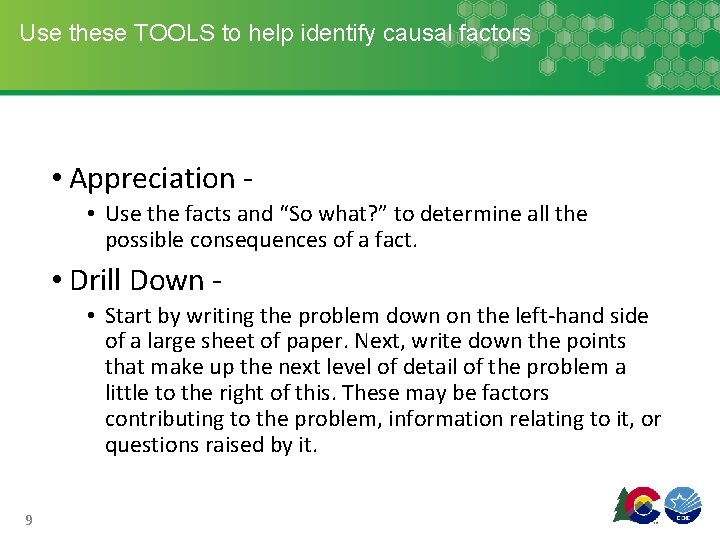
Use these TOOLS to help identify causal factors • Appreciation • Use the facts and “So what? ” to determine all the possible consequences of a fact. • Drill Down • Start by writing the problem down on the left-hand side of a large sheet of paper. Next, write down the points that make up the next level of detail of the problem a little to the right of this. These may be factors contributing to the problem, information relating to it, or questions raised by it. 9
RCA 10
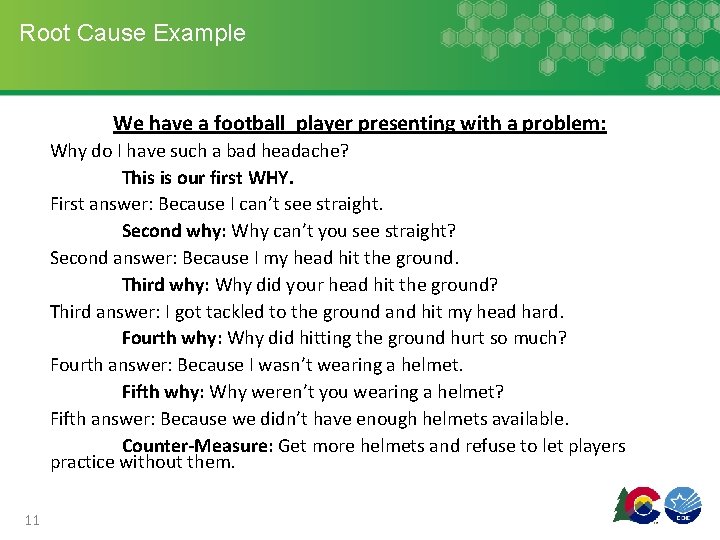
Root Cause Example We have a football player presenting with a problem: Why do I have such a bad headache? This is our first WHY. First answer: Because I can’t see straight. Second why: Why can’t you see straight? Second answer: Because I my head hit the ground. Third why: Why did your head hit the ground? Third answer: I got tackled to the ground and hit my head hard. Fourth why: Why did hitting the ground hurt so much? Fourth answer: Because I wasn’t wearing a helmet. Fifth why: Why weren’t you wearing a helmet? Fifth answer: Because we didn’t have enough helmets available. Counter-Measure: Get more helmets and refuse to let players practice without them. 11
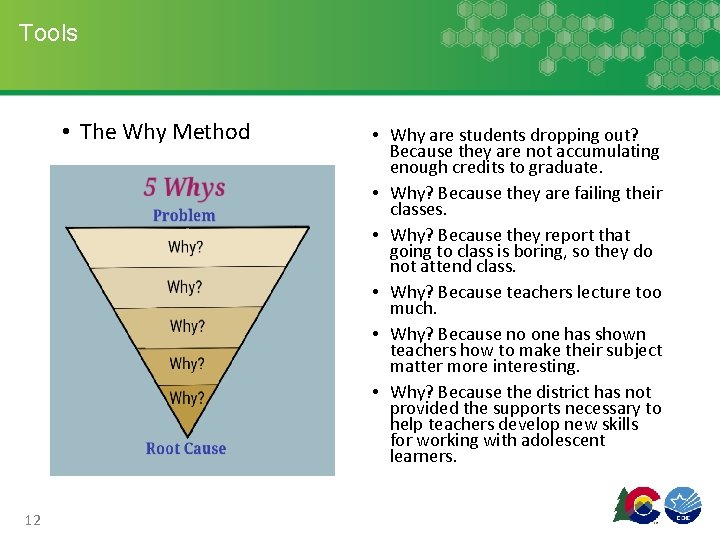
Tools • The Why Method 12 • Why are students dropping out? Because they are not accumulating enough credits to graduate. • Why? Because they are failing their classes. • Why? Because they report that going to class is boring, so they do not attend class. • Why? Because teachers lecture too much. • Why? Because no one has shown teachers how to make their subject matter more interesting. • Why? Because the district has not provided the supports necessary to help teachers develop new skills for working with adolescent learners.
List One Root Cause Use the chat box and list one root cause that you think you have in your program. Use any one of the tools to help you determine a root cause. - 13
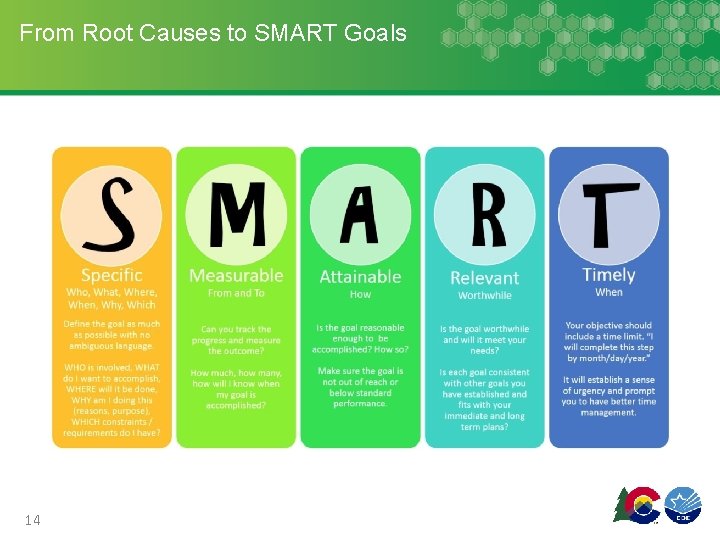
From Root Causes to SMART Goals 14
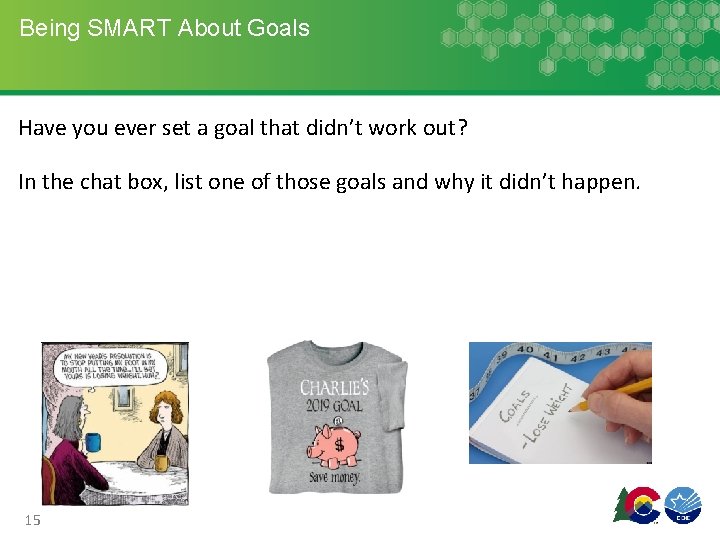
Being SMART About Goals Have you ever set a goal that didn’t work out? In the chat box, list one of those goals and why it didn’t happen. 15
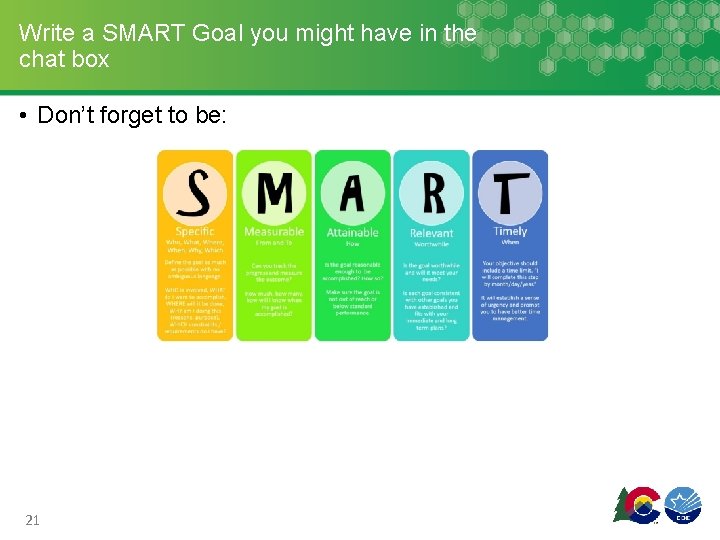
Characteristics of Effective Goals • Dissatisfaction with status quo • Goal acceptance and commitment • Goal Specificity - clearly articulates who, what, why, when, where, how • Conceivable and clearly understood • Measureable • Believable - I/We have what we need to succeed • Attainable • Degree of difficulty - high enough to encourage high performance yet still attainable • Lack of conflict with other important goals • Considering different ways to accomplish the goal • Persistence (despite demands and distractions) • Feedback about progress/effectiveness - Relevance • Timeline, deadlines, timebound 16
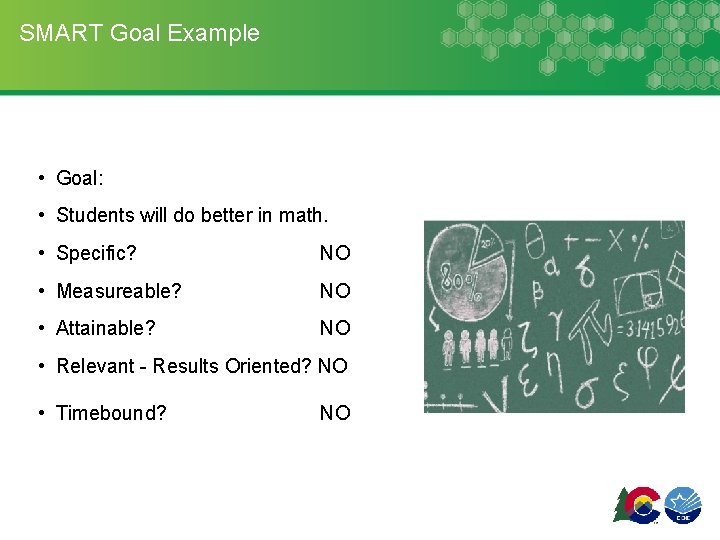
SMART Goal Example • Goal: • Students will do better in math. • Specific? NO • Measureable? NO • Attainable? NO • Relevant - Results Oriented? NO • Timebound? NO
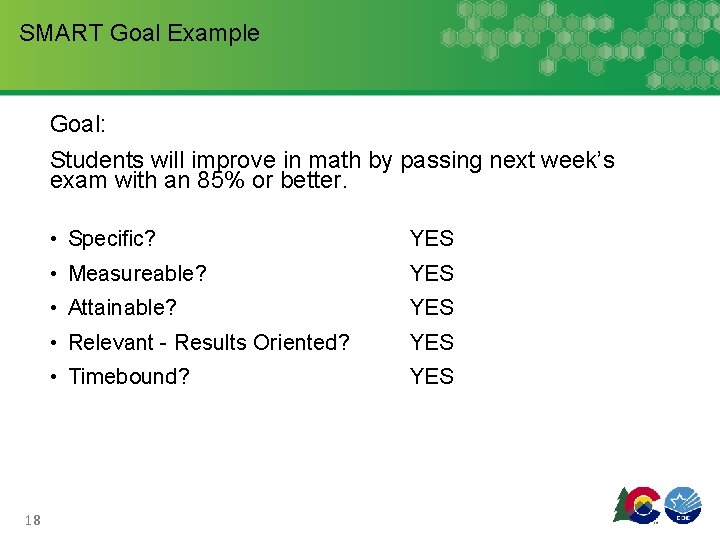
SMART Goal Example Goal: Students will improve in math by passing next week’s exam with an 85% or better. 18 • Specific? YES • Measureable? YES • Attainable? YES • Relevant - Results Oriented? YES • Timebound? YES
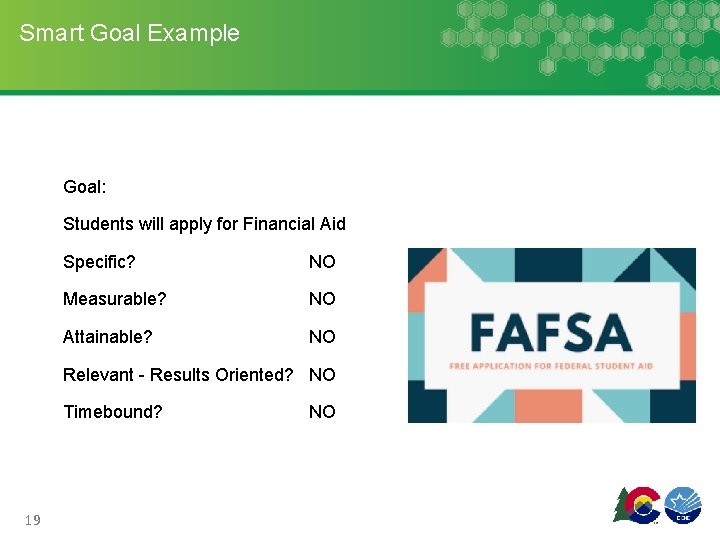
Smart Goal Example Goal: Students will apply for Financial Aid Specific? NO Measurable? NO Attainable? NO Relevant - Results Oriented? NO Timebound? 19 NO
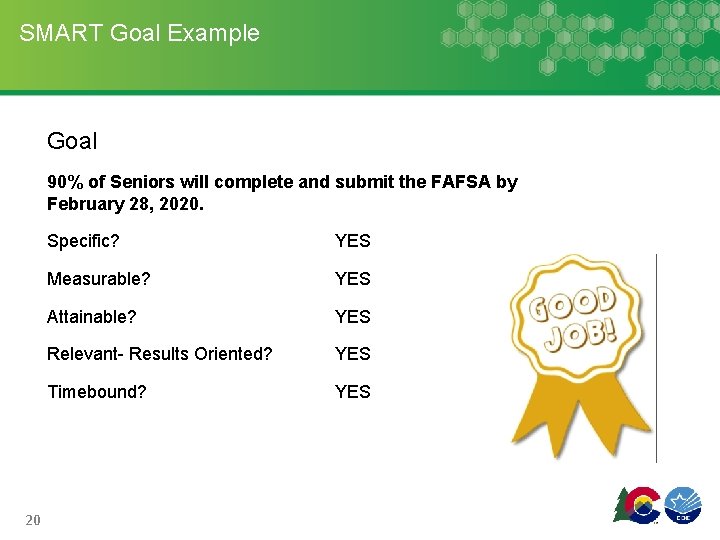
SMART Goal Example Goal 90% of Seniors will complete and submit the FAFSA by February 28, 2020. 20 Specific? YES Measurable? YES Attainable? YES Relevant- Results Oriented? YES Timebound? YES
Write a SMART Goal you might have in the chat box • Don’t forget to be: 21
How is your goal Specific? Write in chat box 22
How will you Measure it? Write in the chat box 23
How will you ACHIEVE it? Write in the chat box 24
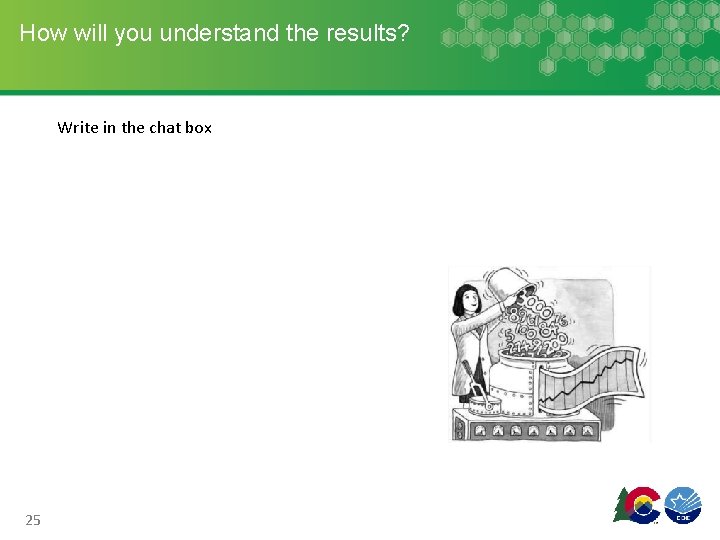
How will you understand the results? Write in the chat box 25
What is your timeline? Write in the chat box 26
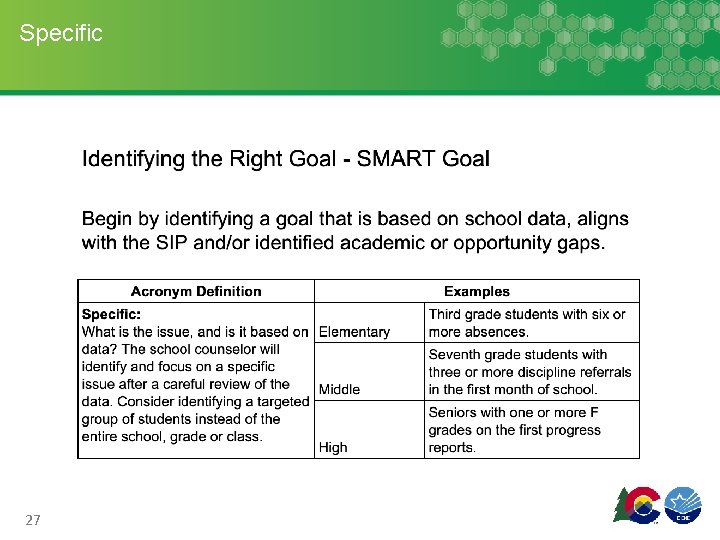
Specific 27
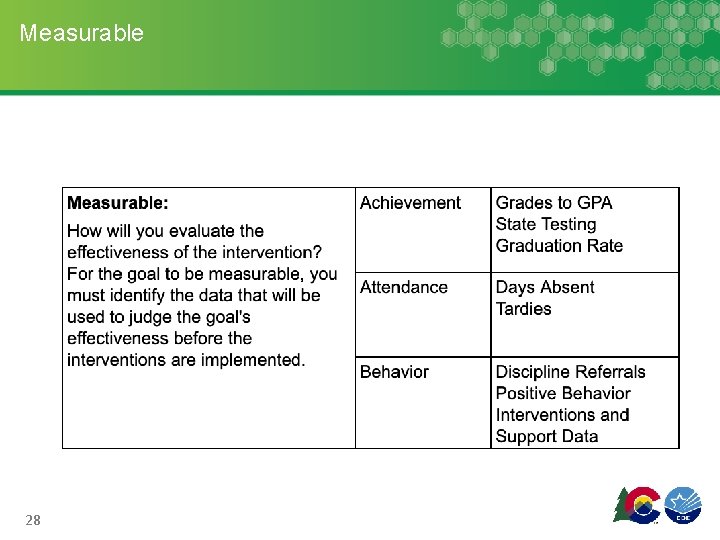
Measurable 28
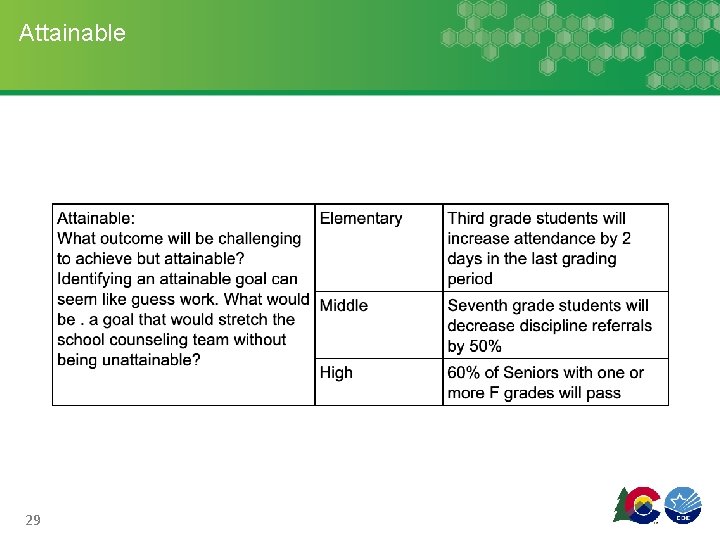
Attainable 29
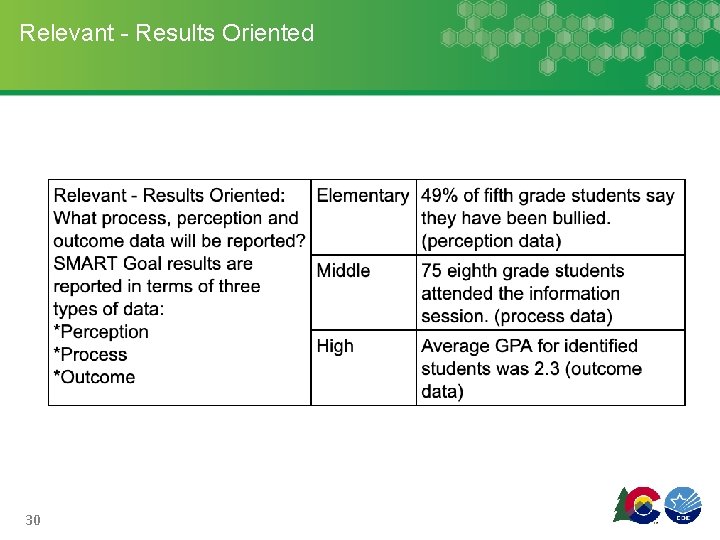
Relevant - Results Oriented 30
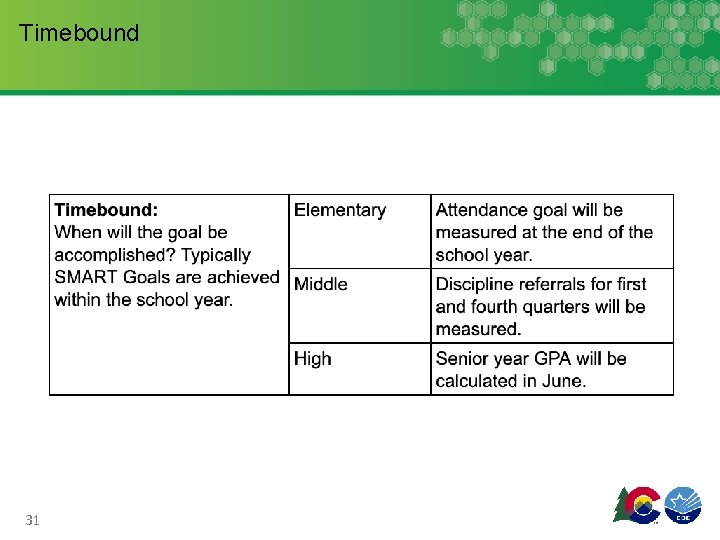
Timebound 31
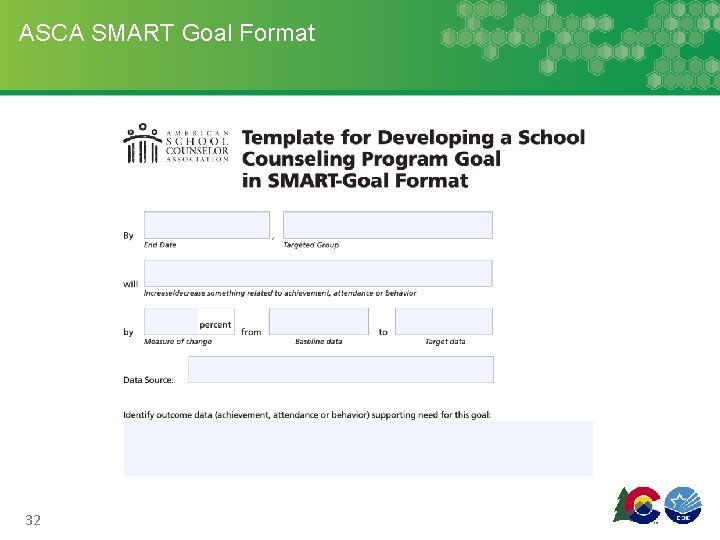
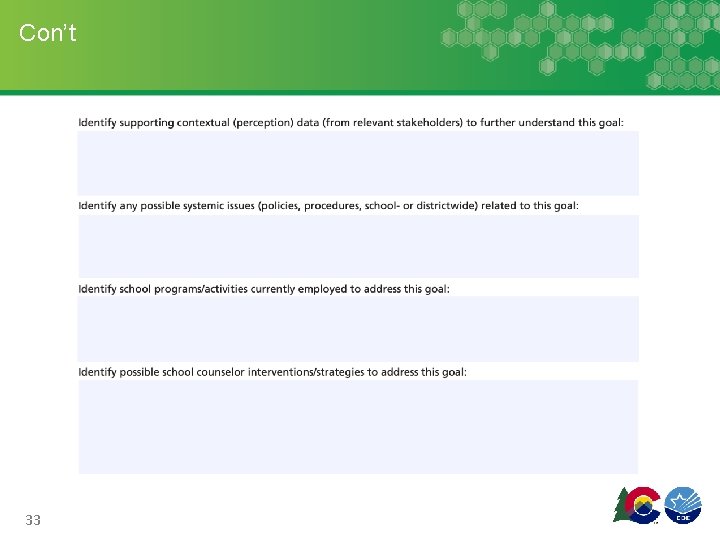
ASCA SMART Goal Format 32
Con’t 33
Tips for using the Template • If you cannot make your goal fit the template, perhaps you need to rethink the goal itself. • Be specific. Address one thing and one thing only in the goal. • Stretch. Aim a little high than you think you can reach. • Use your professional judgment for choosing an amount of change for desired end result. • Understand that it is more challenging to move whole school data vs. narrowly focused group data. 34
Thoughts • You will want to make sure your Counselor Corps Grant Goals align with the overarching goals of the school. • In what way can the school counseling program goals contribute in a meaningful way to the overall academic achievement of every student? • What data driven challenges are reasonable and appropriate to invest time, talent, and resources in? • If the goals selected are important only to the school counseling program, the impact of success on the quest for legitimacy and efforts to garner additional social capital are lost. • Be careful to limit goals to what might actually be accomplished. 35
Happy Holidays! 36