
ROOT CAUSE ANALYSIS BY Mohan Sabaratnam Director Quality
ROOT CAUSE ANALYSIS BY Mohan Sabaratnam Director, Quality and Accreditation
In Simple Terms • Root Cause can be described as that cause, which if it were controlled or eliminated would make the problem go away. 5/26/2021 Copyright 2014 2
What is Root Cause Analysis? • A system of problem solving which aims to identify the root causes of problems or incidents. • When a problem is identified, the tendency is to simply “fix the problem. ” This is necessary, but not sufficient under ISO/IEC 17025. • With “root cause analysis, ” the reason(s) the problem occurred in the first place are identified, so that these may also be addressed. • Goal of “root cause analysis” is to reduce the likelihood of recurrence of the problem. Reactive Proactive Approach to Quality Copyright 2016 3
Principles of Root Cause Analysis • Consider Costs/Benefits vs. Risks: Level of effort expended on root-cause analysis should align with the significance or severity of the incident. – Most incidents require only a scaled-down effort, while significant incidents should be investigated using one or more of the formal analytical models. – Usually not cost-effective to eliminate all risk. Focus on the one action that is most likely to correct the problem. • Root Cause Analysis identifies the “what, ” the “how, ” and the “why” associated with incidents that are investigated. • A successful Root Cause Analysis will identify the controllable, causal factors that can be corrected to reduce the chance of recurrence of similar incidents in the future. Copyright 2016 4
Root Cause Analysis in a QMS Phase 1 - Collecting of relevant data and information about an incident (failure event) Phase 2 – Root-Cause Analysis Ø What are the causes (conditions or actions) immediately preceding and surrounding the problem? Ø Identify the reasons why the causes existed, working back to the root causes (the fundamental reason which, if corrected, will reduce the odds of recurrence. Phase 3 - Correcting: Implementing effective corrective actions for each root cause. Phase 4 – Informing: Management and personnel involved with the incident should be informed of the results of any investigation. Phase 5 – Verifying: Verifying if corrective action has been effective in resolving the problem. Copyright 2016 5
ISO/IEC 17025 Requirements for Root Cause Analysis The laboratory shall establish a policy and procedure for implementing corrective action. The procedure for corrective action shall start with an investigation to determine the root cause(s) of the problem. APLAC TC 002 (9/10) – Internal Audits for Laboratories and Inspection Bodies: (Sec. 7. 3): The formal corrective action procedure may need to be followed to reveal the root causes of some problems and to implement effective corrective and preventive actions. Copyright 2016 6
Common Applications (ISO) • ISO/IEC 17025 (Testing and Calibration Laboratories) ü Complaints and Appeals (Sec. 4. 8) ü Nonconforming Tests (Sec. 4. 9) ü Corrective Actions (Sec. 4. 11 – Mandatory Root Cause Analysis) ü Internal Audit Findings (Sec. 4. 14) ü PT/ILC Outliers (Sec. 5. 9) • ISO/IEC 17020 (Inspection Bodies) ü Complaints and Appeals (Sec. 7. 5) ü Internal Audit Findings (Sec. 8. 6) ü Corrective Actions (Sec. 8. 7) ü impartiality and operational integrity in work? Copyright 2016 7
Principles of Root Cause Analysis • Must be performed systematically as an investigation ü Objective assessment – not assigning blame ü Broader input is best (not just one person) ü Not limited to fixing the identified problem ü “Dig deeper” – What are the reasons that this problem occurred? • Look closely at: ü Standards and procedures - personnel and equipment ü Are these incomplete or ambiguous? ü Can a written checklist be helpful? ü Is there a machine/automated solution for checking this? ü Training and qualifications of personnel • Document the process and findings! Copyright 2016 8
The 5 Steps of 5 Whys Invite anyone affected by the issue • Identify the problem or situation I • Invite anyone affected or noticed the issue to a 5 whys meeting Select a 5 Whys master for the meeting • 5 Whys master will lead the discussion • assign responsibility for the solutions • Record the notes of the meeting Note: No special qualifications to be a 5 Whys master Ask “why” 5 times • Dig at least 5 levels deep into the issue with 5 levels of “whys. ” • Discuss all potential paths • Picking one path to perform just the amount of corrective actions needed to solve a problem. • If the same problem seems to occur again, then choose another route. • Identify actionable steps that have been or will be taken. Assign responsibility for solutions • At the end of the exercise come up with 5 related “corrective actions” that all agree on. • Master assigns responsibility for the solutions to various participants in the discussion. Email the whole team the results • Notes are emailed to the whole team with the results. • This makes the team stay in the loop and understand any steps taken as a result of 5 Whys. • Sharing this information widely gives everyone insight into the kinds of problems and solutions the team is facing Copyright 2016 9
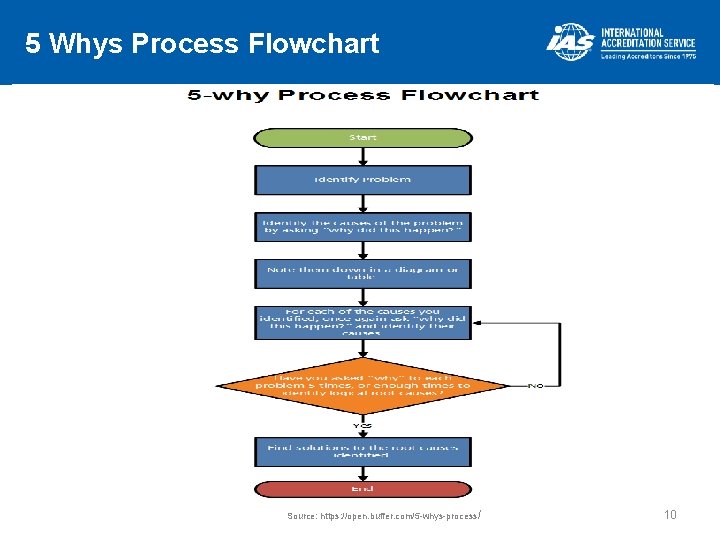
5 Whys Process Flowchart Source: https: //open. buffer. com/5 -whys-process/ 10
• Class Exercise 11
Analytical Models • Fishbone (Ishikawa) diagram: identifies many possible causes for an effect or problem and sorts ideas into useful categories. (Brainstorm) • Pareto chart: shows on a bar graph which factors are more significant. (Cause and Effect) • Scatter diagram: graphs pairs of numerical data, with one variable on each axis, to help you look for a relationship. (Trend Analysis) Source: http: //asq. org/learn-about-quality/cause-analysis-tools/overview. html Copyright 2016 12
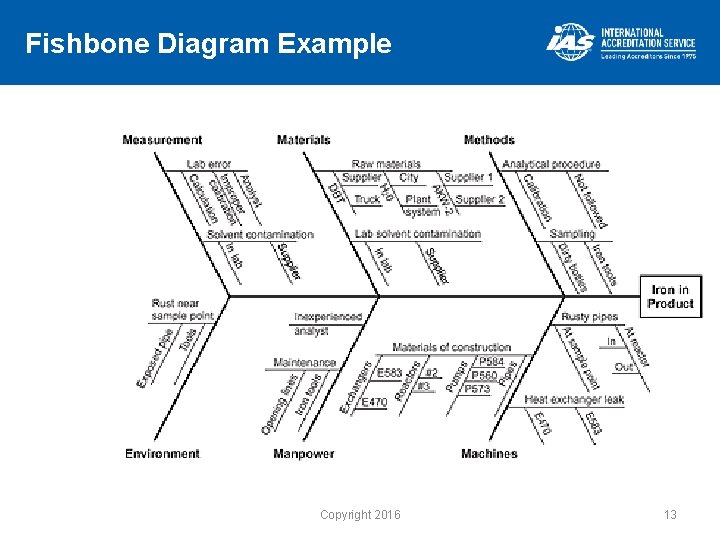
Fishbone Diagram Example Copyright 2016 13
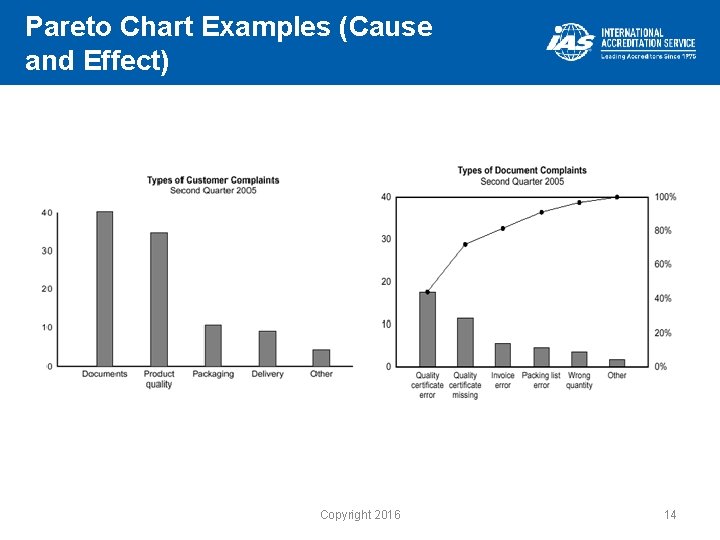
Pareto Chart Examples (Cause and Effect) Copyright 2016 14
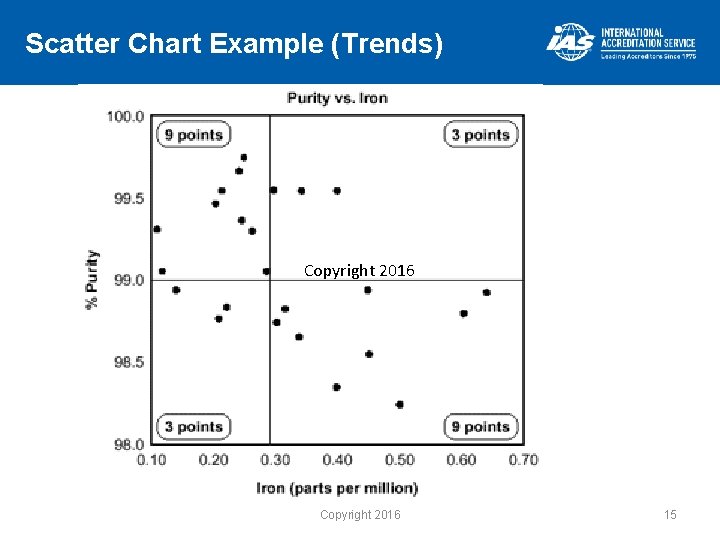
Scatter Chart Example (Trends) Copyright 2016 15
CONCLUSION Root Cause Analysis helps to solve difficult problems in our environment: • . . . investigate an accident or safety incident; • . . . eliminate waste and maximizes value; • . . . figure out why equipment keeps failing; • . . . prevent simple mistakes from becoming huge problems; • . . . increase the reliability and availability of your systems; • . . . understand how a problem occurred so you can make sure it never happens again; • … etc. • Root cause analysis is the answer for long term solutions. • Treats underlying factors that creates the problem in the first place. 5/26/2021 Copyright 2016 16
• Class Exercise 5/26/2021 Copyright 2016 17
- Slides: 17