
Root Cause Analysis 5 Whys Definition This is






- Slides: 16
Root Cause Analysis – 5 Whys
Definition • This is a simple but powerful tool for cutting quickly through the outward symptoms of a problem to reveal its underlying causes, so that you can deal with it once and for all. • The 5 Whys uses "counter-measures, " rather than "solutions. " A counter-measure is an action or set of actions that seeks to prevent the problem from arising again, while a solution may just seek to deal with the symptom. As such, counter-measures are more robust, and will more likely prevent the problem from recurring.
When To Use 5 Whys? • You can use 5 Whys for troubleshooting, quality improvement, and problem solving, but it is most effective when used to resolve simple or moderately difficult problems. • It may not be suitable if you need to tackle a complex or critical problem. This is because 5 Whys can lead you to pursue a single track, or a limited number of tracks, of inquiry when, in fact, there could be multiple causes.
How To Use the 5 Whys 1. Assemble a Team • Gather together people who are familiar with the specifics of the problem, and with the process that you're trying to fix. • Include someone to act as a facilitator, who can keep the team focused on identifying effective counter-measures.
2. Define the Problem • If you can, observe the problem in action. Discuss it with your team and write a brief, clear problem statement that you all agree on. • For example, "Team A isn't meeting its response time targets" or "Software release B resulted in too many rollback failures. " • Then, write your statement on a whiteboard or sticky note, leaving enough space around it to add your answers to the repeated question, "Why? "
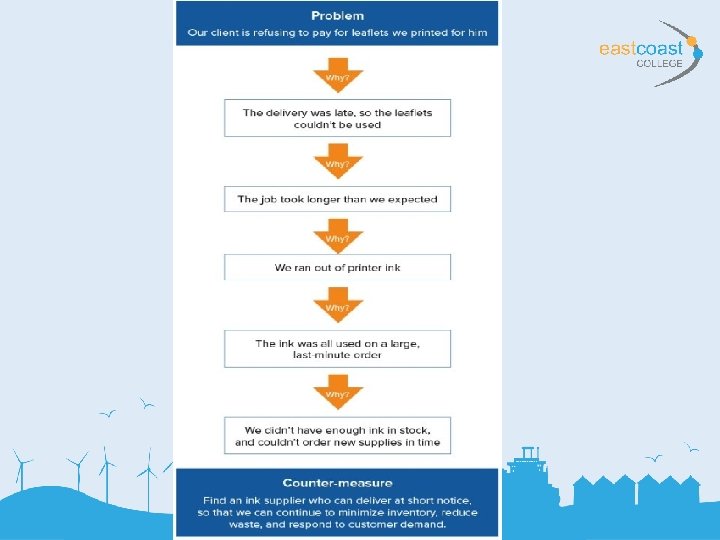
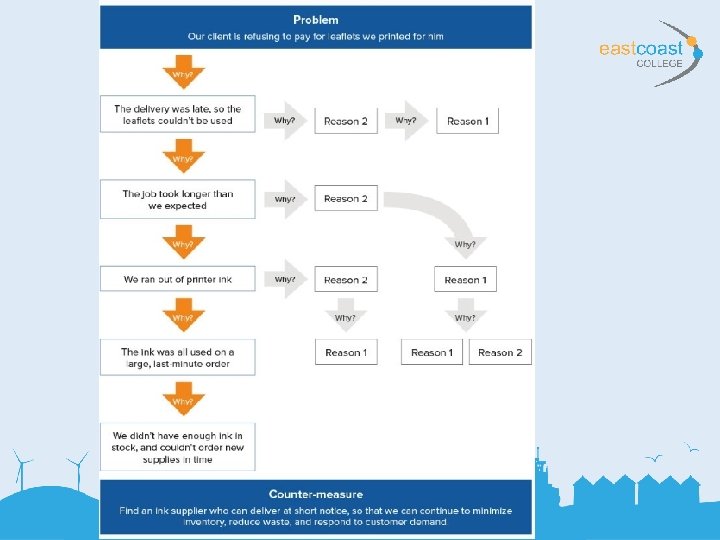
3. Ask the First ‘Why’ • Ask your team why the problem is occurring. (For example, "Why isn't Team A meeting its response time targets? ") • Asking "Why? " sounds simple, but answering it requires serious thought. Search for answers that are grounded in fact: they must be accounts of things that have actually happened, not guesses at what might have happened. • This prevents 5 Whys from becoming just a process of deductive reasoning, which can generate a large number of possible causes and, sometimes, create more confusion as you chase down hypothetical problems. • Your team members may come up with one obvious reason why, or several plausible ones. Record their answers as succinct phrases, rather than as single words or lengthy statements, and write them below (or beside) your problem statement. For example, saying "volume of calls is too high" is better than a vague "overloaded. "
4. Ask ‘Why’ x 4 More • For each of the answers that you generated in Step 3, ask four further "whys" in succession. • Each time, frame the question in response to the answer you've just recorded.
5. Know When to Stop • You'll know that you've revealed the root cause of the problem when asking "why" produces no more useful responses, and you can go no further. An appropriate counter-measure or process change should then become evident. • If you identified more than one reason in Step 3, repeat this process for each of the different branches of your analysis until you reach a root cause for each one.
6. Address the Root Cause(s) • Now that you've identified at least one root cause, you need to discuss and agree on the countermeasures that will prevent the problem from recurring.
7. Monitor Your Measures • Keep a close watch on how effectively your counter -measures eliminate or minimize the initial problem. You may need to amend them, or replace them entirely. If this happens, it's a good idea to repeat the 5 Whys process to ensure that you've identified the correct root cause.