
ROOT 4 STAR a ROOT based framework for
ROOT 4 STAR: a ROOT based framework for user analysis and data mining Jérôme Lauret - jlauret@bnl. gov Jerome Lauret – ROOT Workshop 2005, CERN, CH
Introduction l This should really have been a talk with a title such as “How ROOT helps an experiment with its data taking and analysis – Real life experience from PBytes experiments” l ROOT is HEAVILY used in RHIC/STAR ¡ ¡ In fact, all RHIC experiments use it It is used to build frameworks for standard or distributed computing It is versatile enough to allow developments (Qt. Root, …) It is stable enough that we use it from online to offline … But before more ROOT commercials … Jerome Lauret – ROOT Workshop 2005, CERN, CH
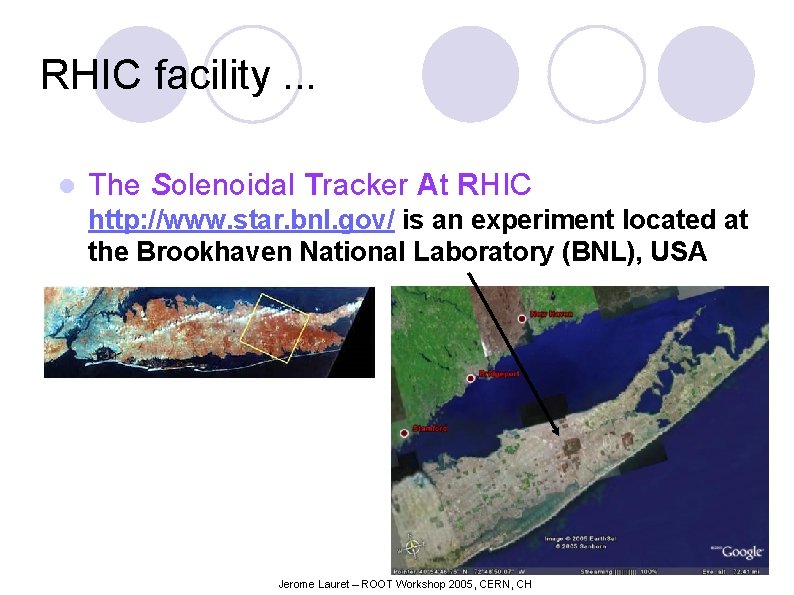
RHIC facility. . . l The Solenoidal Tracker At RHIC http: //www. star. bnl. gov/ is an experiment located at the Brookhaven National Laboratory (BNL), USA Jerome Lauret – ROOT Workshop 2005, CERN, CH
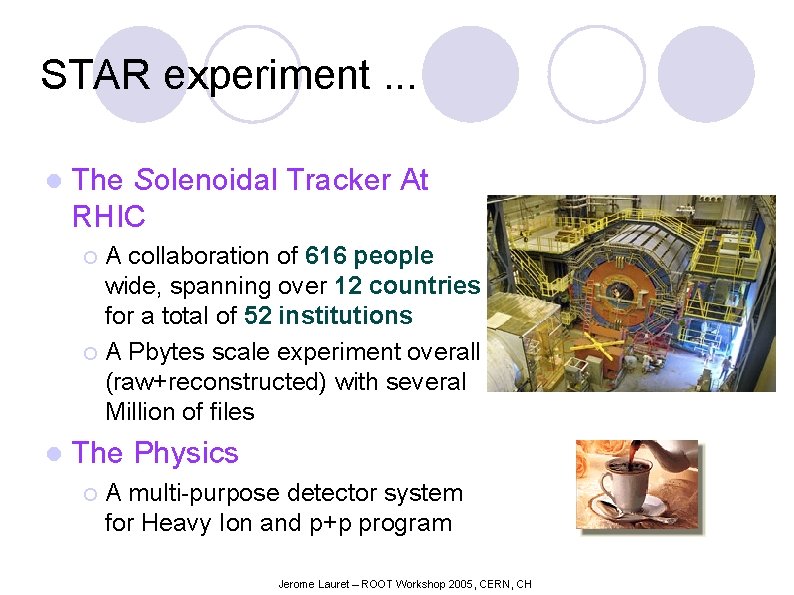
STAR experiment. . . l The Solenoidal Tracker At RHIC A collaboration of 616 people wide, spanning over 12 countries for a total of 52 institutions ¡ A Pbytes scale experiment overall (raw+reconstructed) with several Million of files ¡ l The Physics ¡ A multi-purpose detector system for Heavy Ion and p+p program Jerome Lauret – ROOT Workshop 2005, CERN, CH
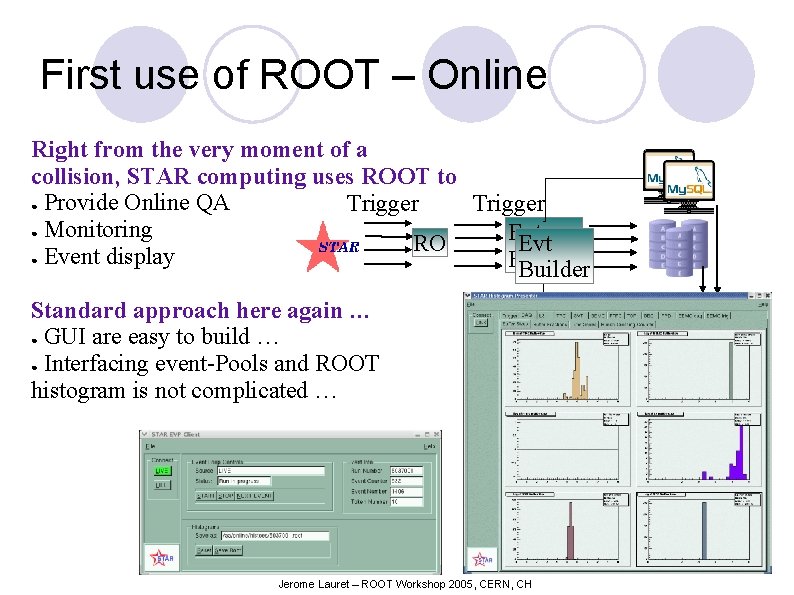
First use of ROOT – Online Right from the very moment of a collision, STAR computing uses ROOT to ● Provide Online QA Trigger ● Monitoring Evt RO Evt ● Event display Builder Standard approach here again … ● GUI are easy to build … ● Interfacing event-Pools and ROOT histogram is not complicated … Jerome Lauret – ROOT Workshop 2005, CERN, CH
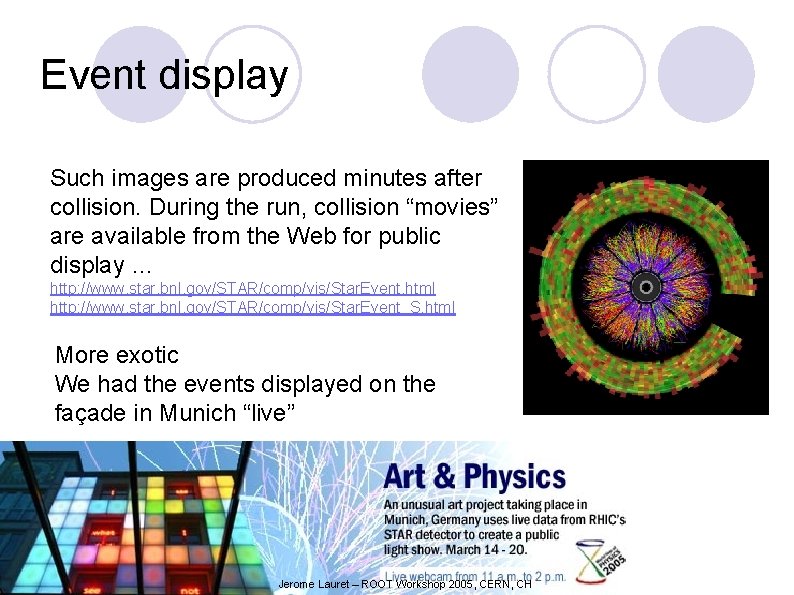
Event display Such images are produced minutes after collision. During the run, collision “movies” are available from the Web for public display … http: //www. star. bnl. gov/STAR/comp/vis/Star. Event. html http: //www. star. bnl. gov/STAR/comp/vis/Star. Event_S. html More exotic We had the events displayed on the façade in Munich “live” Jerome Lauret – ROOT Workshop 2005, CERN, CH
The Offline STAR framework Jerome Lauret – ROOT Workshop 2005, CERN, CH
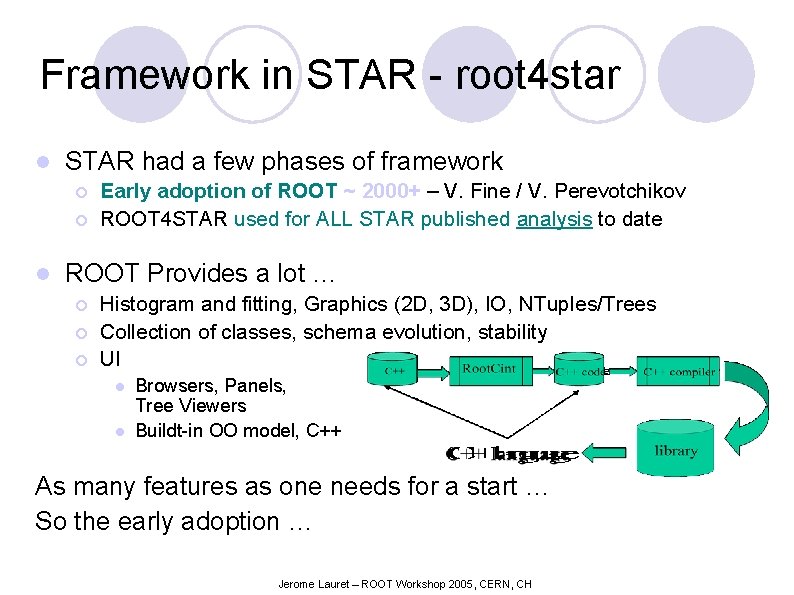
Framework in STAR - root 4 star l STAR had a few phases of framework ¡ ¡ l Early adoption of ROOT ~ 2000+ – V. Fine / V. Perevotchikov ROOT 4 STAR used for ALL STAR published analysis to date ROOT Provides a lot … ¡ ¡ ¡ Histogram and fitting, Graphics (2 D, 3 D), IO, NTuples/Trees Collection of classes, schema evolution, stability UI l l Browsers, Panels, Tree Viewers Buildt-in OO model, C++ As many features as one needs for a start … So the early adoption … Jerome Lauret – ROOT Workshop 2005, CERN, CH
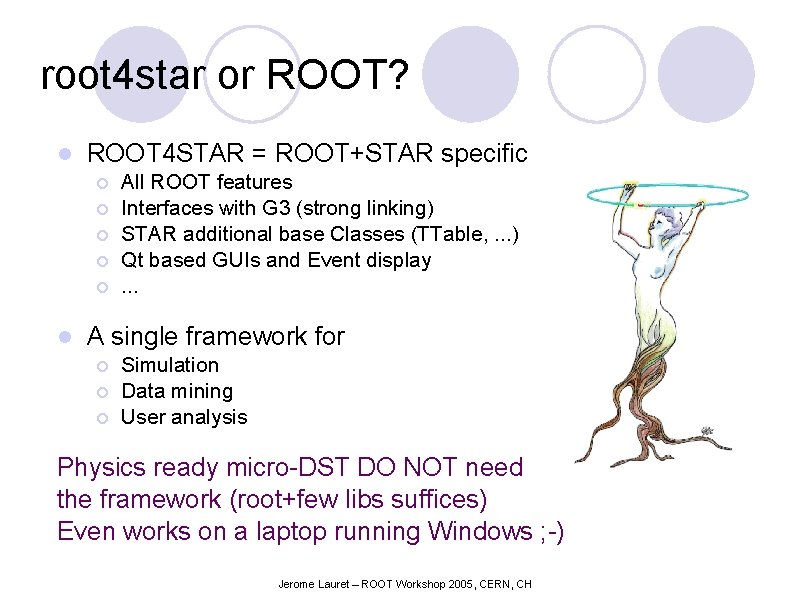
root 4 star or ROOT? l ROOT 4 STAR = ROOT+STAR specific ¡ ¡ ¡ l All ROOT features Interfaces with G 3 (strong linking) STAR additional base Classes (TTable, . . . ) Qt based GUIs and Event display. . . A single framework for ¡ ¡ ¡ Simulation Data mining User analysis Physics ready micro-DST DO NOT need the framework (root+few libs suffices) Even works on a laptop running Windows ; -) Jerome Lauret – ROOT Workshop 2005, CERN, CH
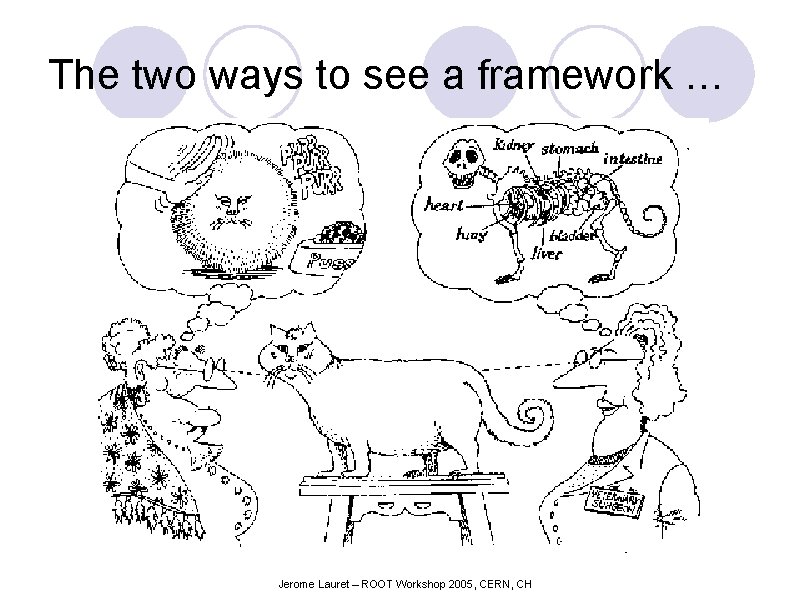
The two ways to see a framework … Jerome Lauret – ROOT Workshop 2005, CERN, CH
In real life (hopefully the user end) l The STAR code is ¡ Codes deriving from a base class St. Maker l l l ¡ ¡ A hierarchical collection of STAR Makers handling data-sets A single instance of a “chain”, a “steering” component l l l Arranged into libraries, blocks are components Makers are loaded via dynamic libraries User can start from template example All dependencies in one another sorted NO NEED TO KNOW from users A few special makers ¡ ¡ ¡ IOMaker, handles all IO - Persistent event model St. Event Messenger manages all messages (do not prevent cout / printf) DBMaker manages transparently all DB related access (event timestamp based) Jerome Lauret – ROOT Workshop 2005, CERN, CH
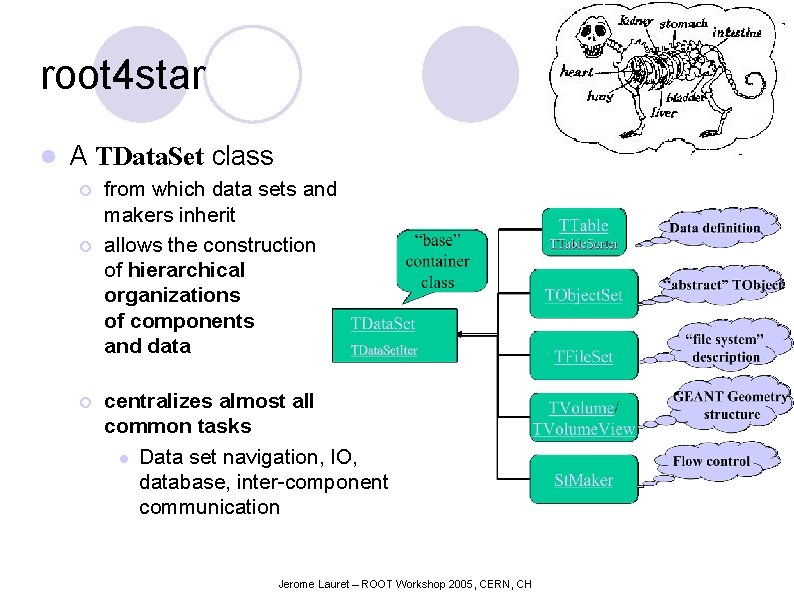
root 4 star l A TData. Set class ¡ ¡ ¡ from which data sets and makers inherit allows the construction of hierarchical organizations of components and data centralizes almost all common tasks l Data set navigation, IO, database, inter-component communication Jerome Lauret – ROOT Workshop 2005, CERN, CH
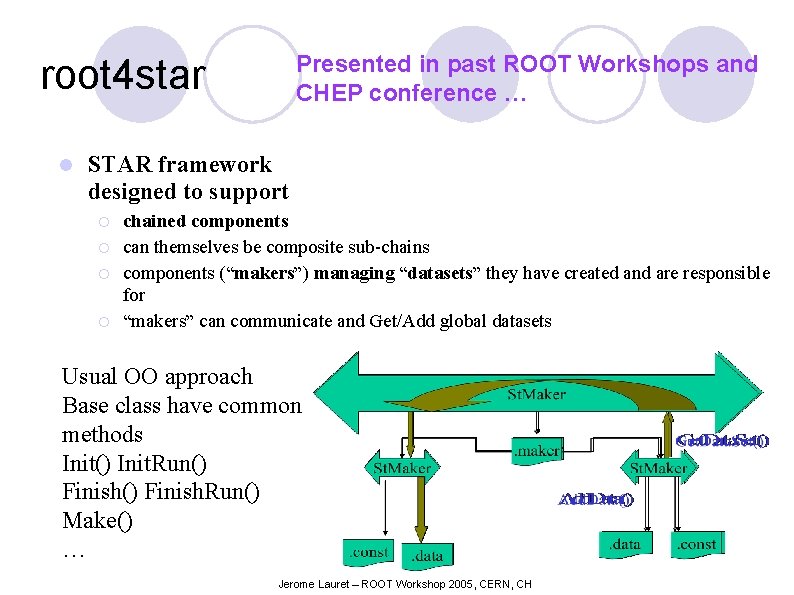
Presented in past ROOT Workshops and CHEP conference … root 4 star l STAR framework designed to support ¡ ¡ chained components can themselves be composite sub-chains components (“makers”) managing “datasets” they have created and are responsible for “makers” can communicate and Get/Add global datasets Usual OO approach Base class have common methods Init() Init. Run() Finish. Run() Make() … Jerome Lauret – ROOT Workshop 2005, CERN, CH
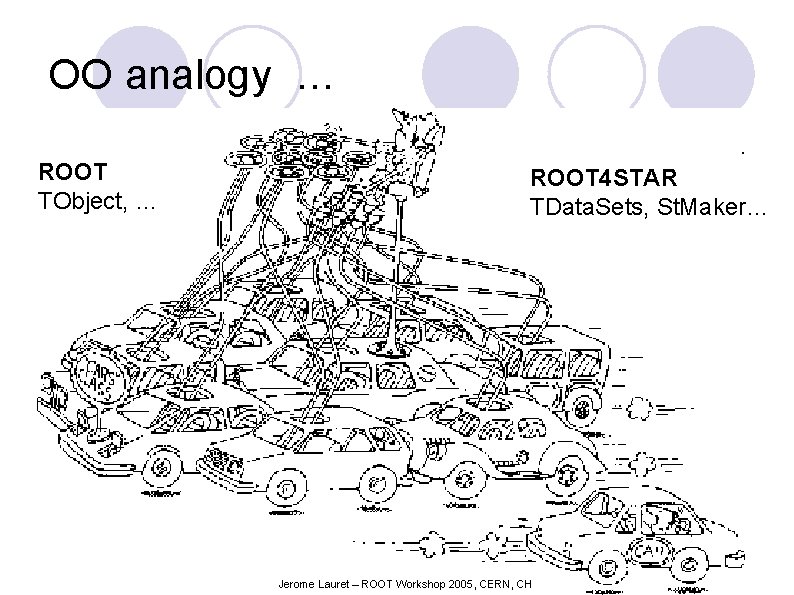
OO analogy … ROOT TObject, … ROOT 4 STAR TData. Sets, St. Maker… Jerome Lauret – ROOT Workshop 2005, CERN, CH
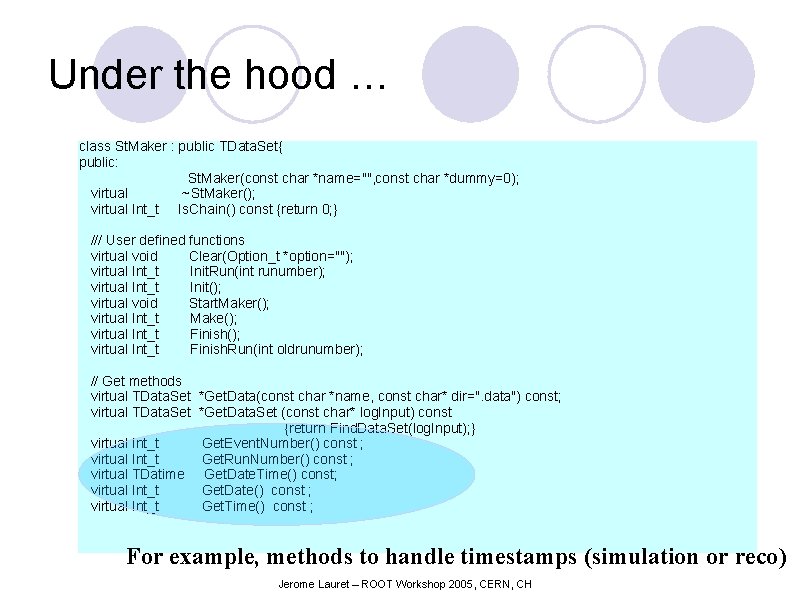
Under the hood … class St. Maker : public TData. Set{ public: St. Maker(const char *name="", const char *dummy=0); virtual ~St. Maker(); virtual Int_t Is. Chain() const {return 0; } /// User defined functions virtual void Clear(Option_t *option=""); virtual Int_t Init. Run(int runumber); virtual Int_t Init(); virtual void Start. Maker(); virtual Int_t Make(); virtual Int_t Finish. Run(int oldrunumber); // Get methods virtual TData. Set *Get. Data(const char *name, const char* dir=". data") const; virtual TData. Set *Get. Data. Set (const char* log. Input) const {return Find. Data. Set(log. Input); } virtual Int_t Get. Event. Number() const ; virtual Int_t Get. Run. Number() const ; virtual TDatime Get. Date. Time() const; virtual Int_t Get. Date() const ; virtual Int_t Get. Time() const ; … For example, methods to handle timestamps (simulation or reco) Jerome Lauret – ROOT Workshop 2005, CERN, CH
Why ROOT 4 STAR instead of ROOT? Good question … l In principle, we are (were) only tight to G 3 l Evaluated VMC approach ¡ ¡ Got rid of legacy codes using (yes ) c-blocks Introduced TGeo based geometry l l ¡ Shaping a common IO model for data / simulation l l l Currently made using g 2 root from G 3 Geo comparison evaluated – seems to do VMC means we retire our FZ format New model was already there … We will have news by CHEP 06 Jerome Lauret – ROOT Workshop 2005, CERN, CH
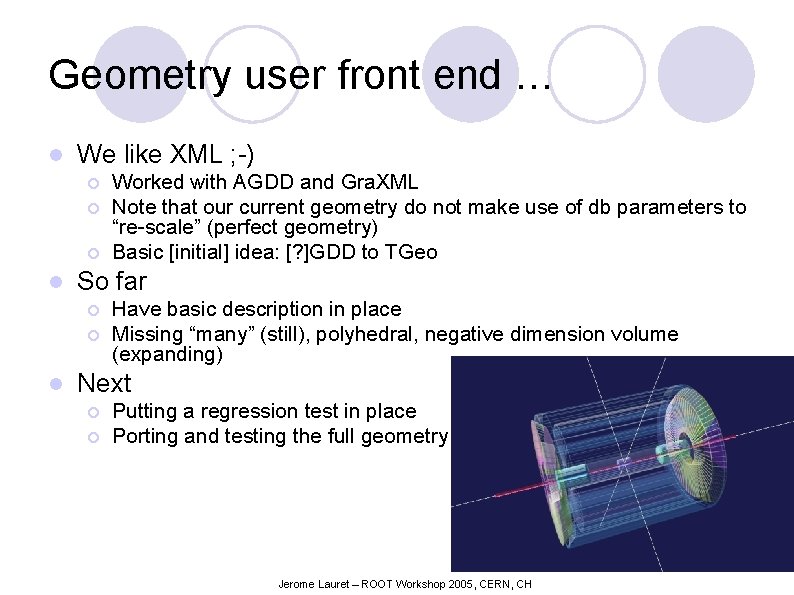
Geometry user front end … l We like XML ; -) ¡ ¡ ¡ l So far ¡ ¡ l Worked with AGDD and Gra. XML Note that our current geometry do not make use of db parameters to “re-scale” (perfect geometry) Basic [initial] idea: [? ]GDD to TGeo Have basic description in place Missing “many” (still), polyhedral, negative dimension volume (expanding) Next ¡ ¡ Putting a regression test in place Porting and testing the full geometry Jerome Lauret – ROOT Workshop 2005, CERN, CH
The Offline STAR data & model Jerome Lauret – ROOT Workshop 2005, CERN, CH
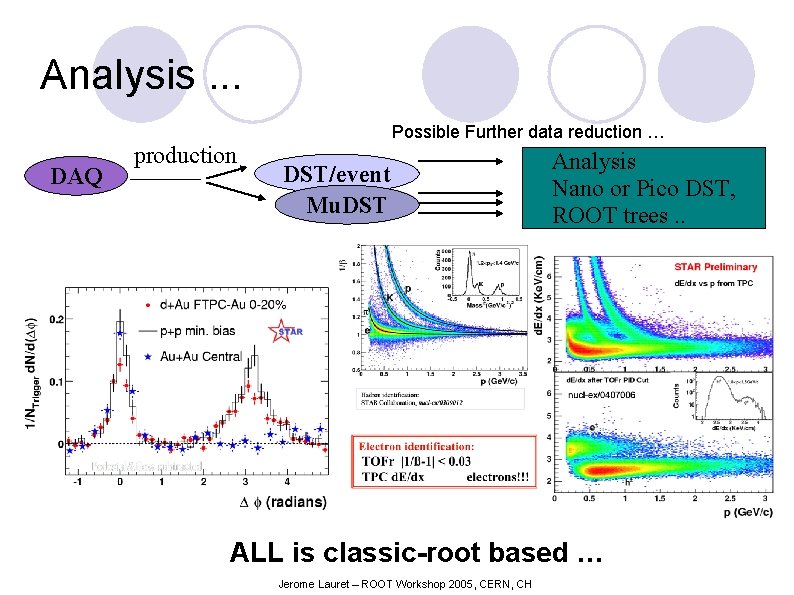
Analysis. . . DAQ production Possible Further data reduction … DST/event Mu. DST Analysis Nano or Pico DST, ROOT trees. . ALL is classic-root based … Jerome Lauret – ROOT Workshop 2005, CERN, CH
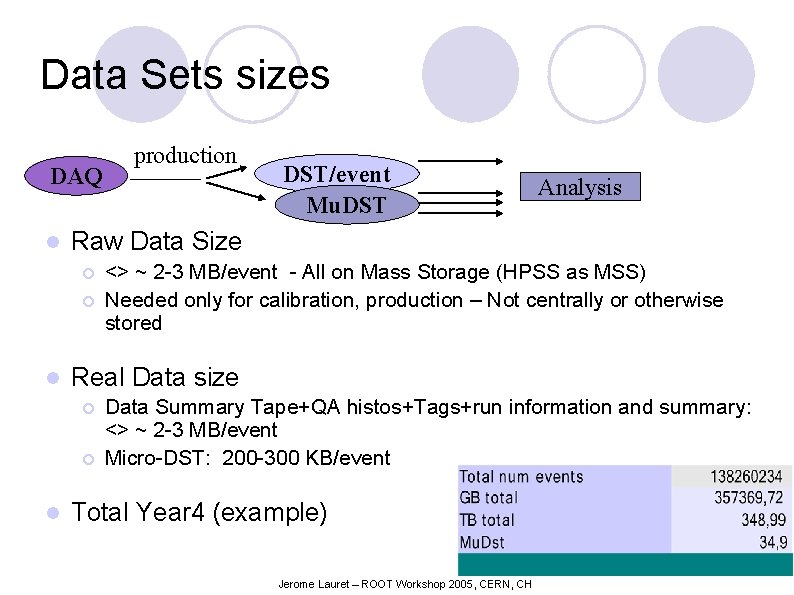
Data Sets sizes DAQ l ¡ Analysis <> ~ 2 -3 MB/event - All on Mass Storage (HPSS as MSS) Needed only for calibration, production – Not centrally or otherwise stored Real Data size ¡ ¡ l DST/event Mu. DST Raw Data Size ¡ l production Data Summary Tape+QA histos+Tags+run information and summary: <> ~ 2 -3 MB/event Micro-DST: 200 -300 KB/event Total Year 4 (example) Jerome Lauret – ROOT Workshop 2005, CERN, CH
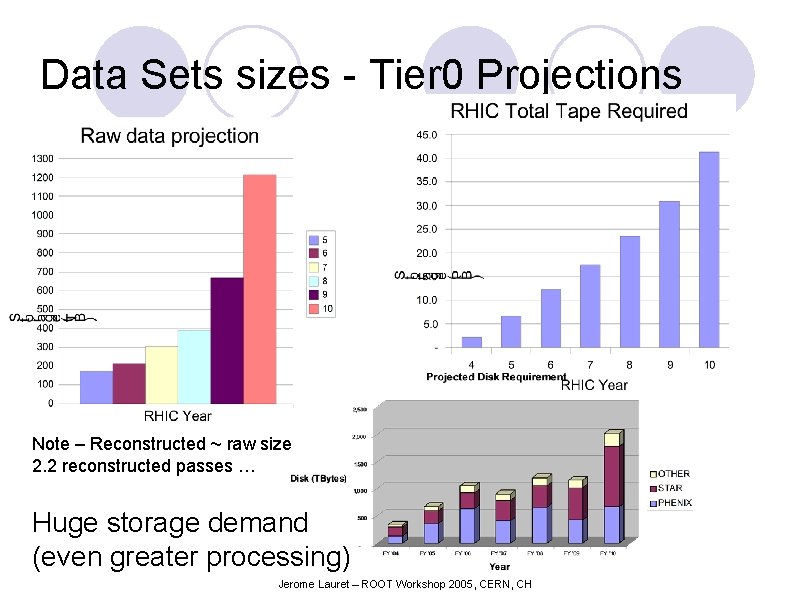
Data Sets sizes - Tier 0 Projections Note – Reconstructed ~ raw size 2. 2 reconstructed passes … Huge storage demand (even greater processing) Jerome Lauret – ROOT Workshop 2005, CERN, CH
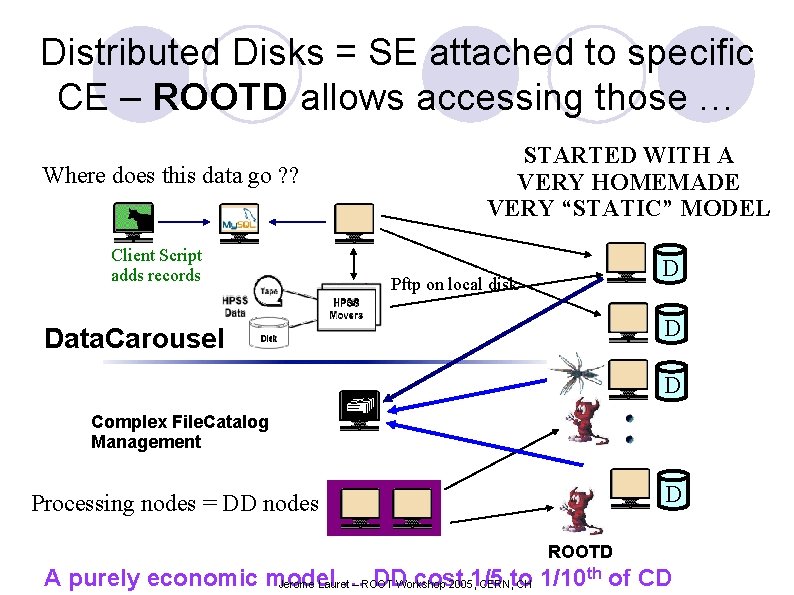
Distributed Disks = SE attached to specific CE – ROOTD allows accessing those … Where does this data go ? ? Client Script adds records STARTED WITH A VERY HOMEMADE VERY “STATIC” MODEL D Pftp on local disk D Data. Carousel D Complex File. Catalog Management D Processing nodes = DD nodes ROOTD th of CD A purely economic model … DDWorkshop cost 1/5 Jerome Lauret – ROOT 2005, CERN, to CH 1/10
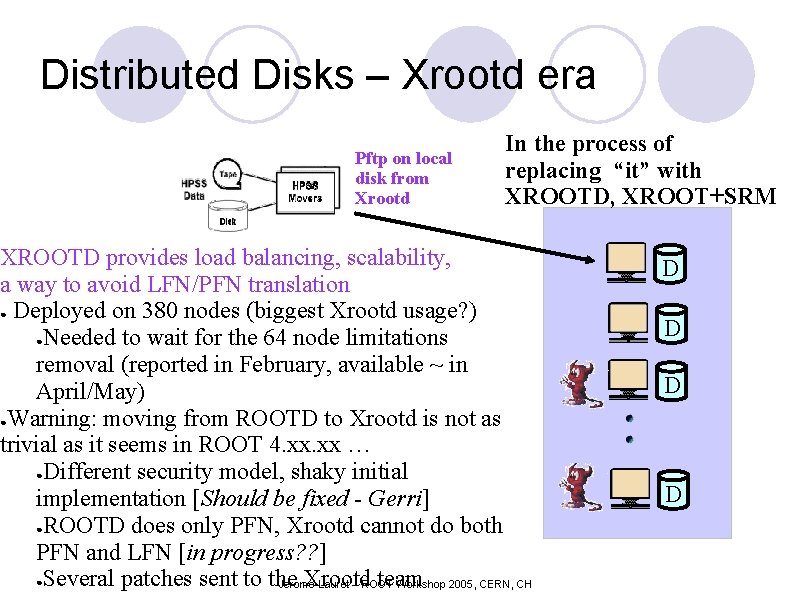
Distributed Disks – Xrootd era Pftp on local disk from Xrootd In the process of replacing “it” with XROOTD, XROOT+SRM XROOTD provides load balancing, scalability, a way to avoid LFN/PFN translation ● Deployed on 380 nodes (biggest Xrootd usage? ) ●Needed to wait for the 64 node limitations removal (reported in February, available ~ in April/May) ●Warning: moving from ROOTD to Xrootd is not as trivial as it seems in ROOT 4. xx … ●Different security model, shaky initial implementation [Should be fixed - Gerri] ●ROOTD does only PFN, Xrootd cannot do both PFN and LFN [in progress? ? ] ●Several patches sent to the Xrootd team Jerome Lauret – ROOT Workshop 2005, CERN, CH D D
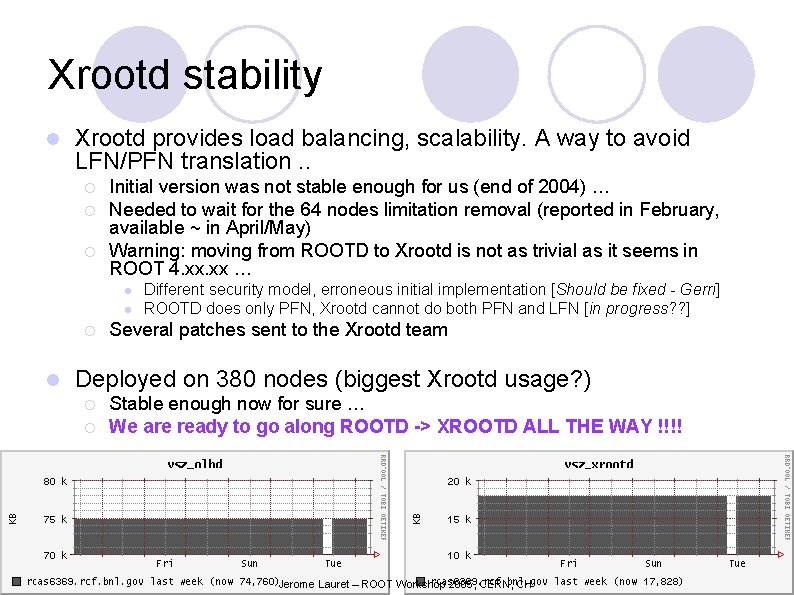
Xrootd stability l Xrootd provides load balancing, scalability. A way to avoid LFN/PFN translation. . ¡ ¡ ¡ Initial version was not stable enough for us (end of 2004) … Needed to wait for the 64 nodes limitation removal (reported in February, available ~ in April/May) Warning: moving from ROOTD to Xrootd is not as trivial as it seems in ROOT 4. xx … l l ¡ l Different security model, erroneous initial implementation [Should be fixed - Gerri] ROOTD does only PFN, Xrootd cannot do both PFN and LFN [in progress? ? ] Several patches sent to the Xrootd team Deployed on 380 nodes (biggest Xrootd usage? ) ¡ ¡ Stable enough now for sure … We are ready to go along ROOTD -> XROOTD ALL THE WAY !!!! Jerome Lauret – ROOT Workshop 2005, CERN, CH
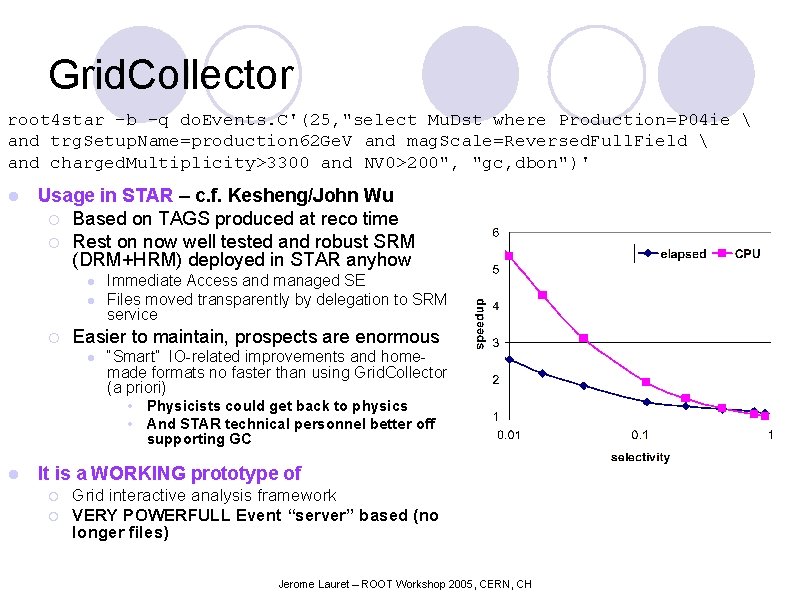
Grid. Collector root 4 star -b -q do. Events. C'(25, "select Mu. Dst where Production=P 04 ie and trg. Setup. Name=production 62 Ge. V and mag. Scale=Reversed. Full. Field and charged. Multiplicity>3300 and NV 0>200", "gc, dbon")' l Usage in STAR – c. f. Kesheng/John Wu ¡ Based on TAGS produced at reco time ¡ Rest on now well tested and robust SRM (DRM+HRM) deployed in STAR anyhow l l ¡ Immediate Access and managed SE Files moved transparently by delegation to SRM service Easier to maintain, prospects are enormous l “Smart” IO-related improvements and homemade formats no faster than using Grid. Collector (a priori) • Physicists could get back to physics • And STAR technical personnel better off supporting GC l It is a WORKING prototype of ¡ ¡ Grid interactive analysis framework VERY POWERFULL Event “server” based (no longer files) Jerome Lauret – ROOT Workshop 2005, CERN, CH
Summary l Is ROOT great ? ? ¡ ¡ I think it fair to say YES Fair to mention that I had at maximum 4 “major” issues in 4 years (resolved within 24 hours, special thanks to Philippe, Rene, …) l ¡ l Outstanding support and outstanding team Fait to say that it provided all features needed for data processing, framework, analysis, … Could it be better ? Always … ¡ We need more display capabilities l l ¡ Qt like work important (to us and other efforts like QScan, …) Geometry work (Andrei, …) should be a priority … We need MORE distributed computing aware capabilities / Grid l l l Managing SE (Xrootd, perhaps Grid. Collector …) Managing CE, … Ideally, event based a-la-Grid. Collector is necessary (in the plans? ) Jerome Lauret – ROOT Workshop 2005, CERN, CH
- Slides: 26