
RoomTemperature Semiconductors From concepts to applications Zhong He

- Slides: 26
Room-Temperature Semiconductors: From concepts to applications Zhong He Nuclear Engineering and Radiological Sciences Department The University of Michigan, Ann Arbor, Michigan August 19 th, 2011, Beijing Summer School
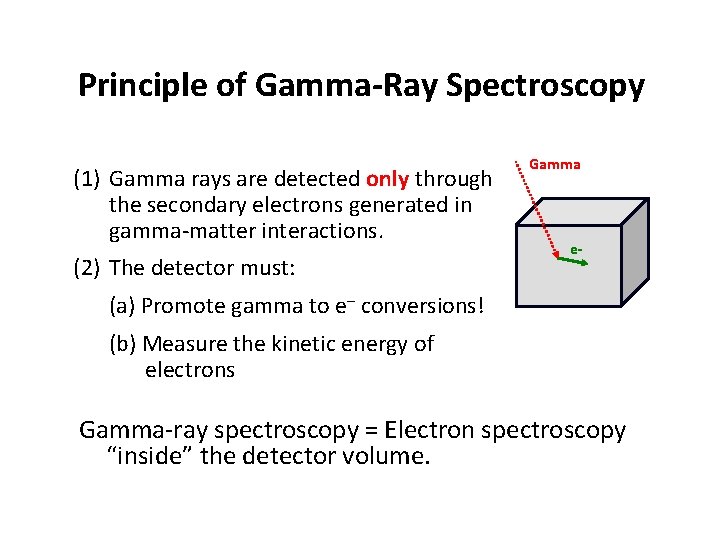
Principle of Gamma-Ray Spectroscopy (1) Gamma rays are detected only through the secondary electrons generated in gamma-matter interactions. (2) The detector must: Gamma e- (a) Promote gamma to e– conversions! (b) Measure the kinetic energy of electrons Gamma-ray spectroscopy = Electron spectroscopy “inside” the detector volume.
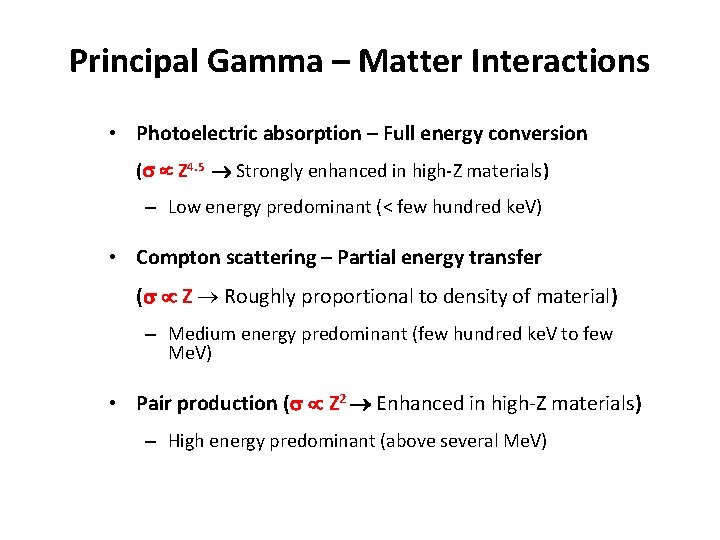
Principal Gamma – Matter Interactions • Photoelectric absorption – Full energy conversion ( Z 4. 5 Strongly enhanced in high-Z materials) – Low energy predominant (< few hundred ke. V) • Compton scattering – Partial energy transfer ( Z Roughly proportional to density of material) – Medium energy predominant (few hundred ke. V to few Me. V) • Pair production ( Z 2 Enhanced in high-Z materials) – High energy predominant (above several Me. V)
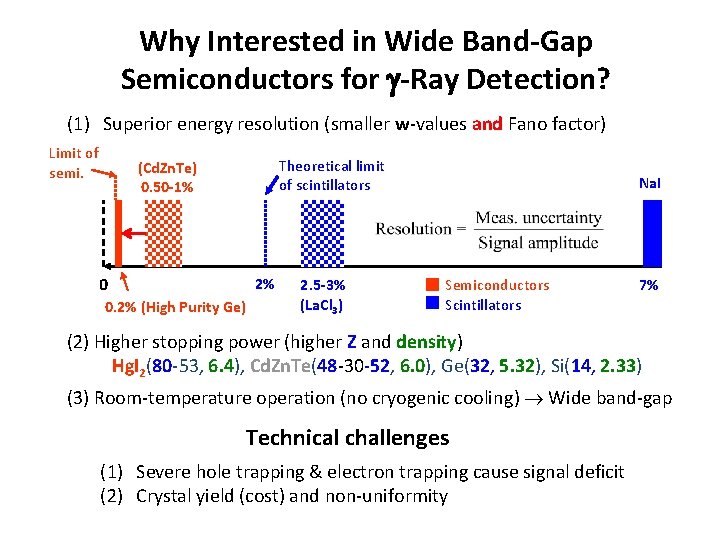
Why Interested in Wide Band-Gap Semiconductors for -Ray Detection? (1) Superior energy resolution (smaller w-values and Fano factor) Limit of semi. Theoretical limit of scintillators (Cd. Zn. Te) 0. 50 -1% 0 0. 2% (High Purity Ge) 2% 2. 5 -3% (La. Cl 3) Na. I Semiconductors Scintillators 7% (2) Higher stopping power (higher Z and density) Hg. I 2(80 -53, 6. 4), Cd. Zn. Te(48 -30 -52, 6. 0), Ge(32, 5. 32), Si(14, 2. 33) (3) Room-temperature operation (no cryogenic cooling) Wide band-gap Technical challenges (1) Severe hole trapping & electron trapping cause signal deficit (2) Crystal yield (cost) and non-uniformity
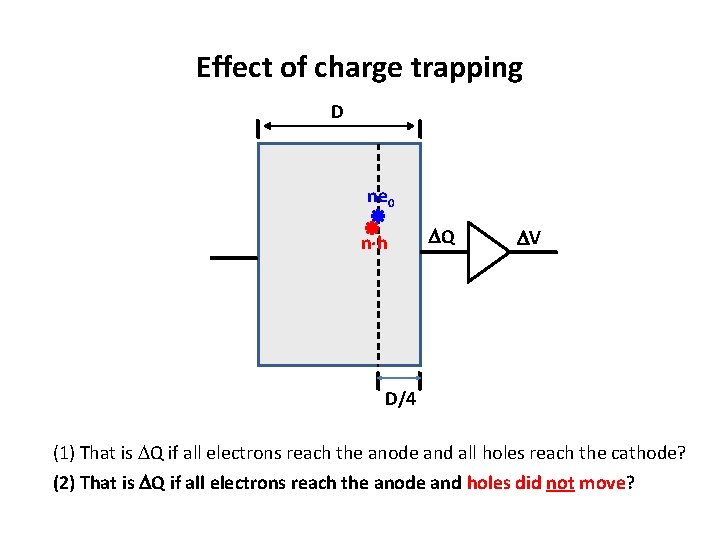
Effect of charge trapping D ne 0 n h Q V D/4 (1) That is Q if all electrons reach the anode and all holes reach the cathode? (2) That is Q if all electrons reach the anode and holes did not move?
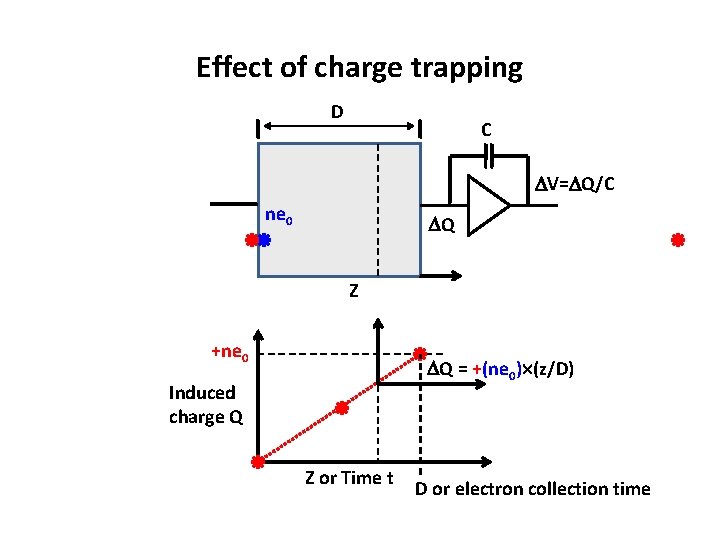
Effect of charge trapping D C V= Q/C ne 0 Q Z +ne 0 Q = +(ne 0) (z/D) Induced charge Q Z or Time t D or electron collection time
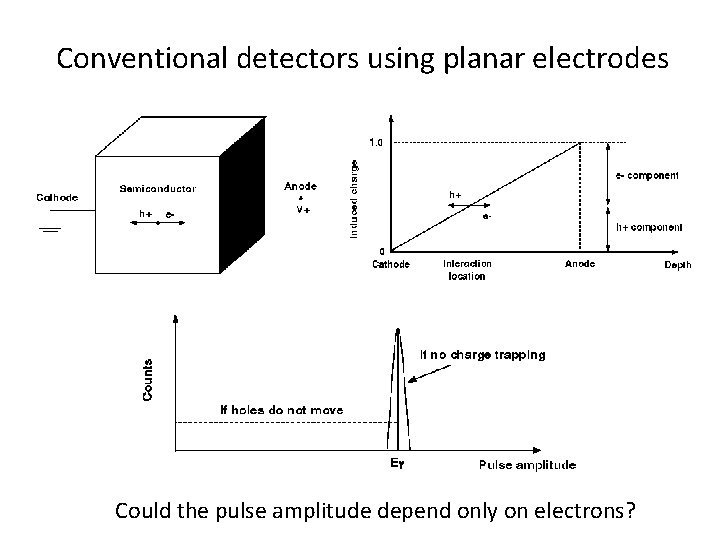
Conventional detectors using planar electrodes Could the pulse amplitude depend only on electrons?
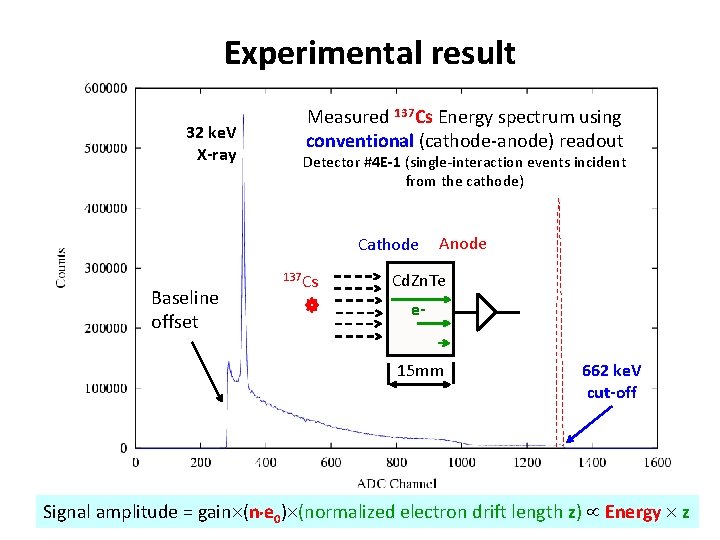
Experimental result 32 ke. V X-ray Measured 137 Cs Energy spectrum using conventional (cathode-anode) readout Detector #4 E-1 (single-interaction events incident from the cathode) Cathode Baseline offset 137 Cs Anode Cd. Zn. Te e 15 mm 662 ke. V cut-off Signal amplitude = gain (n e 0) (normalized electron drift length z) Energy z
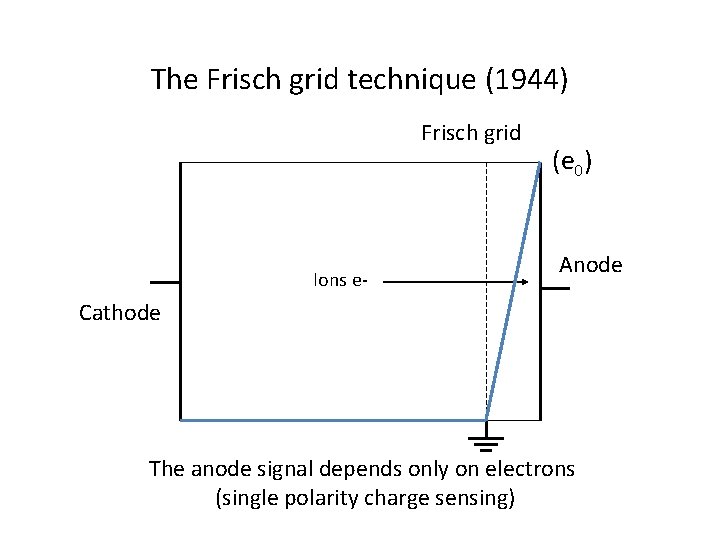
The Frisch grid technique (1944) Frisch grid Ions e- (e 0) Anode Cathode The anode signal depends only on electrons (single polarity charge sensing)
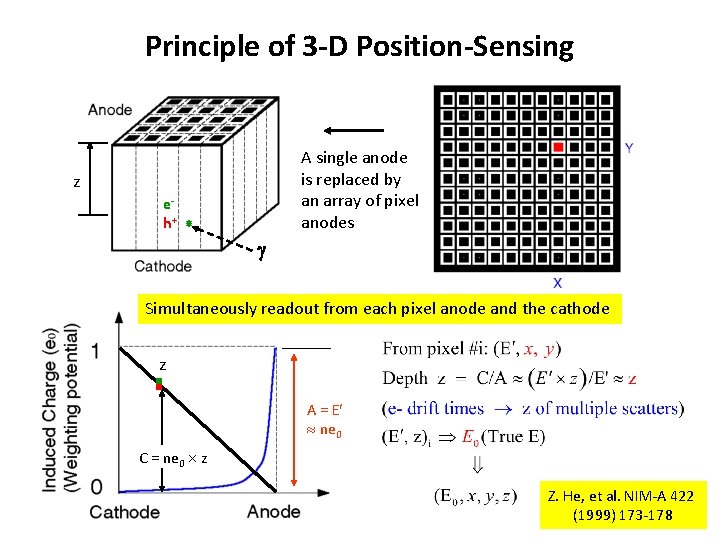
Principle of 3 -D Position-Sensing A single anode is replaced by an array of pixel anodes z eh+ Simultaneously readout from each pixel anode and the cathode z A = E ne 0 C = ne 0 z Z. He, et al. NIM-A 422 (1999) 173 -178
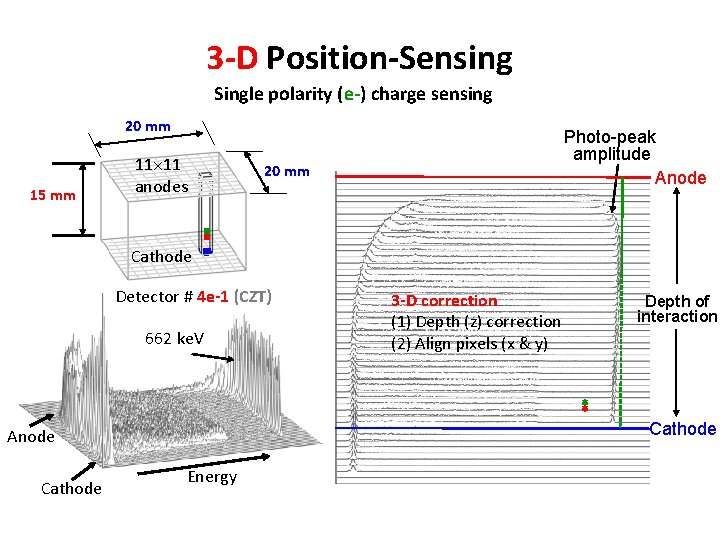
3 -D Position-Sensing Single polarity (e-) charge sensing 20 mm 15 mm 11 11 anodes Photo-peak amplitude Anode 20 mm Cathode Detector # 4 e-1 (CZT) 662 ke. V Depth of interaction Cathode Anode Cathode 3 -D correction (1) Depth (z) correction (2) Align pixels (x & y) Energy
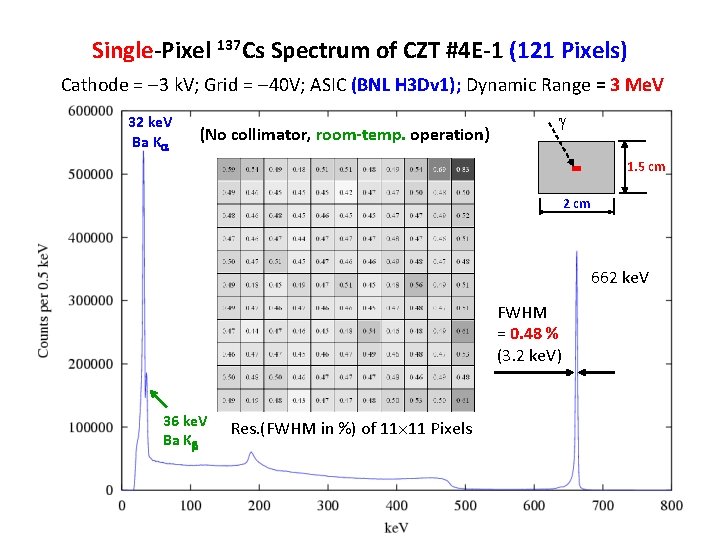
Single-Pixel 137 Cs Spectrum of CZT #4 E-1 (121 Pixels) Cathode = 3 k. V; Grid = 40 V; ASIC (BNL H 3 Dv 1); Dynamic Range = 3 Me. V 32 ke. V Ba K (No collimator, room-temp. operation) 1. 5 cm 2 cm 662 ke. V FWHM = 0. 48 % (3. 2 ke. V) 36 ke. V Ba K Res. (FWHM in %) of 11 11 Pixels
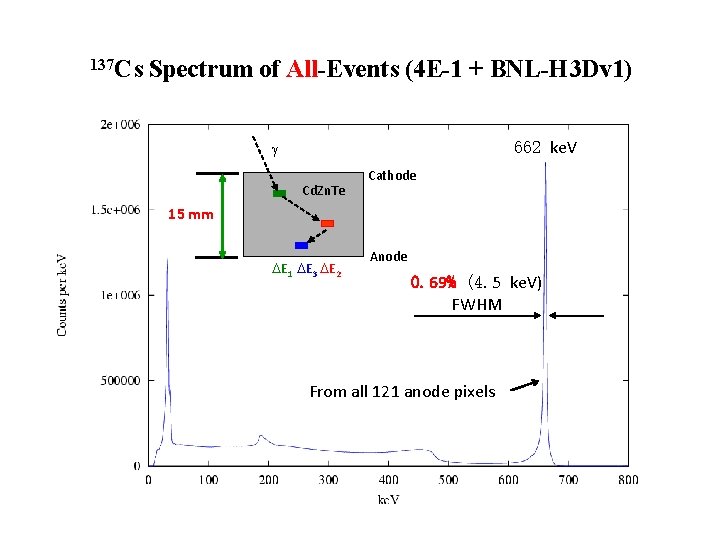
137 Cs Spectrum of All-Events (4 E-1 + BNL-H 3 Dv 1) 662 ke. V Cd. Zn. Te Cathode 15 mm E 1 E 3 E 2 Anode 0. 69% (4. 5 ke. V) FWHM From all 121 anode pixels
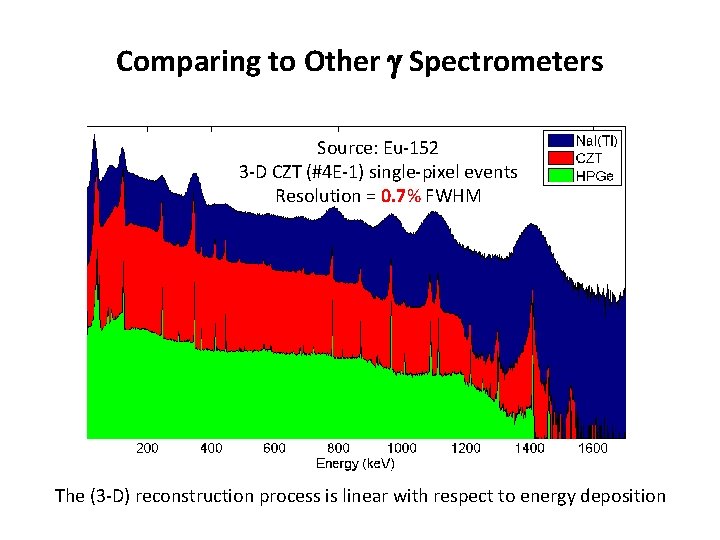
Comparing to Other Spectrometers Source: Eu-152 3 -D CZT (#4 E-1) single-pixel events Resolution = 0. 7% FWHM The (3 -D) reconstruction process is linear with respect to energy deposition
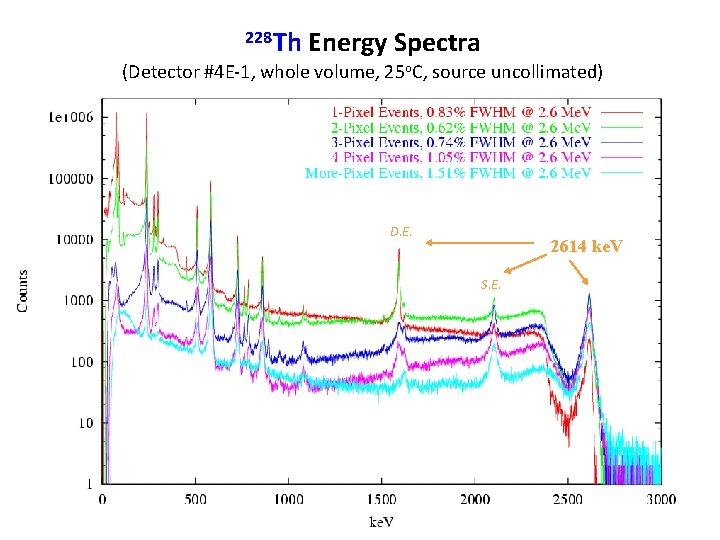
228 Th Energy Spectra (Detector #4 E-1, whole volume, 25 o. C, source uncollimated) D. E. 2614 ke. V S. E.
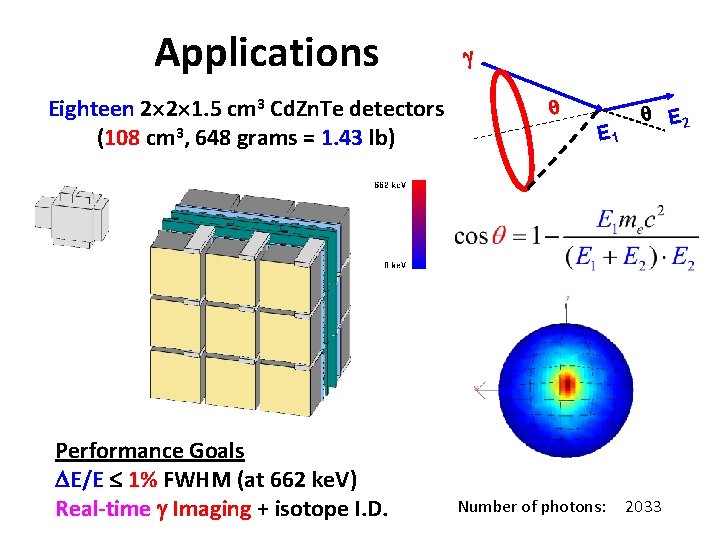
Applications Eighteen 2 2 1. 5 cm 3 Cd. Zn. Te detectors (108 cm 3, 648 grams = 1. 43 lb) Performance Goals E/E 1% FWHM (at 662 ke. V) Real-time Imaging + isotope I. D. E 1 Number of photons: E 2 18 2033 97 4 3 2 1
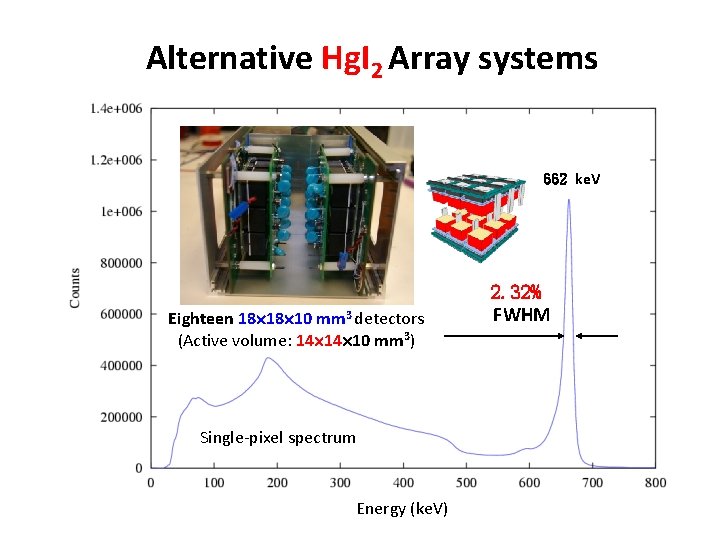
Alternative Hg. I 2 Array systems 662 ke. V Eighteen 18 18 10 mm 3 detectors (Active volume: 14 14 10 mm 3) Single-pixel spectrum Energy (ke. V) 2. 32% FWHM
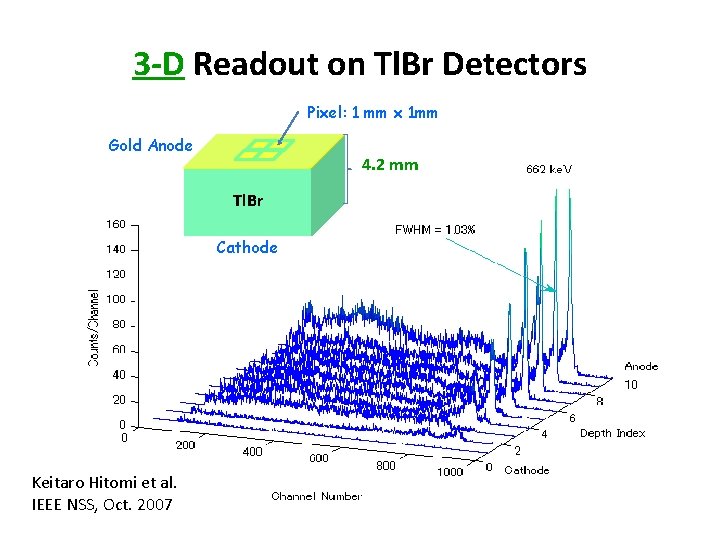
3 -D Readout on Tl. Br Detectors Pixel: 1 mm x 1 mm Gold Anode 4. 2 mm Tl. Br Cathode Keitaro Hitomi et al. IEEE NSS, Oct. 2007
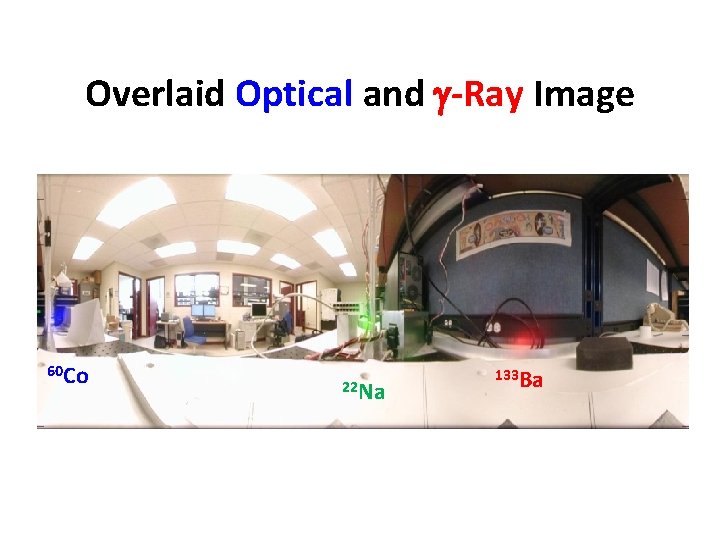
Overlaid Optical and -Ray Image 60 Co 22 Na 133 Ba
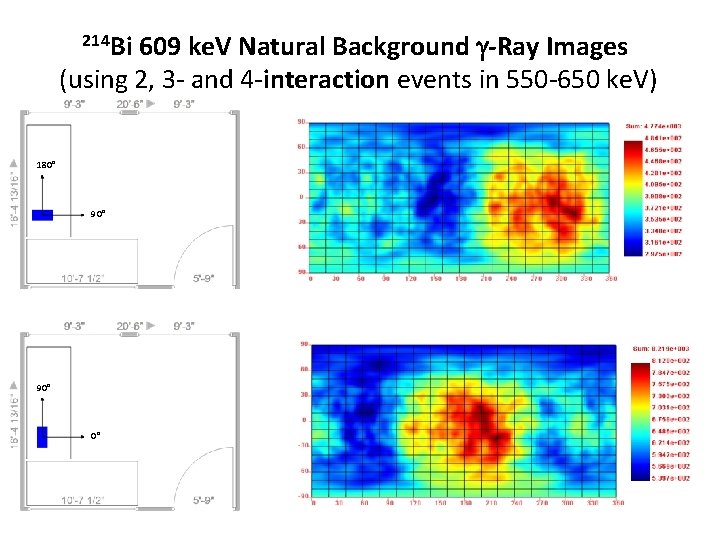
609 ke. V Natural Background -Ray Images (using 2, 3 - and 4 -interaction events in 550 -650 ke. V) 214 Bi 180° 90° 0°
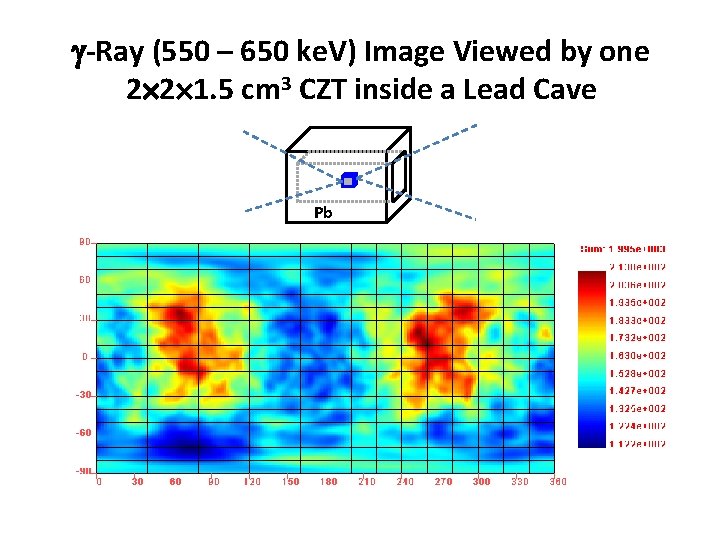
-Ray (550 – 650 ke. V) Image Viewed by one 2 2 1. 5 cm 3 CZT inside a Lead Cave Pb
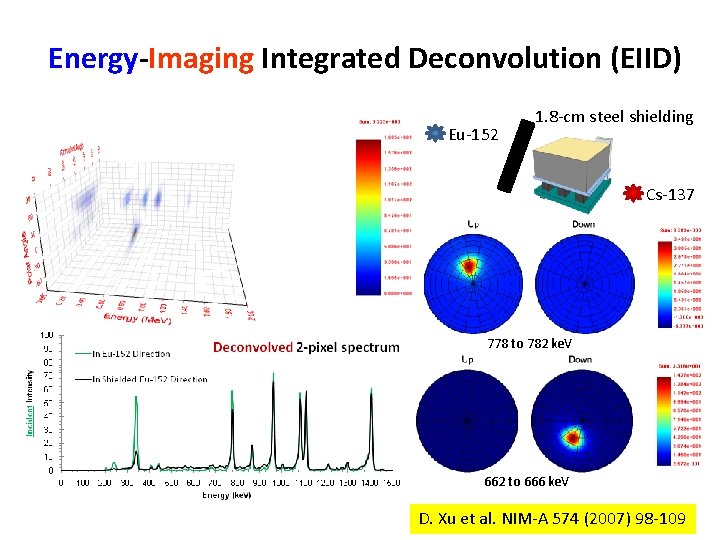
Energy-Imaging Integrated Deconvolution (EIID) Eu-152 1. 8 -cm steel shielding Cs-137 778 to 782 ke. V 662 to 666 ke. V D. Xu et al. NIM-A 574 (2007) 98 -109
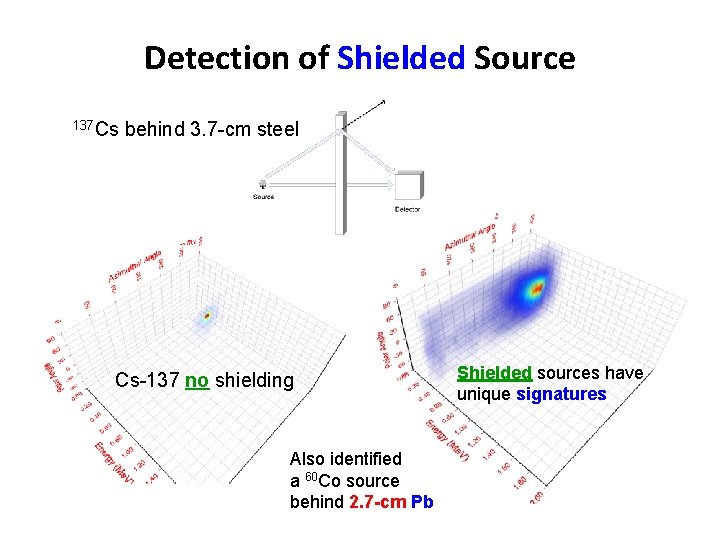
Detection of Shielded Source 137 Cs behind 3. 7 -cm steel Cs-137 no shielding Also identified a 60 Co source behind 2. 7 -cm Pb Shielded sources have unique signatures
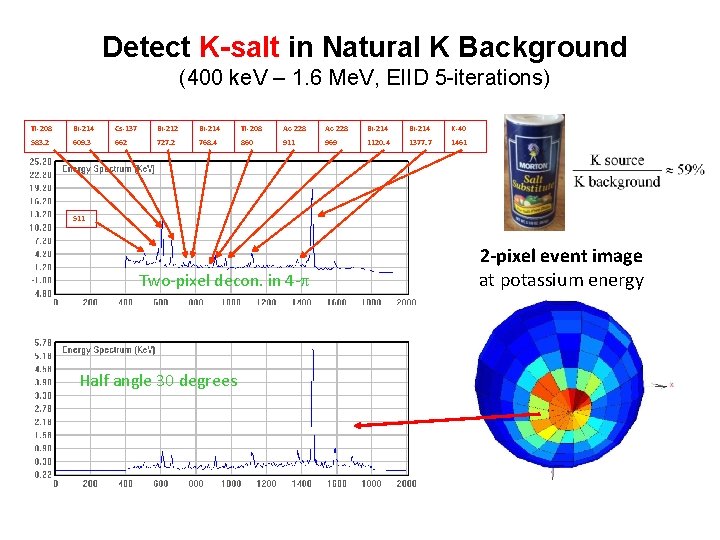
Detect K-salt in Natural K Background (400 ke. V – 1. 6 Me. V, EIID 5 -iterations) Tl-208 Bi-214 Cs-137 Bi-212 Bi-214 Tl-208 Ac-228 Bi-214 K-40 583. 2 609. 3 662 727. 2 768. 4 860 911 969 1120. 4 1377. 7 1461 All events Raw 511 Two-pixel decon. in 4 - Half angle 30 degrees 2 -pixel event image at potassium energy
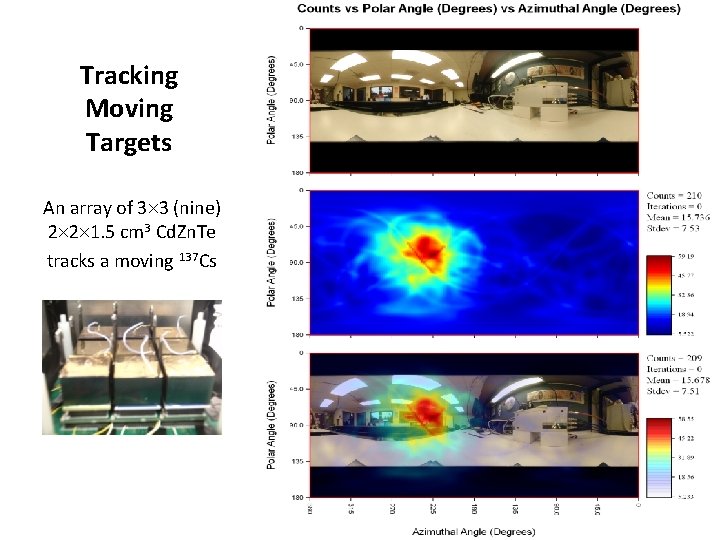
Tracking Moving Targets An array of 3 3 (nine) 2 2 1. 5 cm 3 Cd. Zn. Te tracks a moving 137 Cs
Today and Tomorrow