
ROOFS Roof Top most part of building Protects
ROOFS
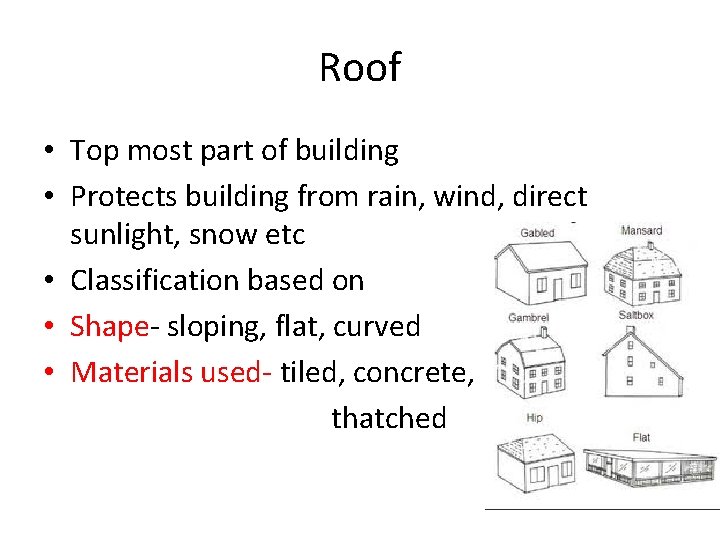
Roof • Top most part of building • Protects building from rain, wind, direct sunlight, snow etc • Classification based on • Shape- sloping, flat, curved • Materials used- tiled, concrete, thatched
REQUIREMENTS OF A ROOF • It should have adequate strength and stability to • • carry the dead and live loads. Should protect the building against rain, sunlight, wind, etc It should be waterproof and should have efficient drainage arrangements. It should provide adequate thermal insulation & fire resistant. It should provide adequate insulation against sound.
Sloping/ Pitched roof • Sloping top surface • Suitable for places where rainfall / snowfall is heavy • Used in coastal areas
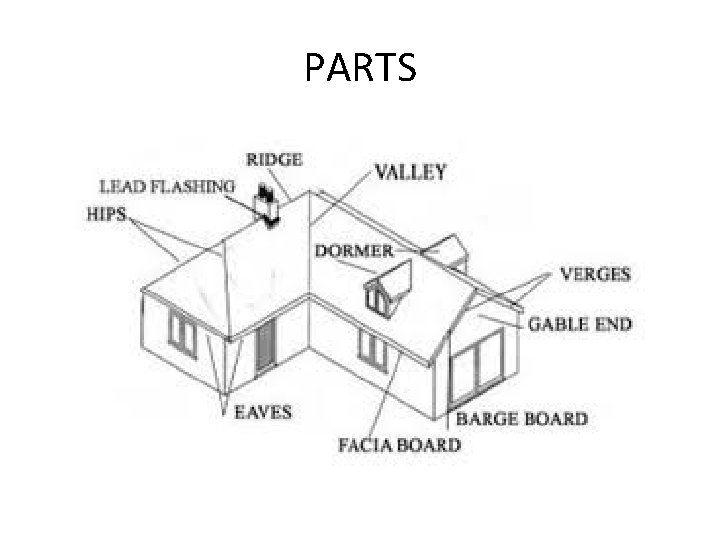
PARTS
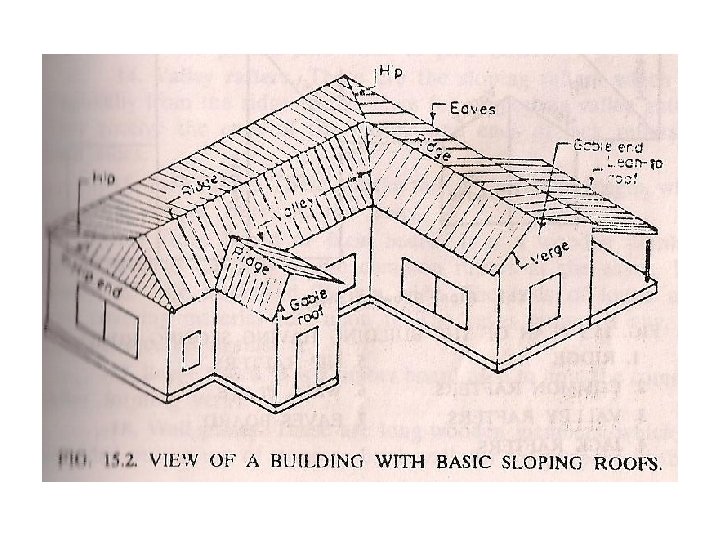
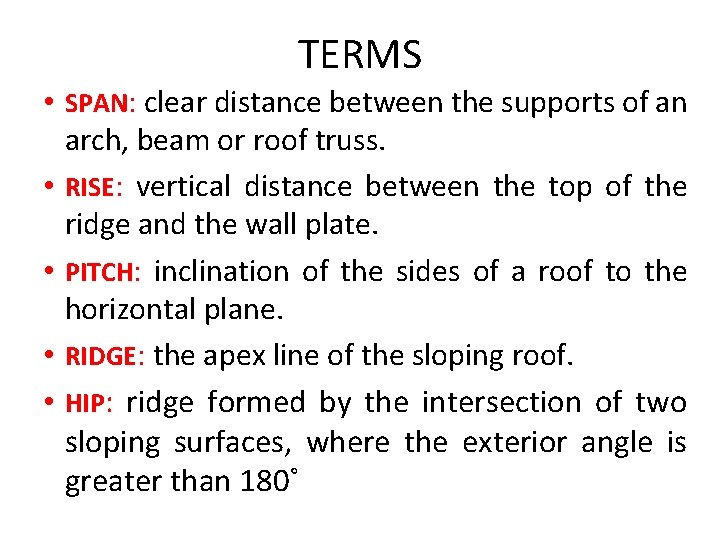
TERMS • SPAN: clear distance between the supports of an arch, beam or roof truss. • RISE: vertical distance between the top of the ridge and the wall plate. • PITCH: inclination of the sides of a roof to the horizontal plane. • RIDGE: the apex line of the sloping roof. • HIP: ridge formed by the intersection of two sloping surfaces, where the exterior angle is greater than 180˚
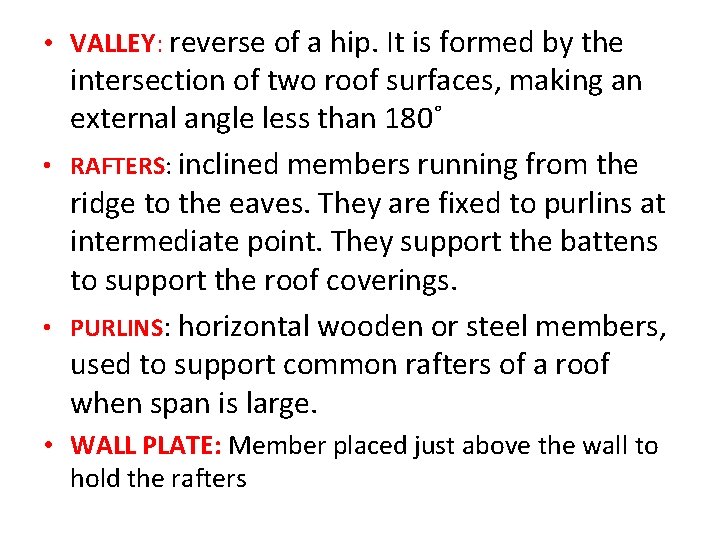
• VALLEY: reverse of a hip. It is formed by the intersection of two roof surfaces, making an external angle less than 180˚ • RAFTERS: inclined members running from the ridge to the eaves. They are fixed to purlins at intermediate point. They support the battens to support the roof coverings. • PURLINS: horizontal wooden or steel members, used to support common rafters of a roof when span is large. • WALL PLATE: Member placed just above the wall to hold the rafters
TYPES OF PITCHED ROOF • • LEAN TO ROOF COUPLE CLOSE ROOF COLLAR BEAM ROOF COLLAR & TIE ROOF(PURLIN ROOF) KING POST TRUSS QUEEN POST TRUSS STEEL TRUSS
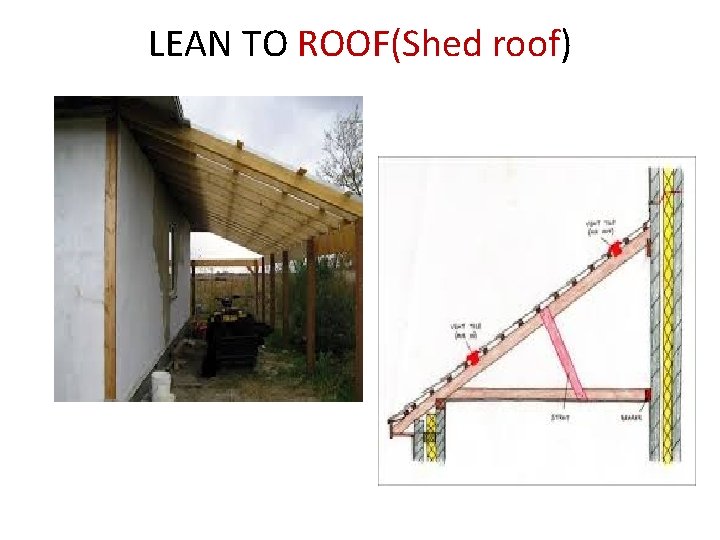
LEAN TO ROOF(Shed roof)
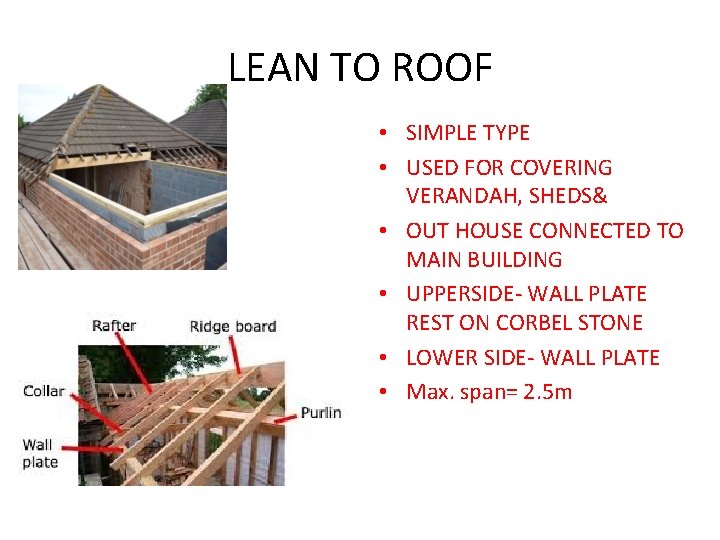
LEAN TO ROOF • SIMPLE TYPE • USED FOR COVERING VERANDAH, SHEDS& • OUT HOUSE CONNECTED TO MAIN BUILDING • UPPERSIDE- WALL PLATE REST ON CORBEL STONE • LOWER SIDE- WALL PLATE • Max. span= 2. 5 m

COUPLE ROOF • Formed by pair of inclined rafters, • Centre ridge & wall plates • Battens are supported on rafters • Span 3. 5 m
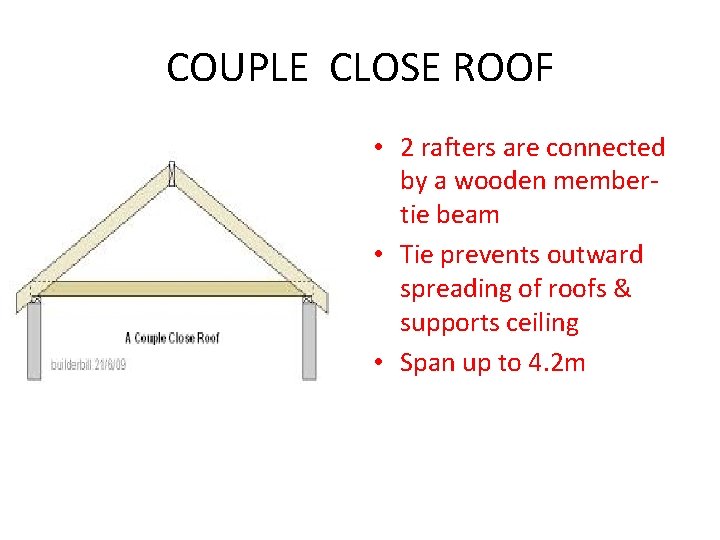
COUPLE CLOSE ROOF • 2 rafters are connected by a wooden membertie beam • Tie prevents outward spreading of roofs & supports ceiling • Span up to 4. 2 m

COLLAR BEAM ROOF • Modified form of couple close roof • Position of tie beam is just raised-collar beam • Used to increase the ht: of room • Span 4 -4. 5 m

COLLAR & TIE ROOF(PURLIN ROOF)

• To reduce the c/s size of rafters for span > 3 m, intermediate supports are introduced under the rafter- purlin • Span up to 4. 8 m

KING POST TRUSS • Central vertical post used to support tie beam-king post • Struts-2 inclined members provided on either side of king post. Used to prevent bending on principal rafter • Span 5 -8 m • Used when – Span >5 m – Intermediate supports for purlins & ties are unavailable

QUEEN POST TRUSS • Queen post- 2 vertical post • Consist of 2 principal rafters, struts, tie beams, purlins, straining beam • straining beam-horizontal beam which keeps upper end of queen post in position & to counteract the thrust of struts • Span 8 -13 m
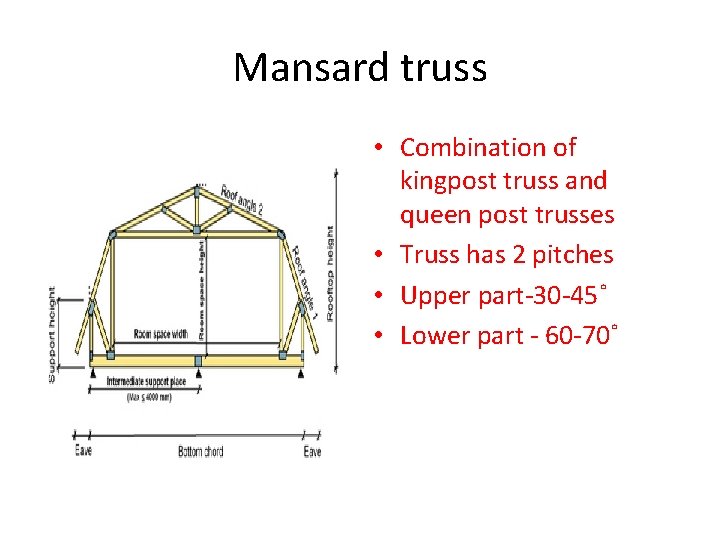
Mansard truss • Combination of kingpost truss and queen post trusses • Truss has 2 pitches • Upper part-30 -45˚ • Lower part - 60 -70˚
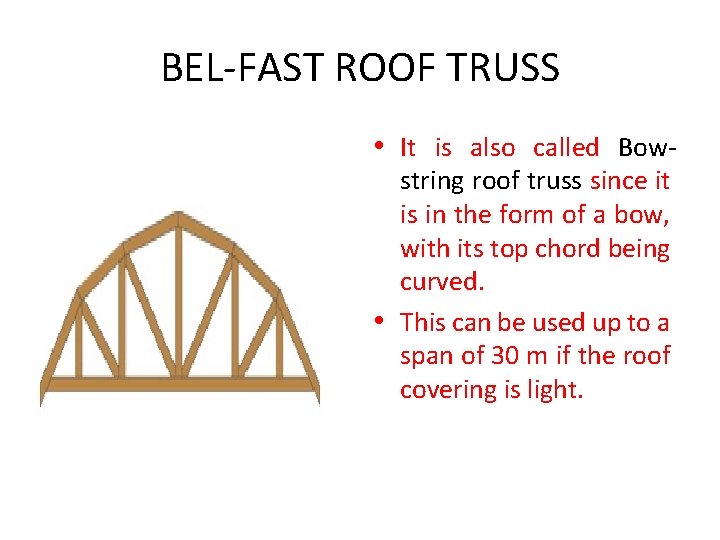
BEL-FAST ROOF TRUSS • It is also called Bowstring roof truss since it is in the form of a bow, with its top chord being curved. • This can be used up to a span of 30 m if the roof covering is light.
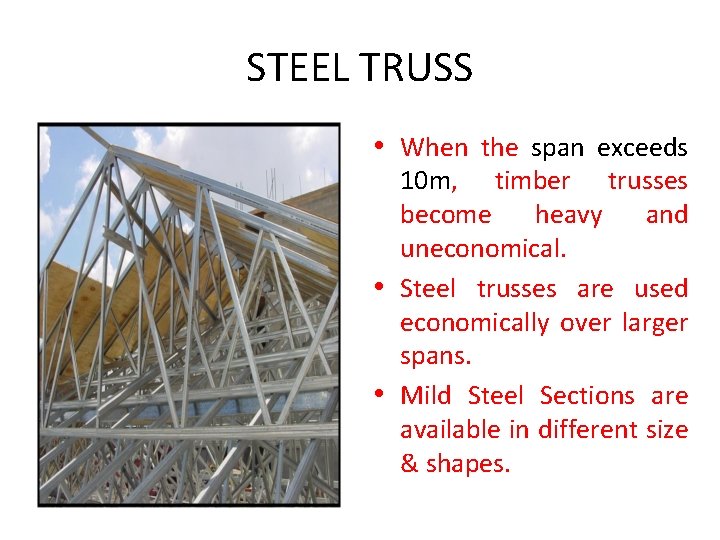
STEEL TRUSS • When the span exceeds 10 m, timber trusses become heavy and uneconomical. • Steel trusses are used economically over larger spans. • Mild Steel Sections are available in different size & shapes.

STEEL TRUSS
Advantages • Precast structures of desired dimensions are available • Termite & fire proof • Light in weight • Can be fabricated in any form • Strong & durable • Quickly &easily installed
• • Flat /terraced Roof laid at an angle <10˚ Slope for easy drainage Used in multi storey constructions. Advantages- – Terrace can be used for playing & domestic purposes – Simple construction & maintenance – Good insulating property & fire resisting – More stable against wind – No need of false ceiling – Upper floor can be constructed – Need less roofing materials
• Disadvantages – Can’t be used for long spans without columns & beams – Not suitable for heavy rainfall areas – High initial cost – Slowly construction compared to truss – Cracks may develop due to temperature variation – If proper slope is not provided for drainage, the water may get collected, causing leaks

TYPES OF FLAT ROOFS • • • RCC flat roof Filler slab Madras terrace roof Bengal terrace roof Reinforced brick cement roof

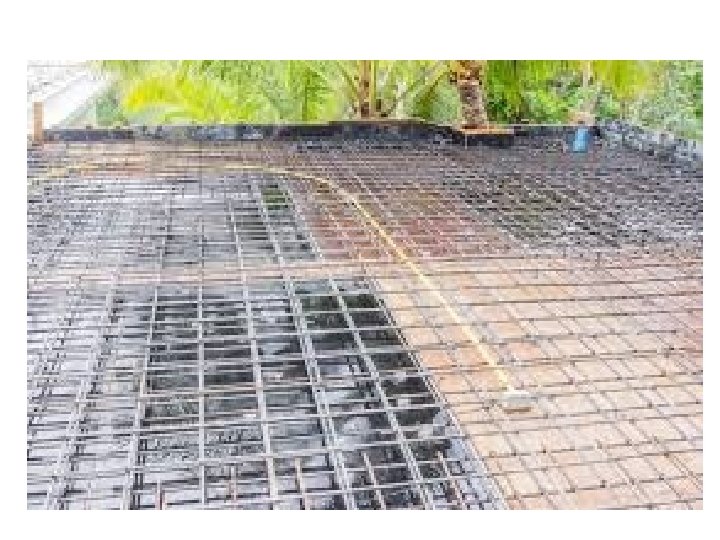
RCC flat roof • Made up of concrete & steel • Consist of RC flat slab which covers the distance b/w supports • Steel reinforcement is provide at the bottom to resist the tensile forces • For greater spans some of the bars are bend up to the top at the supports • Easy to construct • Provides smooth finishing surface • Thickness of slab depends on – Type of concrete – Span – Floor loads
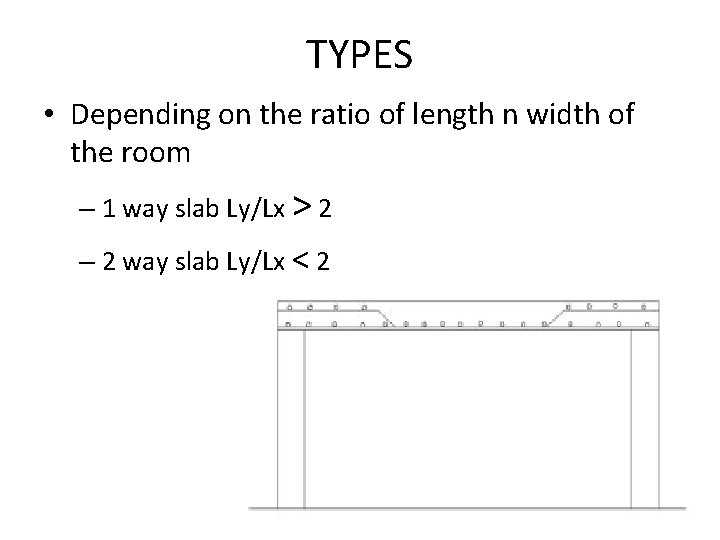
TYPES • Depending on the ratio of length n width of the room – 1 way slab Ly/Lx > 2 – 2 way slab Ly/Lx < 2
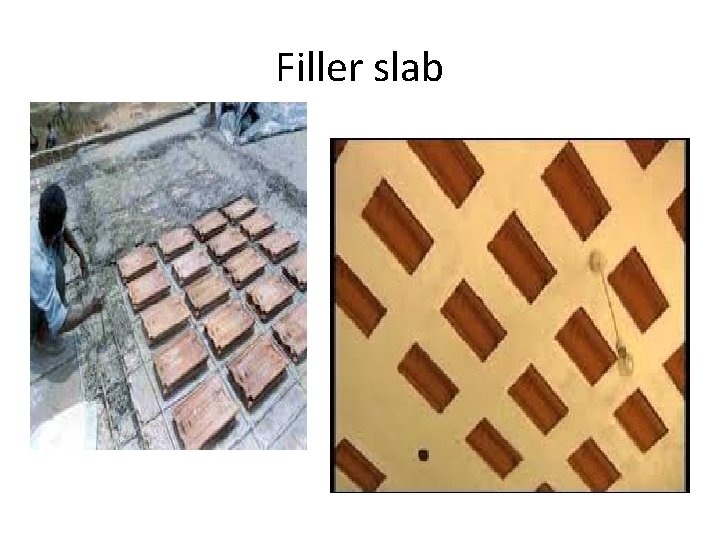
Filler slab
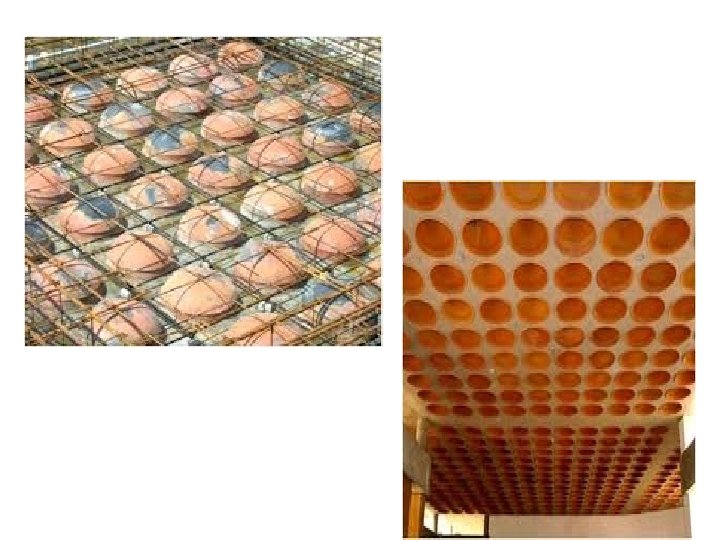
• Bottom portion of the slab is replaced by flat clay/MP tiles • Top portion-compression • Bottom portion-tension • Tensile force is carried by reinforcement so concrete in that portion is replaced by cheaper filler materials • Above formwork steel reinforcements are tied together to form a grid • Pairs of tiles are placed in the gap b/w the reinforcement • Freshly prepared concrete is pored in b/w the reft & tiles & compact it carefully • Level the concrete surface & cure it for 14 days
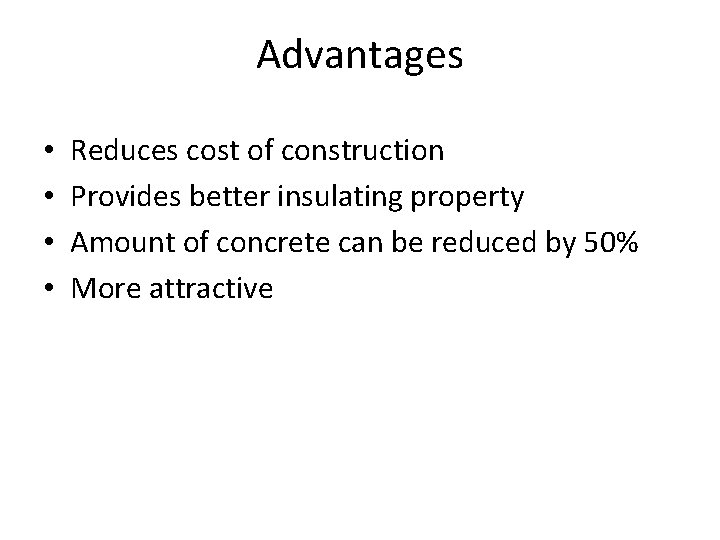
Advantages • • Reduces cost of construction Provides better insulating property Amount of concrete can be reduced by 50% More attractive
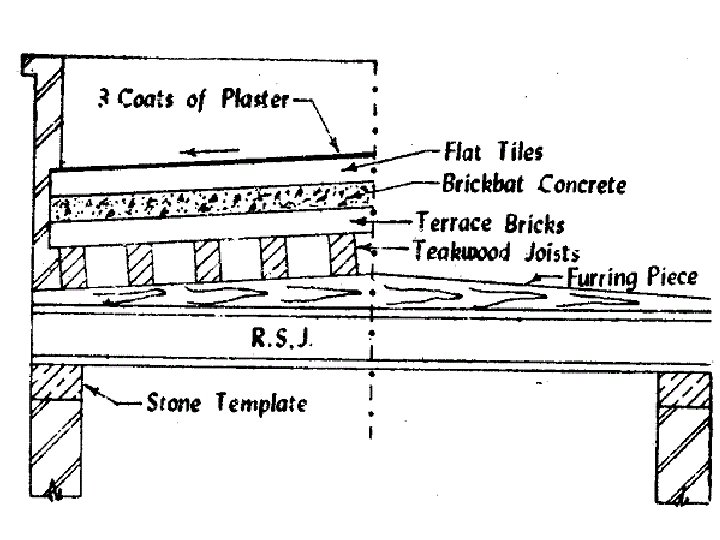
Madras terrace roof/wooden flat roof • Slope < 1 in 100 Construction procedure • Teak wood joists are placed on rolled steel joists • Furring piece is placed b/w wooden joist & RSJ for giving sufficient slope • Terrace bricks (15 x 75 x 25 mm) are laid diagonally across joists
• Brick bat concrete (75 mm thick) is laid & rammed and allowed to set for 3 days • 2 course of flat tiles are laid over the concrete • Surface of roof is finished with 3 coats of plaster
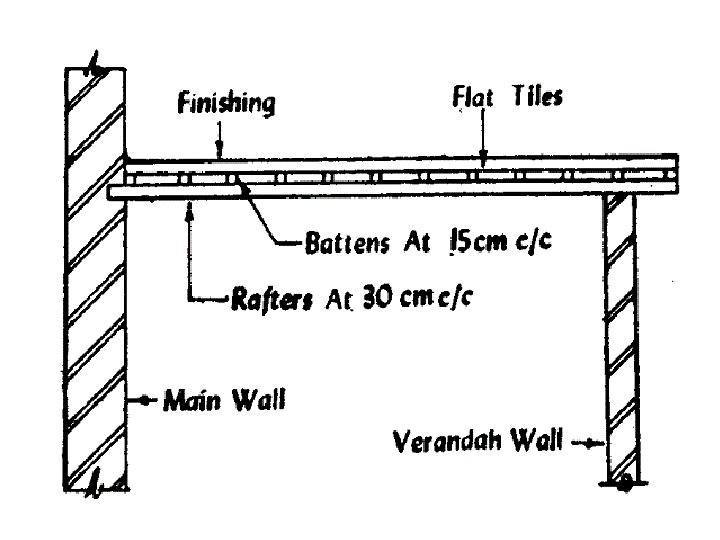
Bengal terrace roof • Rafters are placed with slight inclination at 30 m centre to centre or 50 m centre to centre • Battems are placed at right angles to rafters at 15 m centre to centre • A course of flat tiles is laid in mortar over battens. • Finally roof is finished by applying 2 or more course of flat tiles with 2 -3 coats of plaster OR • A layer of jelly concrete 40 mm thick may be laid over flat tiles
REINFORCED BRICK CEMENT ROOF • Bricks are laid horizontally between steel bars and concrete mix was inserted into joints • Top surface is plastered with 20 mm thick cement mortar • Over that apply hot bitumen coat or cement paste coat of 50 mm thick • Thickness of slab may be 100 mm to 200 mm • This type of roof is used upto span 4 m
- Slides: 39