
Roofing Fall Protection The following presentation can be
Roofing Fall Protection • The following presentation can be used to satisfy the training requirements of the Fall Protection Standard in the WISHA Safety Standards for Construction - WAC 296 -155 -24505(3) & (4). • Training is required as part of the fall protection work plan (see next slide to view WISHA rules on fall protection training). • These two training modules contains generic information for fall protection in the roofing industry. It is best suited for new employees not familiar with fall protection. • You will need to add work-site specific information to provide the necessary training for your employees and meet the intent of the WISHA regulations.
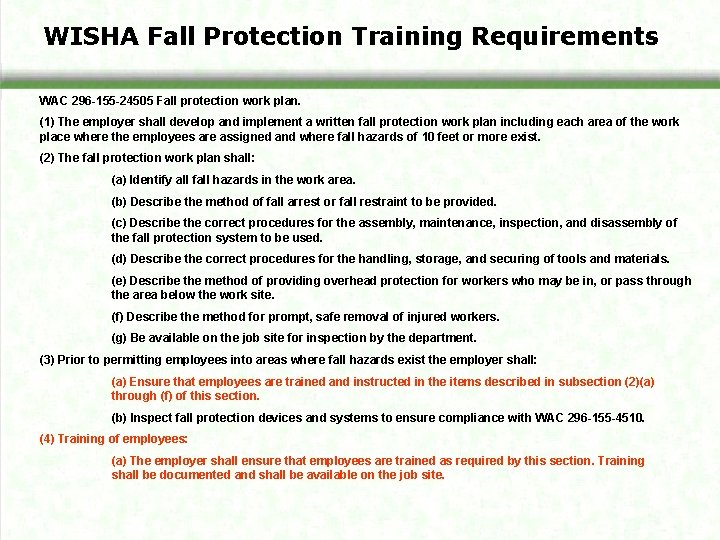
WISHA Fall Protection Training Requirements WAC 296 -155 -24505 Fall protection work plan. (1) The employer shall develop and implement a written fall protection work plan including each area of the work place where the employees are assigned and where fall hazards of 10 feet or more exist. (2) The fall protection work plan shall: (a) Identify all fall hazards in the work area. (b) Describe the method of fall arrest or fall restraint to be provided. (c) Describe the correct procedures for the assembly, maintenance, inspection, and disassembly of the fall protection system to be used. (d) Describe the correct procedures for the handling, storage, and securing of tools and materials. (e) Describe the method of providing overhead protection for workers who may be in, or pass through the area below the work site. (f) Describe the method for prompt, safe removal of injured workers. (g) Be available on the job site for inspection by the department. (3) Prior to permitting employees into areas where fall hazards exist the employer shall: (a) Ensure that employees are trained and instructed in the items described in subsection (2)(a) through (f) of this section. (b) Inspect fall protection devices and systems to ensure compliance with WAC 296 -155 -4510. (4) Training of employees: (a) The employer shall ensure that employees are trained as required by this section. Training shall be documented and shall be available on the job site.
How to Use This Power. Point Program • Users with Power. Point can download, edit, and use the program for training with a laptop and multimedia projector. • Additional information is found in the Notes at the bottom of each slide. You can read the text in quotations found in the Notes section or use your own words. • If you want to print out this program, the PDF version uses less computer memory and prints faster.
Meeting WISHA Training Requirements • To meet the WISHA training requirements for fall protection, you must include information specific to your worksite as indicated in slides #17, 18, & 19 of this module. • Preview this program and include your specific workplace information prior to conducting the training. • It is recommended you keep an attendance roster for your records to document training.

Module 2 Roofing Fall Protection This training will cover the following: Fall arrest equipment Inspection and maintenance of fall protection equipment Rescuing a fallen coworker The fall protection work plan 1
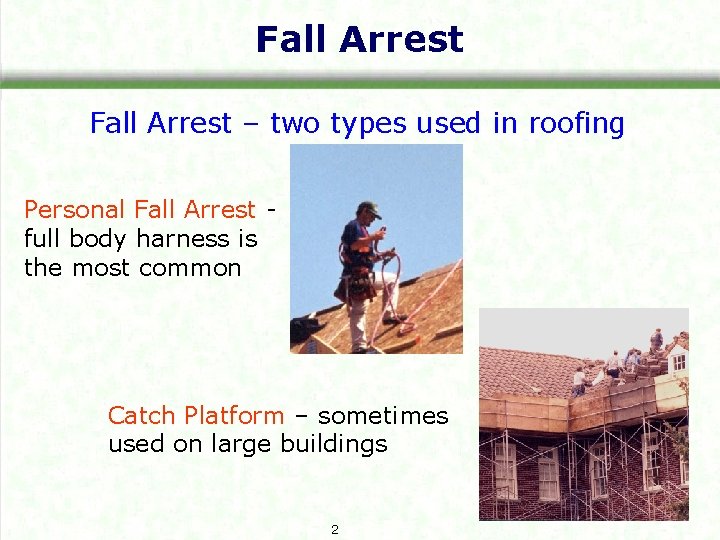
Fall Arrest – two types used in roofing Personal Fall Arrest full body harness is the most common Catch Platform – sometimes used on large buildings 2
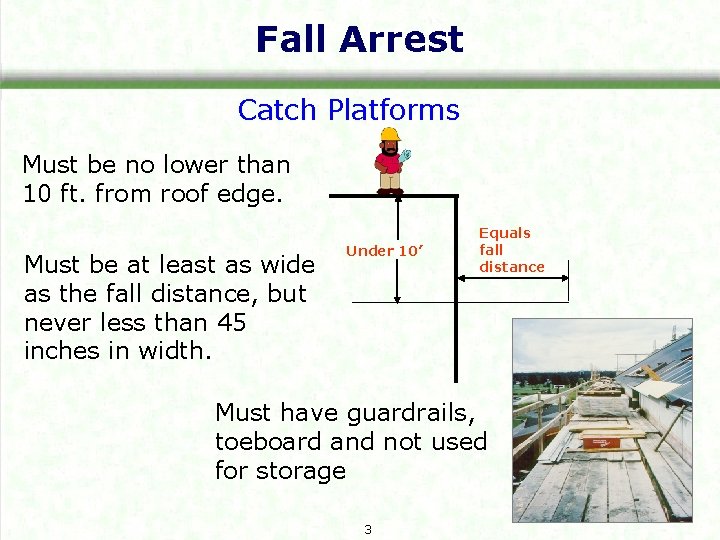
Fall Arrest Catch Platforms Must be no lower than 10 ft. from roof edge. Must be at least as wide as the fall distance, but never less than 45 inches in width. Under 10’ Equals fall distance Must have guardrails, toeboard and not used for storage 3
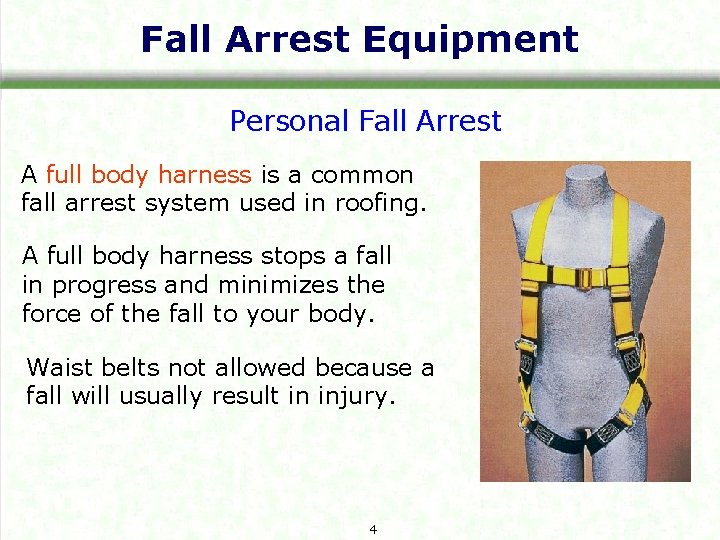
Fall Arrest Equipment Personal Fall Arrest A full body harness is a common fall arrest system used in roofing. A full body harness stops a fall in progress and minimizes the force of the fall to your body. Waist belts not allowed because a fall will usually result in injury. 4
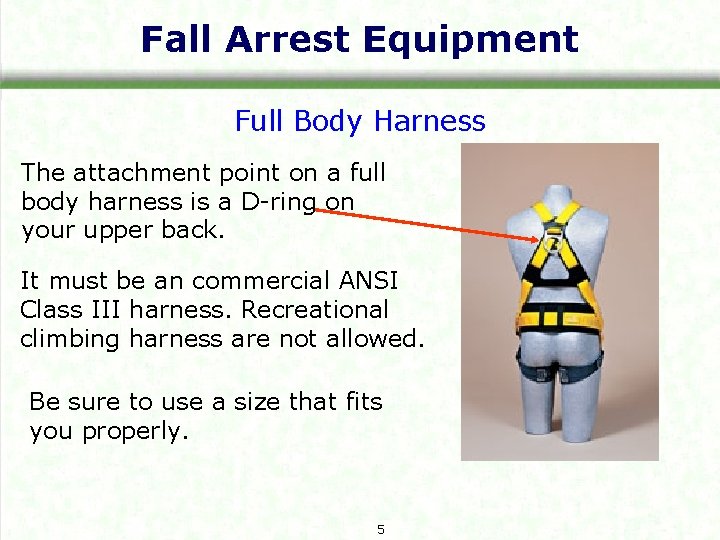
Fall Arrest Equipment Full Body Harness The attachment point on a full body harness is a D-ring on your upper back. It must be an commercial ANSI Class III harness. Recreational climbing harness are not allowed. Be sure to use a size that fits you properly. 5
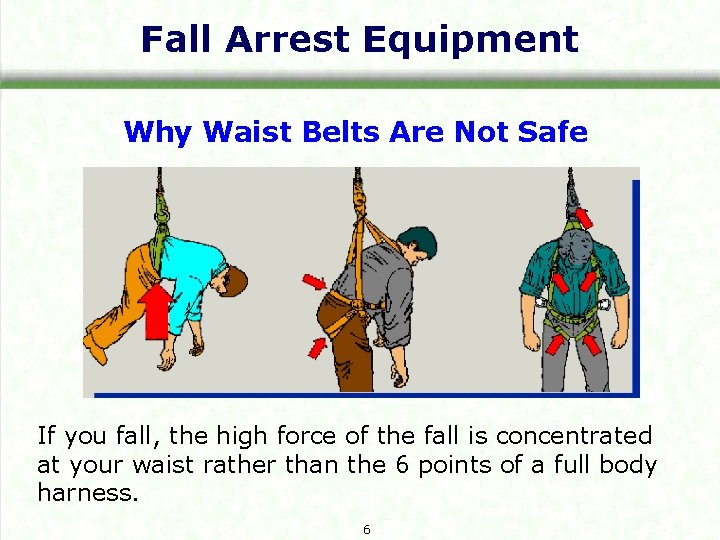
Fall Arrest Equipment Why Waist Belts Are Not Safe If you fall, the high force of the fall is concentrated at your waist rather than the 6 points of a full body harness. 6
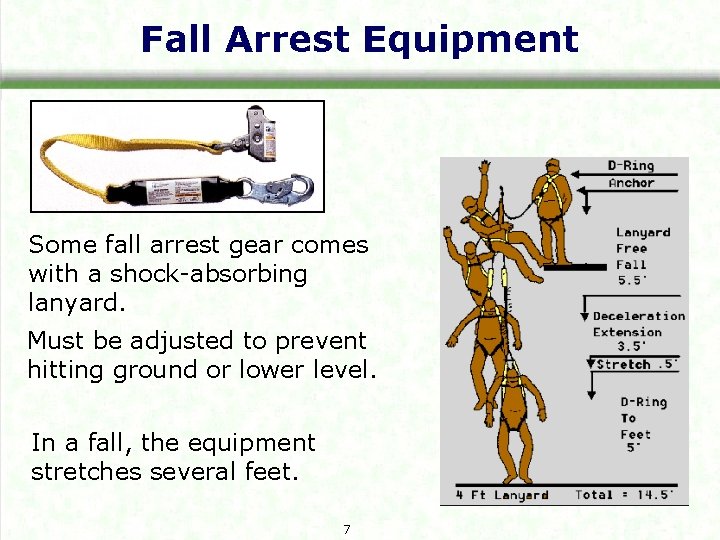
Fall Arrest Equipment Some fall arrest gear comes with a shock-absorbing lanyard. Must be adjusted to prevent hitting ground or lower level. In a fall, the equipment stretches several feet. 7
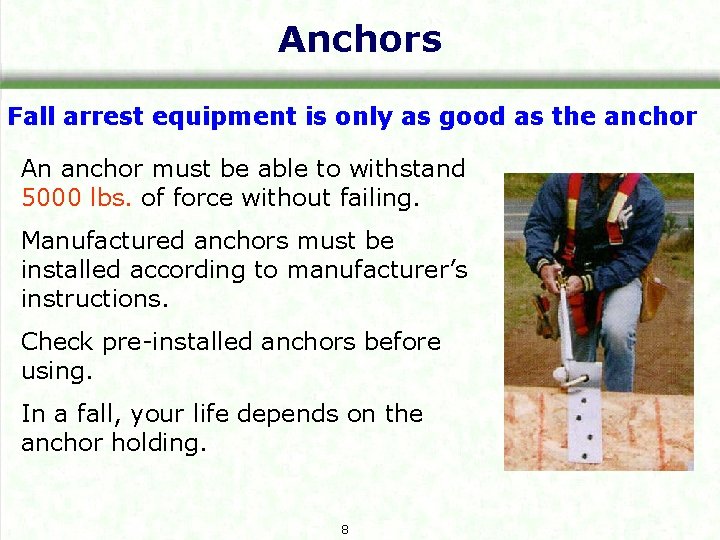
Anchors Fall arrest equipment is only as good as the anchor An anchor must be able to withstand 5000 lbs. of force without failing. Manufactured anchors must be installed according to manufacturer’s instructions. Check pre-installed anchors before using. In a fall, your life depends on the anchor holding. 8
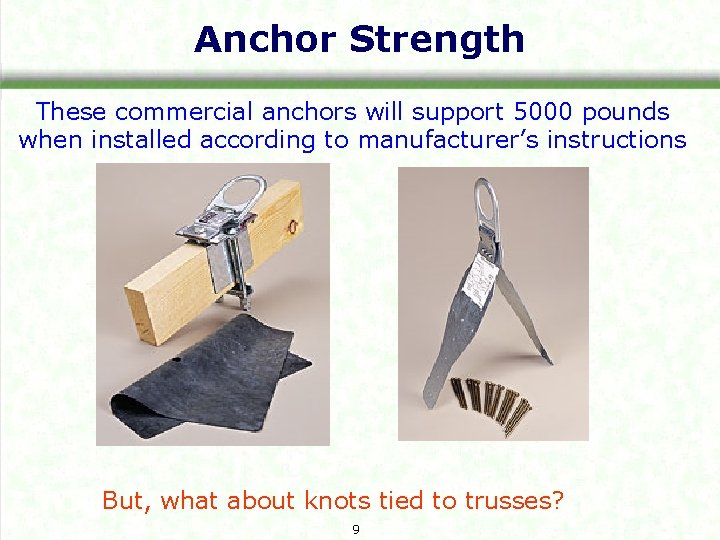
Anchor Strength These commercial anchors will support 5000 pounds when installed according to manufacturer’s instructions But, what about knots tied to trusses? 9
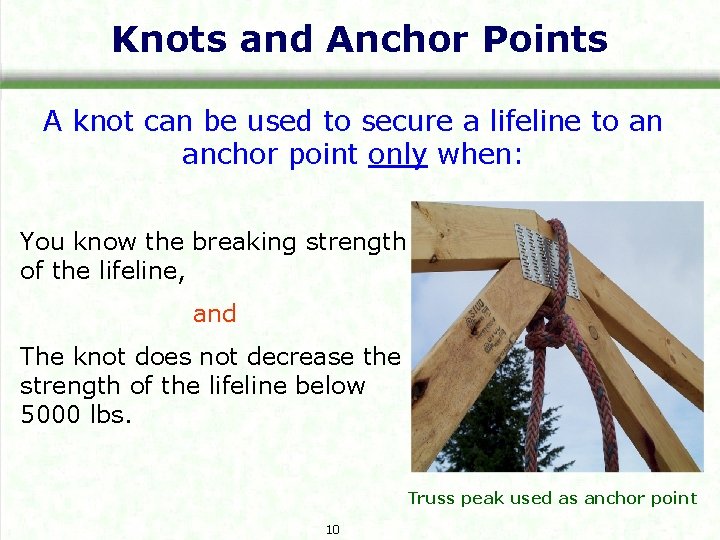
Knots and Anchor Points A knot can be used to secure a lifeline to an anchor point only when: You know the breaking strength of the lifeline, and The knot does not decrease the strength of the lifeline below 5000 lbs. Truss peak used as anchor point 10
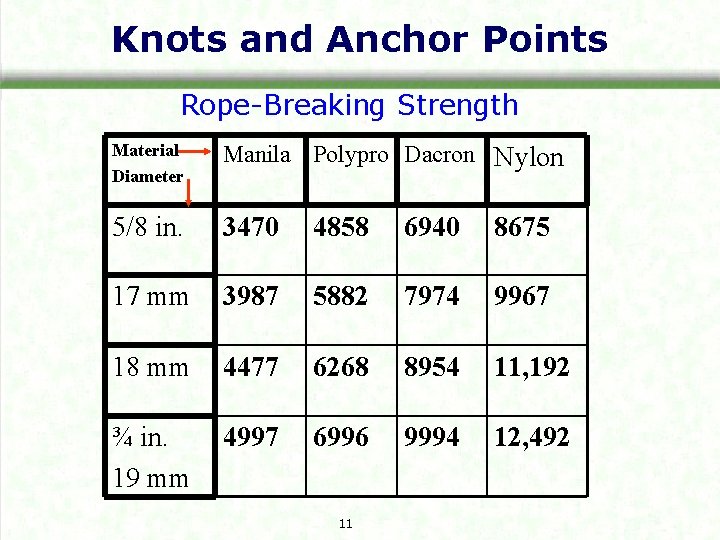
Knots and Anchor Points Rope-Breaking Strength Material Diameter Manila Polypro Dacron Nylon 5/8 in. 3470 4858 6940 8675 17 mm 3987 5882 7974 9967 18 mm 4477 6268 8954 11, 192 ¾ in. 19 mm 4997 6996 9994 12, 492 11
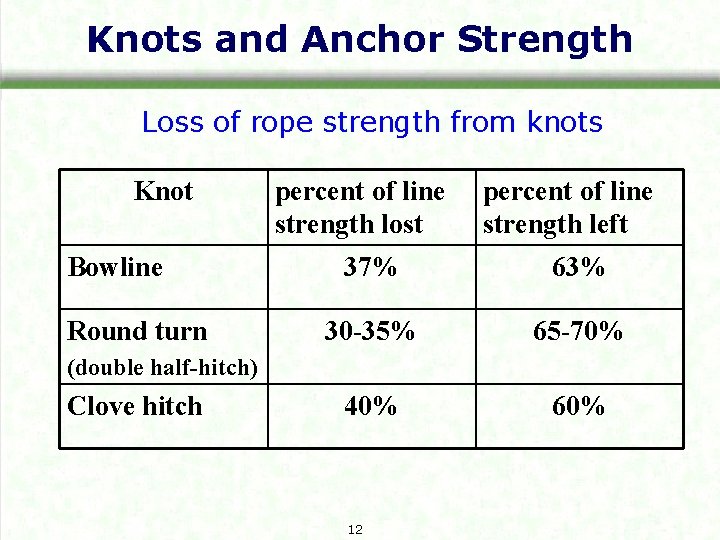
Knots and Anchor Strength Loss of rope strength from knots Knot Bowline Round turn percent of line strength lost percent of line strength left 37% 63% 30 -35% 65 -70% 40% 60% (double half-hitch) Clove hitch 12

Fall Arrest Equipment Use Protect rope or lanyard from sharp edges Knots in ropes or lanyard can reduce strength by as much as 50% 13
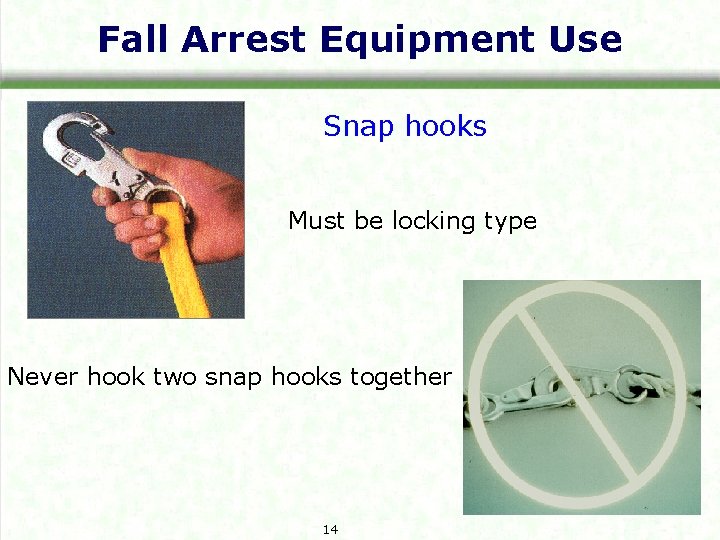
Fall Arrest Equipment Use Snap hooks Must be locking type Never hook two snap hooks together 14
Fall Arrest Equipment Use Some Equipment Do’s and Don’ts • Do inspect for wear and damage before use. • Do remove from service after a fall for inspection. • Don’t use to lift materials. • Don’t attach to guardrails or hoists. 15
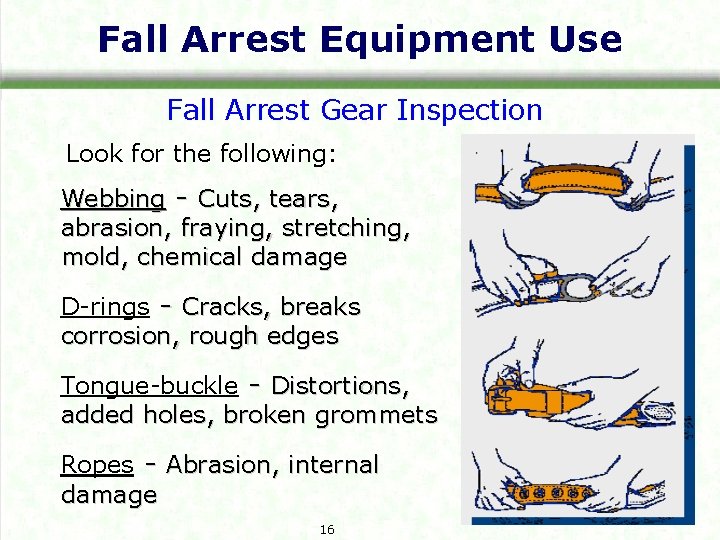
Fall Arrest Equipment Use Fall Arrest Gear Inspection Look for the following: Webbing - Cuts, tears, abrasion, fraying, stretching, mold, chemical damage D-rings - Cracks, breaks corrosion, rough edges Tongue-buckle - Distortions, added holes, broken grommets Ropes - Abrasion, internal damage 16
Handling Tools & Materials Describe here your procedures for handling, storing and securing tools and materials at the jobsite. 17
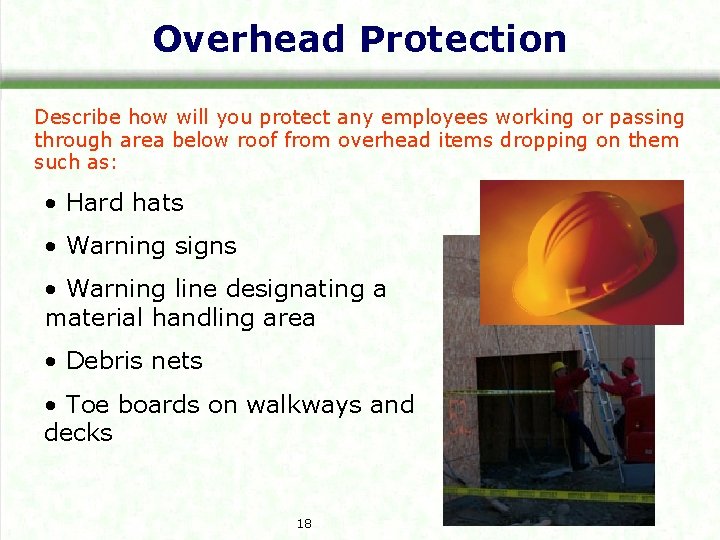
Overhead Protection Describe how will you protect any employees working or passing through area below roof from overhead items dropping on them such as: • Hard hats • Warning signs • Warning line designating a material handling area • Debris nets • Toe boards on walkways and decks 18
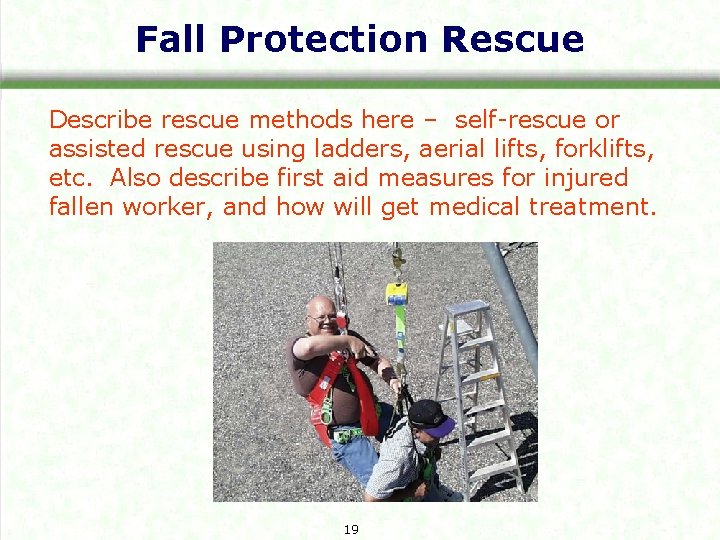
Fall Protection Rescue Describe rescue methods here – self-rescue or assisted rescue using ladders, aerial lifts, forklifts, etc. Also describe first aid measures for injured fallen worker, and how will get medical treatment. 19
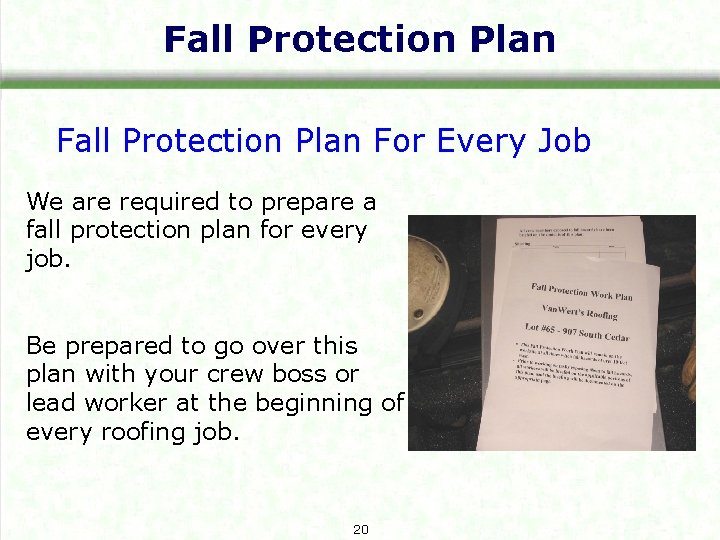
Fall Protection Plan For Every Job We are required to prepare a fall protection plan for every job. Be prepared to go over this plan with your crew boss or lead worker at the beginning of every roofing job. 20
The End
- Slides: 25