
Ron Rash Signs My older kin always believed

Ron Rash
Signs My older kin always believed in looking backward to explain the here and now, always a sign present in the past each time a barn burned down, a life was lost. So like boys turning over stones to find what dark had hid from the day, they’d turn over in their minds the way a mare turned from its stall as if she smelled hay smoldering, a living hand so damp and cold it seemed already in the grave. And so I learned to see the world as language one might understand but only when translated by signs first forgotten or misread.
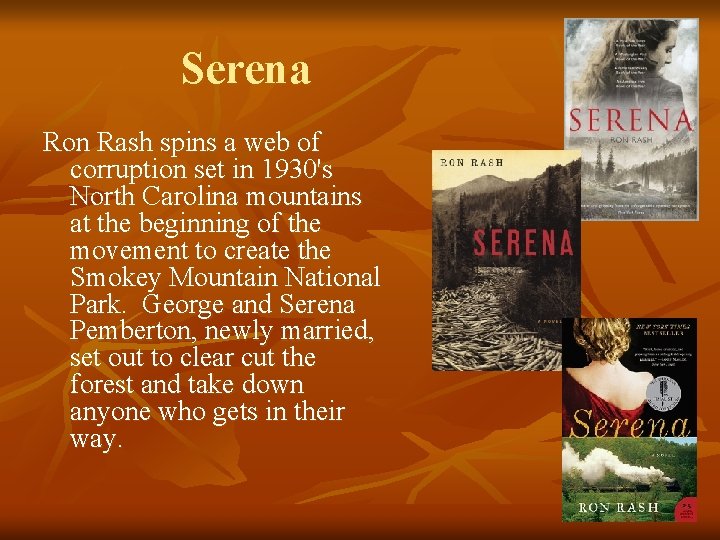
Serena Ron Rash spins a web of corruption set in 1930's North Carolina mountains at the beginning of the movement to create the Smokey Mountain National Park. George and Serena Pemberton, newly married, set out to clear cut the forest and take down anyone who gets in their way.
Meet the Characters - Serena n n “This is what we want, ” she said, her voice deepening, the emotion so often controlled fully unbridled now. “To be like this. No past or future, pure enough to live totally in the present. ” Serena slept all afternoon, and at dinner she ate until her stomach swelled visibly. Afterward, she sent Vaughn to the commissary, and he returned with a chamber pot and a gallon bucket filled with water. When Pemberton asked about food or quilts, Serena told him she’d not eat or sleep again until the eagle did. For two nights and a day Serena did not leave the stall. She’d been told to stay in bed for six weeks, but when a month had passed Serena resumed supervising the cutting crews “Secretary Albright’s commissioned a photograph of the devastation we’ve wrecked upon the land, ” Serena said to Pemberton when he joined her. “A further way to justify his park. ” “Why not, Pemberton, ” Serena said. “I’m pleased with what we’ve done here. Aren’t you? ”
Meet the Characters - Rachel n n n And now this brown-eyed child. Don’t love it, Rachel told herself. Don’t love anything that can be taken away. Sell it, it’ll fetch a good price, Mrs. Pemberton had said when she handed Rachel the bowie knife. And it probably would, perhaps even as much as the ginseng, but Rachel couldn’t abide doing what Mrs. Pemberton had commanded her to do. She’d sell the shoes off her feet before taking the knife out of the box trunk and selling it. Widow Jenkins would say that Rachel was just being prideful, and maybe Preacher Bolick would agree, but she’d had enough proud shucked off her the last few months to believe God wouldn’t begrudge her keeping just a little. “You cut up your feet pretty good, but nothing deep enough to need stitches. That was almost a mile walk and you as sick as him, and barefoot to boot. I don’t know how you did it. You must love that child dear as life. ” “I tried not to, ” Rachel said. “I just couldn’t find a way to stop myself. ”
Meet the Characters - Loggers n n n “The way things is balanced. Everything in the world has its natural place, and if you take something out or put something in that ought not be out or in, everything gets lopsided and out of sorts. ” “So what happens when there ain’t nothing left alive at all? ” he asked. “Used to be thick with trout too, this here stream. There was many a day you and me took our supper from it. Now you’d not catch a knottyhead. ” “And I had my part in the doing of it. ” “We had to feed out families, ” Henryson said. “Yes, we did, ” Ross agreed. “What I’m wondering is how we’ll feed them once all the trees is cut down and the jobs leave. ” “I think this is what the end of the world will be like. , ” Mc. Intyre said, and none among them raised his voice to disagree.

One Foot in Eden
Mill Village Mill houses lined both sides of every road like boxcars on a track. They were so close a man could piss off of his own front porch, hit four houses if he had the wind. Everytime your neighbors had a fight, then made up in bed as couples do, came home drunk, played the radio, you knew, whether or not you wanted to. So I bought a dimestore picture, a country scene, built a frame and nailed it on the wall, no people in it, just a lot of land, stretching out behind an empty barn. Sometimes at night if I was feeling low, I'd stuff my ears with cotton. Then I'd stare up at that picture like it was a window, and I was back home listening to the farm. But what was done. Before too long the weave room jarred the hearing from my ears, and I got used to living with a crowd. Before too long I took the picutre down.
At Reid Hartley’s Junkyard To enter we find the gap between barbed wire and briars, pass the German Shepherd chained to an axle, cross the ditch of oil black as a tar pit, my aunt compelled to come here on a Sunday after church, asking me when her husband refused to search this island reefed with past catastrophes. We make our way to the heart of the junkyard, cling of rust and beggarlice on our clothes, bumpers hot as skillet as we squeeze between car husks to find this forever stilled traffic one Ford pickup, tires stripped, radio yanked out, driver’s door open. My aunt gets in, stares through glass her son looked through the last time he knew the world, as though believing like others who come here she might see something to carry from this wreckage, as I will when I look past my aunt’s ruined Sunday dress, torn stockings, find her right foot pressed to the brake.

Poetry Collections

Short Stories

Other Novels
Honors n n n n 1987 – General Electric Young Writers Award 1996 – The Sherwood Anderson Prize 2002 – Novello Literary Award and Appalachian Book of the Year for One Foot in Eden 2004 – Saints at the River awarded Fiction Book of the Year by Southern Book Critics Circle & Southeastern Booksellers Association 2005 – “Speckled Trout” included in O. Henry Prize Stories 2008 – Chemistry and Other Stories finalist for PEN/Faulkner Award 2009 – Serena finalist for PEN/Faulkner Award
- Slides: 13