
RomiplostimDB 05332 Approved Drug Chemical Formula C 2634
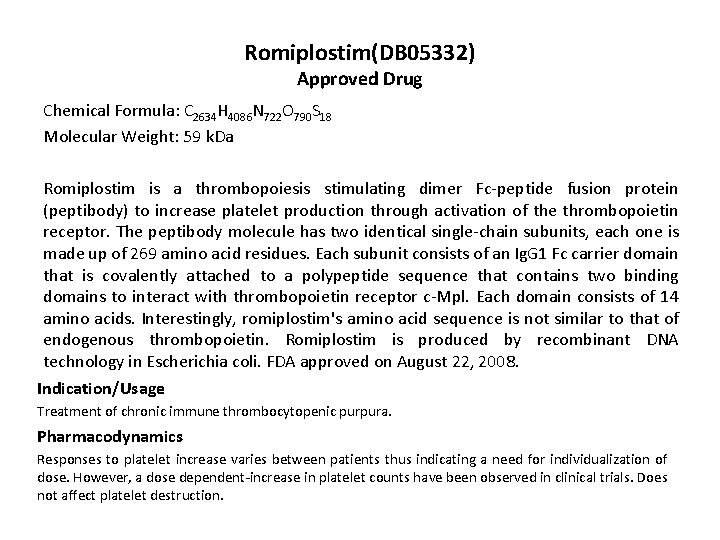
Romiplostim(DB 05332) Approved Drug Chemical Formula: C 2634 H 4086 N 722 O 790 S 18 Molecular Weight: 59 k. Da Romiplostim is a thrombopoiesis stimulating dimer Fc-peptide fusion protein (peptibody) to increase platelet production through activation of the thrombopoietin receptor. The peptibody molecule has two identical single-chain subunits, each one is made up of 269 amino acid residues. Each subunit consists of an Ig. G 1 Fc carrier domain that is covalently attached to a polypeptide sequence that contains two binding domains to interact with thrombopoietin receptor c-Mpl. Each domain consists of 14 amino acids. Interestingly, romiplostim's amino acid sequence is not similar to that of endogenous thrombopoietin. Romiplostim is produced by recombinant DNA technology in Escherichia coli. FDA approved on August 22, 2008. Indication/Usage Treatment of chronic immune thrombocytopenic purpura. Pharmacodynamics Responses to platelet increase varies between patients thus indicating a need for individualization of dose. However, a dose dependent-increase in platelet counts have been observed in clinical trials. Does not affect platelet destruction.
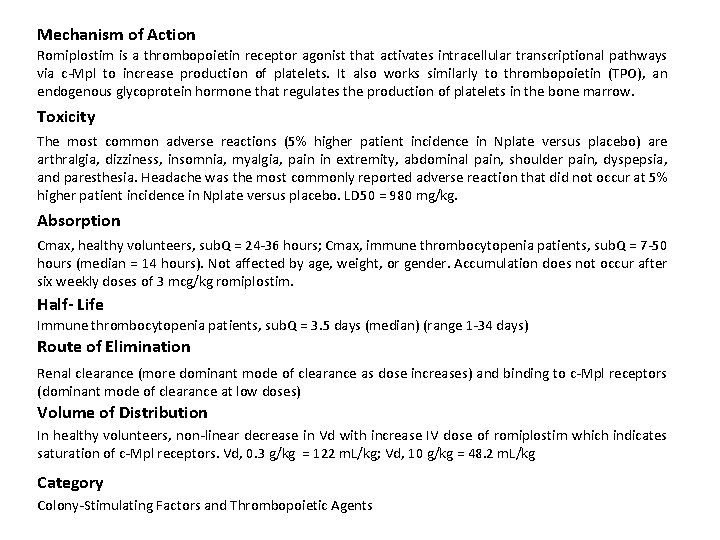
Mechanism of Action Romiplostim is a thrombopoietin receptor agonist that activates intracellular transcriptional pathways via c-Mpl to increase production of platelets. It also works similarly to thrombopoietin (TPO), an endogenous glycoprotein hormone that regulates the production of platelets in the bone marrow. Toxicity The most common adverse reactions (5% higher patient incidence in Nplate versus placebo) are arthralgia, dizziness, insomnia, myalgia, pain in extremity, abdominal pain, shoulder pain, dyspepsia, and paresthesia. Headache was the most commonly reported adverse reaction that did not occur at 5% higher patient incidence in Nplate versus placebo. LD 50 = 980 mg/kg. Absorption Cmax, healthy volunteers, sub. Q = 24 -36 hours; Cmax, immune thrombocytopenia patients, sub. Q = 7 -50 hours (median = 14 hours). Not affected by age, weight, or gender. Accumulation does not occur after six weekly doses of 3 mcg/kg romiplostim. Half- Life Immune thrombocytopenia patients, sub. Q = 3. 5 days (median) (range 1 -34 days) Route of Elimination Renal clearance (more dominant mode of clearance as dose increases) and binding to c-Mpl receptors (dominant mode of clearance at low doses) Volume of Distribution In healthy volunteers, non-linear decrease in Vd with increase IV dose of romiplostim which indicates saturation of c-Mpl receptors. Vd, 0. 3 g/kg = 122 m. L/kg; Vd, 10 g/kg = 48. 2 m. L/kg Category Colony-Stimulating Factors and Thrombopoietic Agents
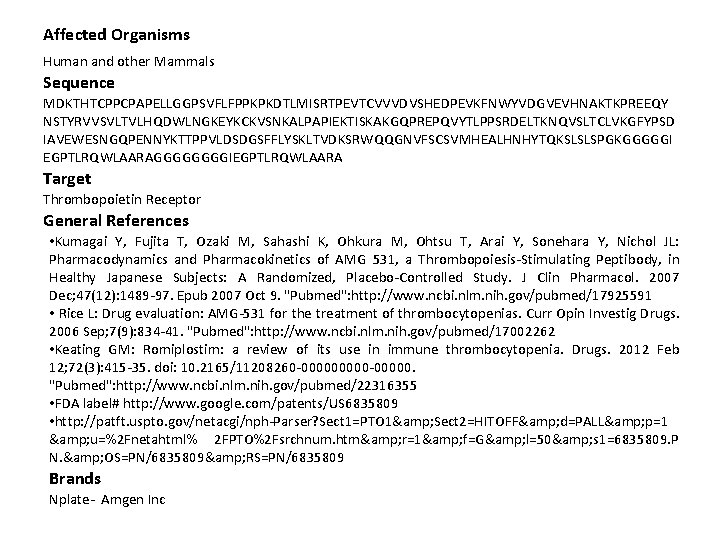
Affected Organisms Human and other Mammals Sequence MDKTHTCPPCPAPELLGGPSVFLFPPKPKDTLMISRTPEVTCVVVDVSHEDPEVKFNWYVDGVEVHNAKTKPREEQY NSTYRVVSVLTVLHQDWLNGKEYKCKVSNKALPAPIEKTISKAKGQPREPQVYTLPPSRDELTKNQVSLTCLVKGFYPSD IAVEWESNGQPENNYKTTPPVLDSDGSFFLYSKLTVDKSRWQQGNVFSCSVMHEALHNHYTQKSLSLSPGKGGGGGI EGPTLRQWLAARAGGGGIEGPTLRQWLAARA Target Thrombopoietin Receptor General References • Kumagai Y, Fujita T, Ozaki M, Sahashi K, Ohkura M, Ohtsu T, Arai Y, Sonehara Y, Nichol JL: Pharmacodynamics and Pharmacokinetics of AMG 531, a Thrombopoiesis-Stimulating Peptibody, in Healthy Japanese Subjects: A Randomized, Placebo-Controlled Study. J Clin Pharmacol. 2007 Dec; 47(12): 1489 -97. Epub 2007 Oct 9. "Pubmed": http: //www. ncbi. nlm. nih. gov/pubmed/17925591 • Rice L: Drug evaluation: AMG-531 for the treatment of thrombocytopenias. Curr Opin Investig Drugs. 2006 Sep; 7(9): 834 -41. "Pubmed": http: //www. ncbi. nlm. nih. gov/pubmed/17002262 • Keating GM: Romiplostim: a review of its use in immune thrombocytopenia. Drugs. 2012 Feb 12; 72(3): 415 -35. doi: 10. 2165/11208260 -00000 -00000. "Pubmed": http: //www. ncbi. nlm. nih. gov/pubmed/22316355 • FDA label# http: //www. google. com/patents/US 6835809 • http: //patft. uspto. gov/netacgi/nph-Parser? Sect 1=PTO 1& Sect 2=HITOFF& d=PALL& p=1 & u=%2 Fnetahtml% 2 FPTO%2 Fsrchnum. htm& r=1& f=G& l=50& s 1=6835809. P N. & OS=PN/6835809& RS=PN/6835809 Brands Nplate- Amgen Inc

Nplate Romiplostim, a member of the TPO mimetic class, is an Fc-peptide fusion protein (peptibody) that activates intracellular transcriptional pathways leading to increased platelet production via the TPO receptor (also known as c. Mpl). The peptibody molecule contains two identical single-chain subunits, each consisting of human immunoglobulin Ig. G 1 Fc domain, covalently linked at the C-terminus to a peptide containing two thrombopoietin receptor-binding domains. Romiplostim has no amino acid sequence homology to endogenous. TPO. Nplate is supplied as a sterile, preservative-free, lyophilized, solid white powder to be administered as subcutaneous injection Formulation Two vial presentations are available, which contain a sufficient amount of active ingredient to provide either 250 mcg or 500 mcg of deliverable romiplostim, respectively. Each single-use 250 mcg vial of Nplate contains the following: 375 mcg romiplostim, 30 mg mannitol, 15 mg sucrose, 1. 2 mg L-histidine, 0. 03 mg polysorbate 20, and sufficient HCl to adjust the p. H to a target of 5. 0. Each single-use 500 mcg vial of Nplate contains the following: 625 mcg romiplostim, 50 mg mannitol, 25 mg sucrose, 1. 9 mg Lhistidine, 0. 05 mg polysorbate 20, and sufficient HCl to adjust the p. H to a target of 5. 0 Used/Prescribed for Nplate is indicated for the treatment of thrombocytopenia in patients with chronic immune thrombocytopenia (ITP) who have had an insufficient response to corticosteroids, immunoglobulins or splenectomy. Dosage The initial dose for Nplate is 1 mcg/kg based on actual body weight, If the platelet count is < 50 x 109/L, increase the dose by 1 mcg/kg, If platelet count is > 200 x 109/L for 2 consecutive weeks, reduce the dose by 1 mcg/kg. , If platelet count is > 400 x 109/L, do not dose. Continue to assess the platelet count weekly. After the platelet count has fallen to < 200 x 109/L, resume Nplate at a dose reduced by 1 mcg/kg.
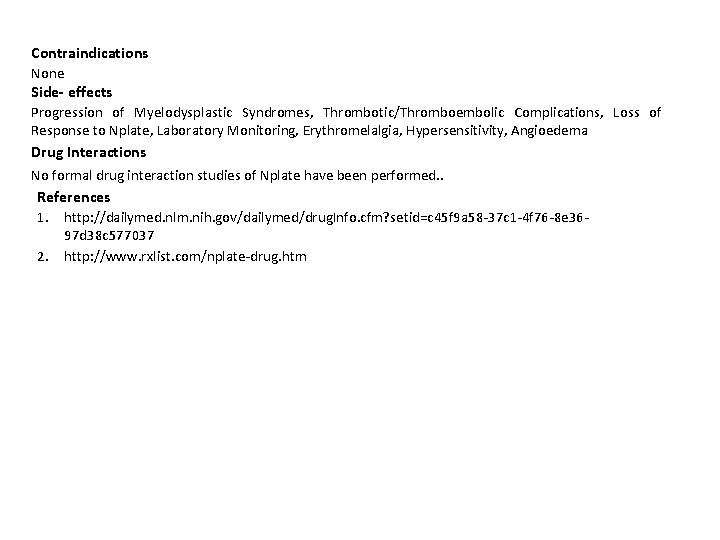
Contraindications None Side- effects Progression of Myelodysplastic Syndromes, Thrombotic/Thromboembolic Complications, Loss of Response to Nplate, Laboratory Monitoring, Erythromelalgia, Hypersensitivity, Angioedema Drug Interactions No formal drug interaction studies of Nplate have been performed. . References 1. http: //dailymed. nlm. nih. gov/dailymed/drug. Info. cfm? setid=c 45 f 9 a 58 -37 c 1 -4 f 76 -8 e 362. 97 d 38 c 577037 http: //www. rxlist. com/nplate-drug. htm
- Slides: 5