Romeo Juliet Literary Terminology Tragedy A form of

- Slides: 16
Romeo & Juliet Literary Terminology
Tragedy • A form of drama based on human suffering that invokes in the audience catharsis (the process of releasing strong or repressed emotions) or pleasure in the viewing (schadenfreude). • So, why do we read tragedies? What to we take pleasure in viewing someone else’s pain?
Tragic Hero • A character who makes a judgment error that ultimately leads to his or her destruction. • Who is the Tragic Hero of Romeo & Juliet? • Can you think of characters from other books or films that fit this description?
Tragic Flaw • The personality trait of the main character that leads to his or her downfall.
Antagonist • A person who actively opposes or is hostile to someone or something; an adversary. • Who is the antagonist of Romeo & Juliet? Why?
Protagonist • The leading character in a story. • An advocate or champion of a particular cause or idea. • Who is the protagonist of Romeo & Juliet? Why?
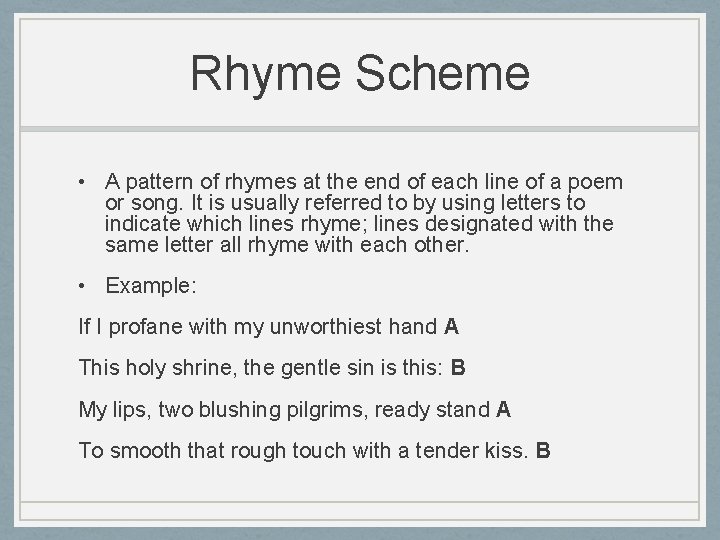
Rhyme Scheme • A pattern of rhymes at the end of each line of a poem or song. It is usually referred to by using letters to indicate which lines rhyme; lines designated with the same letter all rhyme with each other. • Example: If I profane with my unworthiest hand A This holy shrine, the gentle sin is this: B My lips, two blushing pilgrims, ready stand A To smooth that rough touch with a tender kiss. B
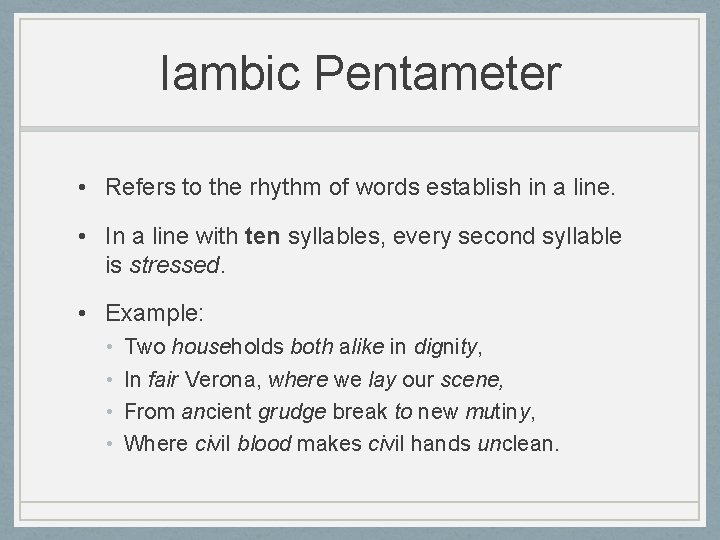
Iambic Pentameter • Refers to the rhythm of words establish in a line. • In a line with ten syllables, every second syllable is stressed. • Example: • • Two households both alike in dignity, In fair Verona, where we lay our scene, From ancient grudge break to new mutiny, Where civil blood makes civil hands unclean.
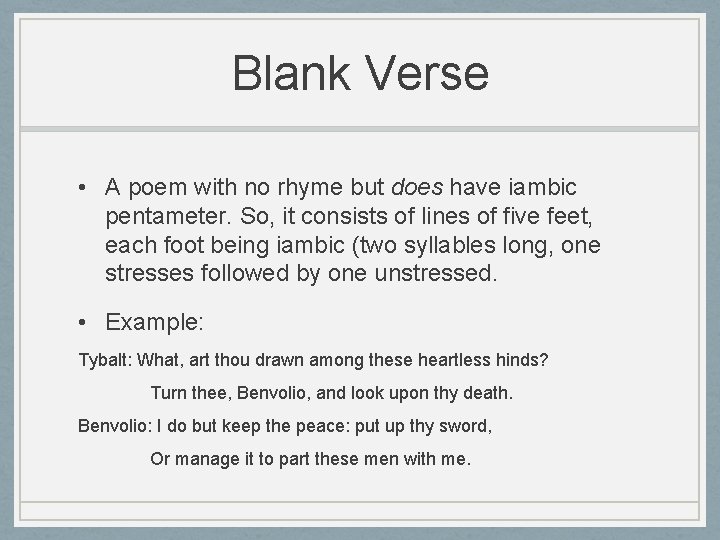
Blank Verse • A poem with no rhyme but does have iambic pentameter. So, it consists of lines of five feet, each foot being iambic (two syllables long, one stresses followed by one unstressed. • Example: Tybalt: What, art thou drawn among these heartless hinds? Turn thee, Benvolio, and look upon thy death. Benvolio: I do but keep the peace: put up thy sword, Or manage it to part these men with me.
Couplet • A pair of lines or metre in poetry. They usually comprise two lines that rhyme and have the same metre. • Example: Juliet: My only love, sprung from my only hate! Too early seen unknown, and known too late!
Quatrain • A type of stanza consisting of four lines. • Written in Iambic Pentameter, the rhyme is ABAB or AABB. • Example: Juliet: Good pilgrim, you do wrong your hand too much, A Which mannerly devotion shows in this; B For saints have hands that pilgrim’s hands do touch, A And palm to palm is holy palmer’s kiss. B
Sonnet • A poem that consists of fourteen lines structured as three quatrains and a couplet. • Generally, sonnets are written in Iambic Pentameter. • The usual rhyme scheme is end-rhymed: a-b-a-b, c-d-c-d, e-f-, g-g. • Examples: The Prologues of Acts One & Two
Monologue • A speech delivered by one person. • Example: The Nurse’s long reminiscence about Juliet in Act One, Scene 3, lines 17 -48.
Soliloquy • A long, usually serious speech that a character makes to an audience and that reveals the character’s thoughts. • Example: At the very beginning of the balcony scene, Romeo recites a soliloquy- Act Two, Scene 2, lines 1 -25.
Aside • A comment spoken by a character in a play that is heard by the audience but is supposedly not heard by the other characters. • Example: Romeo has a couple of asides in Act Two, scene 2 (lines 27 -32 & 37). • Asides are noted in the stages directions.
Juxtaposition • Two things being seen or placed together with contrasting effect. • Example: Romeo: Why then, O brawling love, O loving hate, O any thing, of nothing first create! O heavy lightness, serious vanity; Misshapen chaos or well-seeming forms, Feather of lead, bright smoke, cold fire, sick health, Still-waking sleep, that is not what it is! This love feel I, that feel no love in this.