
Romeo Juliet Feb 19 25 The Tragedy of
Romeo & Juliet Feb 19 -25
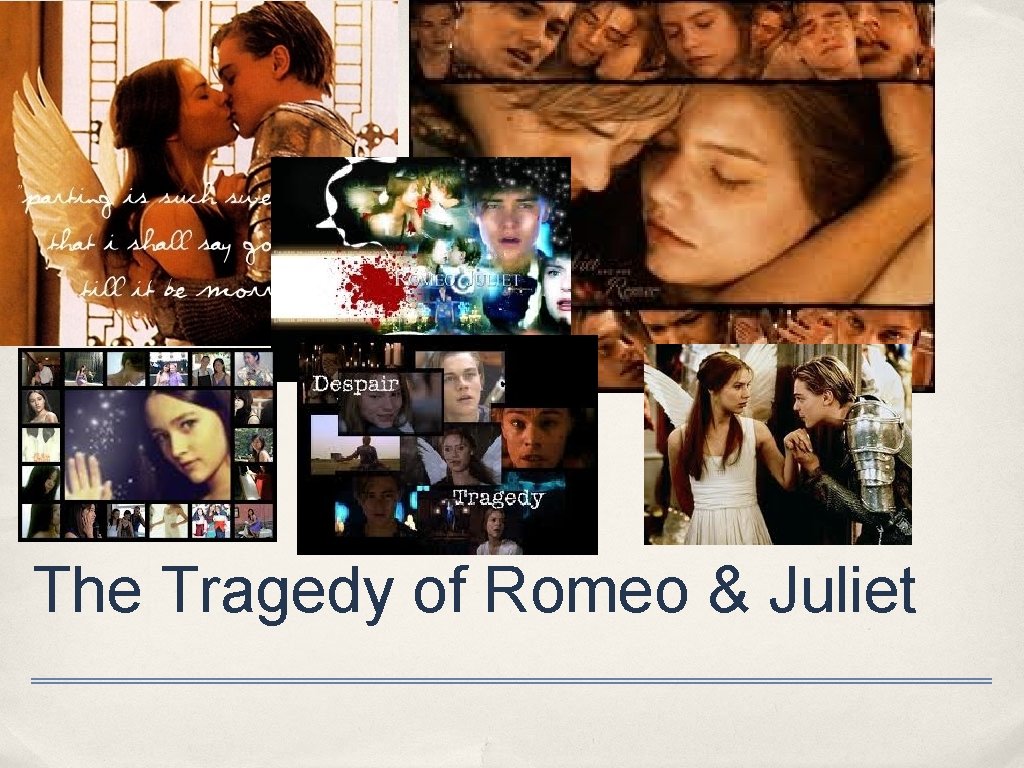
The Tragedy of Romeo & Juliet
Steps for Close Reading ✤ ✤ ✤ Step One: Annotate With Purpose. Underline or highlight key words and phrases, anything that strikes you as surprising or significant, or raises questions. Make notes in the margins, comments and questions. Step Two: Look for patterns in the things you have noticed about the text; repetitions, contradictions, similarities Pay attention to details, vivid language, and precise vocabulary. Step Three: Ask questions about the patterns you’ve noticed, especially those beginning with HOW and WHY. Use your knowledge of literary elements as a guide. For example, if red is repeated, could it be symbolism? Of what? These questions will lead you into considering the deeper theme of the text.
Romeo & Juliet Terms I. Drama - A type of writing that is meant to be performed. II. Tragedy - A play that ends in disaster or misfortune for the main character. In modern drama, the main character can be an ordinary person and the cause of tragedy can be due to the evil of society. III. Aside - A short speech delivered by a character to express his or her true thoughts. Directed toward the audience, and it is presumed that other characters cannot hear it. IV. Monologue - A speech made by a single character on stage addressing other characters I. Soliloquy - A speech made on stage by a single character, but not directed toward other characters. Reveals the characters thoughts and emotions. II. Dialogue - A conversation between two characters on stage III. Blank Verse - Favored by Shakespeare, writing that does not rhyme in any pattern (with the exception of couplets), but when spoken has a beat. The beginning of each line is capitalized. Used by Shakespeare to show passionate or important occasions. ✤ Couplet - Favored by Shakespeare, two lines that usually rhyme, belong together, and often share a similar idea. ✤ Epithet - when an adjective is used to characterize a person, or thing. “Catherine the Great” ✤ Iambic Pentameter - Ten syllables in each line, five pairs of alternating unstressed and stressed syllables to create a rhythm. “If mu-sic be the food of love play on” I. Pun - A play on the different meanings of words, meant to be humorous. Ex: Writing with a broken pencil is pointless. ✤ Dramatic Irony- In a play, when the author is aware of something the character is not. II. Prose- ordinary speech, no rhythm, no rhyme. Shakespeare used prose when writing weird, simple, or everyday life lines.
- Slides: 4