
Romeo and Juliet Vocabulary List 6 Spring 2018
Romeo and Juliet Vocabulary List 6 Spring 2018
List 7 Vocabulary 1. Monologue – a long speech directed at other characters onstage 2. Oxymoron – combination of two contradictory elements 3. Chorus – character in a play who speaks the prologue or comments on the action with song, dance, or recitation 4. Staging – the process of selecting, designing, adapting to, or modifying the performance space for a play or film 5. Soliloquy – when a character speaks their thoughts aloud when alone onstage 6. Aside - when a character speaks but is not heard by the other actors on the stage. Asides are useful for giving the audience special information about the other characters onstage or the action of the plot.
List 7 Continued 7. Paradox – a seemingly contradictory statement that may prove to be true upon further analysis. Examples: “I know that I know nothing at all” “Be cruel to be kind. ” “Less is more” “The deceiver claimed ‘All men are liars’. ” 8. Tragedy - a type of play that presents a serious subject matter about human suffering and corresponding terrible events in a dignified manner. 9. Foil - a character that shows qualities that are in contrast with the qualities of another characte 10. Character – Round – a complex character who is very realistic and develops throughout the course of the story. 11. Character – Flat – a one-dimensional character lacking complexity. 12. Comic Relief – an amusing scene or situation in a serious/tragic setting (like a play) that provides temporary relief from tension or dramatic action.
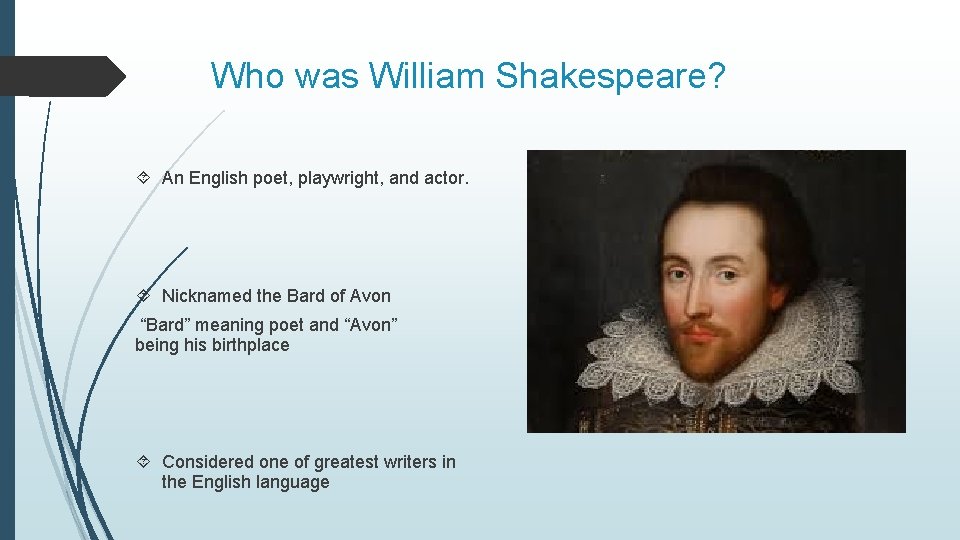
Who was William Shakespeare? An English poet, playwright, and actor. Nicknamed the Bard of Avon “Bard” meaning poet and “Avon” being his birthplace Considered one of greatest writers in the English language
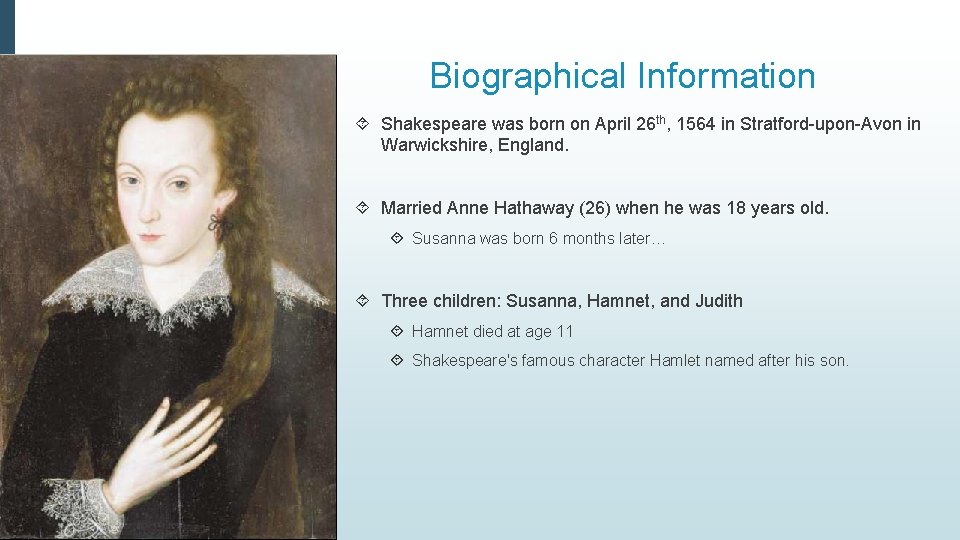
Biographical Information Shakespeare was born on April 26 th, 1564 in Stratford-upon-Avon in Warwickshire, England. Married Anne Hathaway (26) when he was 18 years old. Susanna was born 6 months later… Three children: Susanna, Hamnet, and Judith Hamnet died at age 11 Shakespeare's famous character Hamlet named after his son.
Shakespeare’s Career Shakespeare’s writings can be divided into 4 subgenres: sonnets, comedies, histories, and tragedies. Shakespeare wrote 39 plays and 154 sonnets, Some of his most famous plays include Romeo and Juliet, Macbeth, Hamlet, King Lear, Othello, Julius Ceaser, A Midsummer Night’s Dream, etc. His plays were performed by a theater company known as the Lord Chamberlain’s Men (named after the man in charge of court entertainment during the reign of Queen Elizabeth I). This company was later renamed The King’s Men (during the reign of King James). Shakespeare was their house playwright. Queen Elizabeth and King James were both patrons of this company, one of the largest in London. Shakespeare was an actor and would take on the roles of secondary characters in his own plays
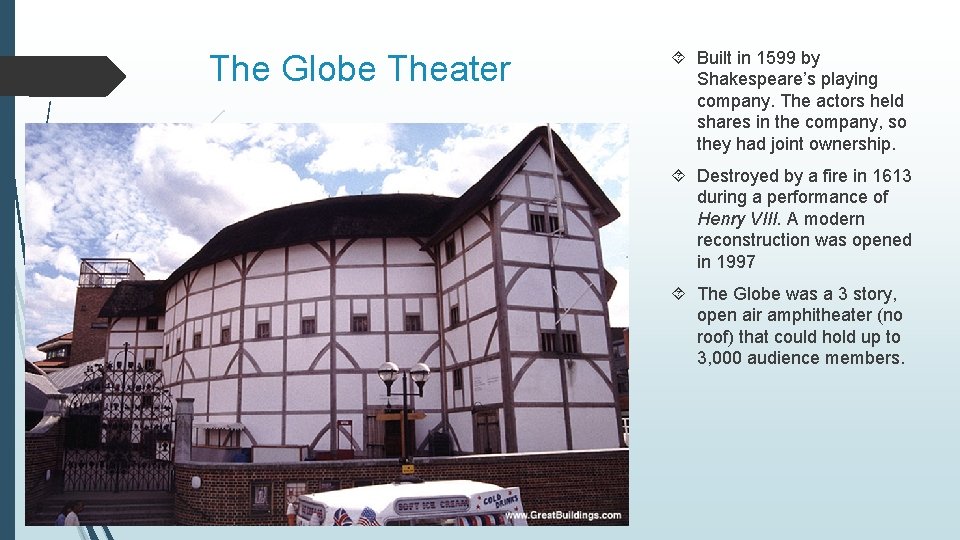
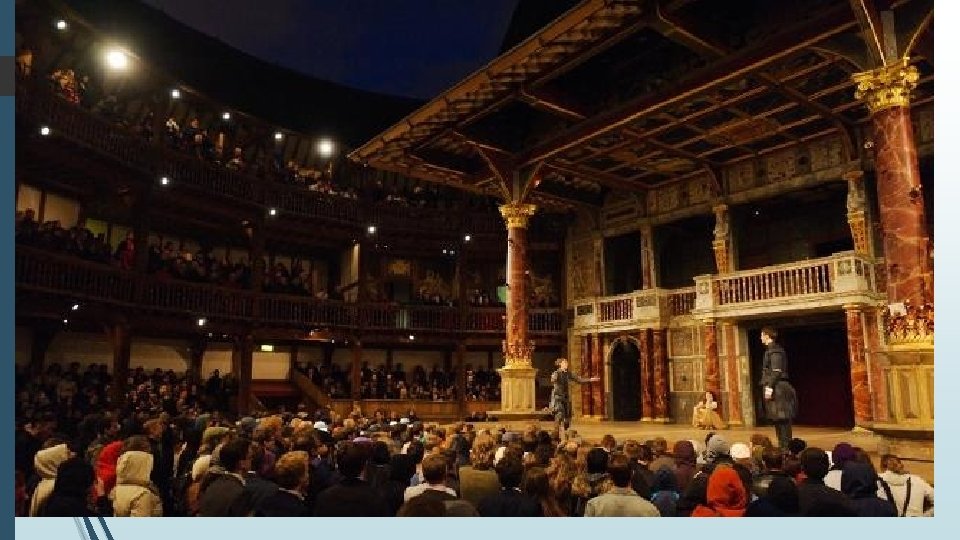
The Globe Theater Built in 1599 by Shakespeare’s playing company. The actors held shares in the company, so they had joint ownership. Destroyed by a fire in 1613 during a performance of Henry VIII. A modern reconstruction was opened in 1997 The Globe was a 3 story, open air amphitheater (no roof) that could hold up to 3, 000 audience members.
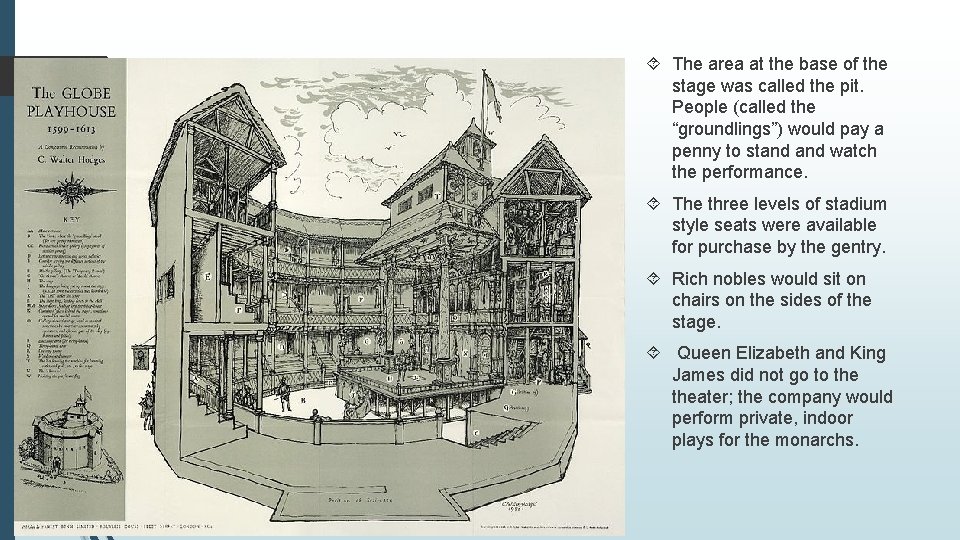
The area at the base of the stage was called the pit. People (called the “groundlings”) would pay a penny to stand watch the performance. The three levels of stadium style seats were available for purchase by the gentry. Rich nobles would sit on chairs on the sides of the stage. Queen Elizabeth and King James did not go to theater; the company would perform private, indoor plays for the monarchs.
The Elizabethan Era, England’s “Golden Age” The period of history during the reign of Queen Elizabeth (1558 -1603) The height of the English Renaissance, a cultural and artistic movement dating from the late 15 th-early 17 th centuries. Poetry, music, literature, and theater developed Age of exploration and expansion abroad. Virginia was “discovered” and colonized. Sir Walter Raleigh founded the Roanoke Colony, aka the Lost Colony.
Shakespeare’s Death and Legacy He died on April 23, 1616 at the age of 52. Expanded the potential of characterization, plot, language, and genre Before Romeo and Juliet, romance was not considered a topic for a tragedy Soliloquys were usually used to convey info about characters or events, but Shakespeare used them to give us insight into the character’s minds. 20, 000 pieces of music connected to his works Influenced famous authors such as Dickens and Melville Psychologist Sigmund Freud drew on Shakespearean psychology The Golden Age was an age of exploration; consequently, the English language was evolving. Shakespeare recorded these changes in writing and originated some of his own. “All that glitters is not gold”, “Dog will have his day”, “cold comfort”, “faint hearted”, “for goodness sakes”, “Full circle”, “the game is afoot”, “jealously is the green eyed monster”, “Its all Greek to me” etc.
- Slides: 11