
ROME CHAPTER 12 Decline and legacy of the
- Slides: 9
ROME, CHAPTER 12 Decline and legacy of the Roman Empire
I. Crumbling of an Empire A. When the Pax Romana ended, it was followed by approximately 100 years of chaos. B. Some of the problems were internal, meaning within the empire itself. Other problems were external—outside forces attacking parts of the empire. C. Here are some of the internal factors that contributed to the instability: 1. The army had grown very powerful and demanded higher and higher wages to ensure their loyalty to the emperor. If the emperor could not pay, they would attempt a coup (overthrow). 2. The legions would then turn on each other, and would fight civil wars over which emperor should be on the throne. 3. This cycle was so out of control, that during a period of 50 years, Rome had between 22 -26 emperors, most of whom were murdered by the army or their own bodyguards. 4. Traditional Roman values of loyalty, virtue, and courage were ignored. 5. Corruption within the government was rampant, with officials taking bribes and openly lying to the public. 6. Talented and capable individuals did not want to be part of the government. 7. Education lost its importance 8. Many wealthy Romans stopped paying their taxes. 9. Wandering bands of Roman soldiers and foreign invaders attacked farms loss of crops food shortages higher food prices less money for other goods decrease in profits from trade increase in unemployment. 10. The government responded to the economic problems by making more coins but with less silver and gold in them, which meant their value was decreased. Farmers and merchants were forced to raise prices even more to make a profit. The combination of increased prices with a decrease in the value of currency is an economic problem called INFLATION.
II. Crumbling of an Empire, part 2—External Threats (Rome had 99 problems, and invasion was one!) A. Germanic tribes were attacking from the west, and Persians from the east B. In the A. D. 300 s and 400 s, Germanic tribes had been taking lands from the Roman empire—sometimes through battles, and other times just by settling those areas. C. Some of them were seeking better farmlands, while others were trying to escape their enemies—the Huns (fierce warriors from Mongolia in Asia) D. The Visigoths (Visi means WEST; Ostro means EAST, so their name means the Germanic people from the west): had asked the Roman empire for protection in return for their promise to not attack Rome. The Visigoths kept their promise, but the Romans were cruel to them—overcharging them for food and forcing many Visigoths into slavery. E. So, the Visigoths rebelled! They defeated the Romans at the battle of Adrianople. F. This inspired other Germanic people to attack different parts of the Roman Empire: places like Gaul (in modern-day France) and North Africa. In A. D. 410, Alaric led his Germanic forces into Italy and captured Rome. G. Another group called the Vandals attacked Roman lands in Spain and North Africa; then they crossed the Mediterranean, invaded Italy, and entered Rome in AD 455. they looted the city and burned the buildings as they were passing through. H. A German general in the Roman army named Odoacer led his troops, including ROMANS, and overthrew the emperor Romulus Augustus. From this moment on, no Roman emperor would ever again rule from Rome. (more on this later…for now, we need to rewind a bit)
III. Attempts to save the Empire A. Back in A. D. 284, when the problems were already obvious, Diocletian became emperor and tried to fix the problems. 1. He built forts along the frontiers 2. Divided the empire into four parts that report to him 3. Set a limit on prices for goods and on wages B. However, his laws failed to make the empire more efficient; they were largely disobeyed, and he lacked the power to enforce them. C. As soon as Diocletian left office in AD 305, fighting broke out again throughout the empire (remember that Rome didn’t just have outside threats, they had been fighting civil wars for decades) D. In AD 312, a general named Constantine became emperor. He attempted to stabilize the empire by reinforcing Diocletian’s laws and economic reforms. But these are not the actions for which Constantine is best known. 1. For one thing, he moved the capital of the empire from Rome in Italy to Byzantium, a city in Asia Minor, in modern-day Turkey (specifically, in what is today Istanbul). The city was renamed Constantinople. 2. But Constantine’s biggest claim-to-fame is that he was the first Roman emperor to profess Christianity. Prior to him, Christians in the Empire were persecuted and often killed (brutally), but Constantine not only tolerated Christianity, he converted to the religion.
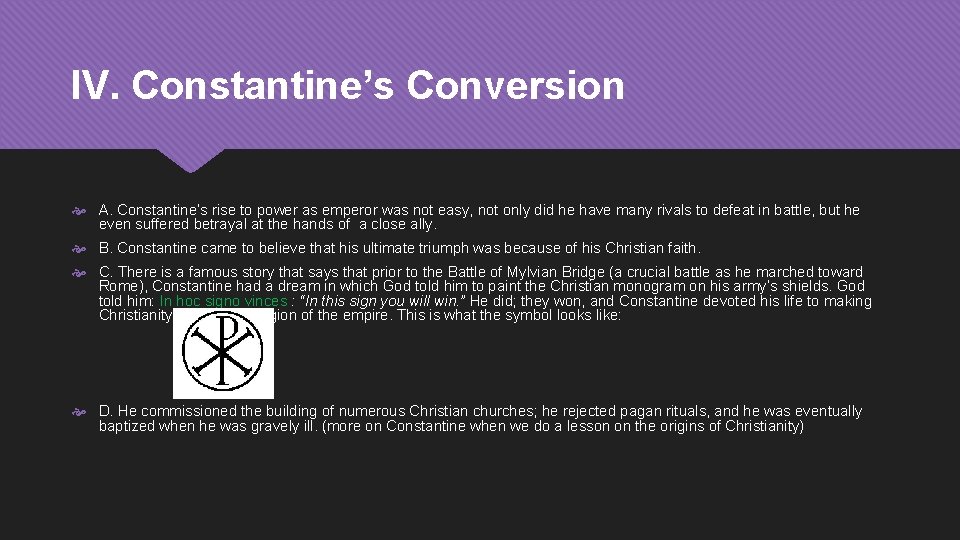
IV. Constantine’s Conversion A. Constantine’s rise to power as emperor was not easy, not only did he have many rivals to defeat in battle, but he even suffered betrayal at the hands of a close ally. B. Constantine came to believe that his ultimate triumph was because of his Christian faith. C. There is a famous story that says that prior to the Battle of Mylvian Bridge (a crucial battle as he marched toward Rome), Constantine had a dream in which God told him to paint the Christian monogram on his army’s shields. God told him: In hoc signo vinces : “In this sign you will win. ” He did; they won, and Constantine devoted his life to making Christianity the official religion of the empire. This is what the symbol looks like: D. He commissioned the building of numerous Christian churches; he rejected pagan rituals, and he was eventually baptized when he was gravely ill. (more on Constantine when we do a lesson on the origins of Christianity)
V. After Constantine A. After Constantine’s death, Theodosius became emperor. He believed that the empire was too large, and he made a decision of historic proportions—Theodosius decided that upon his death, the empire should be divided into two parts: B. The Western Roman Empire would have its capital in Rome C. The Eastern Roman Empire would have its capital in Constantinople D. The Roman Empire would no longer be one, unified empire. The two newly created empires would have separate capitals, different emperors, and they would end up having very different histories. E. Spoiler alert: by AD 445, the Western Roman Empire would be ruled by Germanic leaders, not Romans, and by AD 550, the Western Roman Empire ceased to exist. 1. The Germanic tribes had taken over in the 440’s, but they never united with one another to maintain ONE unified western empire. Remember the German general Odoacer who had conquered Rome? He was killed when the Visigoths attacked Rome, and he was replaced by Theodoric who set up a new kingdom in Italy. 2. Other Germanic kingdoms were established throughout other parts of what used to be the Western Roman Empire; thus, that part of Europe became a bunch of separate kingdoms instead of ONE empire. 2. On the other hand, the Eastern Roman Empire thrived and continued to exist for approximately a thousand years (when the Ottoman Turks conquered Constantinople and renamed it Istanbul)
VI. The Cultural Legacy of Rome A. Despite the division of the Empire into two parts, and the demise of the Western part of the empire, the influence of Roman culture (its LEGACY) would live on. So let’s delve into Roman culture: B. Religion and philosophy 1. Originally, the Romans were polytheistic. Their most important gods were borrowed from the Greek religion, but their names were changed to Roman ones (for ex. Zeus=Jupiter, Athena=Minerva, Aphrodite=Venus, Hades=Pluto, Poseidon=Neptune, Ares=Mars, Hermes=Mercury). 2. Starting with Augustus, they also began to see the emperors as gods. 3. One of the most popular philosophies in ancient Rome was Stoicism (remember that from when we studies Greece? ) Roman Stoics focused on living practical lives, including being involved in the political life of the community, and treating people fairly—even those they conquered, with one exception… 4. Despite the focus on fair treatment, the Romans did enslave captured enemies, and they often treated their slaves poorly, which sometimes led to slave revolts Famous example: Spartacus, a former enslaved gladiator, led a massive slave rebellion in 73 BC. His army grew to anywhere from 70, 000 to 100, 00 and engaged in guerrilla warfare tactics. Their rebellion was finally crushed in 72 BC; Spartacus was probably killed in that last battle; survivors were hunted down and killed—some were crucified.
Cultural legacy continued… C. Science and art in the Roman world was also heavily influenced by the Greeks. They adopted Galen’s work on anatomy and Ptolemy’s ideas about astronomy—including the erroneous belief that the sun moves around the earth) D. Roman numerals, which are based on letters, are still used today E. Their architecture was outstanding with many structures that still survive despite wars, earthquakes, and the ravages of time. 1. They used arches and built aqueducts; 2. their way of building tunnels and bridges still influence our modern architecture, 3. and their concrete mix which included volcanic ash and stone is actually stronger than the concrete we use today! 4. Our highway system replicates their own. F. Their literature was influenced by the Greeks, with emphasis on epic poetry and plays. Virgil is the best-known Roman poet. G. Roman historians Livy and Tacitus were inspired by Greek historian Herodotus H. Roman language , Latin, spread throughout the empire and FAR outlived the empire itself. 1. Latin was used throughout Europe in government, church, trade, and education until about AD 1500. 2. Latin is the basis for Spanish, Italian, Portuguese, and French. 3. Latin is also the root for many words we use in English. 4. The Germanic people who took over in the Western Roman Empire, adopted Latin as their language. I. Christianity: as you recall, Constantine embraced Christianity. It would become the official religion of the empire. That is a legacy that is still obvious today. Not only is the Christian faith the primary religion throughout Europe, it is also the religion that European settlers and conquerors would take to the people of all the parts of the world they colonized in later centuries (including America).
1. One of the issues that led to Rome’s instability was the fact that many of the wealthier Romans stopped paying taxes. Explain what the effects of the wealthiest members of a society refusing to pay taxes could be. 2. Based on the contents of these notes, where do you think the word VANDALISM came from? Questions: 3. What pattern do you notice about the Roman god names? 4. The Romans eventually came to consider their emperors as gods. Which other civilization that we have studied does this remind you of? How so? 5. Look at the problems that led to the decline of the Roman empire, find at least ONE that we are currently facing in the United States and explain how it is manifesting itself in our country.