
Romberg Rule of Integration 1 Basis of Romberg
Romberg Rule of Integration 1
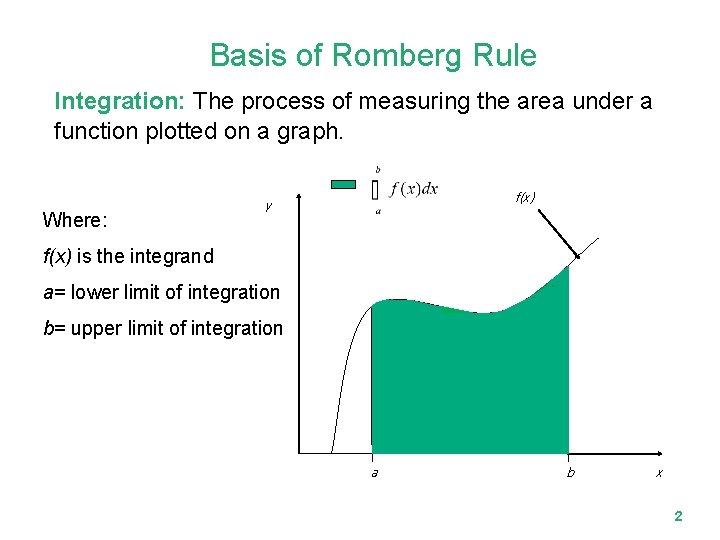
Basis of Romberg Rule Integration: The process of measuring the area under a function plotted on a graph. Where: f(x) y f(x) is the integrand a= lower limit of integration b= upper limit of integration a b x 2

What is The Romberg Rule? Romberg Integration is an extrapolation formula of the Trapezoidal Rule for integration. It provides a better approximation of the integral by reducing the True Error. 3
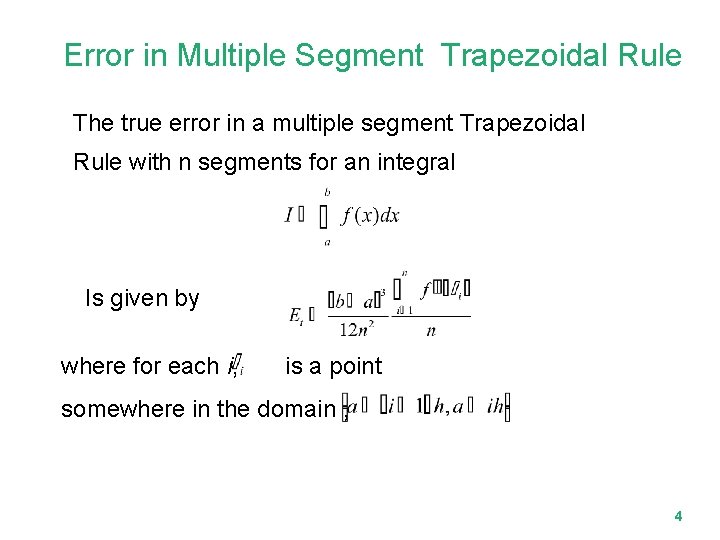
Error in Multiple Segment Trapezoidal Rule The true error in a multiple segment Trapezoidal Rule with n segments for an integral Is given by where for each i, is a point somewhere in the domain , 4
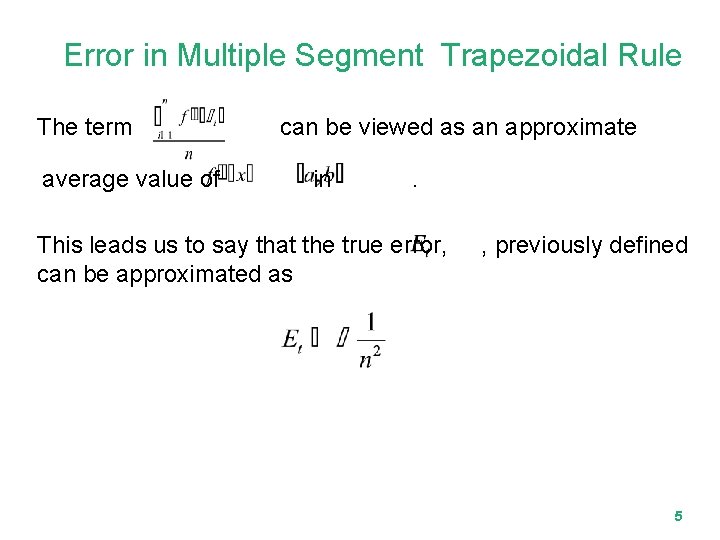
Error in Multiple Segment Trapezoidal Rule The term average value of can be viewed as an approximate in . This leads us to say that the true error, can be approximated as , previously defined 5
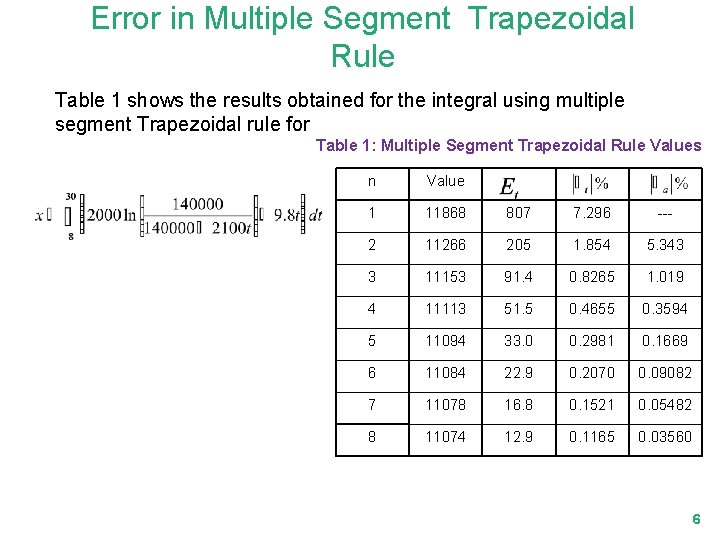
Error in Multiple Segment Trapezoidal Rule Table 1 shows the results obtained for the integral using multiple segment Trapezoidal rule for Table 1: Multiple Segment Trapezoidal Rule Values n Value 1 11868 807 7. 296 --- 2 11266 205 1. 854 5. 343 3 11153 91. 4 0. 8265 1. 019 4 11113 51. 5 0. 4655 0. 3594 5 11094 33. 0 0. 2981 0. 1669 6 11084 22. 9 0. 2070 0. 09082 7 11078 16. 8 0. 1521 0. 05482 8 11074 12. 9 0. 1165 0. 03560 6
Error in Multiple Segment Trapezoidal Rule The true error gets approximately quartered as the number of segments is doubled. This information is used to get a better approximation of the integral, and is the basis of Richardson’s extrapolation. 7
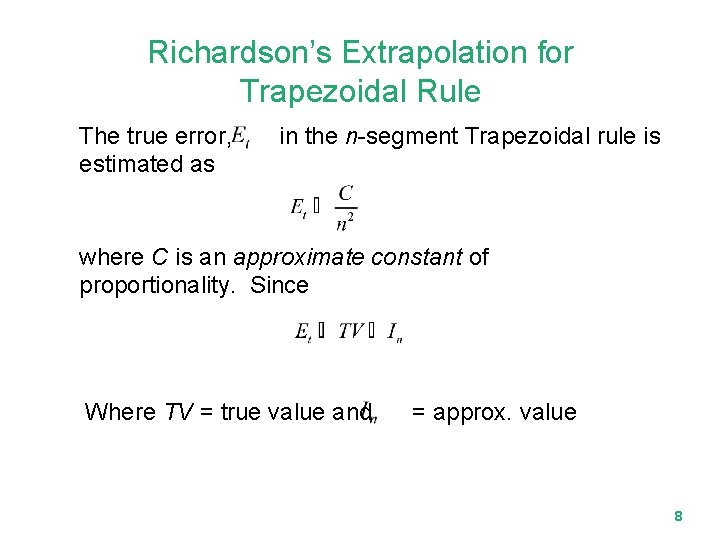
Richardson’s Extrapolation for Trapezoidal Rule The true error, estimated as in the n-segment Trapezoidal rule is where C is an approximate constant of proportionality. Since Where TV = true value and = approx. value 8
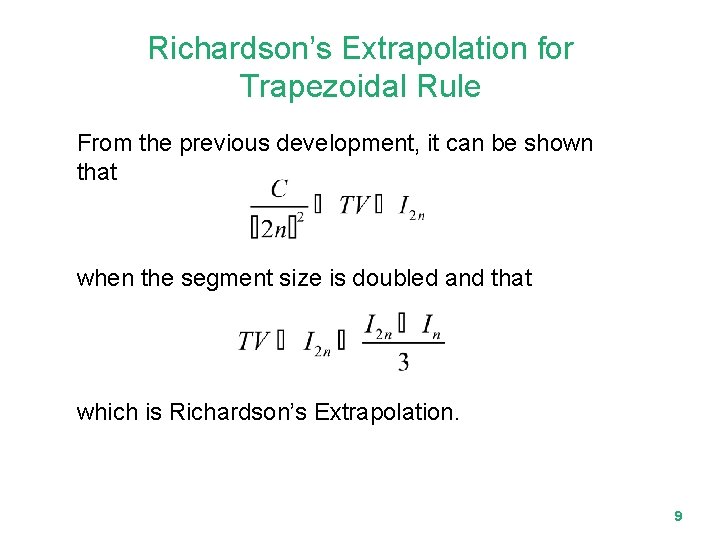
Richardson’s Extrapolation for Trapezoidal Rule From the previous development, it can be shown that when the segment size is doubled and that which is Richardson’s Extrapolation. 9
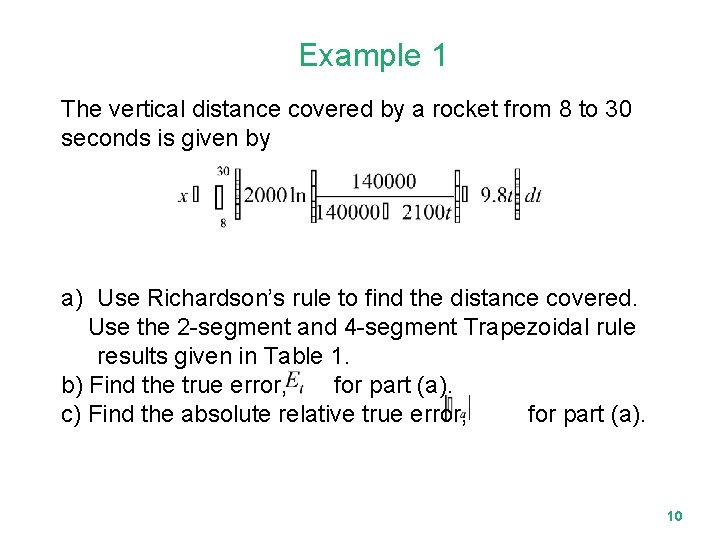
Example 1 The vertical distance covered by a rocket from 8 to 30 seconds is given by a) Use Richardson’s rule to find the distance covered. Use the 2 -segment and 4 -segment Trapezoidal rule results given in Table 1. b) Find the true error, for part (a). c) Find the absolute relative true error, for part (a). 10
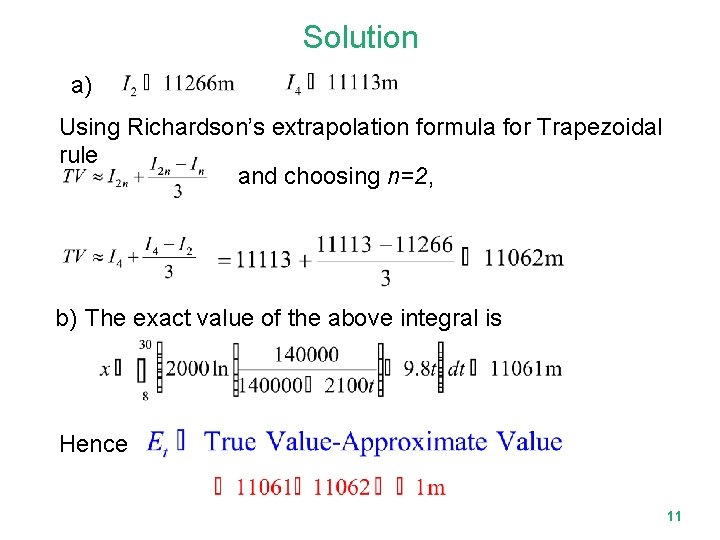
Solution a) Using Richardson’s extrapolation formula for Trapezoidal rule and choosing n=2, b) The exact value of the above integral is Hence 11
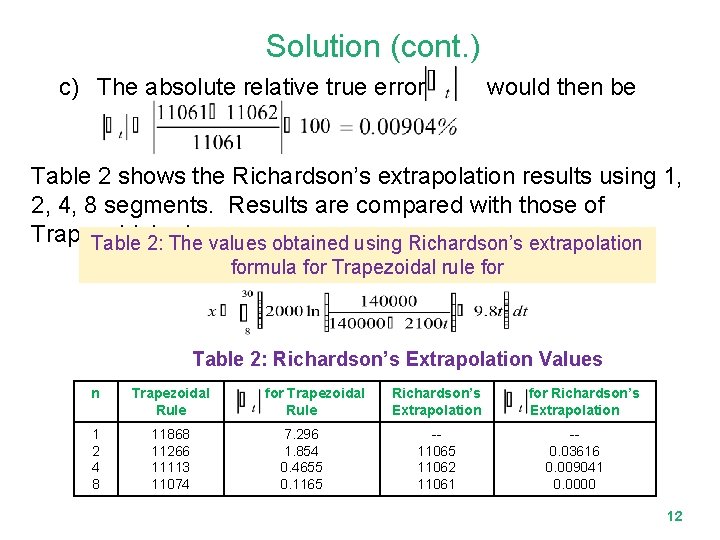
Solution (cont. ) c) The absolute relative true error would then be Table 2 shows the Richardson’s extrapolation results using 1, 2, 4, 8 segments. Results are compared with those of Trapezoidal Table 2: rule. The values obtained using Richardson’s extrapolation formula for Trapezoidal rule for Table 2: Richardson’s Extrapolation Values n Trapezoidal Rule 1 2 4 8 11868 11266 11113 11074 for Trapezoidal Rule 7. 296 1. 854 0. 4655 0. 1165 Richardson’s Extrapolation -11065 11062 11061 for Richardson’s Extrapolation -0. 03616 0. 009041 0. 0000 12
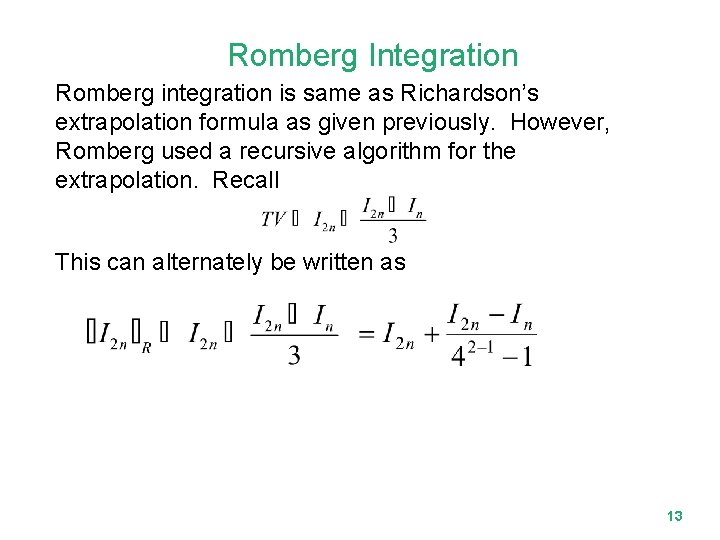
Romberg Integration Romberg integration is same as Richardson’s extrapolation formula as given previously. However, Romberg used a recursive algorithm for the extrapolation. Recall This can alternately be written as 13

Romberg Integration Note that the variable TV is replaced by as the value obtained using Richardson’s extrapolation formula. Note also that the sign is replaced by = sign. Hence the estimate of the true value now is Where error. is an approximation of the true 14

Romberg Integration Determine another integral value with further halving the step size (doubling the number of segments), It follows from the two previous expressions that the true value TV can be written as 15

Romberg Integration A general expression for Romberg integration can be written as The index k represents the order of extrapolation. k=1 represents the values obtained from the regular Trapezoidal rule, k=2 represents values obtained using the true estimate as O(h 2). The index j represents the more and less accurate estimate of the integral. 16
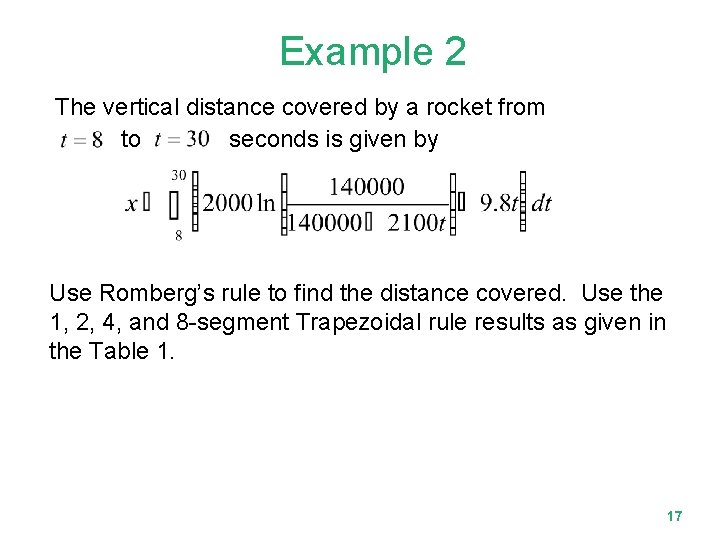
Example 2 The vertical distance covered by a rocket from to seconds is given by Use Romberg’s rule to find the distance covered. Use the 1, 2, 4, and 8 -segment Trapezoidal rule results as given in the Table 1. 17
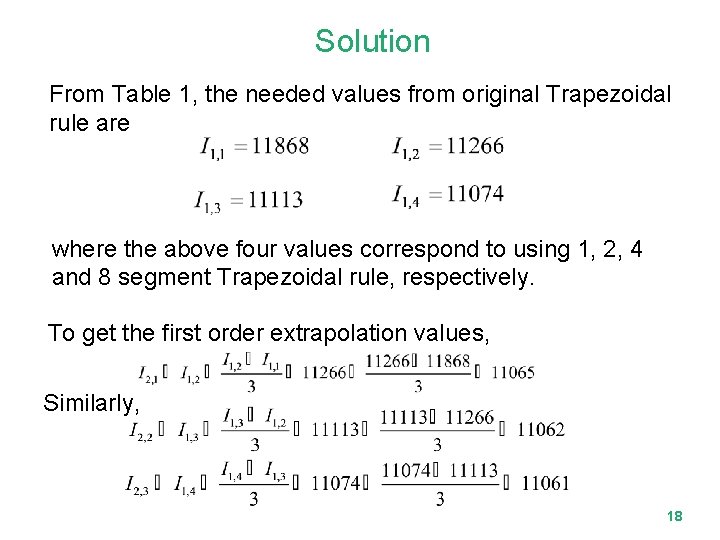
Solution From Table 1, the needed values from original Trapezoidal rule are where the above four values correspond to using 1, 2, 4 and 8 segment Trapezoidal rule, respectively. To get the first order extrapolation values, Similarly, 18

Solution (cont. ) For the second order extrapolation values, Similarly, For the third order extrapolation values, 19
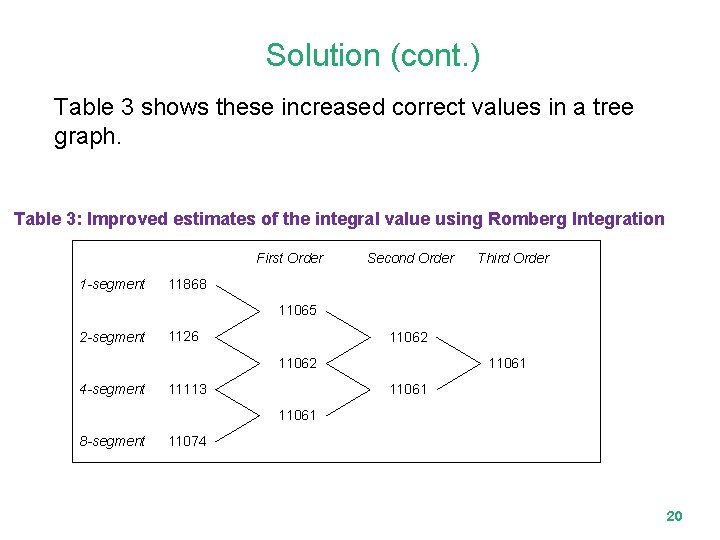
Solution (cont. ) Table 3 shows these increased correct values in a tree graph. Table 3: Improved estimates of the integral value using Romberg Integration First Order 1 -segment Second Order Third Order 11868 11065 2 -segment 1126 11062 4 -segment 11113 11061 8 -segment 11074 20
- Slides: 20