
Romanticism Romanticism was an international artistic and philosophical
- Slides: 8
Romanticism • Romanticism was an international artistic and philosophical movement • The early Romantic period coincided with the “age of revolutions” (in America and France) • The 1798 publication of Lyrical Ballads by Wordsworth and Coleridge is often seen as the starting point of the movement in England • The strongholds of the movement were in England Germany
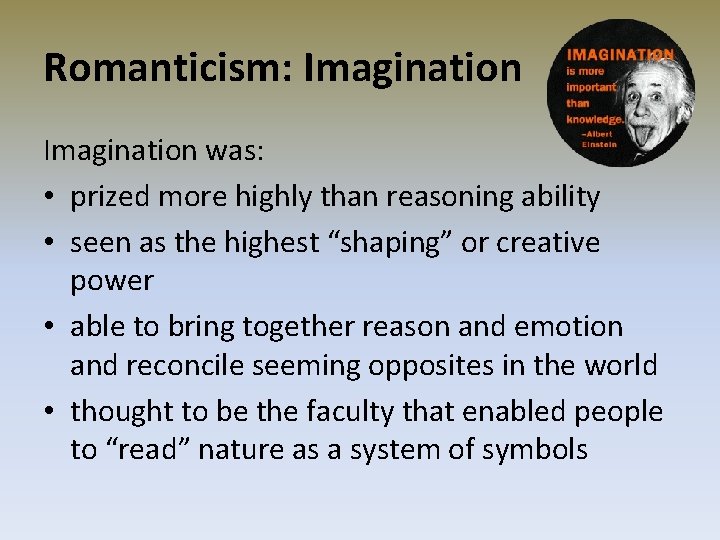
Romanticism: Imagination was: • prized more highly than reasoning ability • seen as the highest “shaping” or creative power • able to bring together reason and emotion and reconcile seeming opposites in the world • thought to be the faculty that enabled people to “read” nature as a system of symbols
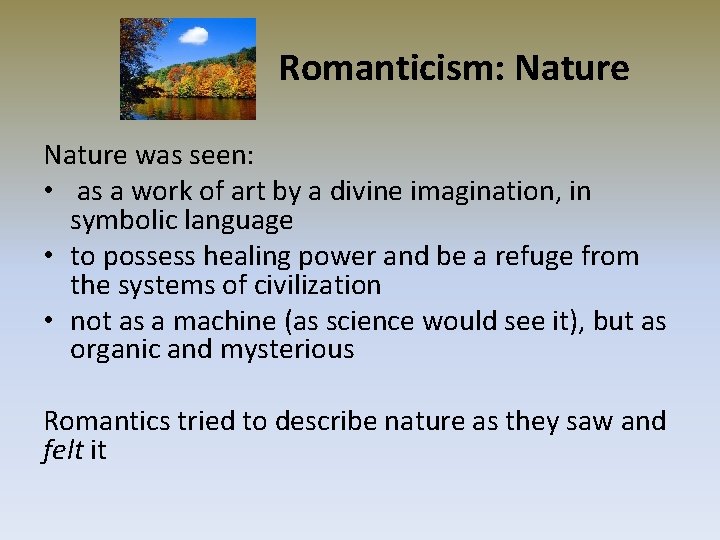
Romanticism: Nature was seen: • as a work of art by a divine imagination, in symbolic language • to possess healing power and be a refuge from the systems of civilization • not as a machine (as science would see it), but as organic and mysterious Romantics tried to describe nature as they saw and felt it
Romanticism: Symbolism and Myth Symbolism was: • seen as the human equivalent to nature’s emblematic language • valued because it could suggest multiple things and express the “inexpressible” – like complex emotions Myth was used to express natural truths. Horrific and gothic themes were explored. The emotions sought for when discussing man’s proper attitude toward nature were wonder and awe.
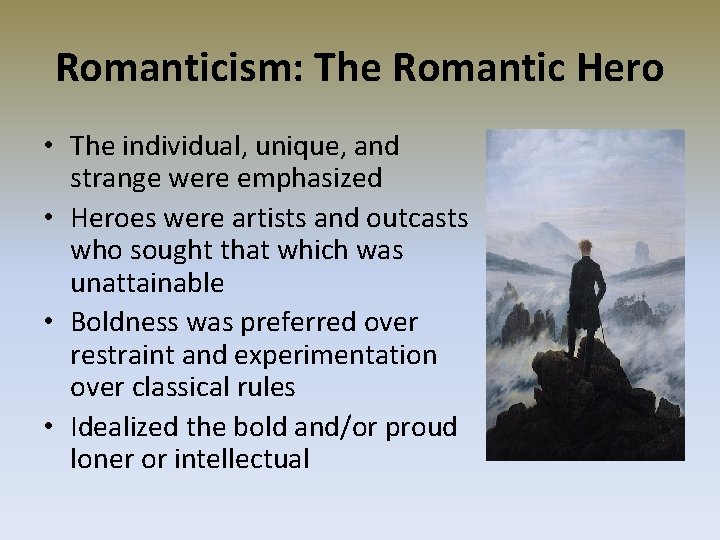
Romanticism: The Romantic Hero • The individual, unique, and strange were emphasized • Heroes were artists and outcasts who sought that which was unattainable • Boldness was preferred over restraint and experimentation over classical rules • Idealized the bold and/or proud loner or intellectual
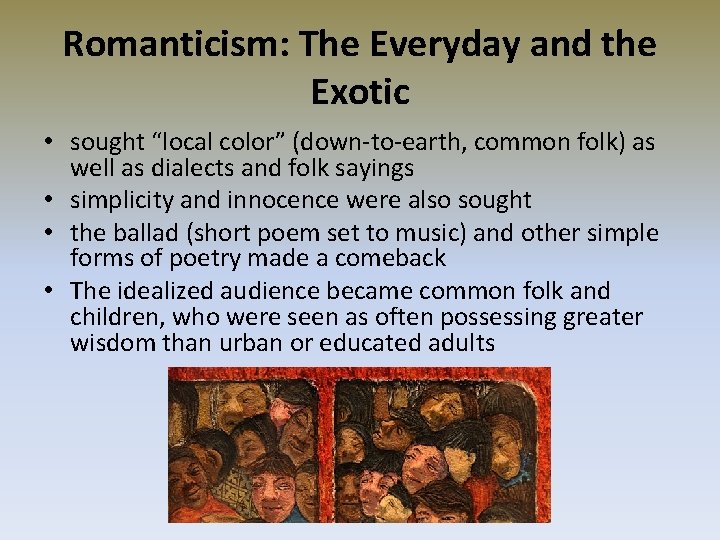
Romanticism: The Everyday and the Exotic • sought “local color” (down-to-earth, common folk) as well as dialects and folk sayings • simplicity and innocence were also sought • the ballad (short poem set to music) and other simple forms of poetry made a comeback • The idealized audience became common folk and children, who were seen as often possessing greater wisdom than urban or educated adults
Romanticism: Other Concepts • Intuition, instincts, and feelings were emphasized • Emotions were seen as a necessary supplement to logic • Art was not valuable as a mirror for the external world, but as a source of illumination of the internal world of the mind and heart • First-person lyric poetry became popular and more autobiographical as the inner-lives of individuals became an important subject
Common Types of Lyric Poetry • Ballad: poetry (usually a narrative/story) set to music • Ode: a lyrical verse written in praise of, or dedicated to someone or something which captures the poet's interest or serves as inspiration • Pastoral: shows the country life (shepherds and whatnot) in an idealized, positive way