
ROMANTICISM PERIOD Historical Context 1800 1850 ish time


- Slides: 21
ROMANTICISM PERIOD
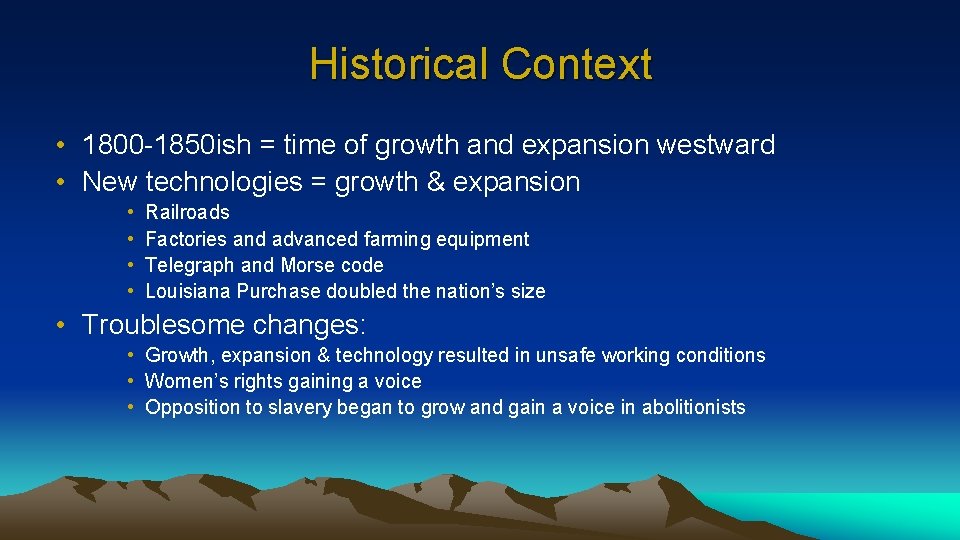
Historical Context • 1800 -1850 ish = time of growth and expansion westward • New technologies = growth & expansion • • Railroads Factories and advanced farming equipment Telegraph and Morse code Louisiana Purchase doubled the nation’s size • Troublesome changes: • Growth, expansion & technology resulted in unsafe working conditions • Women’s rights gaining a voice • Opposition to slavery began to grow and gain a voice in abolitionists
What is Romanticism? n. A literary and artistic movement that placed an emphasis on imagination (over reason), emotion (over fact), individuality (defining this for Americans), and nature (above all)
Who are the Romantics? n Before 1800 American writers were not widely read – Romantics changed this n These writers define the American voice – personal and bold n These writers defined one of the primary themes of American writing: the quest of the individual to define himself n Bright vs. Dark Romantics
Who are the Bright Romantics? n The Bright Romantics looked at the OPTIMISTIC aspects of Romanticism n William C. Bryant Henry W. Longfellow Oliver W. Holmes James R. Lowell John G. Whittier n n “Fireside Poets”
WHAT IS DARK-ROMANTICISM? n Same attributes of Romanticism but tends to accent the fantastic/negative aspects of human experience more (PESSIMISTIC) n Some works characterized as part of the literary genre known as: gothic
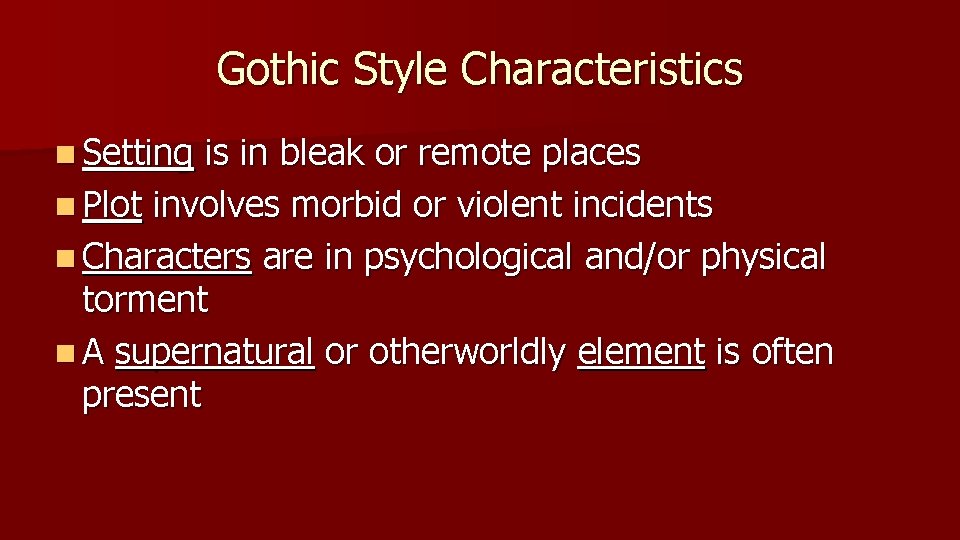
Gothic Style Characteristics n Setting is in bleak or remote places n Plot involves morbid or violent incidents n Characters are in psychological and/or physical torment n A supernatural or otherworldly element is often present
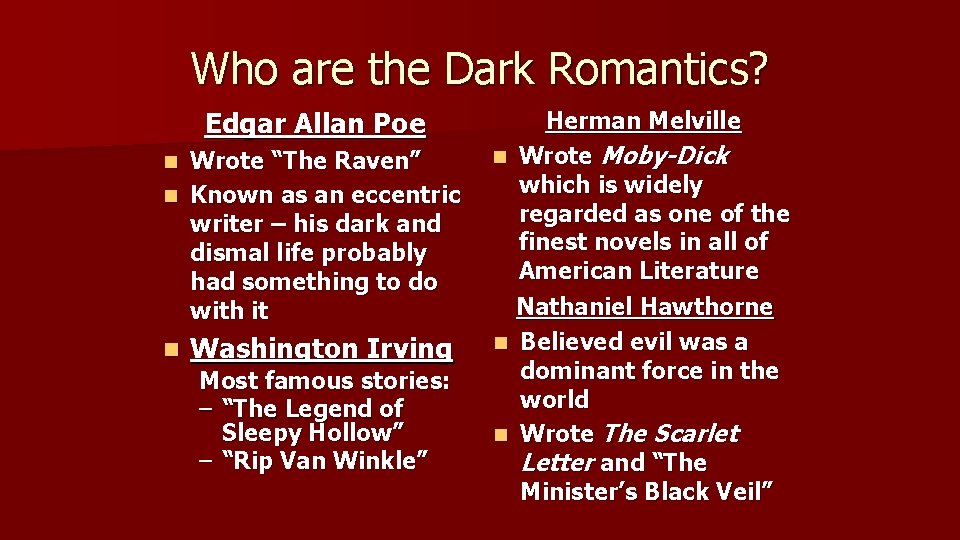
Who are the Dark Romantics? Edgar Allan Poe Wrote “The Raven” n Known as an eccentric writer – his dark and dismal life probably had something to do with it n n Washington Irving Most famous stories: – “The Legend of Sleepy Hollow” – “Rip Van Winkle” Herman Melville n Wrote Moby-Dick which is widely regarded as one of the finest novels in all of American Literature Nathaniel Hawthorne n Believed evil was a dominant force in the world n Wrote The Scarlet Letter and “The Minister’s Black Veil”
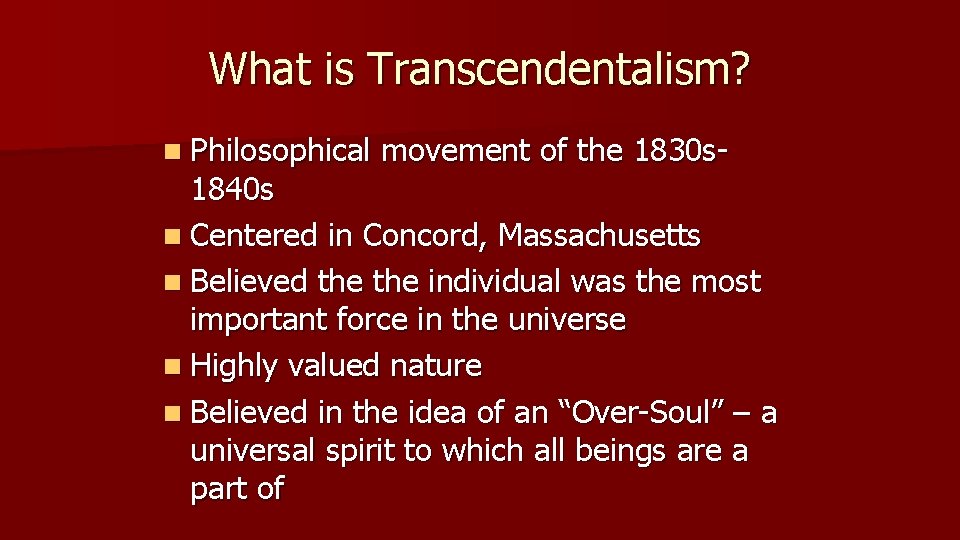
What is Transcendentalism? n Philosophical movement of the 1830 s- 1840 s n Centered in Concord, Massachusetts n Believed the individual was the most important force in the universe n Highly valued nature n Believed in the idea of an “Over-Soul” – a universal spirit to which all beings are a part of
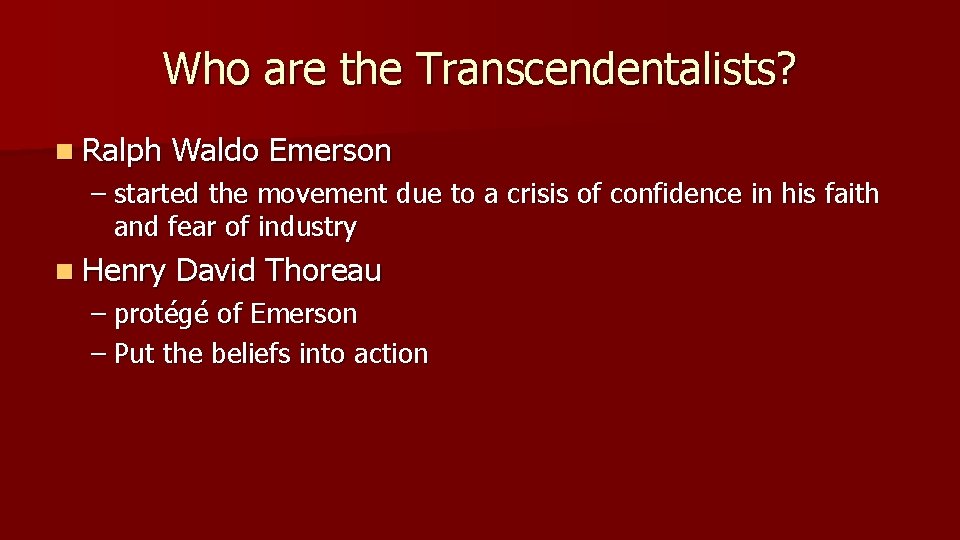
Who are the Transcendentalists? n Ralph Waldo Emerson – started the movement due to a crisis of confidence in his faith and fear of industry n Henry David Thoreau – protégé of Emerson – Put the beliefs into action
Transcendentalism Legacy n Influenced practice of nonviolent civil disobedience – Influenced Mahatma Gandhi & Martin Luther king, Jr. n First to suggest setting aside land to be preserved in its natural state
American Literature Realism
Realism WHAT: n literary movement that stressed the actual (reality) as opposed to the imagined or fanciful WHY: n A reaction against Romanticism n The harsh reality of frontier life and the Civil War shattered the nation’s idealism
Realism - Characteristics n Objective writing about ordinary characters in ordinary situations; “real life” n Character is more important than action and plot n The common man = the hero n Diction is natural vernacular - Dialect and informal language n Local Color n Humor
Who are the Realists? n Mark Twain n Ambrose Bierce n Kate Chopin n Paul Laurence Dunbar
Historical Context n Civil War n Homestead Act moved people to the West n Industrial Revolution (Age of Electricity) n Social & Cultural Issues Grew – The “Gilded Age” (class issues) – Abolishment of slavery – Women’s Rights Movement Growing
Romanticism vs. Realism Romanticism n Aspired to the ideal n Thought to be more refined since it did not show the vulgar details of life Realism n Thought to be more democratic n Critics stressed the potential for vulgarity and its emphasis on the commonplace n Potential “poison” for the pure of mind
How did this literary movement prevail? n The Industrial Revolution – economic, social, and political changes that took place in postwar life allowed American Realism to succeed § Gilded Age § Rights of the oppressed (women, immigrants, African Americans) § Labor Disputes
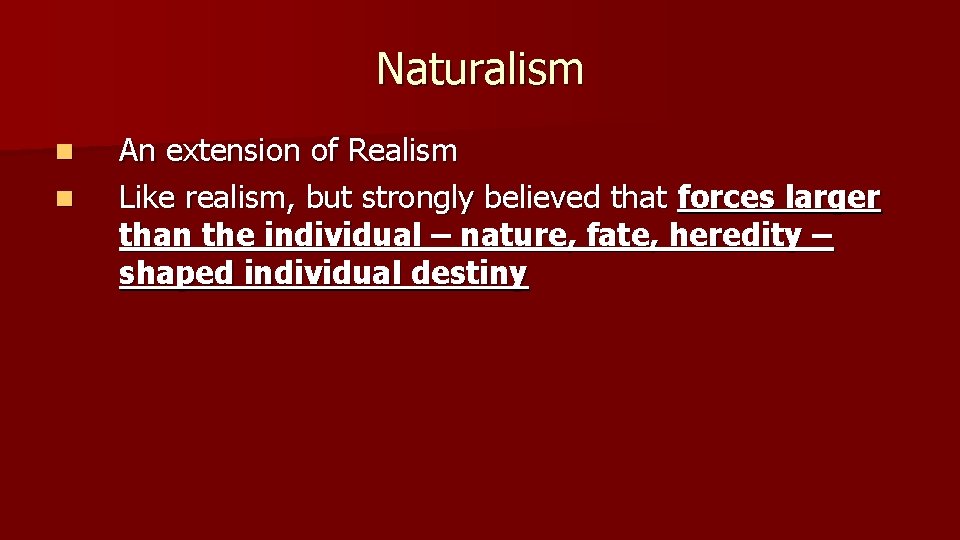
Naturalism n n An extension of Realism Like realism, but strongly believed that forces larger than the individual – nature, fate, heredity – shaped individual destiny
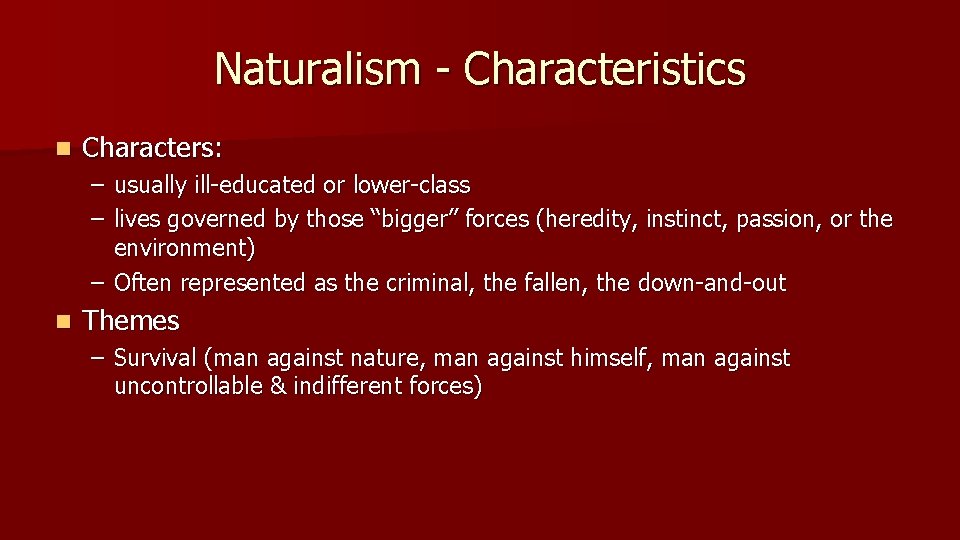
Naturalism - Characteristics n Characters: – usually ill-educated or lower-class – lives governed by those “bigger” forces (heredity, instinct, passion, or the environment) – Often represented as the criminal, the fallen, the down-and-out n Themes – Survival (man against nature, man against himself, man against uncontrollable & indifferent forces)
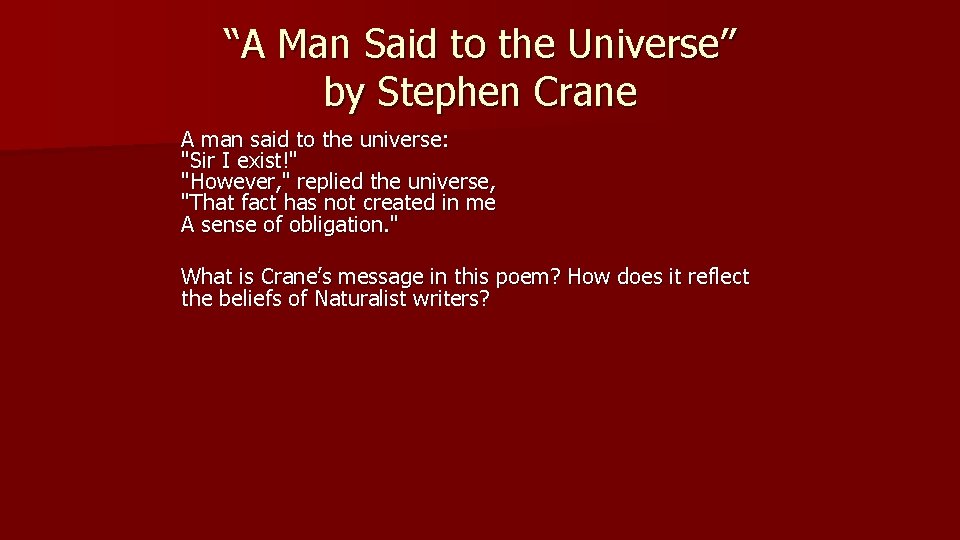
“A Man Said to the Universe” by Stephen Crane A man said to the universe: "Sir I exist!" "However, " replied the universe, "That fact has not created in me A sense of obligation. " What is Crane’s message in this poem? How does it reflect the beliefs of Naturalist writers?