
Romanticism Mary Shelley and Frankenstein 1785 1830 Romanticism
- Slides: 8
Romanticism, Mary Shelley, and Frankenstein 1785 -1830
Romanticism Beginning in the last decades of the 18 th century (1700 -1799), Romanticism transformed poetry, the novel, drama, painting, sculpture, all forms of concert music (especially opera), and ballet. It was deeply connected with the politics of the time, echoing people’s fears, hopes, and aspirations. It was the voice of revolution at the beginning of the 19 th century, (1800 -1899) and the voice of the Establishment at the end of it.
Another aspect of Romanticism is the belief that products of the uncultivated popular imagination could equal or even surpass those of the educated court poets and composers who had previously monopolized the attentions of scholars and connoisseurs. The new romantic taste favored simplicity and naturalness. Simplicity and naturalness were thought to flow most clearly from the “spontaneous” outpourings of the untutored common people.
The Gothic Romance Rejecting the Enlightenment of idea of balance and rationalism, readers early sought out the hysterical, mystical, and the passionate adventures of terrified heroes and heroines in the clutches of frightening, mysterious forces. The modern horror novel and woman’s romance are both descendants of the Gothic romance. Charlotte Bronte – Jane Eyre Emily Bronte – Wuthering Heights Mary Shelley - Frankenstein
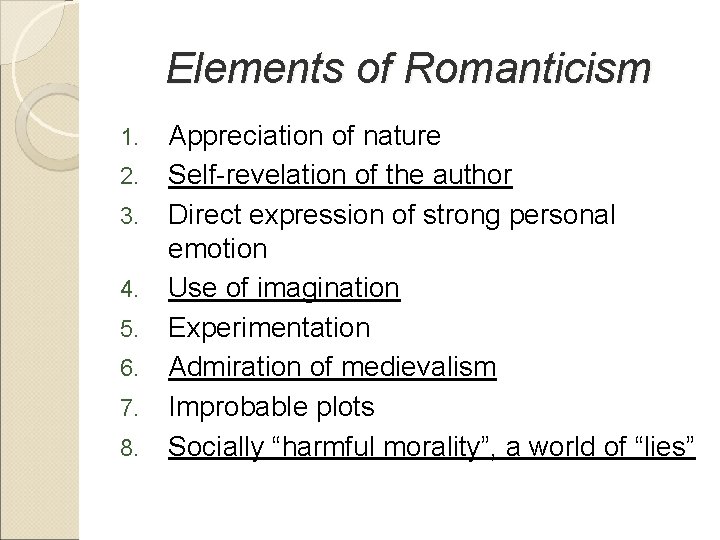
Elements of Romanticism 1. 2. 3. 4. 5. 6. 7. 8. Appreciation of nature Self-revelation of the author Direct expression of strong personal emotion Use of imagination Experimentation Admiration of medievalism Improbable plots Socially “harmful morality”, a world of “lies”
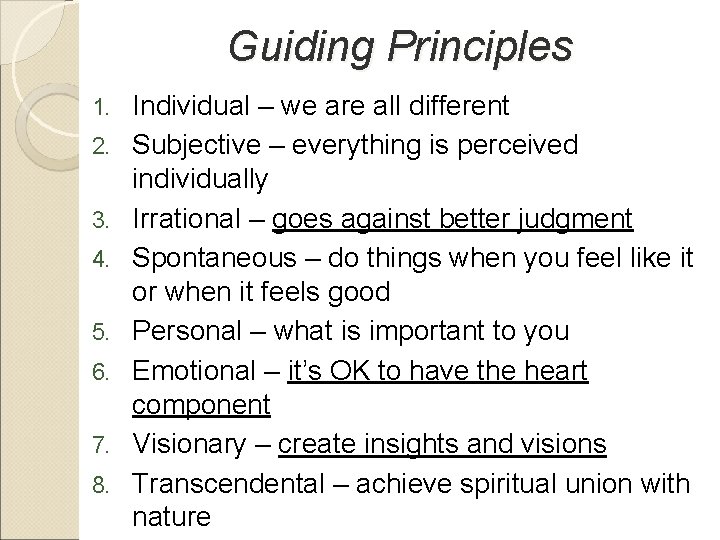
Guiding Principles 1. 2. 3. 4. 5. 6. 7. 8. Individual – we are all different Subjective – everything is perceived individually Irrational – goes against better judgment Spontaneous – do things when you feel like it or when it feels good Personal – what is important to you Emotional – it’s OK to have the heart component Visionary – create insights and visions Transcendental – achieve spiritual union with nature
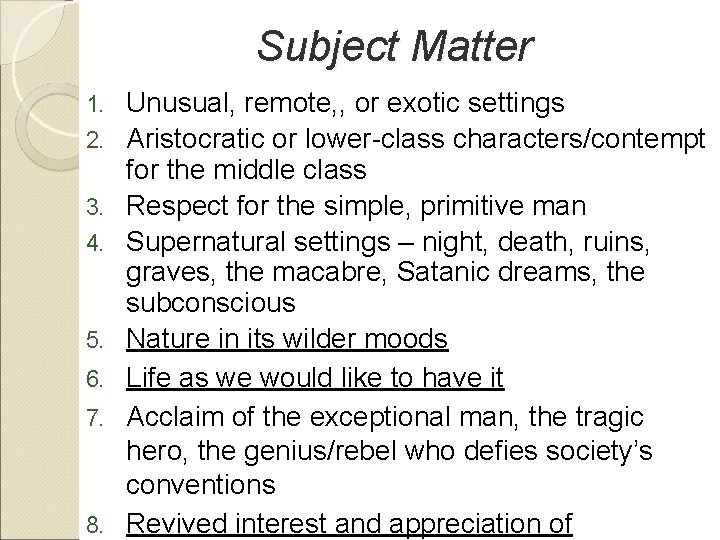
Subject Matter 1. 2. 3. 4. 5. 6. 7. 8. Unusual, remote, , or exotic settings Aristocratic or lower-class characters/contempt for the middle class Respect for the simple, primitive man Supernatural settings – night, death, ruins, graves, the macabre, Satanic dreams, the subconscious Nature in its wilder moods Life as we would like to have it Acclaim of the exceptional man, the tragic hero, the genius/rebel who defies society’s conventions Revived interest and appreciation of
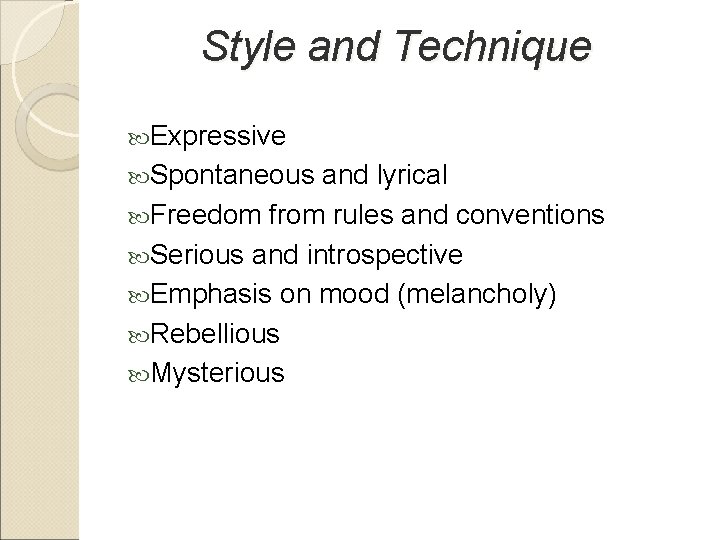
Style and Technique Expressive Spontaneous and lyrical Freedom from rules and conventions Serious and introspective Emphasis on mood (melancholy) Rebellious Mysterious