
Romanticism Definition v Romanticism refers to a movement

- Slides: 25
Romanticism Definition v. Romanticism refers to a movement in art, literature, and music during the 19 th century. (1800 s) v. Romanticism is characterized by the 5 “I”s v. Imagination v. Intuition v. Idealism v. Inspiration v. Individuality
Imagination v. Imagination was emphasized over “reason. ” v. This was a backlash against the rationalism characterized by the Neoclassical period or “Age of Reason. ” v. Imagination was considered necessary for creating all art. v. British writer Samuel Taylor Coleridge called it “intellectual intuition. ”
Intuition v. Romantics placed value on “intuition, ” or feeling and instincts, over reason. v. Emotions were important in Romantic art. v. British Romantic William Wordsworth described poetry as “the spontaneous overflow of powerful feelings. ”
Idealism v. Idealism is the concept that we can make the world a better place. v. Idealism refers to any theory that emphasizes the spirit, the mind, or language over matter – thought has a crucial role in making the world the way it is. v. Immanuel Kant, a German philosopher, held that the mind forces the world we perceive to take the shape of space-andtime.
Inspiration v. The Romantic artist, musician, or writer, is an “inspired creator” rather than a “technical master. ” v. What this means is “going with the moment” or being spontaneous, rather than “getting it precise. ”
Individuality v. Romantics celebrated the individual. v. During this time period, Women’s Rights and Abolitionism were taking root as major movements. v. Walt Whitman, a later Romantic writer, would write a poem entitled “Song of Myself”: it begins, “I celebrate myself…”
Transcendentalism
Origin of the word: Transcend (verb) a : to rise above or go beyond the limits of. b : to triumph over the negative or restrictive aspects of : overcome.
Characteristics of Transcendentalists: • They revered nature and its relationship to humanity. • They had a philosophy of individualism, simplicity, and passive resistance to injustice. • Many maintained a positive, optimistic, or rosy view of life. • They focused their attention on the human spirit.
• Unlike Puritans, they saw humans and nature as possessing an innate goodness. “In the faces of men and women, I see God” -Walt Whitman • Opposed strict ritualism and dogma of established religion.
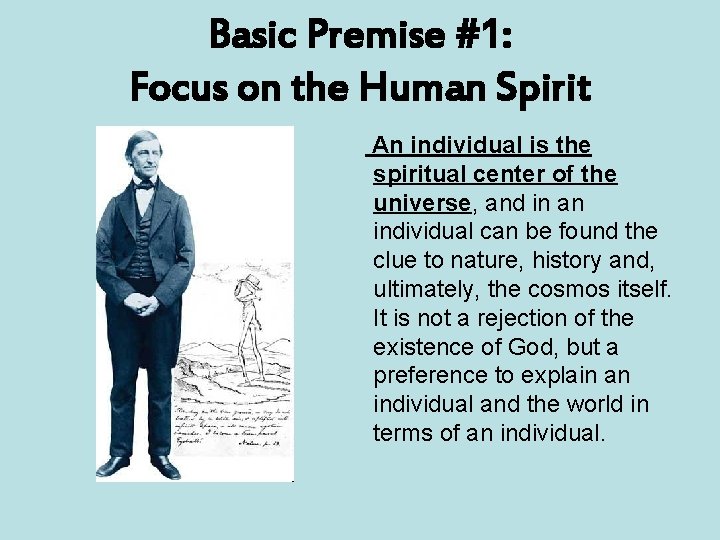
Basic Premise #1: Focus on the Human Spirit An individual is the spiritual center of the universe, and in an individual can be found the clue to nature, history and, ultimately, the cosmos itself. It is not a rejection of the existence of God, but a preference to explain an individual and the world in terms of an individual.
Basic Premise #2: Know Thyself! The structure of the universe literally duplicates the structure of the individual self—all knowledge, therefore, begins with self-knowledge. This is similar to Aristotle's dictum "know thyself. "
Basic Premise #3 Nature reflects Humanity Transcendentalists accepted the concept of nature as a living mystery, full of signs; nature is symbolic and reflects the human spirit. Exploring nature can help you know yourself and understand your place in the universe.
Basic Premise #4: God + Nature + Humanity = Over-Soul All forms of being—God, nature, and humanity—are spiritually united through a shared universal soul, or Over-Soul. This means that self-realization depends upon the reconciliation of two universal psychological tendencies: 1. The desire to embrace the whole world—to know and become one with the world. 2. The desire to withdraw, remain unique and separate—an egotistical existence.
Transcendentalism: In Summary… • Believed in living close to nature/importance of nature. Nature is the source of truth and inspiration. • Taught the dignity of manual labor • Advocated self-trust/ confidence • Valued individuality/non-conformity/free thought • Advocated self-reliance/ simplicity
Who were the Transcendentalists? • • • Ralph Waldo Emerson** Henry David Thoreau** Amos Bronson Alcott Margaret Fuller Ellery Channing **Names to know
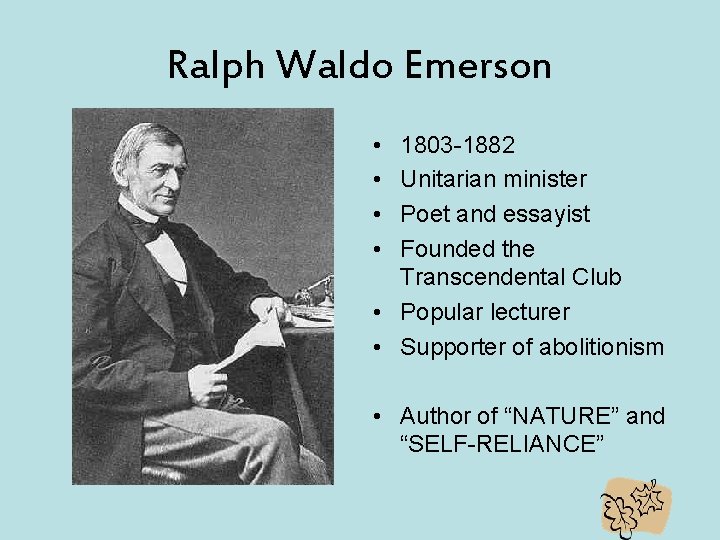
Ralph Waldo Emerson • • 1803 -1882 Unitarian minister Poet and essayist Founded the Transcendental Club • Popular lecturer • Supporter of abolitionism • Author of “NATURE” and “SELF-RELIANCE”
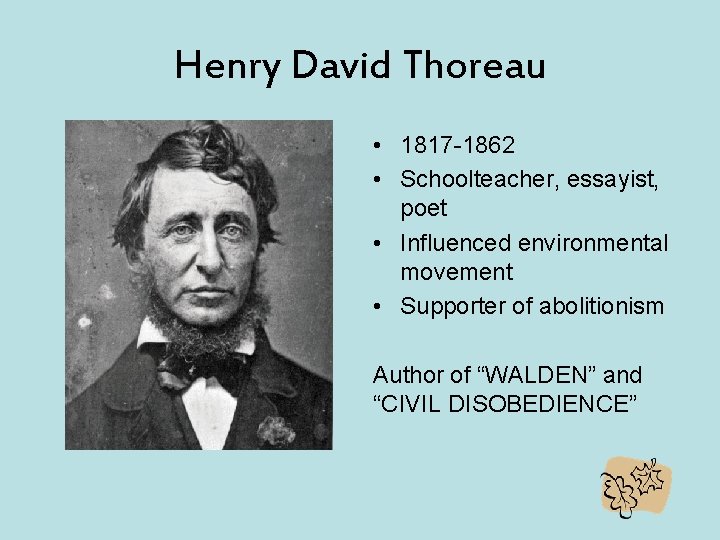
Henry David Thoreau • 1817 -1862 • Schoolteacher, essayist, poet • Influenced environmental movement • Supporter of abolitionism Author of “WALDEN” and “CIVIL DISOBEDIENCE”
Anti. Transcendentalism 19 th century (approx. 1840 -1860) literary movement that focused on the dark side of humanity and the evilness and guilt of sin
Reasons / Causes • Opposed the optimism and naïve idealism of the transcendentalists • Dwelt on guilt and remorse over past sins • Discontented with current circumstances in America (poverty/unjust and cruel treatment of factory workers, poor educational system, lack of women’s rights, slavery…) so they focused on moral dilemmas and society’s ills
Dark Romantic Literature • Prose (short stories and novels) • allegory
Key ideas / Philosophies • Belief in the potential destructiveness of the human spirit • Belief in individual truths, but no universal truths, and the truths of existence are deceitful and disturbing • Human nature is inherently sinful (original sin) and evil is an active force in the universe • Focus on the man’s uncertainty and limitations in the universe
View of Nature • Nature is vast and incomprehensible, a reflection of the struggle between good and evil • Nature is the creation and possession of God and it cannot be understood by human beings
Writing Style • Man vs. Nature conflicts bring out the evil in humanity • Raw and morbid diction • Focus on the protagonist’s inner struggles • Typical protagonists are haunted outsiders who are alienated from society • Prevalent use of symbolism
Author to know… Edgar Allan Poe Texts to note: “The Raven” (poem) “The Pit and the Pendulum” (short story)