
Romanticism A Movement Across the Arts Definition v

- Slides: 10
Romanticism A Movement Across the Arts
Definition v. Romanticism refers to a movement in art, literature, and music during the 19 th century. v. Romanticism is characterized by the 5 “I”s v. Imagination v. Intuition v. Idealism v. Inspiration v. Individuality
Imagination v. Imagination was emphasized over “reason. ” v. This was a backlash against the rationalism characterized by the Neoclassical period or “Age of Reason. ” v. Imagination was considered necessary for creating all art.
Intuition v. Romantics placed value on “intuition, ” or feeling and instincts, over reason. v. Emotions were important in Romantic art. v. British Romantic William Wordsworth described poetry as “the spontaneous overflow of powerful feelings. ”
Idealism v. Idealism is the concept that we can make the world a better place. v. Idealism refers to any theory that emphasizes the spirit, the mind, or language over matter – thought has a crucial role in making the world the way it is. v. The mind forces the world we perceive to take the shape of space-and-time.
Inspiration v. The Romantic artist, musician, or writer, is an “inspired creator” rather than a “technical master. ” v. What this means is “going with the moment” or being spontaneous, rather than “getting it precise. ”
Individuality v. Romantics celebrated the individual. v. During this time period, Women’s Rights and Abolitionism were taking root as major movements. v. Walt Whitman, a later Romantic writer, would write a poem entitled “Song of Myself”: it begins, “I celebrate myself…”
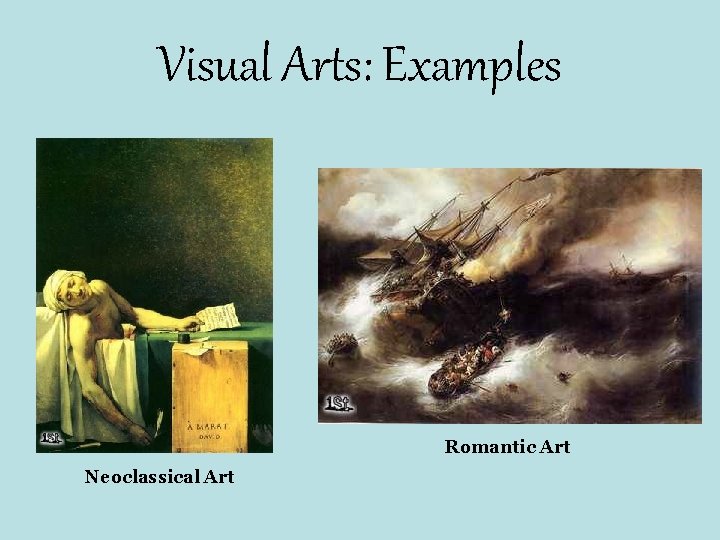
Visual Arts v Neoclassical art was rigid, severe, and unemotional; it hearkened back to ancient Greece and Rome v Romantic art was emotional, deeply-felt, individualistic, and exotic. It has been described as a reaction to Neoclassicism, or “anti-Classicism. ”
Visual Arts: Examples Romantic Art Neoclassical Art
Literature v. In America, Romanticism most strongly impacted literature. v. Writers explored supernatural and gothic themes. v. Writers wrote about nature – Transcendentalists believed God was in nature, unlike “Age of Reason” writers like Franklin and Jefferson, who saw God as a “divine watchmaker, ” who created the universe and left it to run itself.