
Romantic Poetry Introduction to the 9 step Analysis
- Slides: 12
Romantic Poetry Introduction to the 9 -step Analysis Process
Prior Knowledge Discussion What do you think Romantic literature is about? What would make a piece of literature Romantic? What prior knowledge do you have about Romantic literature? Think about your experiences last year with American Gothic and Transcendentalism. What do you know about history during the late 1700 s and early 1800 s? What big historical events happened prior to this period?
The Romantic Literary Movement Started in England in the early 1800 s Expressed in poetry, short stories, novels, and plays Was a reaction to the “Age of Reason” of the 1700 s- that is the science, laws, and logic of the revolutionary period There were different branches of the movement: Gothic and transcendentalism (especially in America)
Themes in Romanticism Love, relationships, hardships of romance, unrequited love Beauty of the human form (often comparing women’s beauty to nature) The beauty and amazement of nature, appreciation of the earth Emotions, feelings, thinking with the “heart” instead of the “head” The darkness of human nature Old stuff like Shakespeare and King Arthur
Major Contributors Percy Shelley Mary Shelley (Percy’s wife, wrote Frankenstein when they were stuck in a castle one night with other writersthey were having a competition as to who write the scariest story. She was just a teenager!) William Wordsworth Samuel Taylor Colerige John Keats William Blake
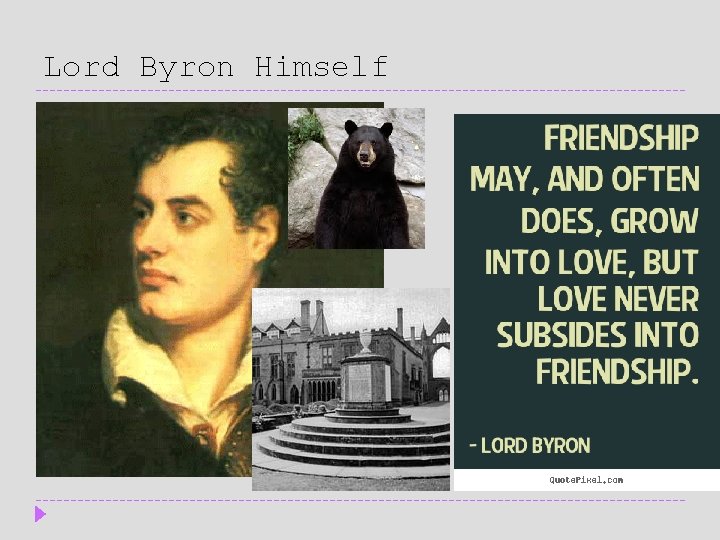
Major Contributors Lord Byron (the baddest of all) wrote beautiful poetry and was exceedingly handsome seduced many women built a giant memorial for his dog was angry that his college wouldn’t let him bring his dog to school so he brought a bear instead because it didn’t explicitly say in the rules that he couldn’t the bear was allowed to stay and he even joked about having the bear apply for a fellowship
Lord Byron Himself
Poetry Terms Speaker: The person or thing narrating the poem. Repetition: Repeating an important point for emphasis. Alliteration: Two or more words close together that begin with the same sounds. End Rhyme: When the ends of words have the same sounds.
Poetry Terms Continued Simile: A comparison using like or as Metaphor: Calling one thing something else to add to the description Theme: The overall message or point of a literary work. The general topic it discusses (Example: The poet is trying to show that life is worth savoring and living).
Poetry Terms Continued Tone: The author’s attitude that comes across in writing Mood: The climate of feeling in the poem. The choice of setting, language, details, images and words create a feeling for the reader. Figurative Language: When something is described in detail to create a mental picture. Symbol: When one thing stands for another.
9 -Step Poetry Analysis The 9 -step process handout you received will help you to read and understand any poem. Read along with the William Wordsworth poem provided and think about the analysis steps we went over. We will brainstorm ideas and responses for each of the 9 steps together as a class to prepare for your next assignment.
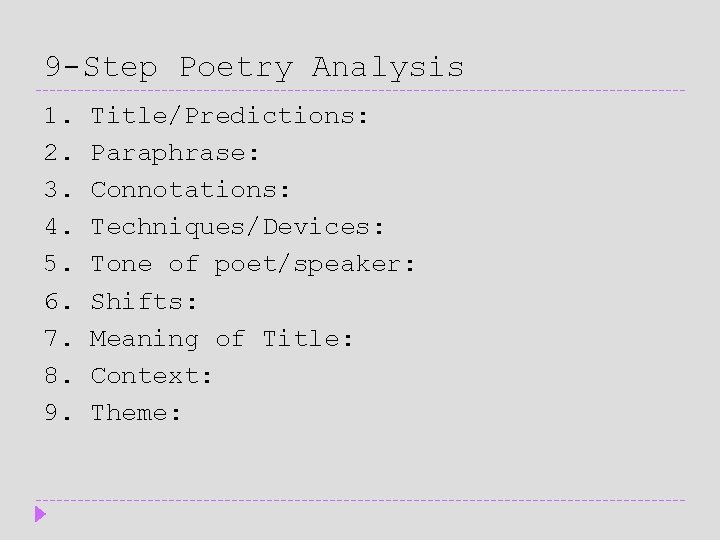
9 -Step Poetry Analysis 1. 2. 3. 4. 5. 6. 7. 8. 9. Title/Predictions: Paraphrase: Connotations: Techniques/Devices: Tone of poet/speaker: Shifts: Meaning of Title: Context: Theme: