
Romantic Love An f MRI Study of a
- Slides: 17
Romantic Love: An f. MRI Study of a Neural Mechanism for Mate Choice Yan Lee (Jo. Jo) Lilly Zhang Tin Poon (Tina)
General Question Addressed in This Paper • Which specific brain system is associated with “courtship attraction”?
Why is this question interesting • Love is a crosscultural universal experience • Love is primarily a motivation system • Love leads to various emotions. • A primary aspect of reproduction • Brain mechanisms that are involved in a relationship are largely unknown
What specific hypothesis was the study supposed to address? • Hypothesis 1: “romantic love would involve subcortical dopaminergic pathways that mediate reward” • Hypothesis 2: “romantic love would involve neural pathways associated with goal-directed behaviors”
• • Age: 18 -26 Duration: 1 -17 months being in love Prescanning orally interview Passionate Love Scale which measures several traits commonly associated with romantic love (Cronbach’s alpha for questionnaire reliability= 0. 81)
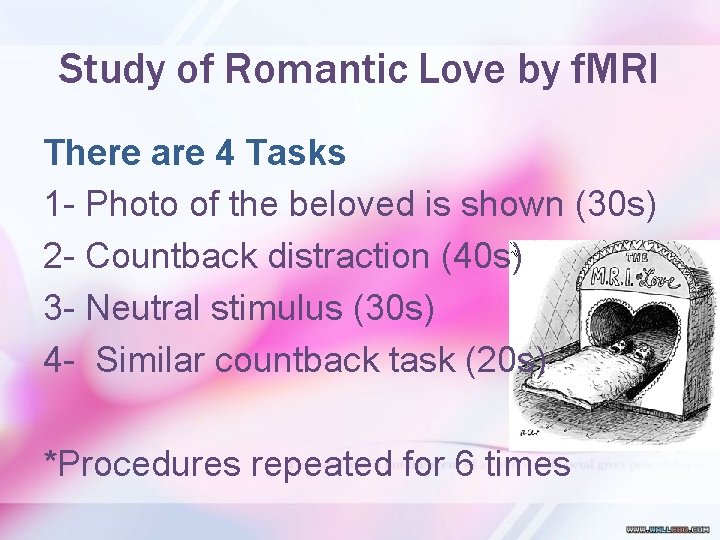
Study of Romantic Love by f. MRI There are 4 Tasks 1 - Photo of the beloved is shown (30 s) 2 - Countback distraction (40 s) 3 - Neutral stimulus (30 s) 4 - Similar countback task (20 s) *Procedures repeated for 6 times
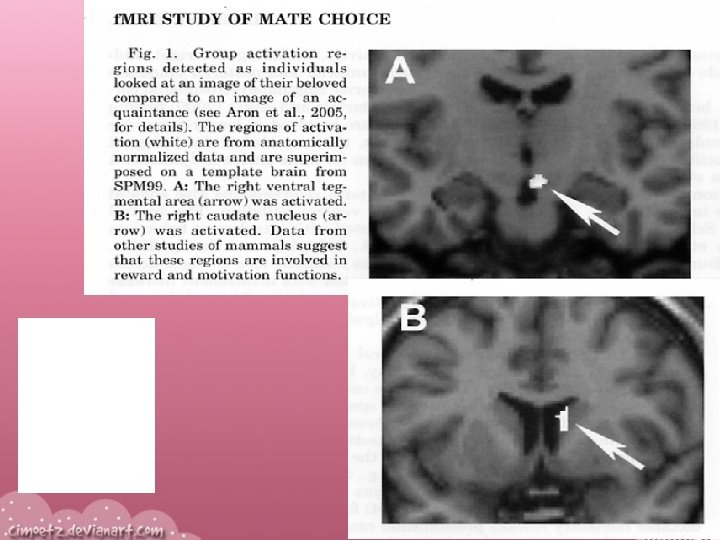
Results • Activation in the right ventral tegmental area (VTA), caudate nucleus in the right medial and posterodosal body • VTA= reward system • VTA sends projections to the caudate nucleus • Hypotheses 1 and 2 are supported • Those who self-reported higher levels of romantic love also showed greater activation in the right anteromedial
Important Things about Romantic Love • Romantic love may be a primary motivation system – Focus on specific reward • Romantic love is distinct from sex drive – f. MRI studies show activation in different brain regions
Bartels and Zeki (2000; 2004) • Investigated brain activity in 17 men and women who had been in love for longer duration (8 -17 months) Results • Same as study by Fisher and Aron • Also found activity in the anterior cingulate, mid-insular cortex and posterior cingulate cortex • Also showed increased activity in the ventral pallidum
Mate choice is dynamic: it changes across time
Cont. Based on a study of Prairie Voles • Prairie voles show increased activity in the ventral pallidum • They form a distinct preference for partners • The injection of dopamine agonist can alter the female preference of her mate
Conclusion • Reward regions using dopamine are activated during feelings of romantic love
• More Money= More Love? – A study by Knutson, both the right anteromedial caudate body and the monetary reward region are activated when people are in love • Activation of VTA and caudate nucleus in early stage romantic love may consist of general arousal
Improvement • There may be bias in self-report • f. MRI study cannot show the causation of mate-choice • Should have included a neutral image of the brain and a f. MRI image of being in love
What’s Next? • The more wealthy the partner is, the more you love? • Will dopamine resolve hatred?
Reference Fisher H, Aron A, Brown L. 2005 Romantic Love: An f. MRI Study of a Neural Mechanism for Mate Choice