
Roman Empire Mr Stikes End of the Republic
Roman Empire Mr. Stikes
End of the Republic • Remember, Julius Caesar enacted a series of reforms that increased the power of the lower classes • In response, he was killed by a group of Senators on the Ides (15 th) of March, 44 B. C.
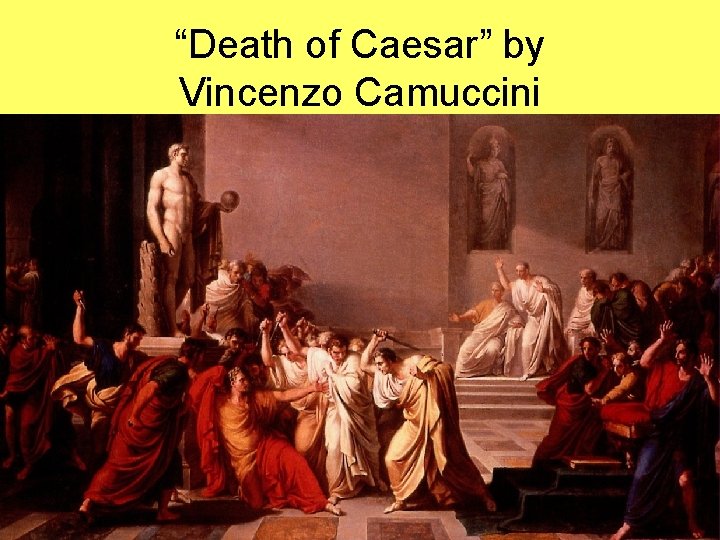
“Death of Caesar” by Vincenzo Camuccini
Civil War • After Julius Caesar’s death, a Second Triumvirate was formed to punish the assassins • Members: – Octavian (Julius Caesar’s nephew) – Marc Antony – Marcus Lepidus
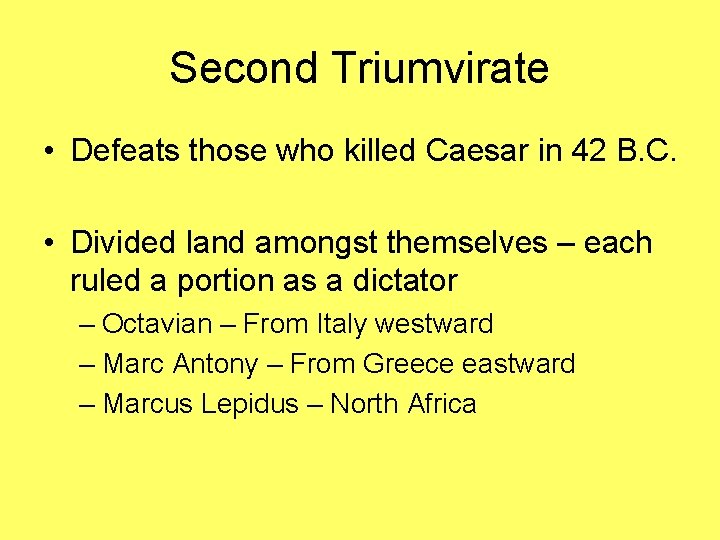
Second Triumvirate • Defeats those who killed Caesar in 42 B. C. • Divided land amongst themselves – each ruled a portion as a dictator – Octavian – From Italy westward – Marc Antony – From Greece eastward – Marcus Lepidus – North Africa
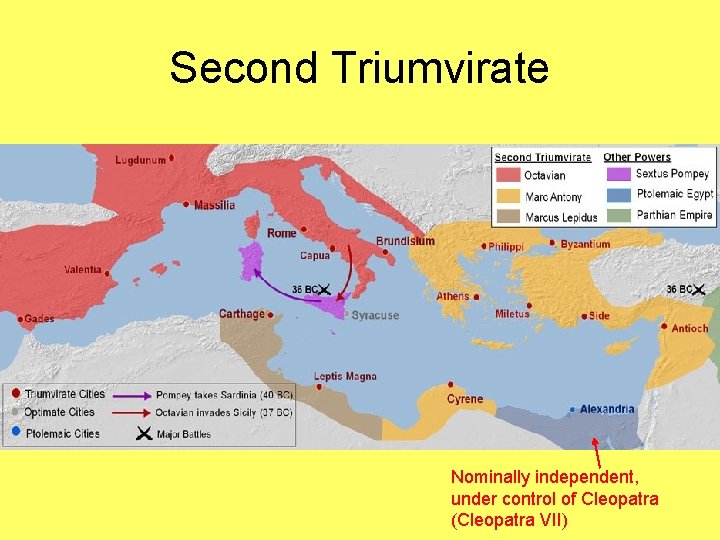
Second Triumvirate Nominally independent, under control of Cleopatra (Cleopatra VII)
Consolidation of Power • Octavian forced Lepidus to retire • Marc Antony marries Cleopatra, Queen of Egypt DID YOU KNOW: Antony was married to Octavian’s sister Octavia before he married Cleopatra – Octavian convinces the Romans that Antony wants to rule Rome as king – 31 B. C. – naval battle at Actium – Octavian defeats Antony & Cleopatra • Cleopatra and Antony commit suicide 1 year later
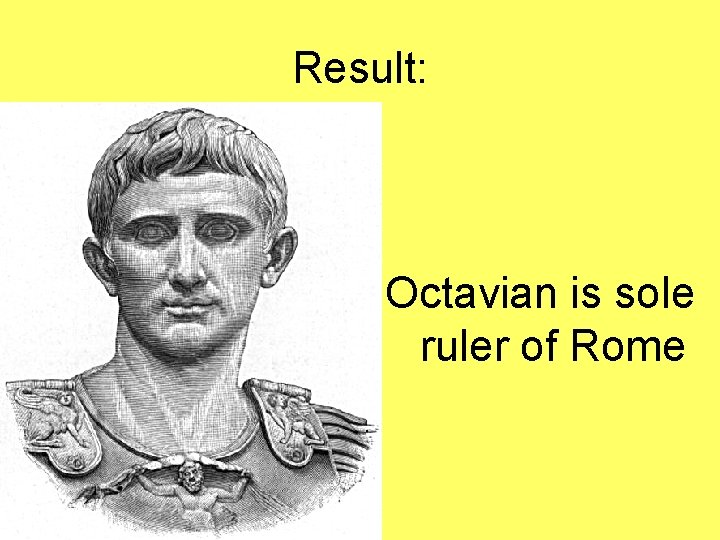
Result: Octavian is sole ruler of Rome
Augustus Caesar • Octavian is appointed as consul, tribune and commander in chief for life in 27 B. C. • He gives himself the title Augustus, meaning “the majestic one” – From now on, he is known as Augustus Caesar
Augustus Caesar • Ruled 40 years • Accomplishments: – “found Rome a city of brick and left it a city of marble” • Great builder – Reduced corruption – Conducted a census to determine taxes – Began Pax Romana (“Roman Peace”) • 200 year period • Began in 31 B. C. • Relatively peaceful time
Julio-Claudian Emperors • Augustus dies in A. D. 14 • Successors: – Tiberius (A. D. 14 -37) • Accused many of treason – Caligula (A. D. 37 -41) • Mentally ill, killed by palace guard – Claudius (A. D. 41 -54) • Great scholar, invaded England – Nero (A. D. 54 -68) • Cruel, perhaps insane, sentenced to death by Senate
Roman Emperors after Nero • For 28 years after Nero’s death, Rome was governed by emperors placed on the throne by the army. • They were: Galba (A. D. 68) Otho (A. D. 69) Vitellius (A. D. 69) Vespasian (A. D. 69 -79) Titus (A. D. 79 -81) Domitian (A. D. 81 -96) Flavians
The Good Emperors • After the assassination of Domitian, the Senate elected Nerva as emperor • The next five emperors are known as the “Good Emperors” because of their administrative effectiveness and large building projects DID YOU KNOW: The term “Five Good Emperors” is taken from Edward Gibbon’s Decline and Fall of the Roman Empire
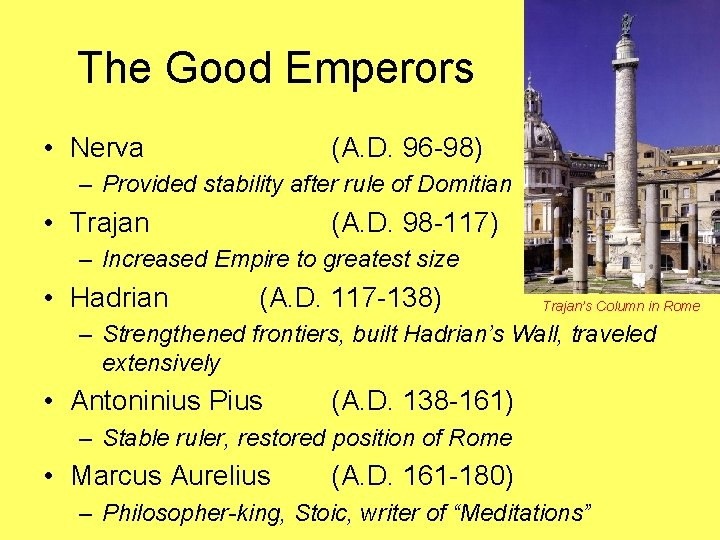
The Good Emperors • Nerva (A. D. 96 -98) – Provided stability after rule of Domitian • Trajan (A. D. 98 -117) – Increased Empire to greatest size • Hadrian (A. D. 117 -138) Trajan’s Column in Rome – Strengthened frontiers, built Hadrian’s Wall, traveled extensively • Antoninius Pius (A. D. 138 -161) – Stable ruler, restored position of Rome • Marcus Aurelius (A. D. 161 -180) – Philosopher-king, Stoic, writer of “Meditations”
The Five Good Emperors • Some scholars claim that the major strength of the Five Good Emperors was that they adopted their successors, instead of relying on blood relatives. WRITING ASSIGNMENT: • Why would this be an advantage? • How is this similar or different to the way in which we choose our rulers in the United States?
Imperial Rome • Roman citizenship was gradually extended throughout the provinces • Roman law stressed the authority of the state over the individual • Army: professional, supplemented by provincial auxiliaries
Imperial Rome • Economy: – Mainly agrarian, with some trade (land & sea) – Major crops: • Grain • Olives • Grapes – Major products: • Olive oil • Wine – Major imports: • Silk from China • Cotton & spices from India • Ivory and wild animals from Africa • Metals from Spain and Britain • Fossilized amber gems from Germany • Slaves from throughout the world
Imperial Rome • Farmers often paid taxes in grain – This allowed the government to distribute free grain to the populace – This discouraged farmers from increasing output
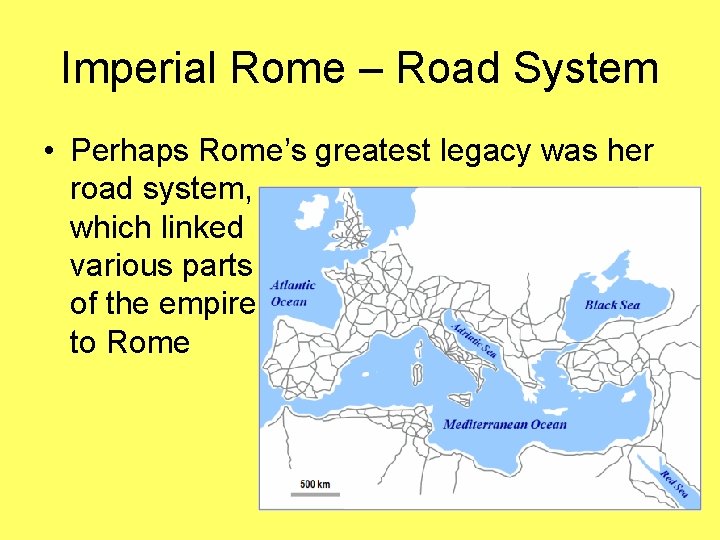
Imperial Rome – Road System • Perhaps Rome’s greatest legacy was her road system, which linked various parts of the empire to Rome
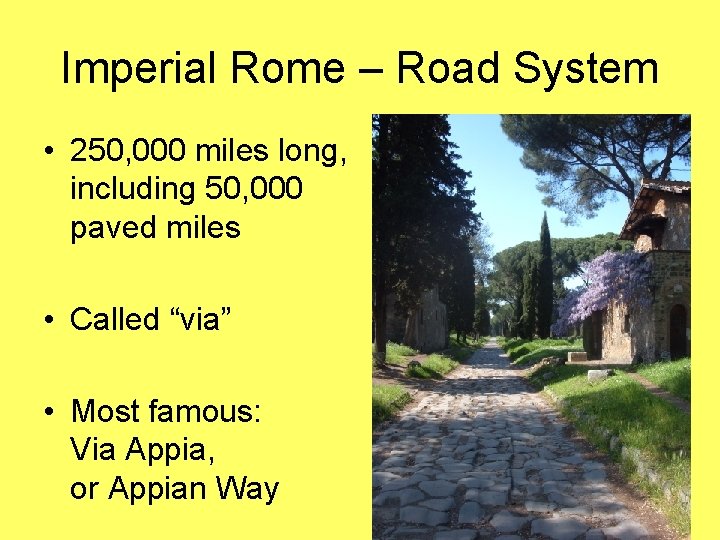
Imperial Rome – Road System • 250, 000 miles long, including 50, 000 paved miles • Called “via” • Most famous: Via Appia, or Appian Way
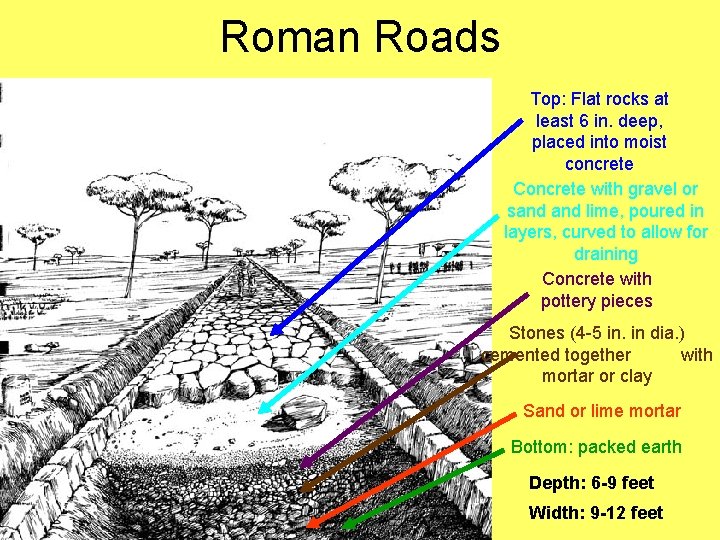
Roman Roads Top: Flat rocks at least 6 in. deep, placed into moist concrete Concrete with gravel or sand lime, poured in layers, curved to allow for draining Concrete with pottery pieces Stones (4 -5 in. in dia. ) cemented together with mortar or clay Sand or lime mortar Bottom: packed earth Depth: 6 -9 feet Width: 9 -12 feet
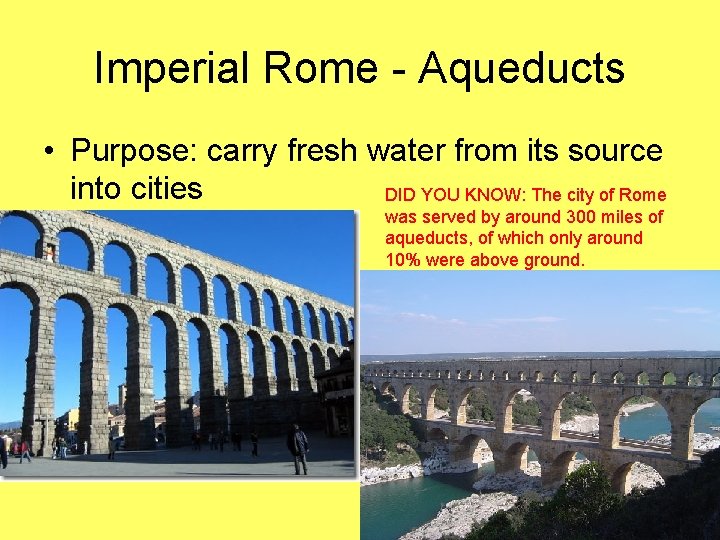
Imperial Rome - Aqueducts • Purpose: carry fresh water from its source into cities DID YOU KNOW: The city of Rome was served by around 300 miles of aqueducts, of which only around 10% were above ground.
Important Roman Advancements in the Imperial Age • Galen – discoveries in medicine • Ptolemy – astronomy • Ovid – poet, – Metamorphoses • Horace – poet, – Odes • Virgil – epic poet, – Aeneid • Livy – Historian – Ab Urbe Condita (From the Founding of the City) • Tacitus – Historian – Historiae, Annales (Histories, Annals)
Rome after the Good Emperors • From A. D. 192 – 284, there were 28 emperors, most of whom met a violent death – This period begins after the death of Commodus in 192 – Many of these were declared emperor by the army – This period is marked by invasion from outside of the empire and civil war within the empire
Rome after the Good Emperors • Economic Decline: – Political instability led to economic decline – War: • Disrupted trade, reducing profits and increasing prices • Destroyed farmland, causing food shortages and raising prices
Rome after the Good Emperors • To combat this, the Imperial government minted more coins, causing inflation – Inflation: continual rising level of prices • Taxes increased, due to increased costs of legions – This made farming less profitable
Attempts at Reform • Diocletian: (r. 284 -305) – General, came to power by killing previous emperor – Divided empire into two parts, each ruled by a coemperor (“Augustus”) and an assistant coemperor (“Caesar”) • Note: There was a senior Augustus who was ultimately in charge of the Empire – Issued Edict of Prices – froze wages, set maximum prices for goods • Penalty for breaking price rules = death – Effect: Emergence of black market, workers tied to jobs by law
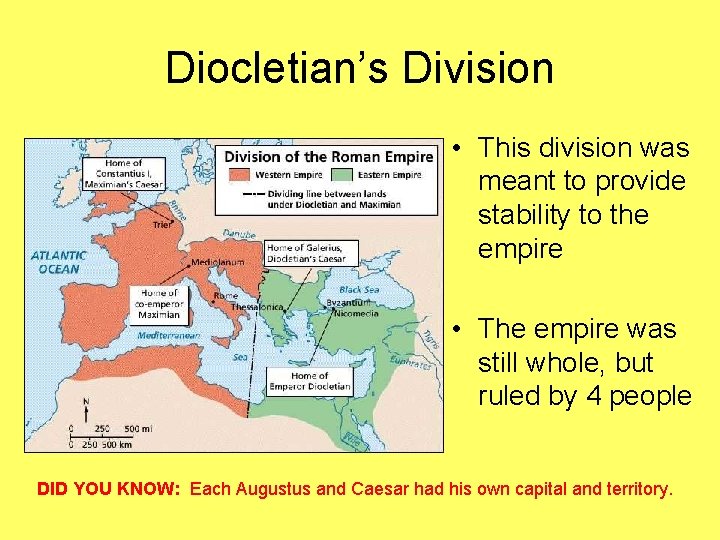
Diocletian’s Division • This division was meant to provide stability to the empire • The empire was still whole, but ruled by 4 people DID YOU KNOW: Each Augustus and Caesar had his own capital and territory.
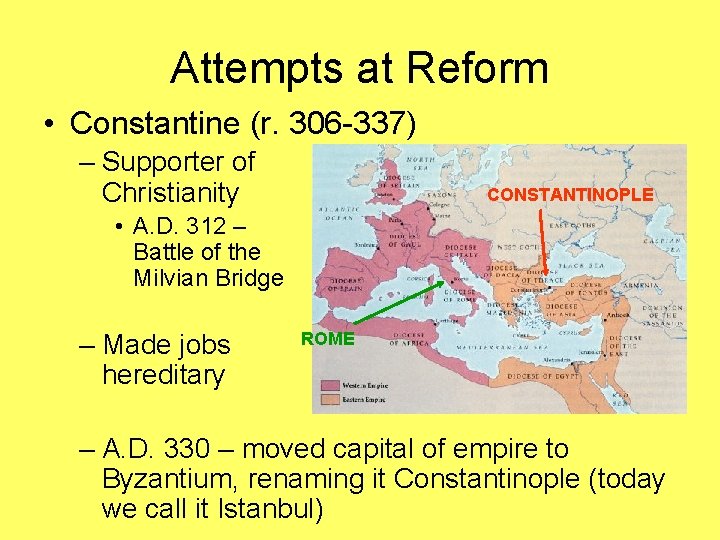
Attempts at Reform • Constantine (r. 306 -337) – Supporter of Christianity CONSTANTINOPLE • A. D. 312 – Battle of the Milvian Bridge – Made jobs hereditary ROME – A. D. 330 – moved capital of empire to Byzantium, renaming it Constantinople (today we call it Istanbul)
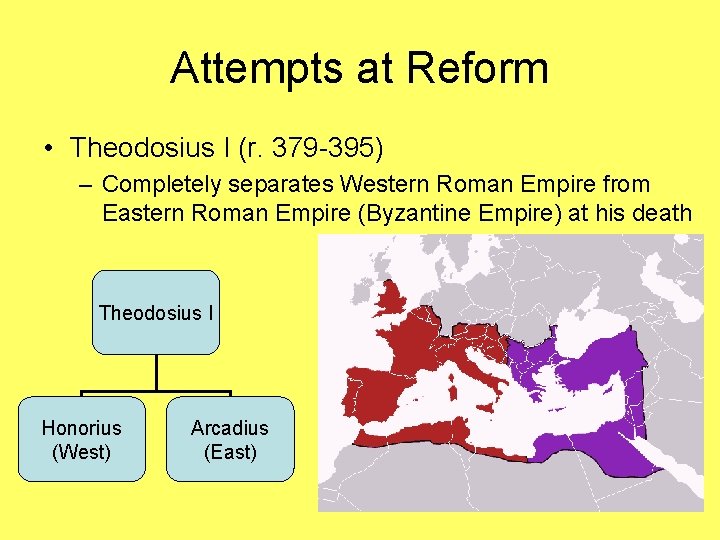
Attempts at Reform • Theodosius I (r. 379 -395) – Completely separates Western Roman Empire from Eastern Roman Empire (Byzantine Empire) at his death Theodosius I Honorius (West) Arcadius (East)
Invasions • Began in late 300’s – Mainly Germanic peoples • • Ostrogoths Visigoths Vandals Franks • • Angles Saxons Huns Avars – Reasons: • Searching for better grazing land • Share of Roman wealth • Nomadic
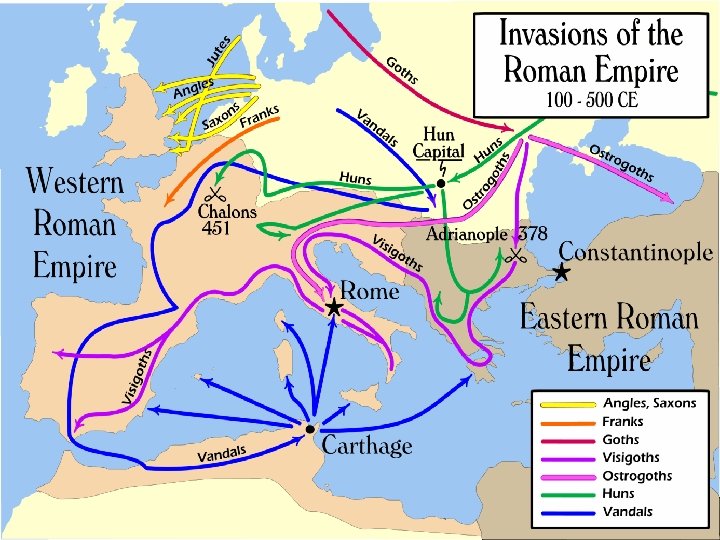
Results & Fall of Western Roman Empire • Vandals raid and sack Rome in A. D. 455 • Odoacer leads troops that sack Rome in A. D. 476 – Removes last Western Roman Emperor, Romulus Augustulus “FALL OF ROME”?
- Slides: 33