
Roman Calendar The Roman Calendar Revised by Julius

Roman Calendar
The Roman Calendar • Revised by Julius Caesar in 46/45 BC (“Julian Calendar”) • He increased the calendar from 355 days to 365 days • He’s the reason our months today have 30 or 31 days (Feb. has always been shorter)
Julian vs. Gregorian • By 1582, the Julian calendar was about 10 days out of alignment due to some small errors • Pope Gregory XIII revised the calendar in 1582 to correct this problem (Gregorian Calendar) • Fun fact: Britain (and its colonies) didn’t adopt the Gregorian Calendar until 1752! Wed. Sept. 2, 1752, was followed by Th. , Sept. 14, 1752 in America!
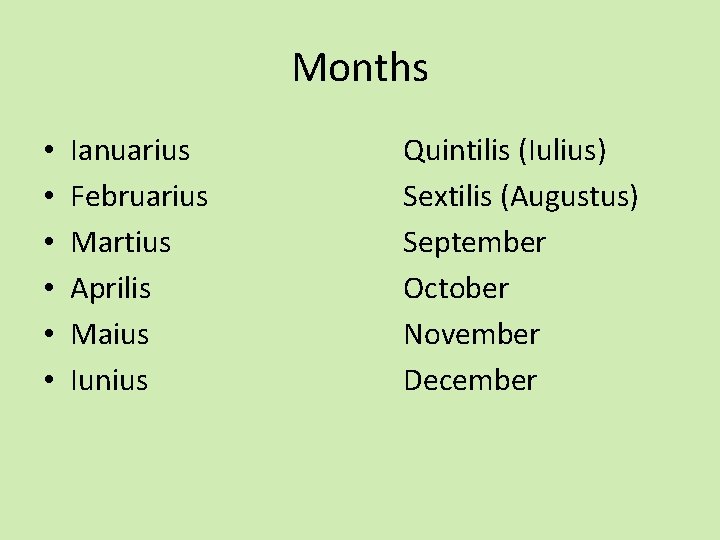
Months • • • Ianuarius Februarius Martius Aprilis Maius Iunius Quintilis (Iulius) Sextilis (Augustus) September October November December
How the Roman Calendar Worked • The month names we use today come from the Latin month names. • Romans did not number the days of the month like we do. • Romans used 3 reference days each month to count down their dates.
Reference Days • Kalendae: the Kalends, the 1 st of the month (where we get the word “calendar”) • Nonae: the Nones, the 5 th day of the month except for March, May, July and October when they’re the 7 th day • Idus: the Ides, the 13 th day of each month except for March, May, July, and October when they’re the 15 th day
Writing Dates • a. d. NN = ante diem NN (on the ‘n’th day before the nomen/named day) • “a. d. III Kal Nov” = “on the 3 rd day before the Kalends of November” (Oct. 30) • Always count inclusively (start your count with the reference day) • Pridie = “the day before” (prid Kal Ian = Dec. 31)
Naming Years • Years were named after the 2 consuls elected for that year: “in the consulship of Marcus Batiatus and Quintus Secundus” • Years could also be named “ab urbe condita” or AUC: “from the founding of the city” (754/753 BC).
Example of Years • "Claudius was born. . . on the Kalends of August in the consulship of Iullus Antonius and Fabius Africanus, . . . " (Suetonius Claudius II. i) • We know from other Roman records these 2 guys were consuls in a. u. c. 744… so that’s about 10 BC on our calendar.
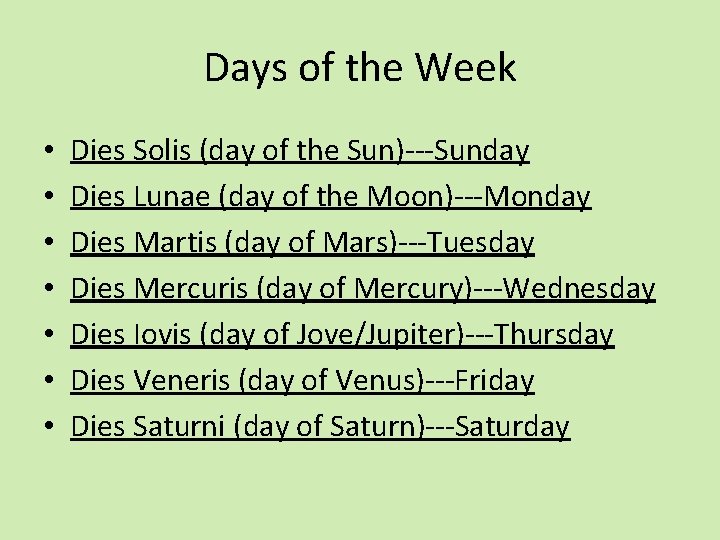
Days of the Week • • Dies Solis (day of the Sun)---Sunday Dies Lunae (day of the Moon)---Monday Dies Martis (day of Mars)---Tuesday Dies Mercuris (day of Mercury)---Wednesday Dies Iovis (day of Jove/Jupiter)---Thursday Dies Veneris (day of Venus)---Friday Dies Saturni (day of Saturn)---Saturday
Telling Time • Each day was divided into 12 hours (horae), from sunrise to sunset. • Hours were numbered: prima, secunda, tertia, etc. (first, second, third…) • In the summer, hours would be longer than in the winter since days were longer.
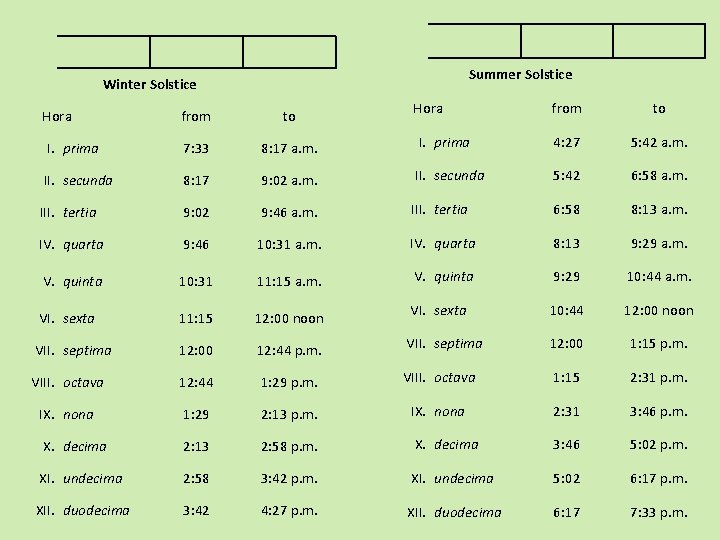
Summer Solstice Winter Solstice from to I. prima 4: 27 5: 42 a. m. 9: 02 a. m. II. secunda 5: 42 6: 58 a. m. 9: 02 9: 46 a. m. III. tertia 6: 58 8: 13 a. m. IV. quarta 9: 46 10: 31 a. m. IV. quarta 8: 13 9: 29 a. m. V. quinta 10: 31 11: 15 a. m. V. quinta 9: 29 10: 44 a. m. VI. sexta 11: 15 12: 00 noon VI. sexta 10: 44 12: 00 noon VII. septima 12: 00 12: 44 p. m. VII. septima 12: 00 1: 15 p. m. VIII. octava 12: 44 1: 29 p. m. VIII. octava 1: 15 2: 31 p. m. IX. nona 1: 29 2: 13 p. m. IX. nona 2: 31 3: 46 p. m. X. decima 2: 13 2: 58 p. m. X. decima 3: 46 5: 02 p. m. XI. undecima 2: 58 3: 42 p. m. XI. undecima 5: 02 6: 17 p. m. XII. duodecima 3: 42 4: 27 p. m. XII. duodecima 6: 17 7: 33 p. m. Hora from to I. prima 7: 33 8: 17 a. m. II. secunda 8: 17 III. tertia Hora
- Slides: 12