
Roman Achievements Roman Achievements The Romans developed innovations

- Slides: 15
Roman Achievements
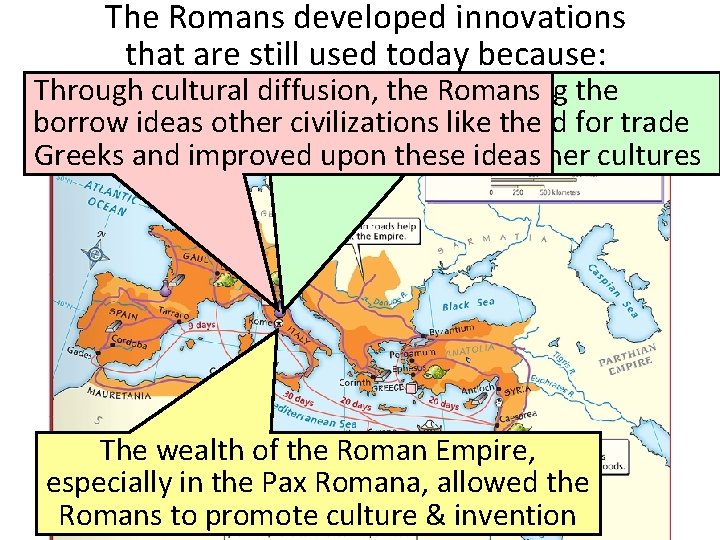
Roman Achievements § The Romans developed innovations that are still used today because: – Rome’s location along the Mediterranean Sea allowed for trade & cultural diffusion with other cultures – Through cultural diffusion, the Romans borrow ideas other civilizations like the Greeks and improved upon these ideas – The wealth of the Roman Empire, especially in the Pax Romana, allowed the Romans to promote culture & invention
The Romans developed innovations that are still used today because: Through cultural diffusion, Rome’s location the Romans along the borrow ideas Mediterranean other civilizations Sealike allowed the for trade Greeks and improved & culturalupon diffusion thesewith ideas other cultures The wealth of the Roman Empire, especially in the Pax Romana, allowed the Romans to promote culture & invention
Roman Architecture • The Romans were tremendous builders who were improved upon Greek designs with two new architectural features: arches & domes: – Arches – curved structures over an opening that can support its own weight – were used by the Romans to create enormous building like the Coliseum and the Pantheon. – Domes – created open spaces in buildings • The Romans built arenas so thousands of people could attend “circuses” (entertainment events).
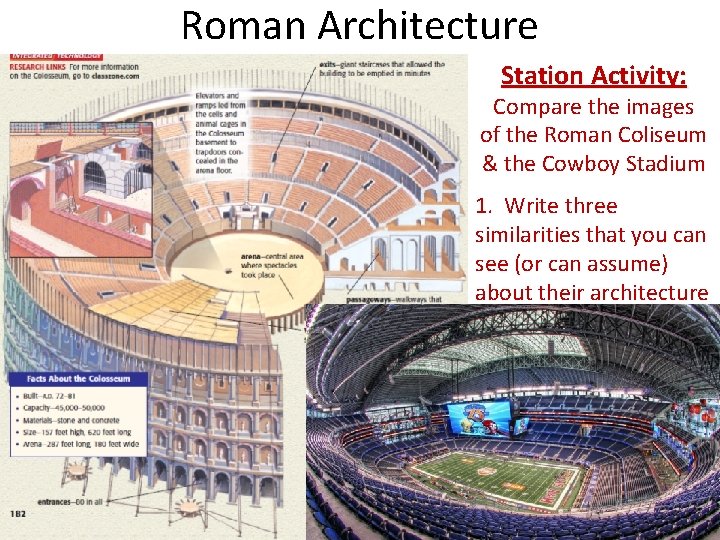
Roman Architecture • Who influenced the Romans in architecture? • What is one unique characteristic of Roman building? • Sketch an arch. Station Activity: Compare the images of the Roman Coliseum & the Cowboy Stadium 1. Write three similarities that you can see (or can assume) about their architecture
Roman Law • Roman laws were made by the Senate and then posted for the people to see, called the Twelve Tables. • The Roman legal system included a criminal court system with lawyers and juries so people accused of crimes could defend themselves. Witnesses could be called to give witness testimony. • Roman law allowed anyone – including the poor and slaves – to accuse others of crimes.
Roman Law Texas Law (Senate Bill 360, House Bill 23) "No person shall operate a motor vehicle on any public road or highway while using a wireless telecommunications device to write, send, or read any text message, instant message, electronic mail, or Internet data. ” “In addition, no persons under the age of 18 years of age may use a wireless telecommunications device while operating a motor vehicle. ” “The fine for offenders will be $150 and one point on their driver license, the new law goes into effect on July 1 st, 2010. ” Source: Texas Law Code, published 2010 Station Activity: Examine the excerpt from a new Texas law. 1. Assuming that the state of Texas borrowed ideas from the Romans, what similarities can you make between Texas laws and Roman laws? 2. If a police officer unfairly gave you a ticket for texting while driving, what Roman legal ideas could you use?
Roman Government • In 509 BC, the Romans overthrew the last Roman king and established a new form of government, known as a republic • The Romans created a republic to prevent any one person from gaining too much power. • They had a Senate, made up of 300 men, that made laws and selected two Consuls to command the army and run the day-to-day affairs of Rome.
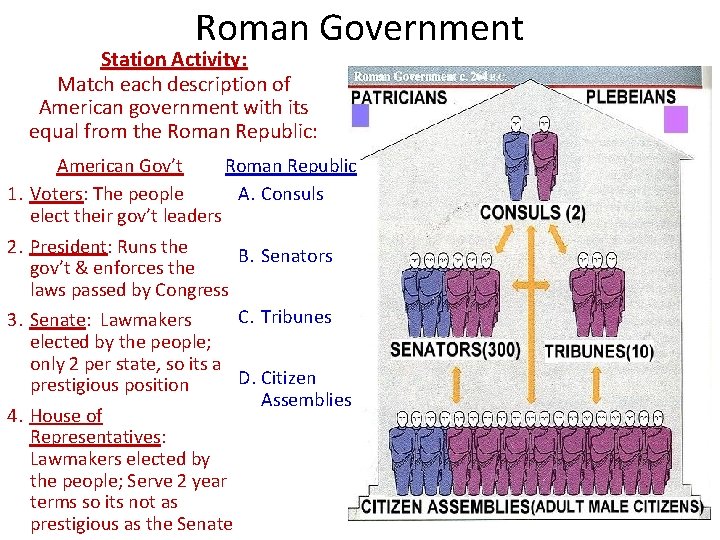
Roman Government Station Activity: Match each description of American government with its equal from the Roman Republic: American Gov’t Roman Republic 1. Voters: The people A. Consuls elect their gov’t leaders 2. President: Runs the B. Senators gov’t & enforces the laws passed by Congress C. Tribunes 3. Senate: Lawmakers elected by the people; only 2 per state, so its a D. Citizen prestigious position Assemblies 4. House of Representatives: Lawmakers elected by the people; Serve 2 year terms so its not as prestigious as the Senate
Roman Roads • The Romans built the largest and longestlasting network of roads in the ancient world. • At the height of the empire, Roman roads stretched for 56, 000 miles and included 29 major highways. • At first the roads were built to move soldiers quickly, but eventually the routes served many people and purposes, including trade.
Roman Aqueducts • One of the Roman’s greatest and most practical engineering feats was the channeling of water to their towns and cities • Roman engineers built the aqueducts to move the cold, clear water from springs over 250 miles into towns. • Some of the aqueducts are still standing and in use. One in Spain is a two-tiered aqueduct that is 95 feet above the ground and is 2, 388 feet long!
Roman Language • Roman conquest spread Latin through much of Europe. Over time, different regions in Europe developed languages based on Latin. • Languages based on Latin are known as Romance languages.
Roman Calendar • The Romans began using a new solar calendar that was borrowed heavily from the Egyptian calendar and had been improved by the scholars of Alexandria. • This new calendar (called the “Julian calendar” after Julius Caesar) had 365 days and 1 extra day every fourth year. • July was named after Julius Caesar because it included his birthday.
Roman Civil Service • Rome’s 1 st emperor, Augustus, created several systems to help himself rule in enormous empire better. • Augustus set up a civil service, with salaried, experienced workers to take care of the empire. • These bureaucrats helped oversee the empire by keeping track of grain, the roads, the postal service and all other things needed to run an empire.
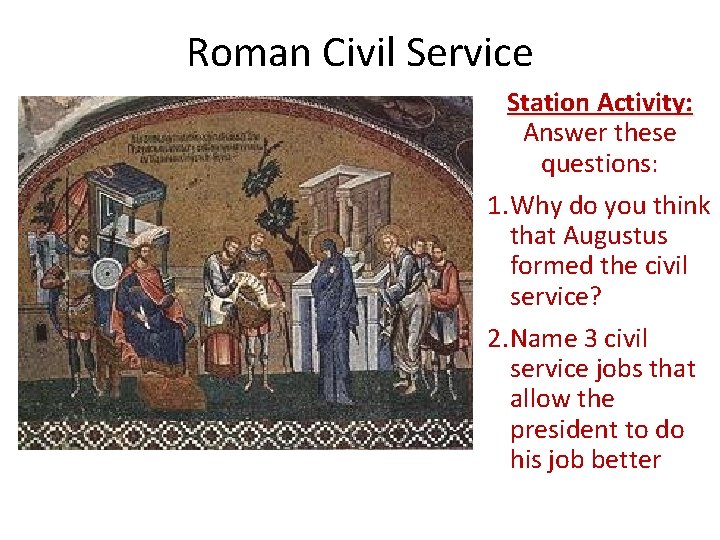
Roman Civil Service Station Activity: Answer these questions: 1. Why do you think that Augustus formed the civil service? 2. Name 3 civil service jobs that allow the president to do his job better