
Rolling Resistance of Tires for Light Vehicles II
- Slides: 26
Rolling Resistance of Tires for Light Vehicles, II: Comparison of Rolling Resistance Values Obtained from Different Test Methods and in Different Laboratories Larry Evans & John Harris, Transportation Research Center, Inc. James D. Mac. Isaac Jr. , USDOT - NHTSA Presented at ITEC 2008 Akron, OH September 17, 2008
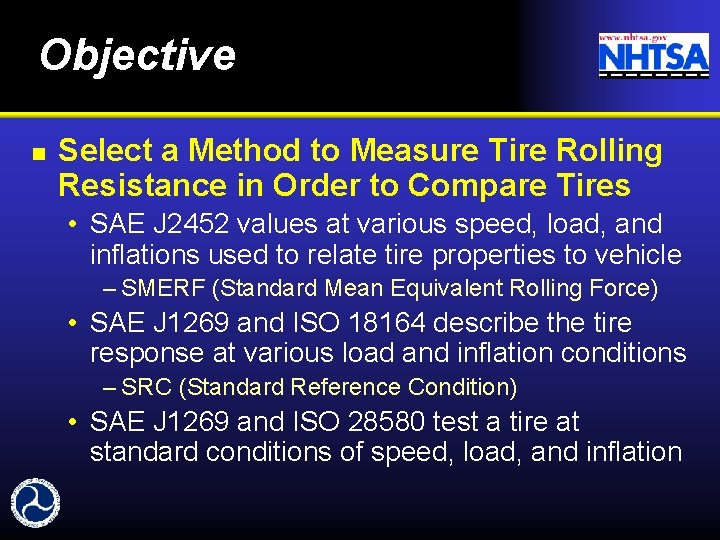
Objective n Select a Method to Measure Tire Rolling Resistance in Order to Compare Tires • SAE J 2452 values at various speed, load, and inflations used to relate tire properties to vehicle – SMERF (Standard Mean Equivalent Rolling Force) • SAE J 1269 and ISO 18164 describe the tire response at various load and inflation conditions – SRC (Standard Reference Condition) • SAE J 1269 and ISO 28580 test a tire at standard conditions of speed, load, and inflation
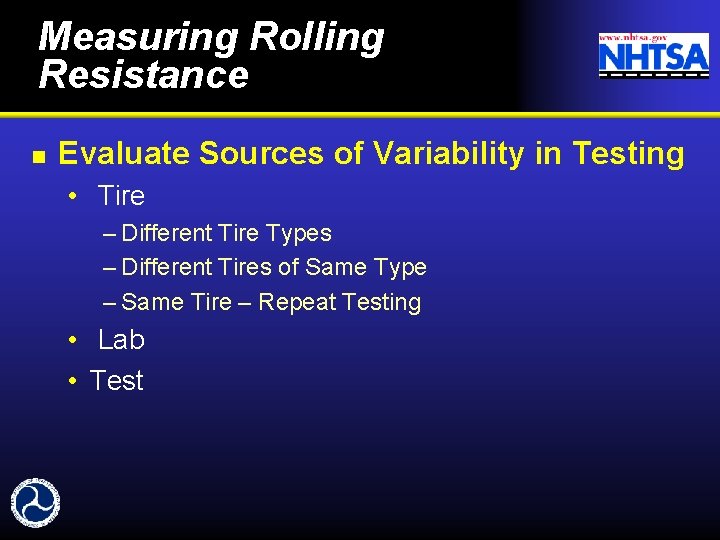
Measuring Rolling Resistance n Evaluate Sources of Variability in Testing • Tire – Different Tire Types – Different Tires of Same Type – Same Tire – Repeat Testing • Lab • Test
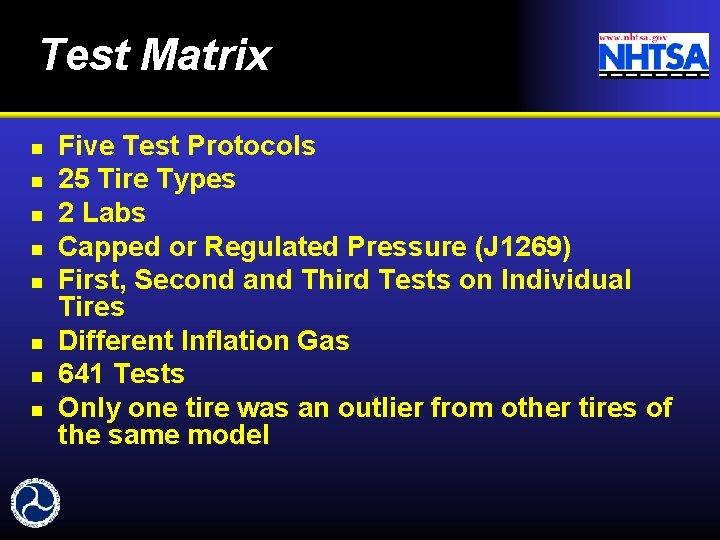
Test Matrix n n n n Five Test Protocols 25 Tire Types 2 Labs Capped or Regulated Pressure (J 1269) First, Second and Third Tests on Individual Tires Different Inflation Gas 641 Tests Only one tire was an outlier from other tires of the same model
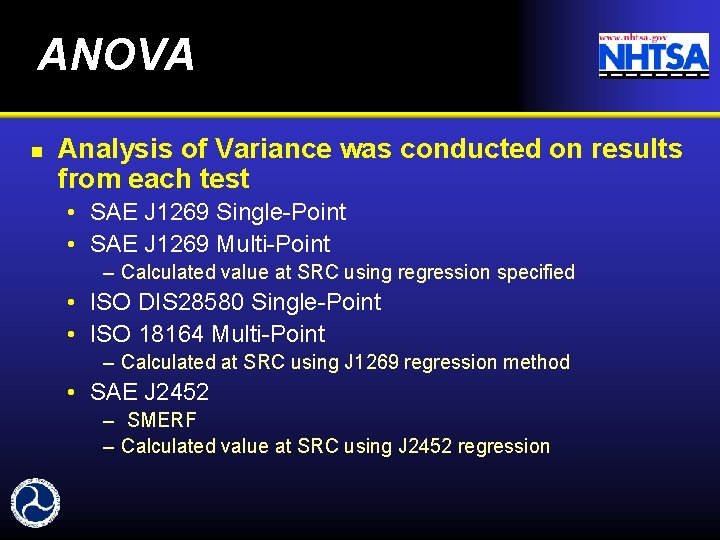
ANOVA n Analysis of Variance was conducted on results from each test • SAE J 1269 Single-Point • SAE J 1269 Multi-Point – Calculated value at SRC using regression specified • ISO DIS 28580 Single-Point • ISO 18164 Multi-Point – Calculated at SRC using J 1269 regression method • SAE J 2452 – SMERF – Calculated value at SRC using J 2452 regression
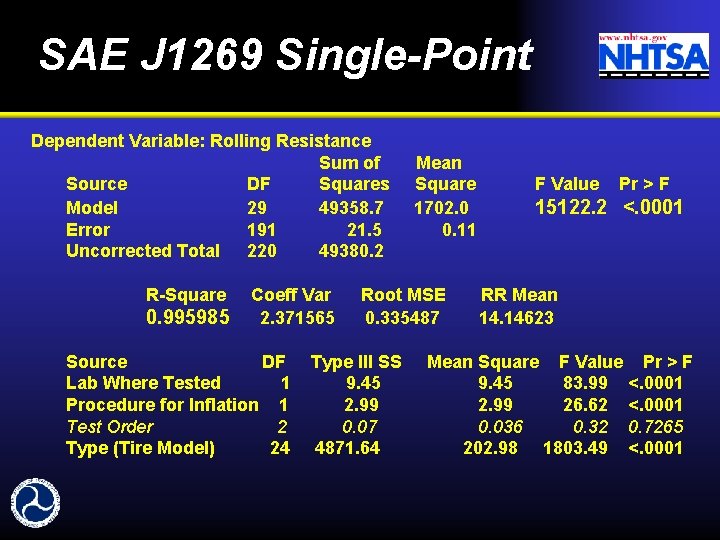
SAE J 1269 Single-Point Dependent Variable: Rolling Resistance Sum of Source DF Squares Model 29 49358. 7 Error 191 21. 5 Uncorrected Total 220 49380. 2 R-Square 0. 995985 Coeff Var 2. 371565 Source DF Lab Where Tested 1 Procedure for Inflation 1 Test Order 2 Type (Tire Model) 24 Mean Square 1702. 0 0. 11 Root MSE 0. 335487 Type III SS 9. 45 2. 99 0. 07 4871. 64 F Value Pr > F 15122. 2 <. 0001 RR Mean 14. 14623 Mean Square F Value Pr > F 9. 45 83. 99 <. 0001 2. 99 26. 62 <. 0001 0. 036 0. 32 0. 7265 202. 98 1803. 49 <. 0001
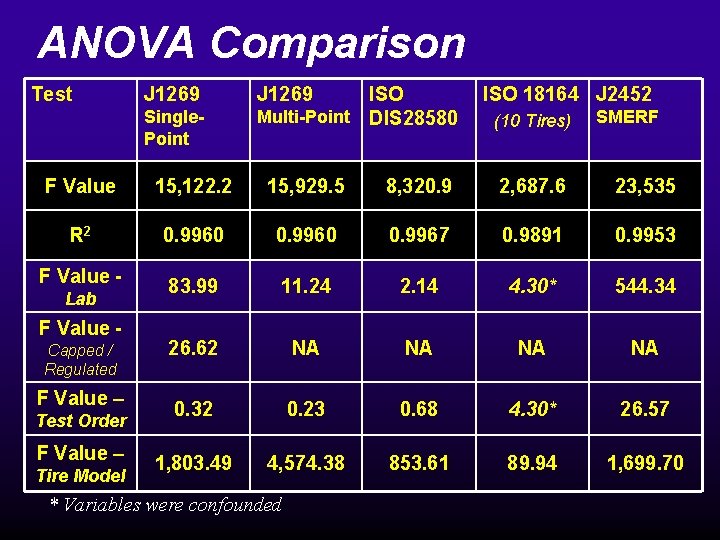
ANOVA Comparison Test J 1269 Single. Point J 1269 ISO Multi-Point DIS 28580 ISO 18164 J 2452 (10 Tires) SMERF F Value 15, 122. 2 15, 929. 5 8, 320. 9 2, 687. 6 23, 535 R 2 0. 9960 0. 9967 0. 9891 0. 9953 83. 99 11. 24 2. 14 4. 30* 544. 34 26. 62 NA NA 0. 32 0. 23 0. 68 4. 30* 26. 57 1, 803. 49 4, 574. 38 853. 61 89. 94 1, 699. 70 F Value Lab F Value Capped / Regulated F Value – Test Order F Value – Tire Model * Variables were confounded
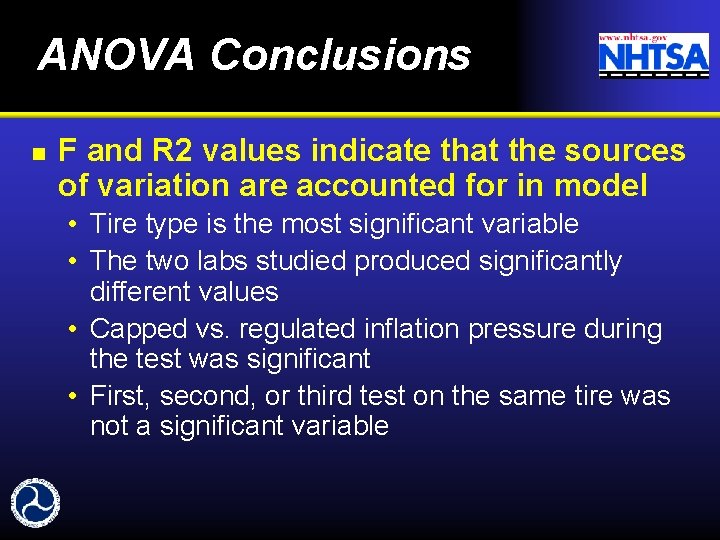
ANOVA Conclusions n F and R 2 values indicate that the sources of variation are accounted for in model • Tire type is the most significant variable • The two labs studied produced significantly different values • Capped vs. regulated inflation pressure during the test was significant • First, second, or third test on the same tire was not a significant variable
Lab Variation n n Test order (1 st, 2 nd, 3 rd) ignored Coefficient of Variation within a lab for a tire type on a test was ≤ 2. 5% • Values were normally distributed within each lab n There was a significant variation between labs for all tests
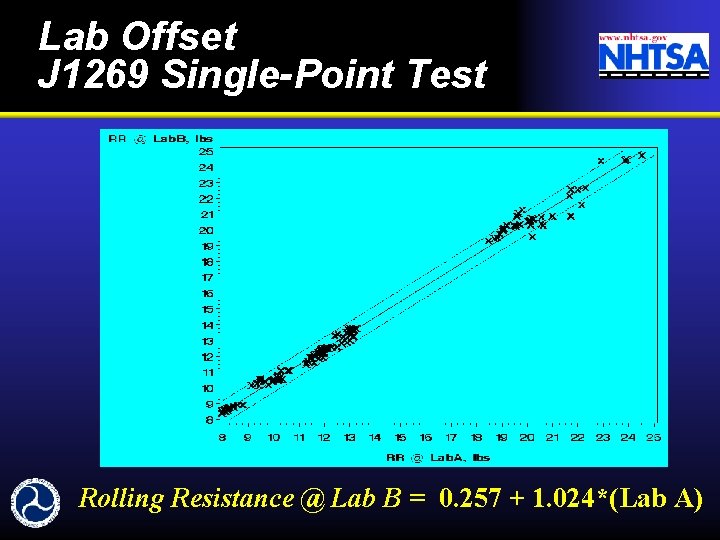
Lab Offset J 1269 Single-Point Test Rolling Resistance @ Lab B = 0. 257 + 1. 024*(Lab A)
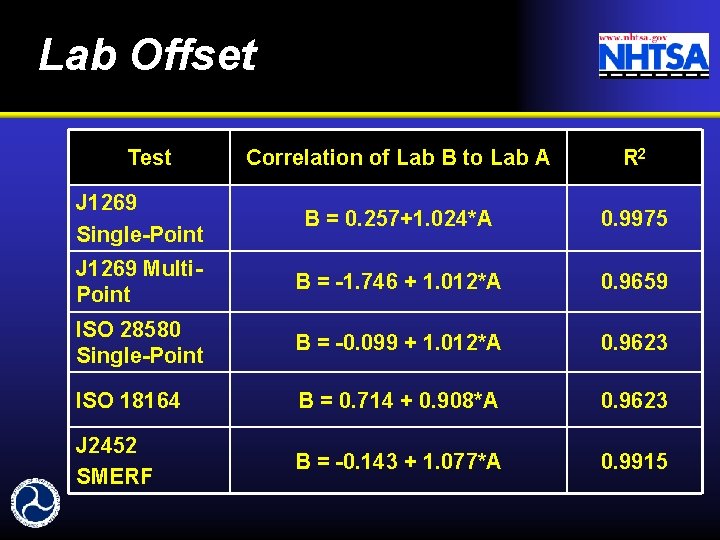
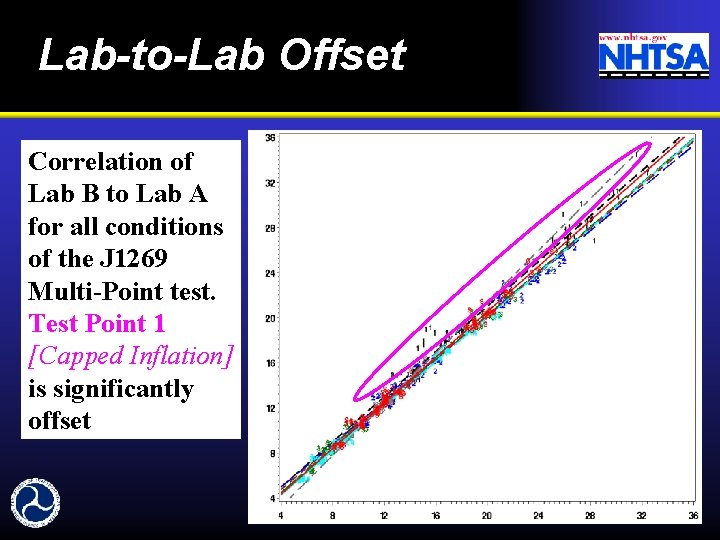
Lab Offset Test Correlation of Lab B to Lab A R 2 J 1269 Single-Point B = 0. 257+1. 024*A 0. 9975 J 1269 Multi. Point B = -1. 746 + 1. 012*A 0. 9659 ISO 28580 Single-Point B = -0. 099 + 1. 012*A 0. 9623 ISO 18164 B = 0. 714 + 0. 908*A 0. 9623 J 2452 SMERF B = -0. 143 + 1. 077*A 0. 9915
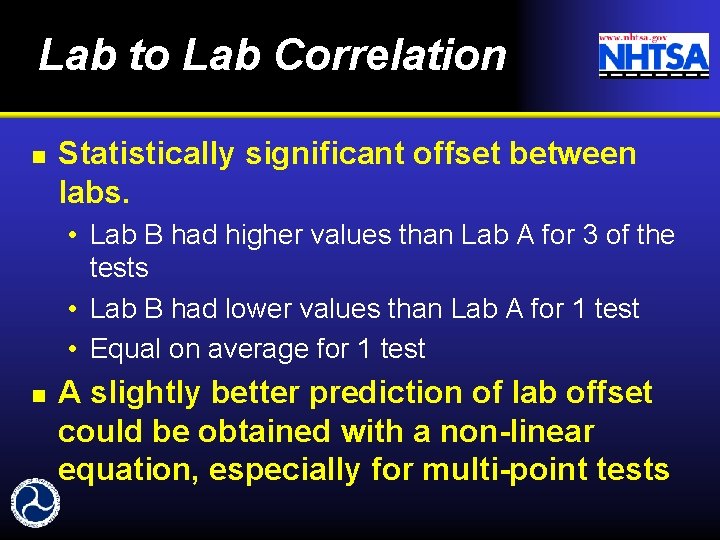
Lab to Lab Correlation n Statistically significant offset between labs. • Lab B had higher values than Lab A for 3 of the tests • Lab B had lower values than Lab A for 1 test • Equal on average for 1 test n A slightly better prediction of lab offset could be obtained with a non-linear equation, especially for multi-point tests
Lab-to-Lab Offset Correlation of Lab B to Lab A for all conditions of the J 1269 Multi-Point test. Test Point 1 [Capped Inflation] is significantly offset
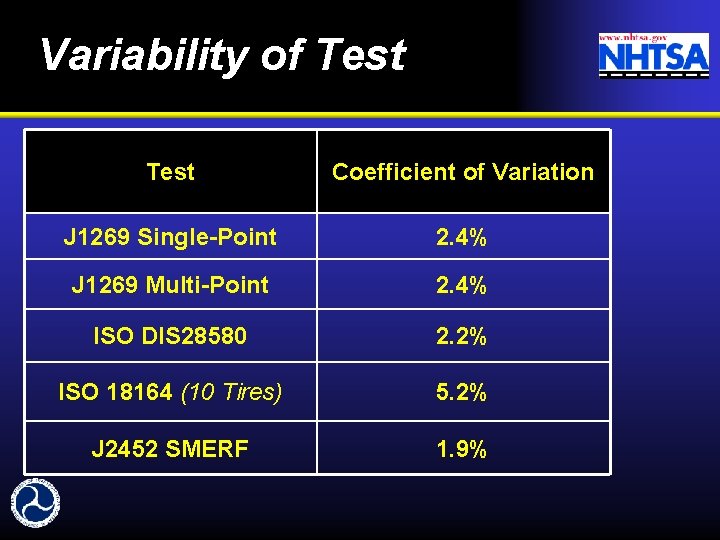
Variability of Test Coefficient of Variation J 1269 Single-Point 2. 4% J 1269 Multi-Point 2. 4% ISO DIS 28580 2. 2% ISO 18164 (10 Tires) 5. 2% J 2452 SMERF 1. 9%
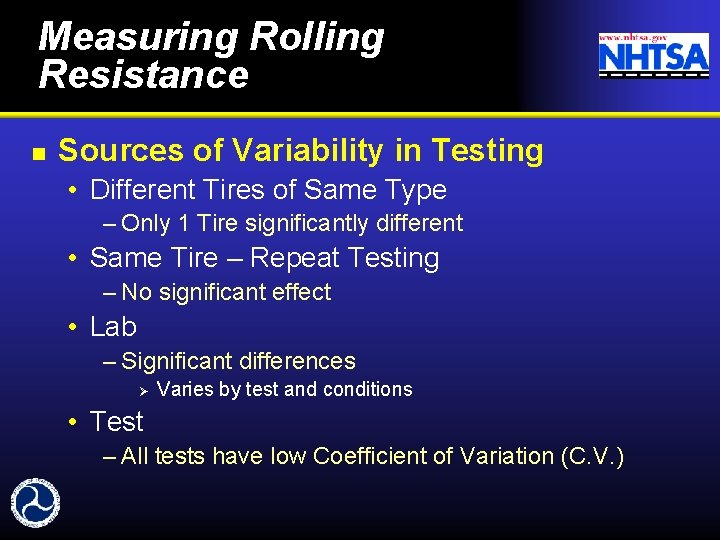
Measuring Rolling Resistance n Sources of Variability in Testing • Different Tires of Same Type – Only 1 Tire significantly different • Same Tire – Repeat Testing – No significant effect • Lab – Significant differences Ø Varies by test and conditions • Test – All tests have low Coefficient of Variation (C. V. )
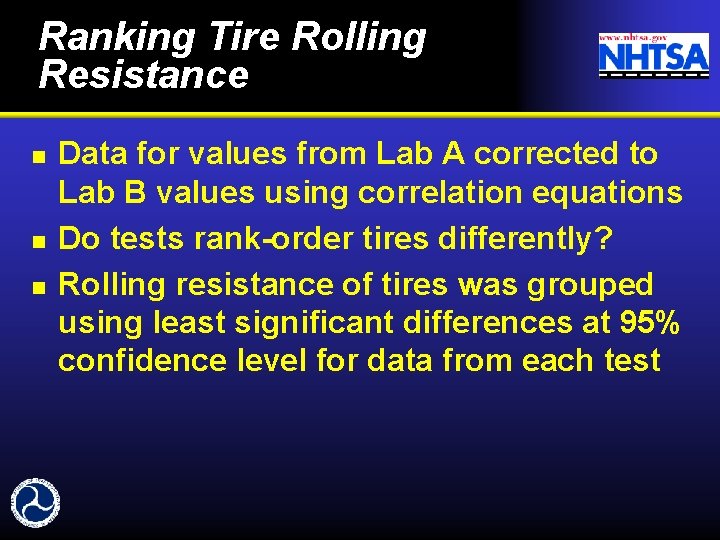
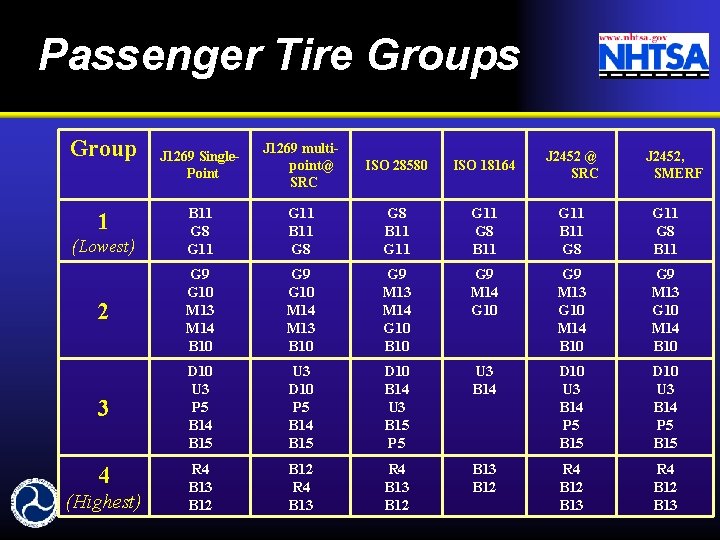
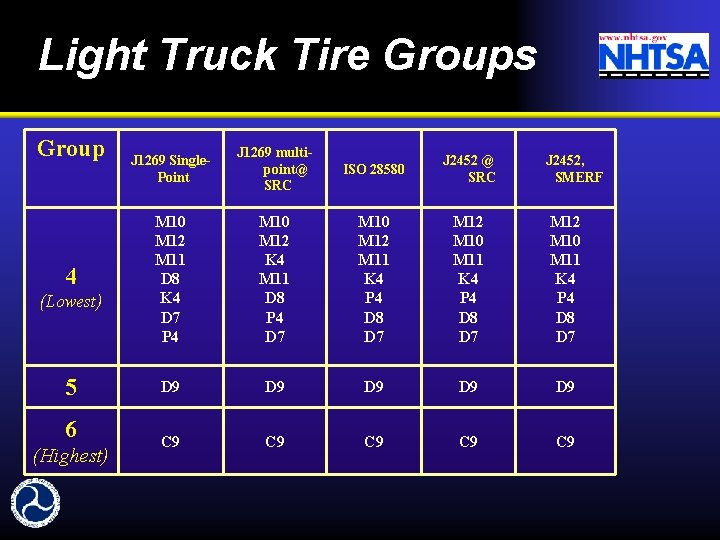
Ranking Tire Rolling Resistance n n n Data for values from Lab A corrected to Lab B values using correlation equations Do tests rank-order tires differently? Rolling resistance of tires was grouped using least significant differences at 95% confidence level for data from each test
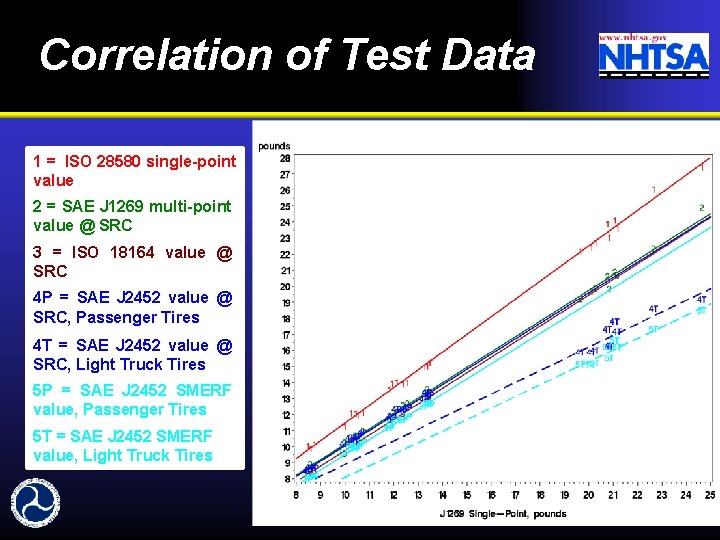
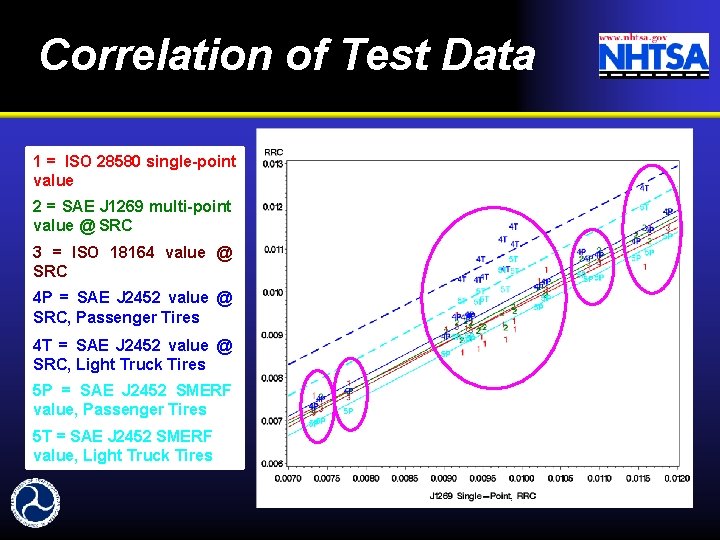
Correlation of Test Data 1 = ISO 28580 single-point value 2 = SAE J 1269 multi-point value @ SRC 3 = ISO 18164 value @ SRC 4 P = SAE J 2452 value @ SRC, Passenger Tires 4 T = SAE J 2452 value @ SRC, Light Truck Tires 5 P = SAE J 2452 SMERF value, Passenger Tires 5 T = SAE J 2452 SMERF value, Light Truck Tires
Passenger Tire Groups Group J 1269 Single. Point J 1269 multipoint@ SRC ISO 28580 ISO 18164 J 2452 @ SRC B 11 G 8 G 11 B 11 G 8 B 11 G 11 B 11 G 8 G 11 G 8 B 11 2 G 9 G 10 M 13 M 14 B 10 G 9 G 10 M 14 M 13 B 10 G 9 M 13 M 14 G 10 B 10 G 9 M 14 G 10 G 9 M 13 G 10 M 14 B 10 3 D 10 U 3 P 5 B 14 B 15 U 3 D 10 P 5 B 14 B 15 D 10 B 14 U 3 B 15 P 5 U 3 B 14 D 10 U 3 B 14 P 5 B 15 R 4 B 13 B 12 B 13 B 12 R 4 B 12 B 13 1 (Lowest) 4 (Highest) J 2452, SMERF
Light Truck Tire Groups Group J 1269 Single. Point J 1269 multipoint@ SRC ISO 28580 J 2452 @ SRC M 10 M 12 M 11 D 8 K 4 D 7 P 4 M 10 M 12 K 4 M 11 D 8 P 4 D 7 M 10 M 12 M 11 K 4 P 4 D 8 D 7 M 12 M 10 M 11 K 4 P 4 D 8 D 7 5 D 9 D 9 D 9 6 C 9 C 9 C 9 4 (Lowest) (Highest) J 2452, SMERF
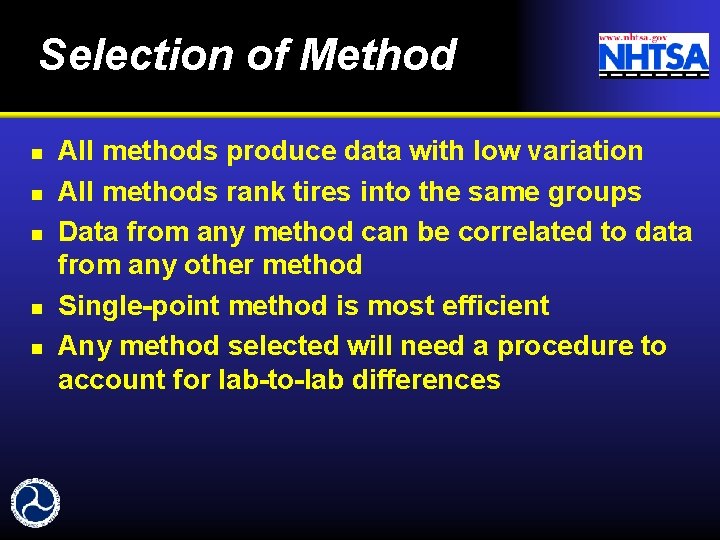
Selection of Method n n n All methods produce data with low variation All methods rank tires into the same groups Data from any method can be correlated to data from any other method Single-point method is most efficient Any method selected will need a procedure to account for lab-to-lab differences
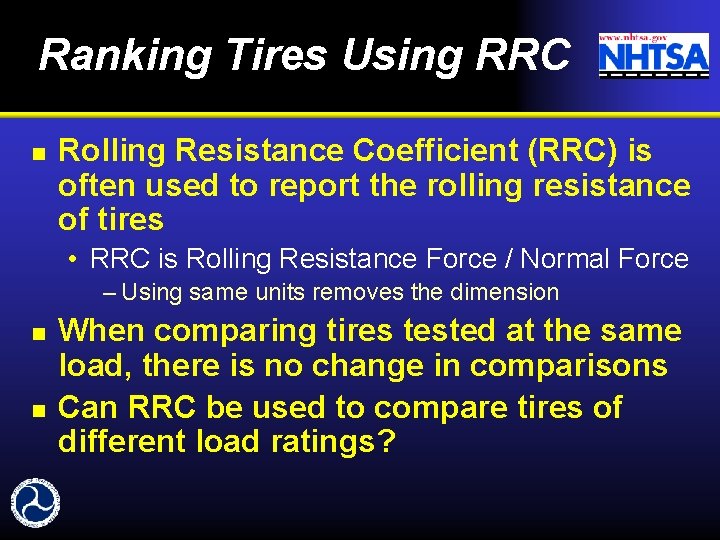
Ranking Tires Using RRC n Rolling Resistance Coefficient (RRC) is often used to report the rolling resistance of tires • RRC is Rolling Resistance Force / Normal Force – Using same units removes the dimension n n When comparing tires tested at the same load, there is no change in comparisons Can RRC be used to compare tires of different load ratings?
Correlation of Test Data 1 = ISO 28580 single-point value 2 = SAE J 1269 multi-point value @ SRC 3 = ISO 18164 value @ SRC 4 P = SAE J 2452 value @ SRC, Passenger Tires 4 T = SAE J 2452 value @ SRC, Light Truck Tires 5 P = SAE J 2452 SMERF value, Passenger Tires 5 T = SAE J 2452 SMERF value, Light Truck Tires
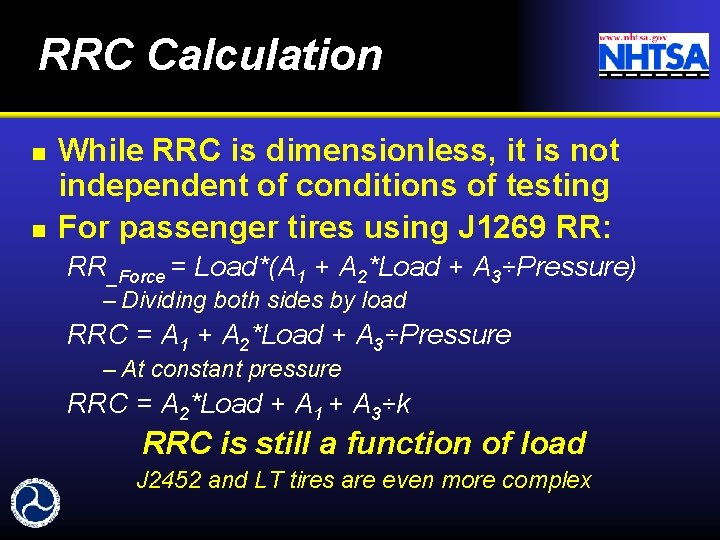
RRC Calculation n n While RRC is dimensionless, it is not independent of conditions of testing For passenger tires using J 1269 RR: RR_Force = Load*(A 1 + A 2*Load + A 3÷Pressure) – Dividing both sides by load RRC = A 1 + A 2*Load + A 3÷Pressure – At constant pressure RRC = A 2*Load + A 1 + A 3÷k RRC is still a function of load J 2452 and LT tires are even more complex
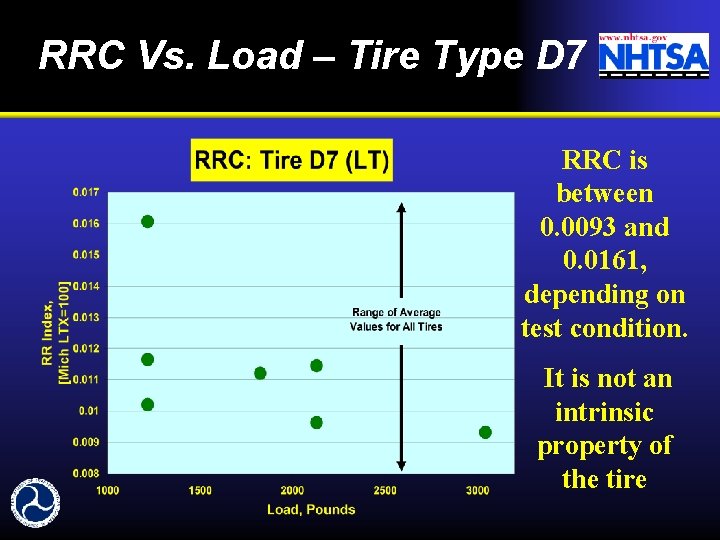
RRC Vs. Load – Tire Type D 7 RRC is between 0. 0093 and 0. 0161, depending on test condition. It is not an intrinsic property of the tire
Conclusions (I) n n n Up to 3 repeat tests of the same tire has no significant effect on rolling resistance values As expected, testing with capped inflation pressure produces a lower value, due to increased pressure Tires of the same model and size produce equivalent rolling resistance values, ± ~6% • Data is normally distributed • 1 outlier tire discovered
Conclusions (II) n Lab-to-Lab variation is significant • Dependent on test conditions and protocol n n All tests produce reliable data with low variation All tests rank order tires into the same groupings Values for all tests are approximately linear functions of the values of any other test Rolling Resistance or RR Coefficient describe a tire’s response at the conditions of test only