
Rolling mill Introduction to Rolling is a bulk
Rolling mill

Introduction to Rolling is a bulk deformation process in which the thickness of the work is reduced by compressive forces exerted by two opposing rolls. The rolls rotate to pull and simultaneously squeeze the work between them.

Introduction to Rolling After casting, ingots are rolled into three intermediate shapes, Ø Blooms: - have square cross section 6” x 6” or larger. They are rolled into structural shapes. Ø Billets: - have square cross section 1. 5” x 1. 5” or larger. they are rolled into bars and rods. Ø Slabs : - have rectangular cross section 10” x 1. 5” or larger. They are rolled into plates, sheets and strips.

Introduction to Rolling The basic process shown in the figure is “Flat Rolling”, used to reduce thickness of a rectangular cross section. A closely related process is “Shape rolling”, in which a square cross section is formed into a shape such as an I-beam. Shape Rolling Flat Rolling Shape Rolling

Types of Rolling Ø Based on work piece geometry : ØFlat rolling - used to reduce thickness of a rectangular cross section ØShape rolling - square cross section is formed, i. e. I‑beam ØBased on work temperature : ØHot Rolling – large amount of deformation. (free from residual stresses) ØCold rolling – produces finished sheet and plate. (metals are stronger) Ø According to No. & arrangement of the rolls : ØTwo-high rolling mill ØTandem rolling mill ØThree-high rolling mill ØCluster rolling mill ØFour-high rolling mill ØPlanetary rolling mill

Types of Rolling Two-high rolling mill Ø Two heavy horizontal rolls rotate in opposite direction, Ø Adjusted by raising or lowering the upper roll. Ø Pull the work into the gap by friction between work part & rolls. Ø Simultaneously squeeze the work to reduce its cross section.
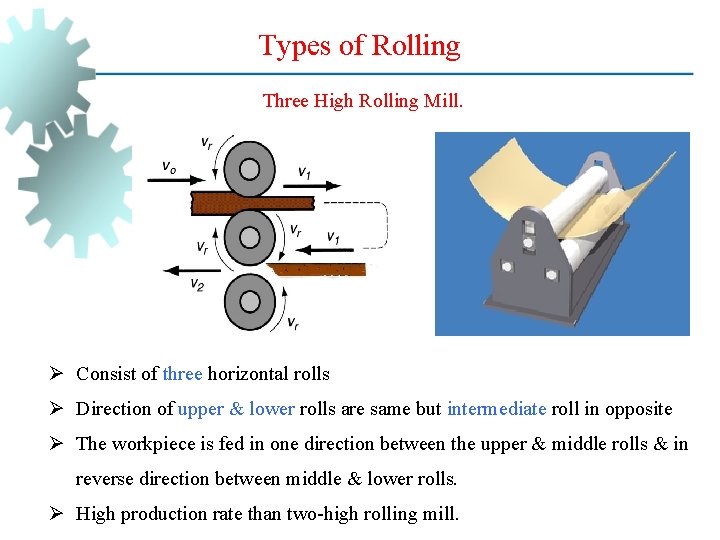
Types of Rolling Three High Rolling Mill. Ø Consist of three horizontal rolls Ø Direction of upper & lower rolls are same but intermediate roll in opposite Ø The workpiece is fed in one direction between the upper & middle rolls & in reverse direction between middle & lower rolls. Ø High production rate than two-high rolling mill.
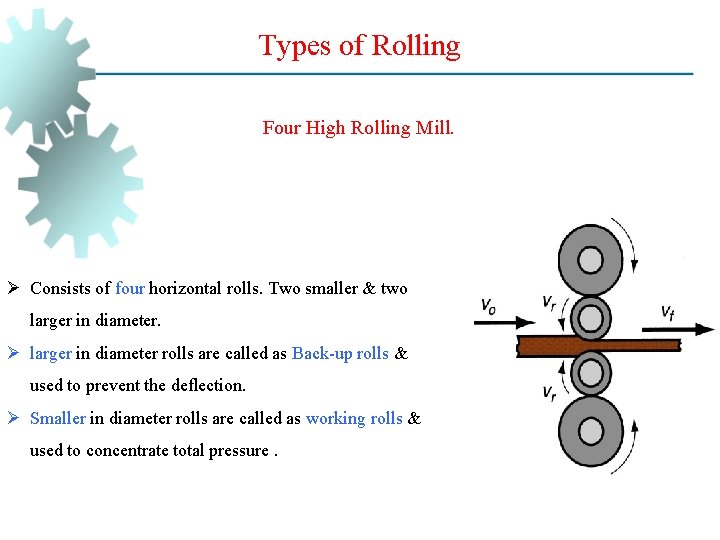
Types of Rolling Four High Rolling Mill. Ø Consists of four horizontal rolls. Two smaller & two larger in diameter. Ø larger in diameter rolls are called as Back-up rolls & used to prevent the deflection. Ø Smaller in diameter rolls are called as working rolls & used to concentrate total pressure.

Types of Rolling Cluster Rolling Mill. Ø Special type of four- high rolling mill. Ø Each of the working rolls is backed up by two or more of the larger back up rolls. Ø Used for rolling hard thin materials.
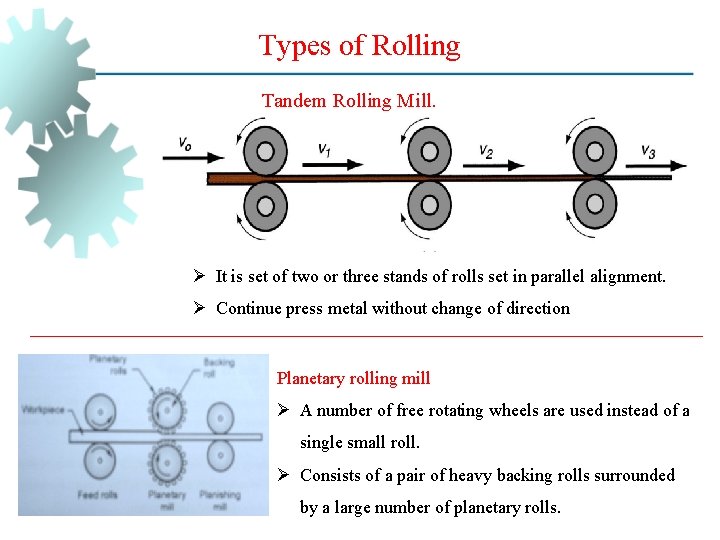
Types of Rolling Tandem Rolling Mill. Ø It is set of two or three stands of rolls set in parallel alignment. Ø Continue press metal without change of direction Planetary rolling mill Ø A number of free rotating wheels are used instead of a single small roll. Ø Consists of a pair of heavy backing rolls surrounded by a large number of planetary rolls.

Types of Rolling Universal Rolling Mill. Ø The metal is reduced by both horizontal & vertical rolls. Ø The horizontal rolls may be either two-high, three-high or four-high arrangement.
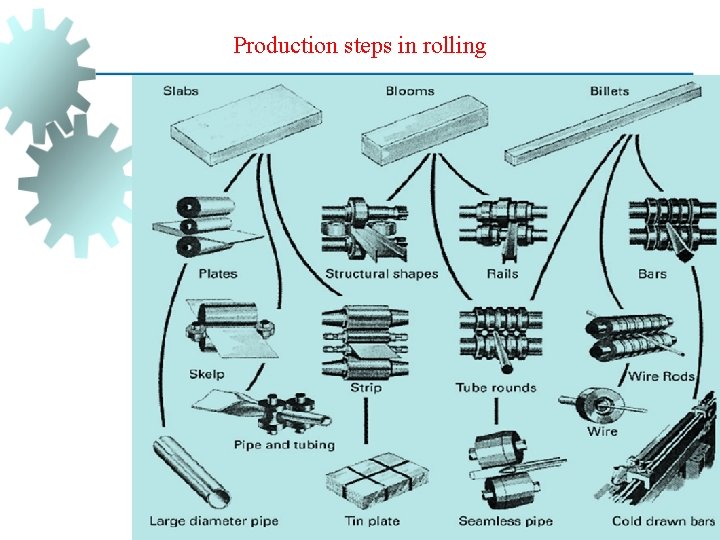
Production steps in rolling Two High Rolling Mill 12
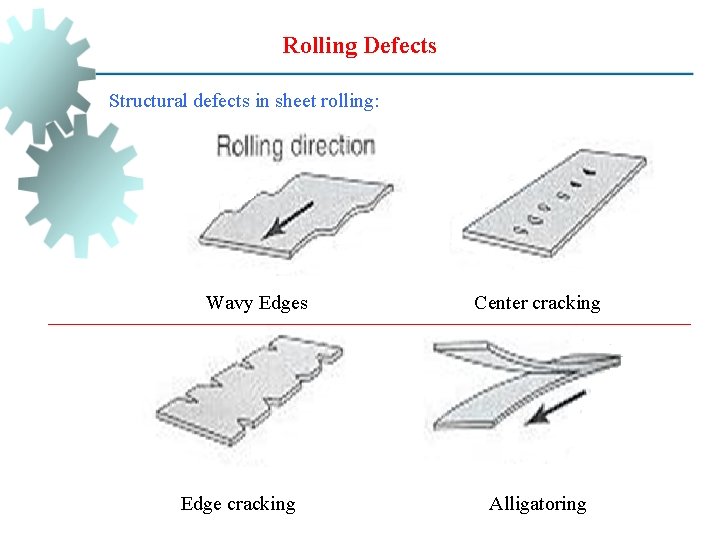
Rolling Defects Structural defects in sheet rolling: Wavy Edges Edge cracking Center cracking Alligatoring
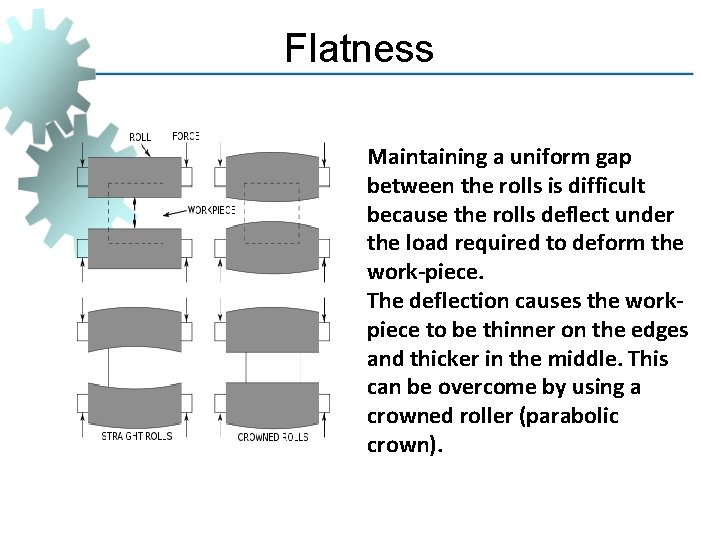
Flatness Maintaining a uniform gap between the rolls is difficult because the rolls deflect under the load required to deform the work-piece. The deflection causes the workpiece to be thinner on the edges and thicker in the middle. This can be overcome by using a crowned roller (parabolic crown).
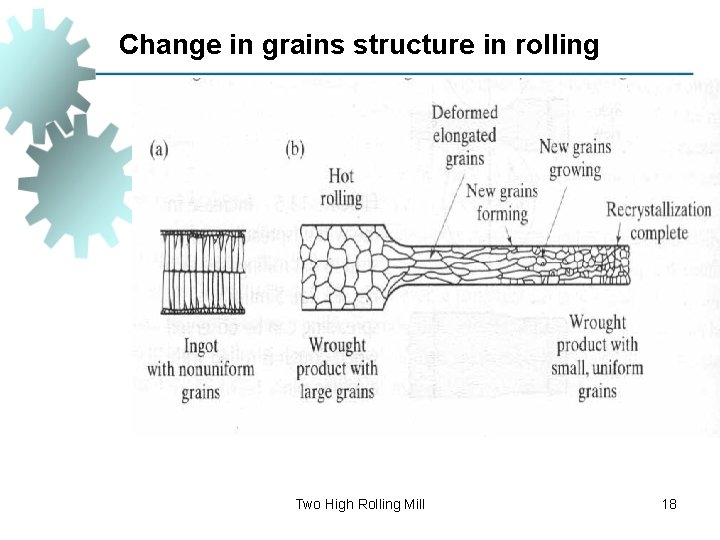
Change in grains structure in rolling Two High Rolling Mill 18
Rolling analysis • In flat rolling, the work is squeezed between two rolls so that its thickness is reduced by an amount called the draft: d = t o - tf where d: draft to: starting thickness tf : final thickness As a fraction of the starting thickness: % reduction = % r = (d/ to) * 100% Two High Rolling Mill 19
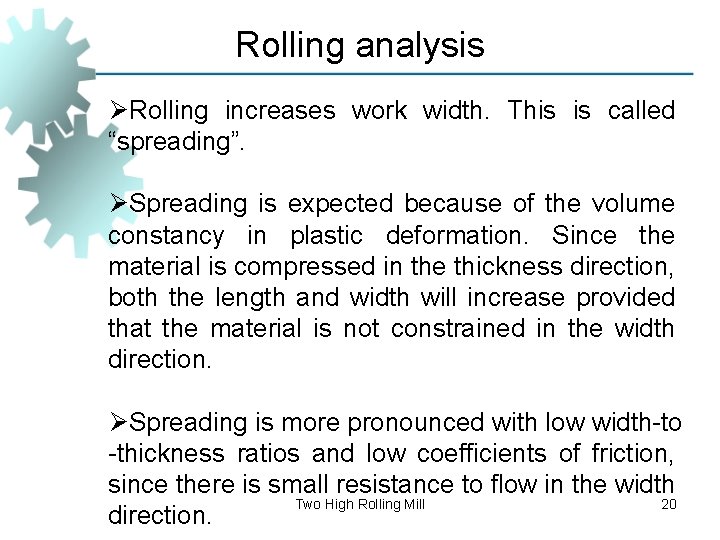
Rolling analysis ØRolling increases work width. This is called “spreading”. ØSpreading is expected because of the volume constancy in plastic deformation. Since the material is compressed in the thickness direction, both the length and width will increase provided that the material is not constrained in the width direction. ØSpreading is more pronounced with low width-to -thickness ratios and low coefficients of friction, since there is small resistance to flow in the width Two High Rolling Mill 20 direction.
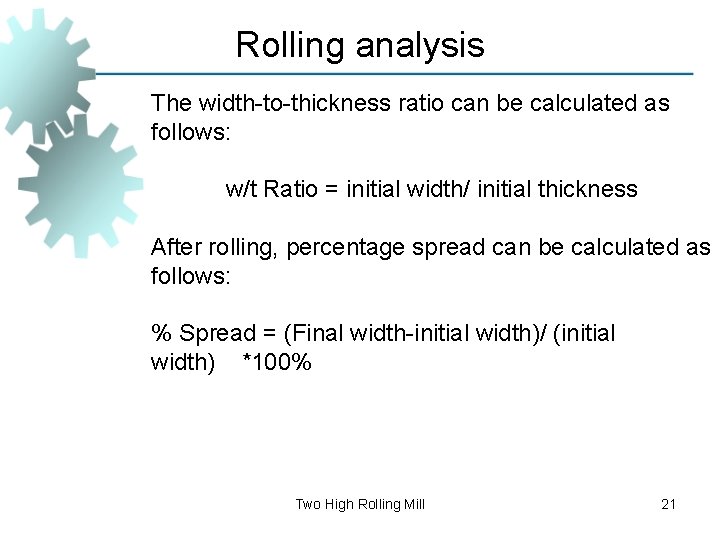
Rolling analysis The width-to-thickness ratio can be calculated as follows: w/t Ratio = initial width/ initial thickness After rolling, percentage spread can be calculated as follows: % Spread = (Final width-initial width)/ (initial width) *100% Two High Rolling Mill 21
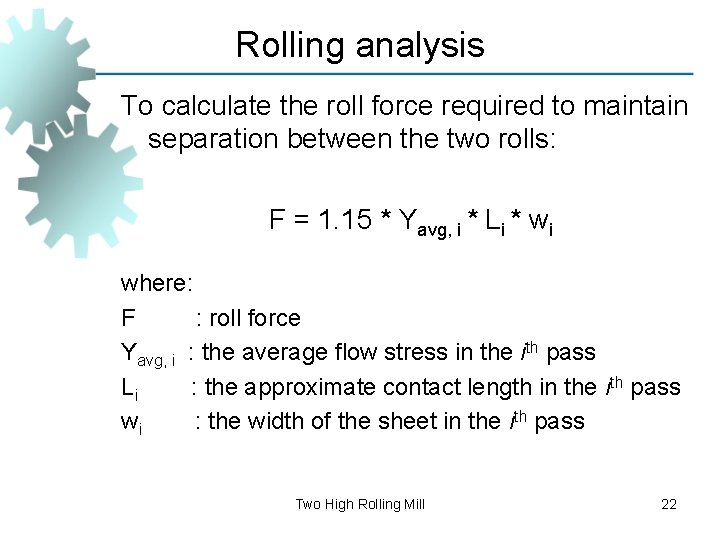
Rolling analysis To calculate the roll force required to maintain separation between the two rolls: F = 1. 15 * Yavg, i * Li * wi where: F : roll force Yavg, i : the average flow stress in the ith pass Li : the approximate contact length in the ith pass wi : the width of the sheet in the ith pass Two High Rolling Mill 22
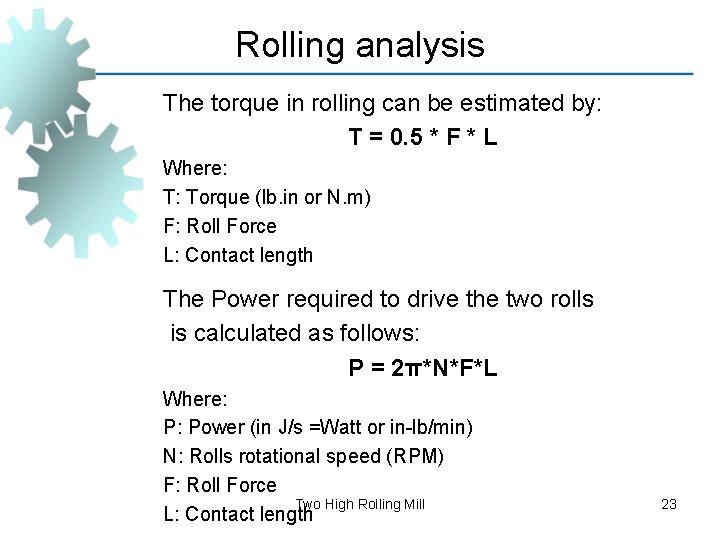
Rolling analysis The torque in rolling can be estimated by: T = 0. 5 * F * L Where: T: Torque (lb. in or N. m) F: Roll Force L: Contact length The Power required to drive the two rolls is calculated as follows: P = 2π*N*F*L Where: P: Power (in J/s =Watt or in-lb/min) N: Rolls rotational speed (RPM) F: Roll Force Two High Rolling Mill L: Contact length 23
Rolling Defects in rolling may be either surface or structural defects: • Surface defects include scale and roll marks. • Structural defects (see next figure) include: 1. Wavy edges: bending of the rolls causes the sheet to be thinner at the edges, which tend to elongate more. Since the edges are restricted by the material at the center, they tend to wrinkle and form wavy edges. 2. Center and edge cracks: caused by low material ductility and barreling of the edges. 3. Alligatoring: results from inhomogeneous deformation or defects in the original cast ingots. • Other defects may includes residual stresses (in some cases. Two residual stresses are desirable). High Rolling Mill 24
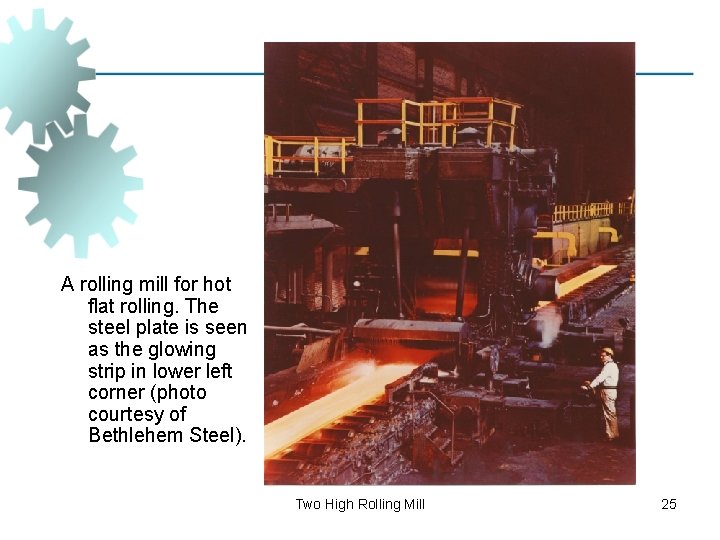
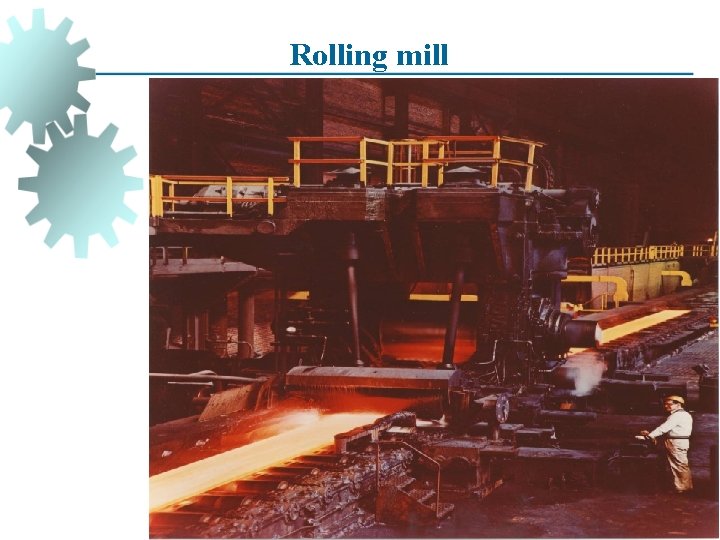
A rolling mill for hot flat rolling. The steel plate is seen as the glowing strip in lower left corner (photo courtesy of Bethlehem Steel). Two High Rolling Mill 25
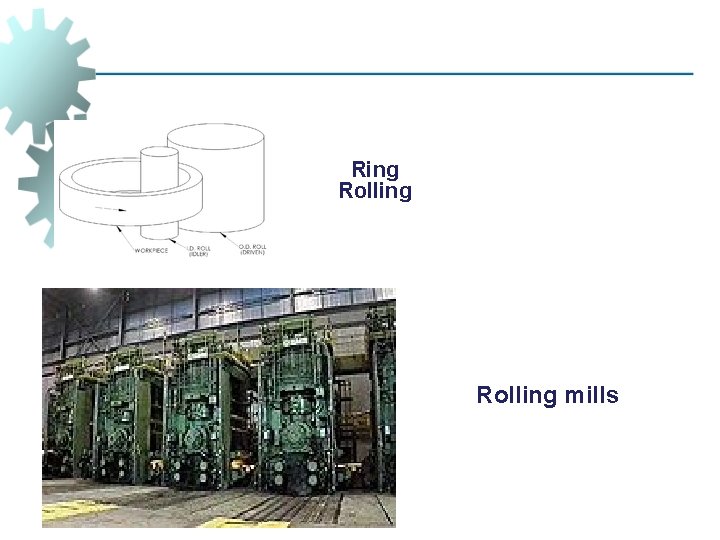
Ring Rolling mills
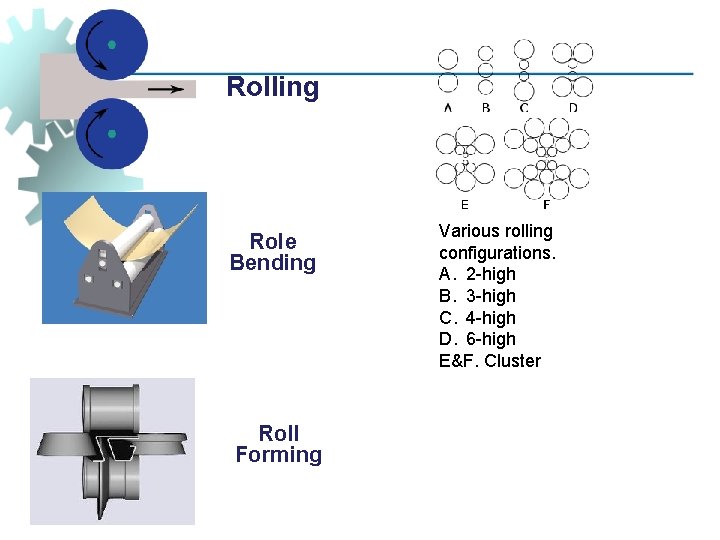
Rolling Role Bending Roll Forming Various rolling configurations. A. 2 -high B. 3 -high C. 4 -high D. 6 -high E&F. Cluster
- Slides: 27