
Roller Coaster Design Project Lab 01 Coaster Project
Roller Coaster Design Project Lab 01: Coaster Project Introduction
Introduction The roller coaster design project uses a nylon ball, two parallel plastic tube tracks, and PVC pipes and connectors in the construction of a scale model roller coaster. In addition, the coaster feature an open-design ‘Add-On’ project Example
Coaster Project Objectives ▪ Project Management and Teamwork • Time management, task scheduling, communication, etc. ▪ Design Process and Cycle • Project proposal process • Identifying requirements/constraints, brainstorming, initial designs, build/test/analyze, final design, etc. ▪ Project Documentation • Project notebook, design review phase documents, final reports, etc.
Coaster Project Timeline
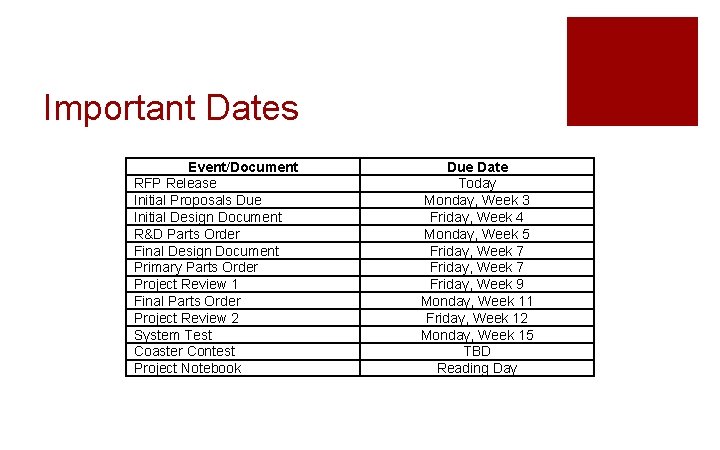
Important Dates Event/Document RFP Release Initial Proposals Due Initial Design Document R&D Parts Order Final Design Document Primary Parts Order Project Review 1 Final Parts Order Project Review 2 System Test Coaster Contest Project Notebook Due Date Today Monday, Week 3 Friday, Week 4 Monday, Week 5 Friday, Week 7 Friday, Week 9 Monday, Week 11 Friday, Week 12 Monday, Week 15 TBD Reading Day
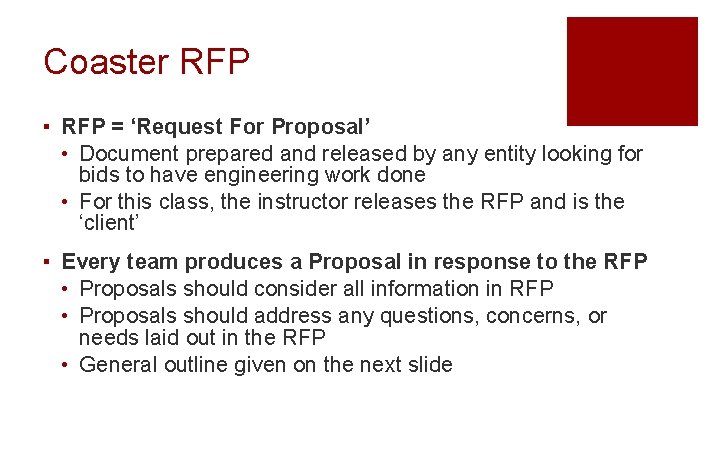
Coaster RFP ▪ RFP = ‘Request For Proposal’ • Document prepared and released by any entity looking for bids to have engineering work done • For this class, the instructor releases the RFP and is the ‘client’ ▪ Every team produces a Proposal in response to the RFP • Proposals should consider all information in RFP • Proposals should address any questions, concerns, or needs laid out in the RFP • General outline given on the next slide
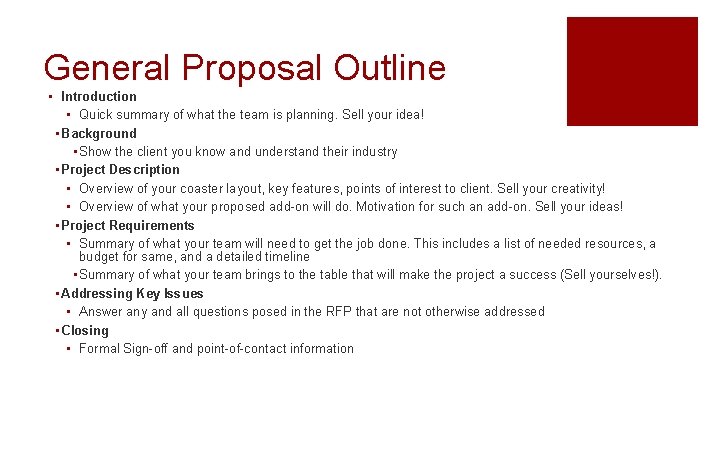
General Proposal Outline ▪ Introduction • Quick summary of what the team is planning. Sell your idea! ▪ Background • Show the client you know and understand their industry ▪ Project Description • Overview of your coaster layout, key features, points of interest to client. Sell your creativity! • Overview of what your proposed add-on will do. Motivation for such an add-on. Sell your ideas! ▪ Project Requirements • Summary of what your team will need to get the job done. This includes a list of needed resources, a budget for same, and a detailed timeline • Summary of what your team brings to the table that will make the project a success (Sell yourselves!). ▪ Addressing Key Issues • Answer any and all questions posed in the RFP that are not otherwise addressed ▪ Closing • Formal Sign-off and point-of-contact information
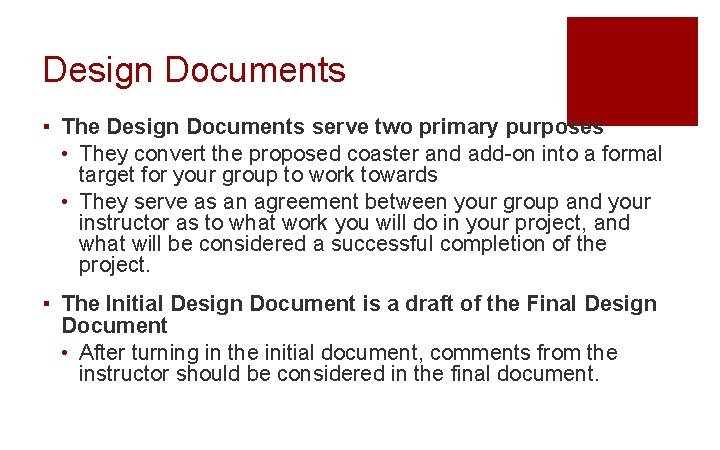
Design Documents ▪ The Design Documents serve two primary purposes • They convert the proposed coaster and add-on into a formal target for your group to work towards • They serve as an agreement between your group and your instructor as to what work you will do in your project, and what will be considered a successful completion of the project. ▪ The Initial Design Document is a draft of the Final Design Document • After turning in the initial document, comments from the instructor should be considered in the final document.
Parts Orders ▪ There are three opportunities for your group to order parts for your coaster throughout the semester • R&D, Primary and Final parts orders • Details can be found in the primary project document ▪ At this time, parts may only be ordered from digikey. com or amazon. com ▪ You may use your own parts in your coaster, however they still count against your total budget (see RFP, project document)
Project Reviews ▪ There are two project reviews during the semester. These serve as opportunities for your instructor to evaluate your progress • Reviews happen during lab time • They will be brief - no more than a few minutes • They are graded based on acceptable progression of the project as defined in your proposal timeline
System Test ▪ The last day of class, coasters will be graded during the system test • Every group will be given three runs, with the highest scoring run counting • Details on grading can be found in the main project document on the EEIC course page • Additional points can be earned via the optional coaster contest held during finals week. See the main project document for more details
Coaster Contest ▪ During finals week, all 1182 groups from all sections at OSU Marion may optionally participate in the Coaster Contest. Full details found in main project document. • Event is open to the public • An brief oral presentation is required to participate • Dress will be business casual • Date is TBD at this time
Project Notebook ▪ The primary document for the 1182 class is the project notebook • Should be present at all group meetings (including class!) • Acts as a record of all group activity (brainstorming, code generation, lab activities, etc) • Significant contributor to your final grade • Subject to pass/fail spot checks • Due on the reading day before finals week
Coaster Kit Components
Coaster Kit Components ▪ Shared Components • Speed Sensor Reader • Development Arduino Boards • Development Servos These components are to stay in the classroom at ALL times ▪ Kit Components ▪ PVC Pipes & Fittings ▪ Track ▪ Speed Sensors and cables ▪ Nylon Balls ▪ PVC Pipes
Arduino Kits ▪ Every student must have an Arduino development kits as detailed in the project document • May be purchased new (check Amazon) or used • Must include sensors (at least 2) and motors (at least 1), as well as more basic components (at least some LEDs, resistors and switches) • Should be brought to all labs and build sessions • Ask if you have any questions or are looking for an exception to these requirements!
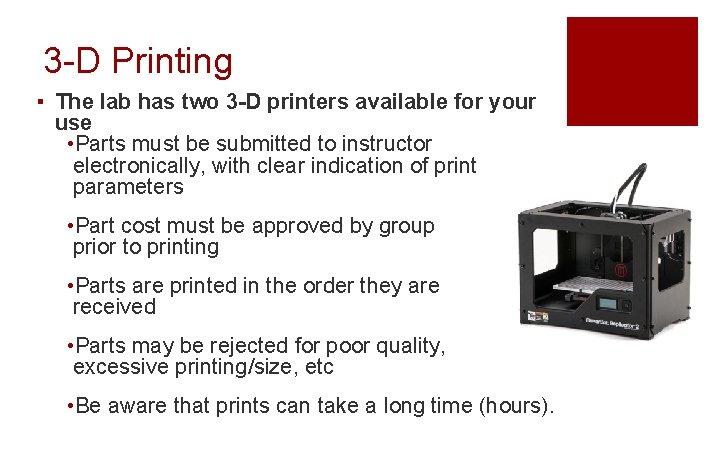
3 -D Printing ▪ The lab has two 3 -D printers available for your use • Parts must be submitted to instructor electronically, with clear indication of print parameters • Part cost must be approved by group prior to printing • Parts are printed in the order they are received • Parts may be rejected for poor quality, excessive printing/size, etc • Be aware that prints can take a long time (hours).
Questions?
- Slides: 18