
Roles of Variables with Examples in Scratch Computer
Roles of Variables with Examples in Scratch Computer Science and Software Engineering © 2014 Project Lead The Way, Inc.

What are variable roles? • A variable role is the reason we are using the variable. • Variables always remember data for later use. But why are we trying to remember something?
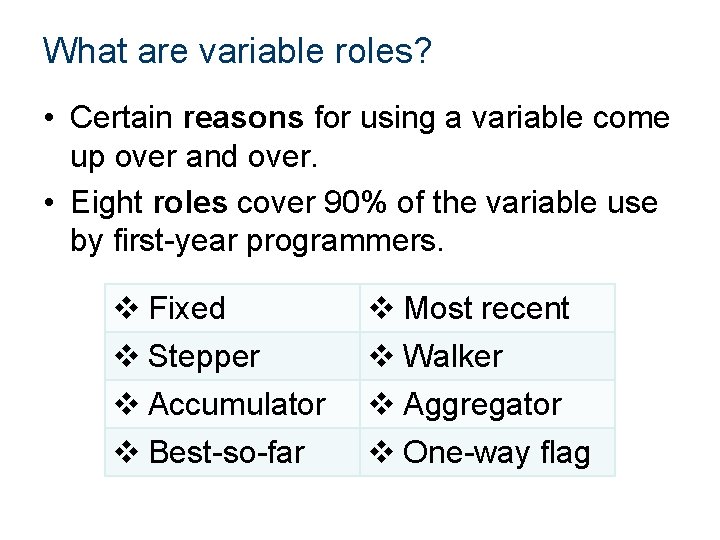
What are variable roles? • Certain reasons for using a variable come up over and over. • Eight roles cover 90% of the variable use by first-year programmers. v Fixed v Stepper v Accumulator v Best-so-far v Most recent v Walker v Aggregator v One-way flag
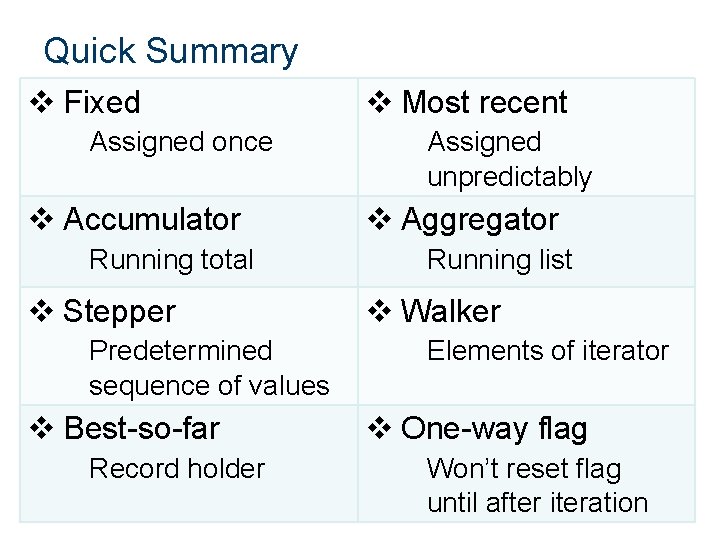
Quick Summary v Fixed Assigned once v Accumulator Running total v Stepper Predetermined sequence of values v Best-so-far Record holder v Most recent Assigned unpredictably v Aggregator Running list v Walker Elements of iterator v One-way flag Won’t reset flag until after iteration
What are variable roles? • Roles say why we are using the variable. • Roles are not syntax. Examples of syntax include whether the variable is used in a conditional, in an expression, or in an assignment block.
Variable Role: Fixed Why use a fixed variable? • Create a single place to tweak a number used throughout a program – low maintenance • Make code easier to read – no wondering “why subtract 20 here? ” • Make it easy to add features: user decides on the constant
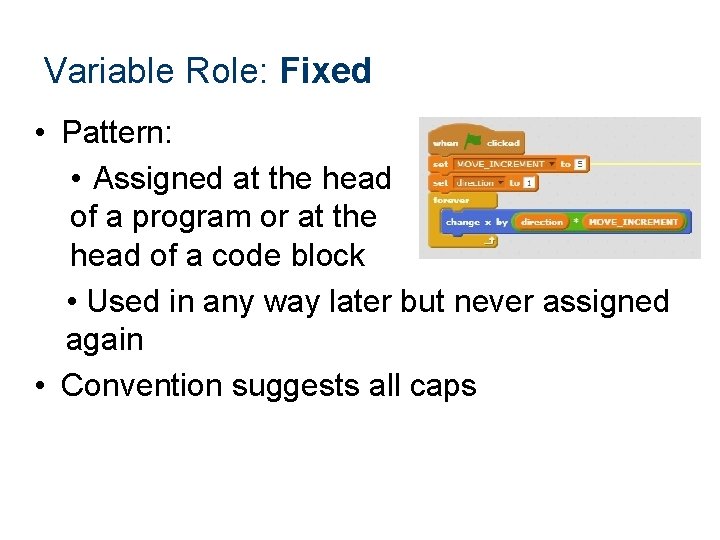
Variable Role: Fixed • Pattern: • Assigned at the head of a program or at the head of a code block • Used in any way later but never assigned again • Convention suggests all caps
Variable Role: Most-Recent Why use a most recent variable? • • • Retrieve or calculate once, use multiple times Remember state of a process Remember user input until needed Embed explanation Debug by printing Pattern: Appears on left of assignment and then in a variety of syntax
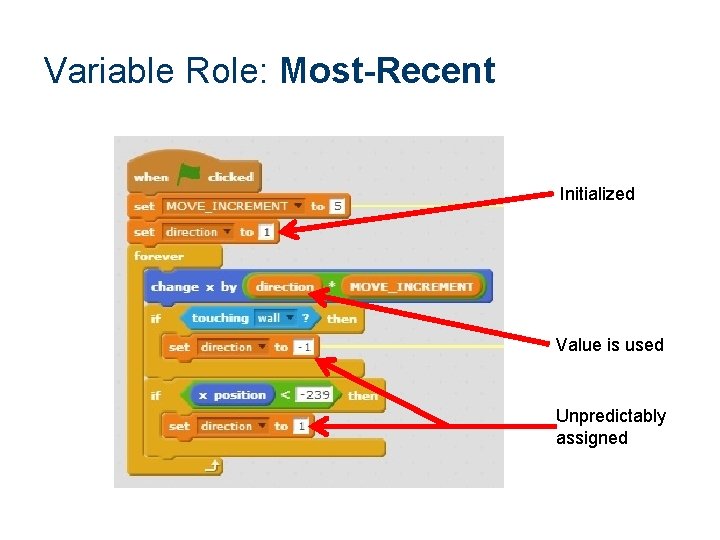
Variable Role: Most-Recent Initialized Value is used Unpredictably assigned
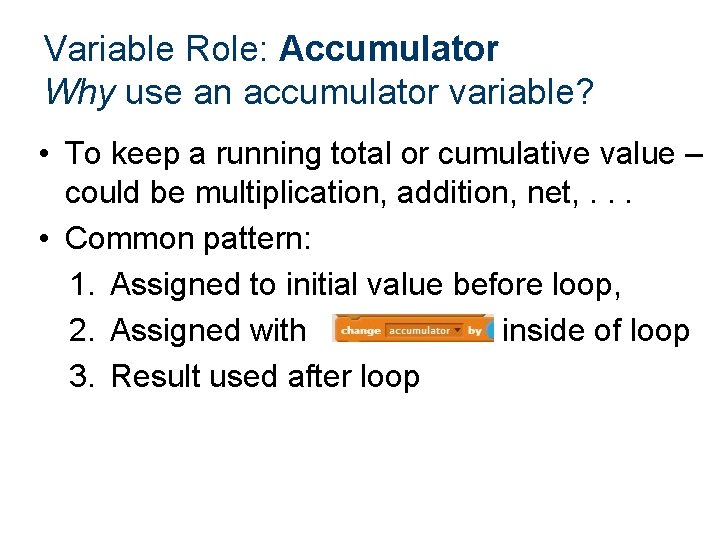
Variable Role: Accumulator Why use an accumulator variable? • To keep a running total or cumulative value – could be multiplication, addition, net, . . . • Common pattern: 1. Assigned to initial value before loop, 2. Assigned with inside of loop 3. Result used after loop
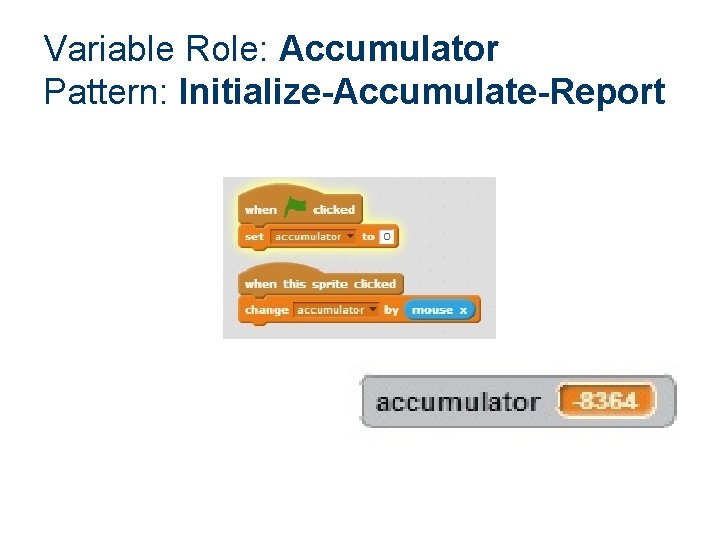
Variable Role: Accumulator Pattern: Initialize-Accumulate-Report
Variable Role: Aggregator Why use an aggregator variable? • To collect items and remember them all separately • Common pattern: 1. Initialize to empty collection before a loop, 2. Append element to aggregate during iteration 3. The aggregate is used during or after the loop

Variable Role: Aggregator Pattern: Initialize-Aggregate-Report
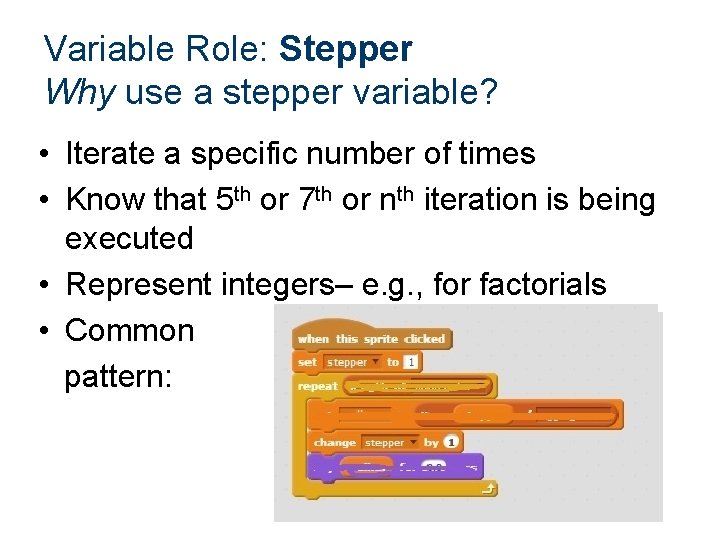
Variable Role: Stepper Why use a stepper variable? • Iterate a specific number of times • Know that 5 th or 7 th or nth iteration is being executed • Represent integers– e. g. , for factorials • Common pattern:
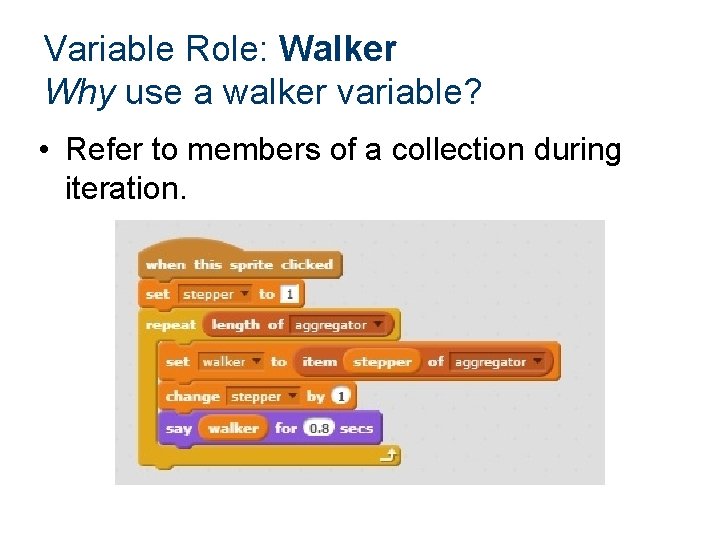
Variable Role: Walker Why use a walker variable? • Refer to members of a collection during iteration.
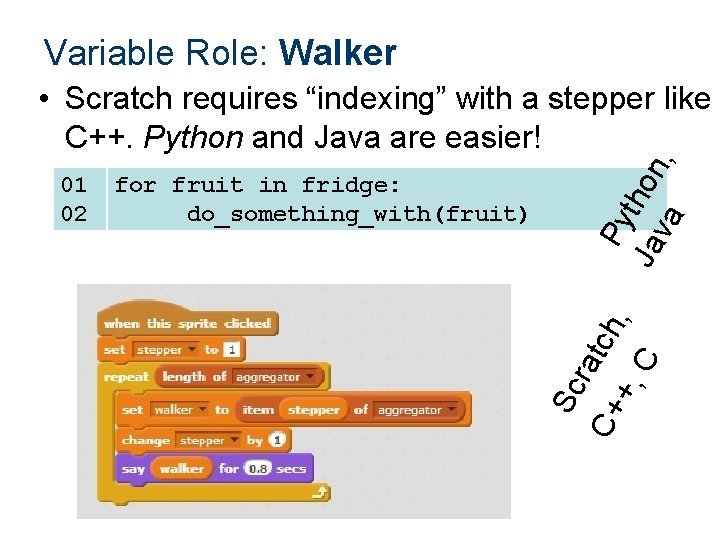
Variable Role: Walker for fruit in fridge: do_something_with(fruit) Sc rat C+ ch , +, C 01 02 Py Ja thon va , • Scratch requires “indexing” with a stepper like C++. Python and Java are easier!
Variable Role: Best-so-far Why use a best-so-far variable? • To remember the record holder while iterating across many opportunities to set the record • Frequent pattern: 1. Initialize to worst-possible value before loop, 2. During iteration, compare something to best-so-far and maybe assign a new record 3. After loop, best-so-far used as the true record-best from all iterations
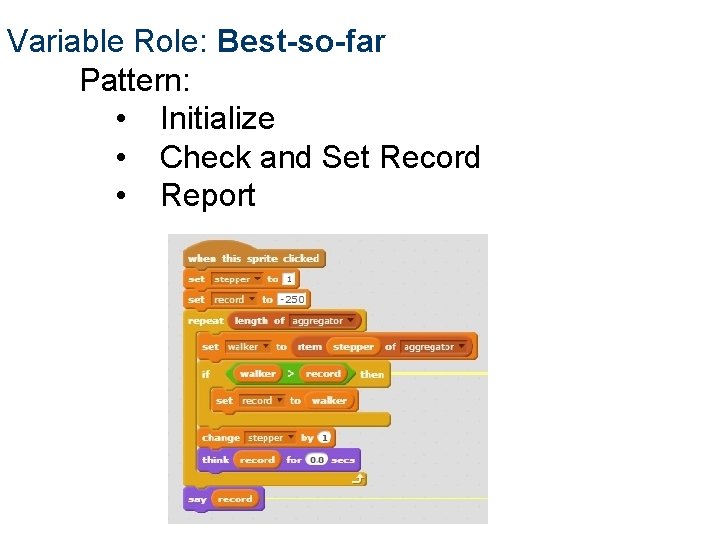
Variable Role: Best-so-far Pattern: • Initialize • Check and Set Record • Report
Variable Role: One-way Flag Why use a one-way-flag variable? • To remember whether any of several opportunities meet a single condition • Common pattern: 1. “Clear” the flag (initialize) to say the opportunity has not yet been met 2. Check for condition with each iteration and “raise” flag if true 3. Flag is not cleared during iteration 4. After loop, check if flag was raised during the iterations
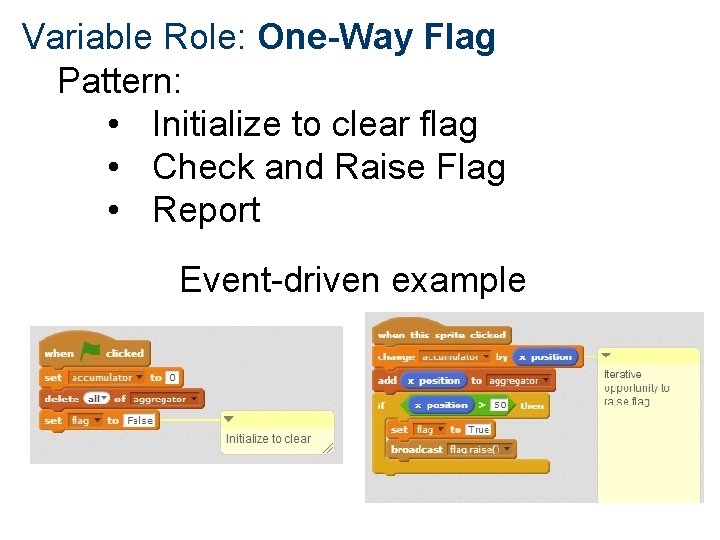
Variable Role: One-Way Flag Pattern: • Initialize to clear flag • Check and Raise Flag • Report Event-driven example
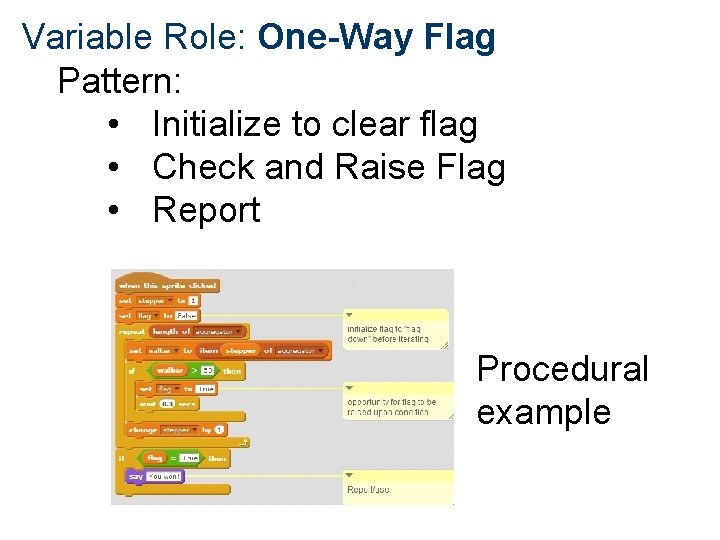
Variable Role: One-Way Flag Pattern: • Initialize to clear flag • Check and Raise Flag • Report Procedural example
- Slides: 21