
Roles of the Public Safety Professional Principles of
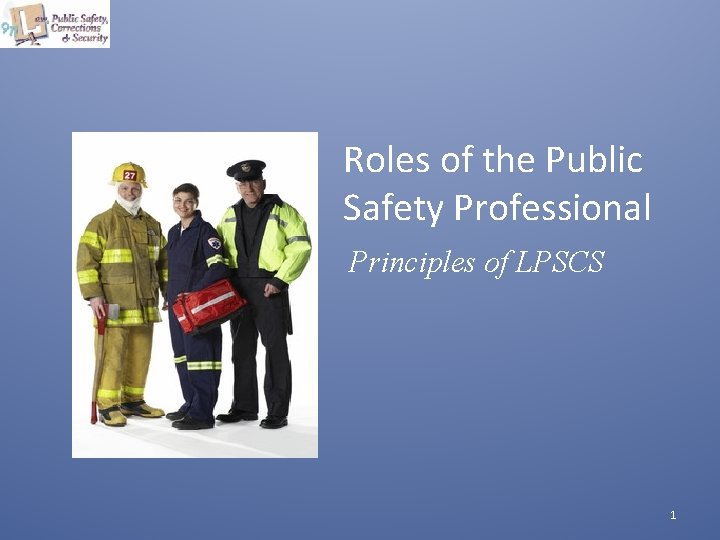
Roles of the Public Safety Professional Principles of LPSCS 1
Copyright and Terms of Service Copyright © Texas Education Agency, 2011. These materials are copyrighted © and trademarked ™ as the property of the Texas Education Agency (TEA) and may not be reproduced without the express written permission of TEA, except under the following conditions: 1) Texas public school districts, charter schools, and Education Service Centers may reproduce and use copies of the Materials and Related Materials for the districts’ and schools’ educational use without obtaining permission from TEA. 2) Residents of the state of Texas may reproduce and use copies of the Materials and Related Materials for individual personal use only, without obtaining written permission of TEA. 3) Any portion reproduced must be reproduced in its entirety and remain unedited, unaltered and unchanged in any way. 4) No monetary charge can be made for the reproduced materials or any document containing them; however, a reasonable charge to cover only the cost of reproduction and distribution may be charged. Private entities or persons located in Texas that are not Texas public school districts, Texas Education Service Centers, or Texas charter schools or any entity, whether public or private, educational or non-educational, located outside the state of Texas MUST obtain written approval from TEA and will be required to enter into a license agreement that may involve the payment of a licensing fee or a royalty. Contact TEA Copyrights with any questions you may have. Copyright © Texas Education Agency 2011. All rights reserved. Images and other multimedia content used with permission. 2
PART 1: Career Opportunities y t n ou Sta te C Where can I work? What can I do? Fe l a r de Private Industry Mun ic Copyright © Texas Education Agency 2011. All rights reserved. Images and other multimedia content used with permission. ipal 3
Municipal Public Safety • • • Police Department City Marshall Fire Department EMS Jailer 9 -1 -1 Operator Crime Scene Investigator Code Enforcement Animal Control Copyright © Texas Education Agency 2011. All rights reserved. Images and other multimedia content used with permission. 4
County Public Safety • • Sheriff Deputy Detention officer Constable Probation Juvenile Probation/Detention Medical Examiner’s Investigator District Attorney’s Investigator Copyright © Texas Education Agency 2011. All rights reserved. Images and other multimedia content used with permission. 5
State Public Safety • • • State Trooper Texas Ranger Game Warden Park Ranger Border Patrol Correctional Officer Parole officer Texas Alcoholic Beverage Commission (TABC) Texas Office of Inspector General Copyright © Texas Education Agency 2011. All rights reserved. Images and other multimedia content used with permission. 6
Federal Public Safety • Federal Bureau of Investigations (FBI) • Secret Service • Drug Enforcement Agency (DEA) • Alcohol Tobacco and Firearms (ATF) • Immigration and Neutralization (INS) • Internal Revenue Service (IRS) • U. S. Customs • Transportation Security Administration (TSA) • U. S. Marshals • Military • Air Marshall • Federal Bureau of Prisons • Federal Probation/Pre. Trial Copyright © Texas Education Agency 2011. All rights reserved. Images and other multimedia content used with permission. 7
Education and Training Requirements: Municipal, County, and State • High School Diploma/GED • 30 + college hours or Bachelor’s degree • TCLEOSE license (peace officer license) • Military training • Good work history Strong character qualities Pass physical agility test U. S. Citizen Written exam Background Investigation (no criminal history) • 21 years of age • Valid driver’s license • • • Copyright © Texas Education Agency 2011. All rights reserved. Images and other multimedia content used with permission. 8
Education Requirements: Federal • U. S. Citizen • At least 23 years old, but no more than 37 years old • 4 -year degree/GPA 2. 5 or higher • 3 years professional work experience • Valid driver’s license • Physical exam • Medical review – 20/20 corrected vision – Pass hearing screening • Extensive background check (no criminal history) Copyright © Texas Education Agency 2011. All rights reserved. Images and other multimedia content used with permission. 9
Roles of Law Enforcement Professionals • Jurisdiction: the geographical region of responsibility or official duties covered by an agency Copyright © Texas Education Agency 2011. All rights reserved. Images and other multimedia content used with permission. 10
Police Duties • • Social Worker Babysitter Attorney Role Model Law Enforcer First Responder Firefighter • • Crime Prevention Court Security Investigator Animal Control Traffic Enforcement Case Worker Crime Scene Investigator Copyright © Texas Education Agency 2011. All rights reserved. Images and other multimedia content used with permission. 11

Sheriff Duties • Officers of the court – Serve as bailiffs in courtrooms and security in courthouses • Jail operations – Staff and maintain the county jail • Law Enforcement – Same duties as police counterparts, but outside the city limits Copyright © Texas Education Agency 2011. All rights reserved. Images and other multimedia content used with permission. 12
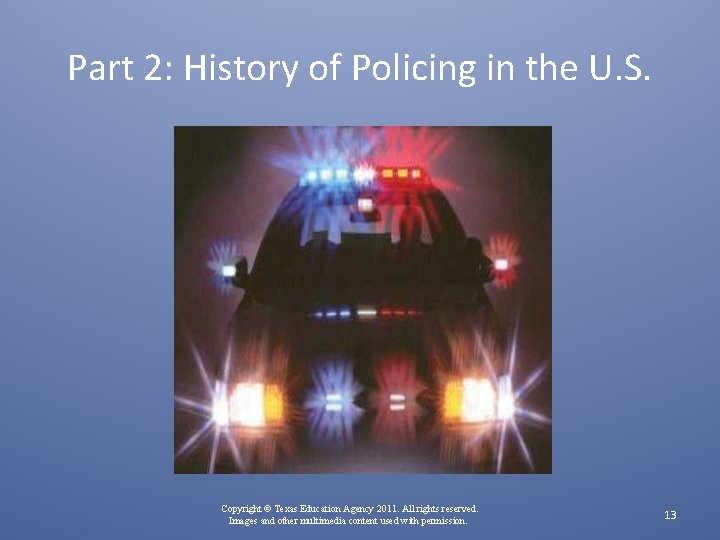
Part 2: History of Policing in the U. S. Copyright © Texas Education Agency 2011. All rights reserved. Images and other multimedia content used with permission. 13
Police • The arrangements made to ensure that the inhabitants keep the peace and obey the laws • The force of peace officers employed for this purpose A system of authority is required for a society to operate effectively. The history of policing reveals the evolution of that authority. Copyright © Texas Education Agency 2011. All rights reserved. Images and other multimedia content used with permission. 14
Roots of American Policing • Code of Hammurabi – The first example of civil and criminal codes – 282 codes that governed civil and criminal behavior in medieval times (eye-for-an-eye philosophy) • Tithing system – A system based on kinship and civilian responsibility and used to maintain social order – Families grouped by “tens” (men only) and formed communities Copyright © Texas Education Agency 2011. All rights reserved. Images and other multimedia content used with permission. 15
Office of Sheriff • Established through the tithing system • Power of Posse Comitatus (the power to summon citizen assistance) • Separation of military from civilian law enforcement Copyright © Texas Education Agency 2011. All rights reserved. Images and other multimedia content used with permission. 16
America Prior to 1776 • Slave patrols in the southern colonies – Civilian groups in southern states to protect against rioting and revolts by slaves • Black codes – Laws passed by southern states after the Civil War to disenfranchise freed slaves Copyright © Texas Education Agency 2011. All rights reserved. Images and other multimedia content used with permission. 17
Policing in America 1776 – 1850 • The first three police departments established in America – Philadelphia 1830 • Night-watch and day-watch forces created – New York 1844 • Night and day watch formed one police force – Boston 1855 • A single police force established Copyright © Texas Education Agency 2011. All rights reserved. Images and other multimedia content used with permission. 18
Policing in America 1850 – 1900 • Urbanization • Conflicts from different groups including minorities and immigrants • Controlled by the municipal government • Trained civil war veterans entered policing • Advances in firearm manufacturing • Carried revolvers for protection • Plessy v. Ferguson – This U. S. landmark Supreme Court case established the “separate but equal” doctrine that allowed racial segregation Copyright © Texas Education Agency 2011. All rights reserved. Images and other multimedia content used with permission. 19
Policing in the Wild West • • • Sparsely inhabited Violence toward Native Americans Lack of tolerance for those who were different Widespread lawlessness Personal defense (vigilantism) Town marshals, U. S. marshals, and the U. S. Army Justice was quick and brutal Firearms and lynch mobs No official law enforcement agency Copyright © Texas Education Agency 2011. All rights reserved. Images and other multimedia content used with permission. 20
Private Policing • Businesses needed professional security and investigative services • Brinks, Pinkerton, and Wells Fargo established • Corruption in local police departments • Geographic jurisdiction limitations • Lack of state/federal police Copyright © Texas Education Agency 2011. All rights reserved. Images and other multimedia content used with permission. 21
Modern Policing 1900 – 1930 • Increased population • Street violence (gangs, gambling, drinking, and prostitution) • Electricity • New inventions that assisted in policing – Automobile – Airplane and telephone – Advances in weapons Copyright © Texas Education Agency 2011. All rights reserved. Images and other multimedia content used with permission. 22
Police Officer – 1900’s • • Working class $1, 400 a year after 6 years Day shift – 75 hrs/wk Night shift – 87 hrs/wk 1 day off in 15 days Obedient to authority, physical strength, and size 6 ft. minimum height No training Copyright © Texas Education Agency 2011. All rights reserved. Images and other multimedia content used with permission. 23
August Vollmer • The Father of Modern Policing • Chief of police, Berkley, CA • “A dedicated body of educated persons comprising a distinctive corporate entity with a prescribed code of behavior” • Emphasis on education, professionalism, and administrative reform Copyright © Texas Education Agency 2011. All rights reserved. Images and other multimedia content used with permission. 24
Vollmer’s Philosophy Use of automobiles and radios Emergency telegraph boxes Typewriters for reports College-educated Entrance testing 3 -year training course Use of polygraph, fingerprints, and scientific evidence • Social workers • • Copyright © Texas Education Agency 2011. All rights reserved. Images and other multimedia content used with permission. 25
Current Trends in Policing • Community policing – Focus on decentralized strategies that promote crime prevention rather than rapid response, crime investigation, and apprehension of the criminal – Focus on promoting quality of life of the community and public order, rather than law enforcement – Use of alternatives other than arrest and force to solve the cause of the problem rather than responding to the symptoms of the problem • Broken Window – the belief that ignoring public order violations and disruptive behavior leads to community neglect, which fosters further disorder and crime Copyright © Texas Education Agency 2011. All rights reserved. Images and other multimedia content used with permission. 26
Current Trends in Policing (continued) • Zero Tolerance – strict enforcement of the laws, even for minor violations (example: “Click it or Ticket” seatbelt campaign) • Problem-oriented – Increased effectiveness by attacking the underlying problems that give rise to incidents that consume patrol and detective time – Reliance on the expertise and creativity of line officers to study problems carefully and develop innovative solutions – Closer involvement with the public to make sure that the police are addressing the needs of citizens Copyright © Texas Education Agency 2011. All rights reserved. Images and other multimedia content used with permission. 27
Current Trends in Policing (continued) • SARA Model – Scanning: gathering data to define the problem – Analysis: determining the nature of the problem, causes, and possible solutions – Response: working with people, groups, and agencies to implement solutions – Assessment: following up on the initiatives taken Copyright © Texas Education Agency 2011. All rights reserved. Images and other multimedia content used with permission. 28
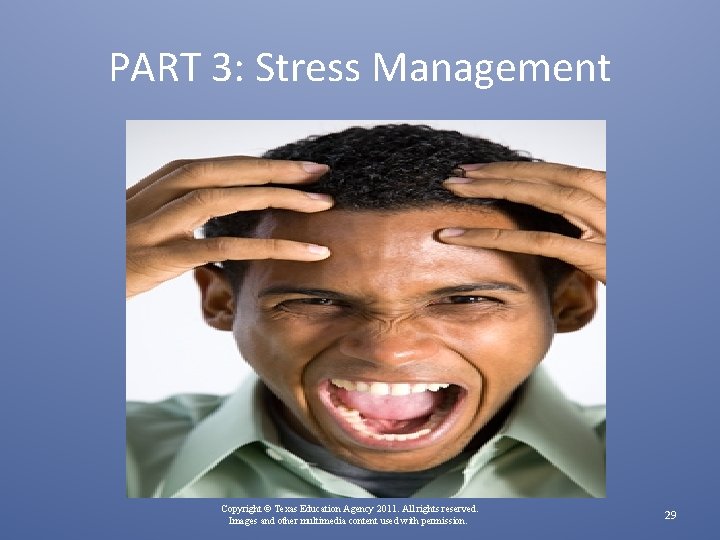
PART 3: Stress Management Copyright © Texas Education Agency 2011. All rights reserved. Images and other multimedia content used with permission. 29
Stress • Captain Says: • A physical, chemical, or emotional factor that causes bodily or mental tension and may be a factor in disease resulting from stress Copyright © Texas Education Agency 2011. All rights reserved. Images and other multimedia content used with permission. 30
Good v. Bad Stress • Sgt. ’s Say: • Attitude is the most important element in keeping your work stress at manageable, healthful levels • Offiers Say: • Perception is the consciousness, the awareness of objects or other data through the senses, insight, and intuition Copyright © Texas Education Agency 2011. All rights reserved. Images and other multimedia content used with permission. 31
Confidence • Sgt. ’s Say: • Belief in one’s own abilities • Lack of confidence = uncertainty and lost credibility • Eliminates worry Copyright © Texas Education Agency 2011. All rights reserved. Images and other multimedia content used with permission. 32
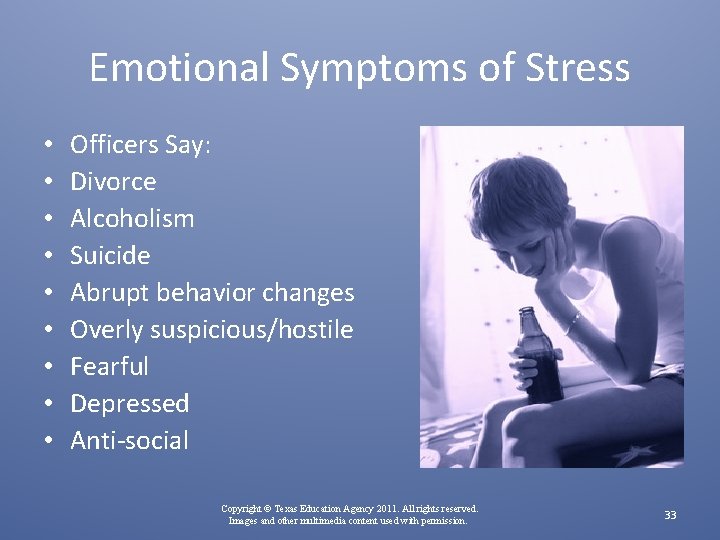
Emotional Symptoms of Stress • • • Officers Say: Divorce Alcoholism Suicide Abrupt behavior changes Overly suspicious/hostile Fearful Depressed Anti-social Copyright © Texas Education Agency 2011. All rights reserved. Images and other multimedia content used with permission. 33
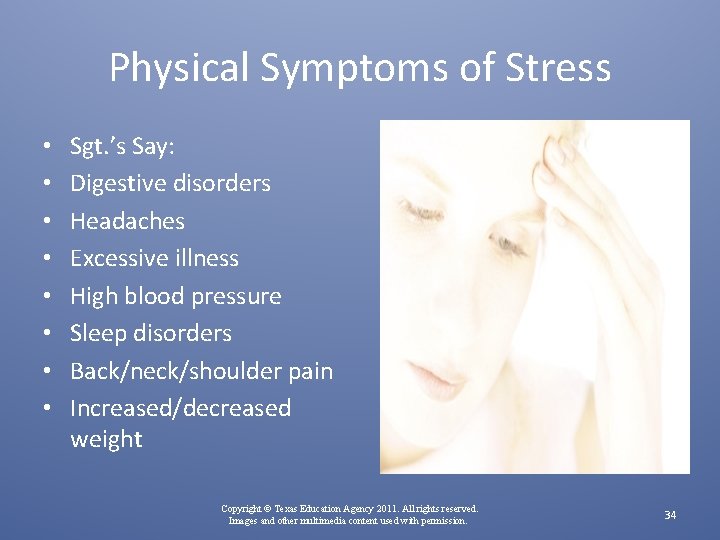
Physical Symptoms of Stress • • Sgt. ’s Say: Digestive disorders Headaches Excessive illness High blood pressure Sleep disorders Back/neck/shoulder pain Increased/decreased weight Copyright © Texas Education Agency 2011. All rights reserved. Images and other multimedia content used with permission. 34
Individual Stressors • • • Captain Says: Fears regarding job competence or success Necessity to conform Necessity to take a second job Altered social status Copyright © Texas Education Agency 2011. All rights reserved. Images and other multimedia content used with permission. 35
Police Work Stressors • • Sgt. ’s and Officers Say: Frequent exposure to life’s miseries Rigors of police work Boredom Fears and dangers Responsibilities Work overload Fragmented nature of the job Copyright © Texas Education Agency 2011. All rights reserved. Images and other multimedia content used with permission. 36
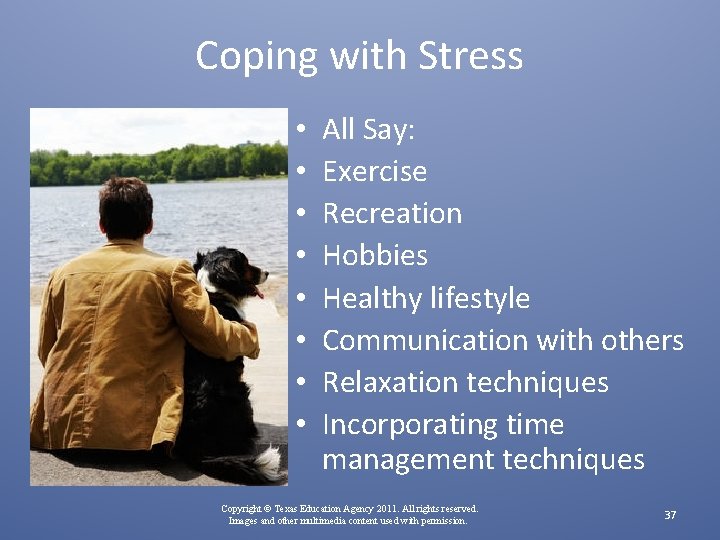
Coping with Stress • • All Say: Exercise Recreation Hobbies Healthy lifestyle Communication with others Relaxation techniques Incorporating time management techniques Copyright © Texas Education Agency 2011. All rights reserved. Images and other multimedia content used with permission. 37
Time Management • • Captain and Sergeants Say: Eat Breakfast Determine your top priorities Get organized Conquer procrastination Learn to say no Protect your prime time Keep weekends for yourself Copyright © Texas Education Agency 2011. All rights reserved. Images and other multimedia content used with permission. 38
Stress Reduction • • • All say: Healthful levels of attitude Laugh a little Consciously relax your muscles Use positive self talk Seek solitude Avoid excess coffee Exercise regularly Talk about it Listen to your conscience Copyright © Texas Education Agency 2011. All rights reserved. Images and other multimedia content used with permission. 39
Resources • Texas Commission on Law Enforcement Officer Standards and Education (TCLEOSE) http: //www. tcleose. state. tx. us/ • Texas Code of Criminal Procedure http: //www. statutes. legis. state. tx. us/ • Fagan, James A. Criminal Justice. Pearson Education, 2004. • Men’s Fitness Magazine issue October 1994 Copyright © Texas Education Agency 2011. All rights reserved. Images and other multimedia content used with permission. 40
- Slides: 40