
Roles of DSOs in facilitating consumers market participation
- Slides: 13
Roles of DSOs in facilitating consumers' market participation Karin Widegren, Swedish Energy Markets Inspectorate Member of CEER Distribution System Working Group 8 th Citizens' Energy Forum, London, 23 February 2016
Outline of the presentation • Role of DSO ► The traditional role of DSOs ► New opportunities and challenges ► CEER conclusions on the future role of DSOs • DSOs consumer relation and data management ► Main principles ► Customers access to meter data and smart meter functionalities ► Consumer data protection and privacy • CEER future work 02/10/2020
The traditional role of DSO Conventional activities of DSOs • Network planning, development, operation and maintenance • Connecting users to the network • Quality of supply and system security at regional/local level • Technical data management • Managing network losses (efficiency) • In several member countries: Metering and consumption data management and billing of network tariffs 3
New opportunities and challenges for DSOs • Changing consumption patterns ► Embedded generation ► Electrical vehicles ► Demand response • New opportunities for DSF through technical advances ► smart meters, data handling and accuracy ► storage behind the meter ► smart appliances • New opportunities through real time monitoring and control ► use the network more efficiently (communication systems, big data etc) ► Possibilities to use system services to minimise capex and opex ► Enhancing network resilience through micro-grids etc. • Possible impact ► Change in local congestion patterns ► Reverse flow and quality control ► Revenue uncertainty - less energy and more capacity needs 4
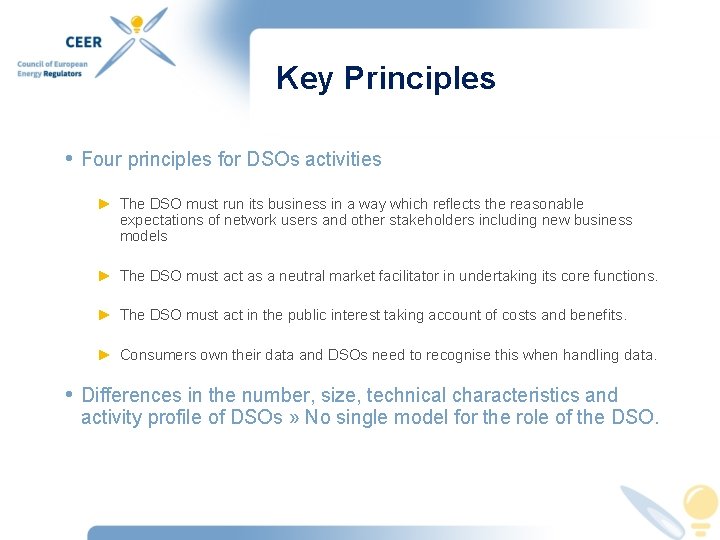
Key Principles • Four principles for DSOs activities ► The DSO must run its business in a way which reflects the reasonable expectations of network users and other stakeholders including new business models ► The DSO must act as a neutral market facilitator in undertaking its core functions. ► The DSO must act in the public interest taking account of costs and benefits. ► Consumers own their data and DSOs need to recognise this when handling data. • Differences in the number, size, technical characteristics and activity profile of DSOs » No single model for the role of the DSO.
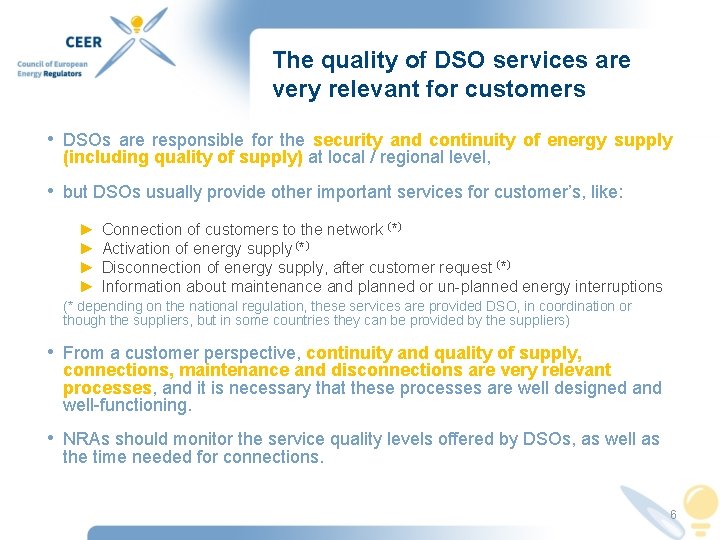
The quality of DSO services are very relevant for customers • DSOs are responsible for the security and continuity of energy supply (including quality of supply) at local / regional level, • but DSOs usually provide other important services for customer’s, like: ► ► Connection of customers to the network (*) Activation of energy supply (*) Disconnection of energy supply, after customer request (*) Information about maintenance and planned or un-planned energy interruptions (* depending on the national regulation, these services are provided DSO, in coordination or though the suppliers, but in some countries they can be provided by the suppliers) • From a customer perspective, continuity and quality of supply, connections, maintenance and disconnections are very relevant processes, and it is necessary that these processes are well designed and well-functioning. • NRAs should monitor the service quality levels offered by DSOs, as well as the time needed for connections. 6
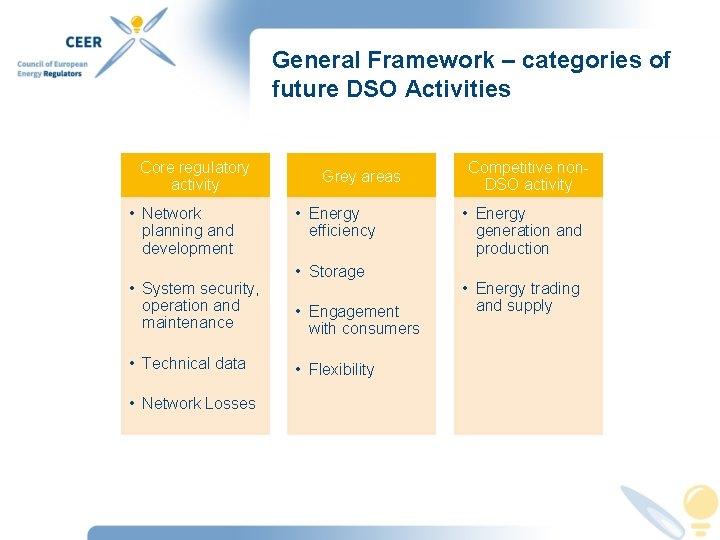
General Framework – categories of future DSO Activities Core regulatory activity • Network planning and development • System security, operation and maintenance • Technical data • Network Losses Grey areas • Energy efficiency • Storage • Engagement with consumers • Flexibility Competitive non. DSO activity • Energy generation and production • Energy trading and supply
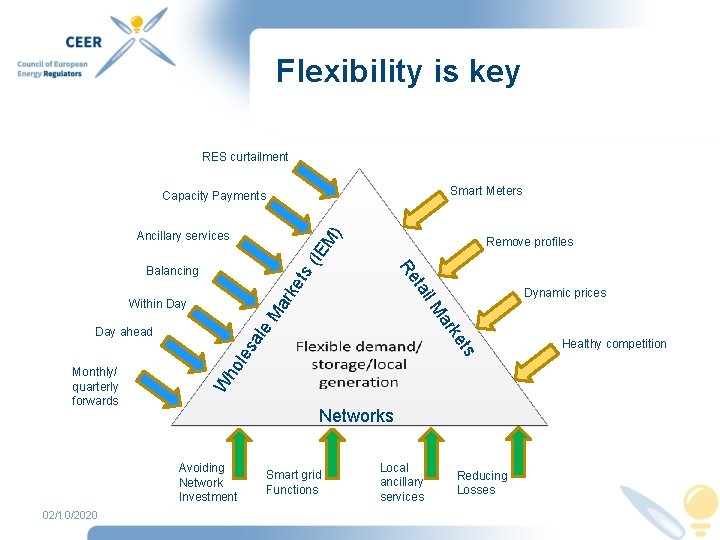
Flexibility is key RES curtailment Smart Meters Capacity Payments M) Ancillary services Ma ho W Monthly/ quarterly forwards Networks Avoiding Network Investment 02/10/2020 ts les ke ale ar Day ahead Dynamic prices l. M Within Day tai rke ts Balancing Re (IE Remove profiles Smart grid Functions Local ancillary services Reducing Losses Healthy competition
DSOs engagement with consumers • CEER believes that DSOs should remain as neutral market facilitators • DSOs are not automatically conferred the status of data management coordinator, although DSOs in some countries can be manager of a data hub • DSOs, who have access to data directly from smart meters, have a special responsibility to act impartially and to make available necessary data to other parties, while respecting data privacy legislation. 02/10/2020
Smart meters, minimum functionalities and harmonisation across the EU • Regulators proposed adoption of at least national standardised arrangements regarding the content of customer meter data, the format in which the data is provided to parties and the systems used for the exchange of this data. • Standardisation would result in significant benefits for consumers ► Greater certainty, efficiency and enhanced competition ► Customers more likely to understand the data, make efficient decisions about their consumption and be better-positioned to decide about changing tariffs or switching • Functionalities are crucial for the sound deployment of smart metering systems and for guaranteeing a minimum level of service to customers. 10
Data protection and privacy • The requirements for data protection are set out in EU data protection and privacy legislation – not primarily an issue for NRAs • General principles for data management arrangements ► Data management arrangements should serve to protect the privacy of personal data ► Customers should ultimately be able to determine how their data is used ► Data management arrangements supported by relevant bodies should highlight the benefits of sharing customer meter data with third parties • Recommendation on privacy and security according to CEER Advice on Customer Data Management for Better Retail Market Functioning (March 2015) ► Customer meter data should be protected by the application of appropriate security and privacy measures ► Customers should control access to their customer meter data, with the exception of data required to fulfil regulated duties and within the national market model. ► The principle should be that the party shall state what information they will collect, with what frequency and for how long 11
Further work • The future DSO and TSO relationship – Q 3 2016 • Status review of implementation of CEER advice on customer meter data management – Q 4 2016 • Guidelines of Good Practice on Incentives Schemes including Innovation – Q 1/Q 2 2017 • Guidelines for flexibility use at distribution level Consult Q 4 2016 • Best Practice Guidelines on Distribution Network Tariffs – Q 2/Q 3 2017 02/10/2020
Thank you for your attention! www. ceer. eu