
Roles and Responsibilities within the Emergency Services Public
Roles and Responsibilities within the Emergency Services (Public Safety Programme) By Gary Johnson DTTLS Dip. RSA, ICS, SET

Aim The aim of this section is to give you an understanding of the roles, structures, responsibilities, expectations and capabilities of the emergency services.
Learning outcomes By the end of this session all learners will be able to: • Understand common emergency response objectives for all services • Understand all the emergency services command capabilities and responsibilities • Achieve common situational awareness during incident • Effectively interact between Services to bring incidents to a successful conclusion

Video clip • https: //www. youtube. com/watch? v=N 5 Uum 0 s. IKp. A • https: //www. youtube. com/watch? v=7 xbm 8 Zwn. Hv. U
Activity In groups of 3 discuss how the emergency services can work together more effective.

Interoperability is the extent to which the emergency services work together coherently so as to become routine.
Features of Interoperability • Understanding each other’s respective roles • Understanding the responsibilities of each service • Understanding the similarities and differences • Developing a shared way of working together • Working from framework • Coordinating from a central point
Similarities • Save lives and prevent suffering • Reducing impact of the incidences • Deal with any problems that may arise • Orchestrate a return to normality
Police • • • Coordinates with other agencies Gather information and share it Preserve the crime scene Investigate the situation Prevention of crime and disorder https: //www. youtube. com/watch? v=iqozrkrl 8 zk https: //www. youtube. com/watch? v=PJU 35 e. HVxj. E https: //www. youtube. com/watch? v=swo. An. LQ 38 NI
Fire service • Save lives • provide assistance to the local authority • Protect the environment • Protector property https: //www. youtube. com/watch? v=i. Pl. MQ 4 A 6 l 6 k https: //www. youtube. com/watch? v=21 Z 1 Vx. MLFr. I
Ambulance service Save and life and reduce suffering Aide in treatment Provide casualty treatment Support your services Coordinate all health and safety resources Support https: //www. youtube. com/watch? v=D_b. Tgdk. HGg. U https: //www. youtube. com/watch? v=1 x-0 q. Uyt. CH 4 https: //www. youtube. com/watch? v=b. Ib. Xxb. Jw. Gx. M
Activity • In of three, identify the roles and responsibilities of the police, fire service and ambulance on flipchart paper
Understanding similarities and differences Understanding the similarities and difference can lead to greater synergy within the blue light service.
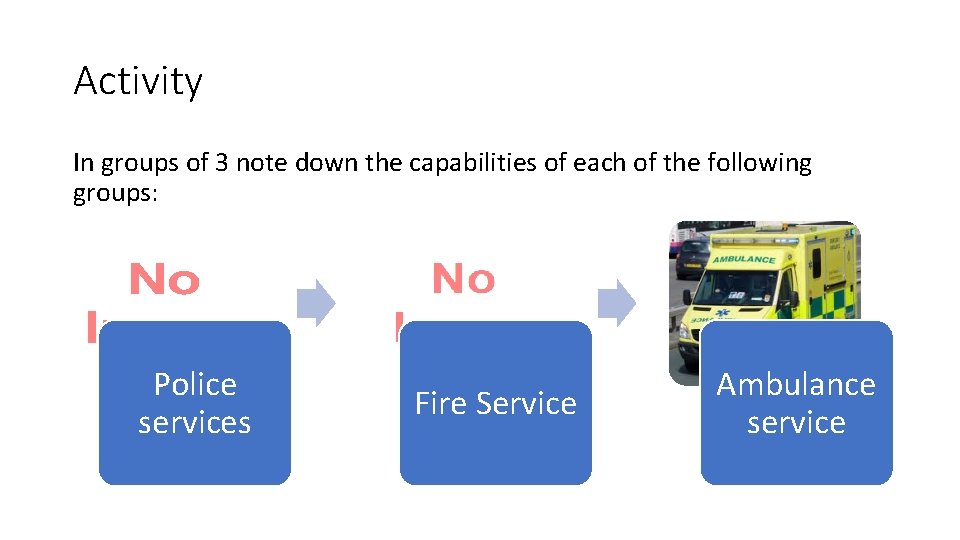
Activity In groups of 3 note down the capabilities of each of the following groups: Police services Fire Service Ambulance service

Multi Agency Interoperability Greater understanding of the capabilities, capacity and limitations leads to interoperability at all levels of the emergency service. Exploring the similarities and differences is an important step which in turn will allow the blue light services to communicate more effectively leading to multi-agency interoperability Activity – Using a dictionary find the words in red.
Common objectives Activity - in groups of 3 identify the common objectives of the emergency services. 15 mins
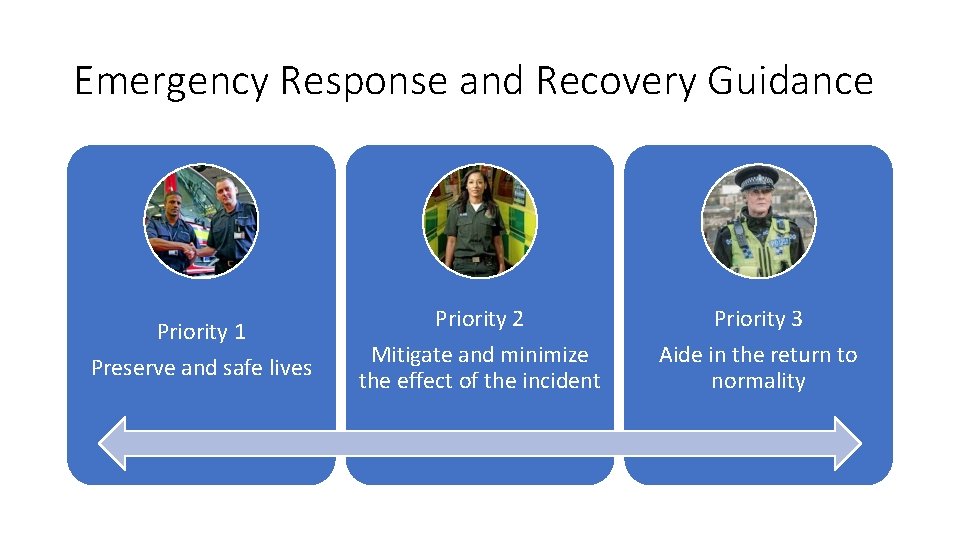
Emergency Response and Recovery Guidance Priority 1 Preserve and safe lives Priority 2 Mitigate and minimize the effect of the incident Priority 3 Aide in the return to normality
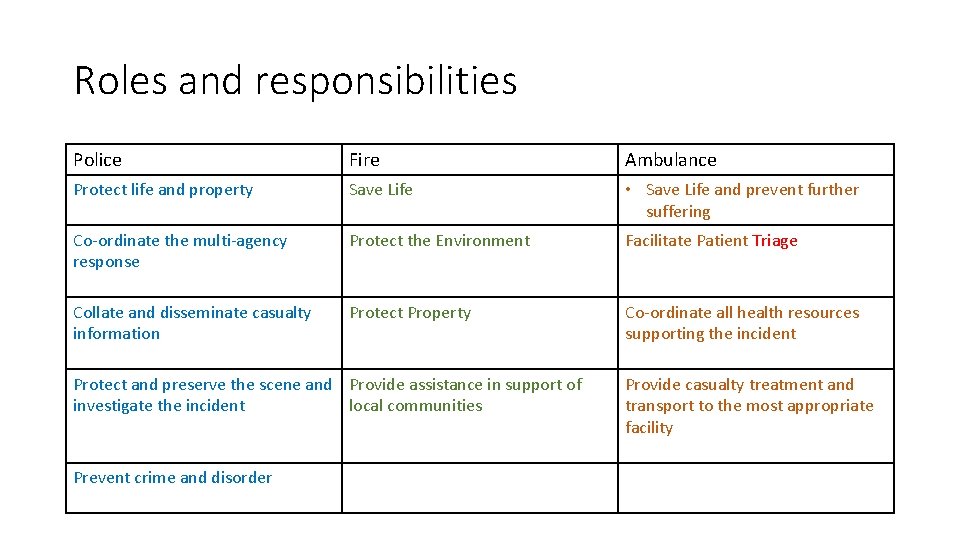
Roles and responsibilities Police Fire Ambulance Protect life and property Save Life • Save Life and prevent further suffering Co-ordinate the multi-agency response Protect the Environment Facilitate Patient Triage Collate and disseminate casualty information Protect Property Co-ordinate all health resources supporting the incident Protect and preserve the scene and Provide assistance in support of investigate the incident local communities Prevent crime and disorder Provide casualty treatment and transport to the most appropriate facility
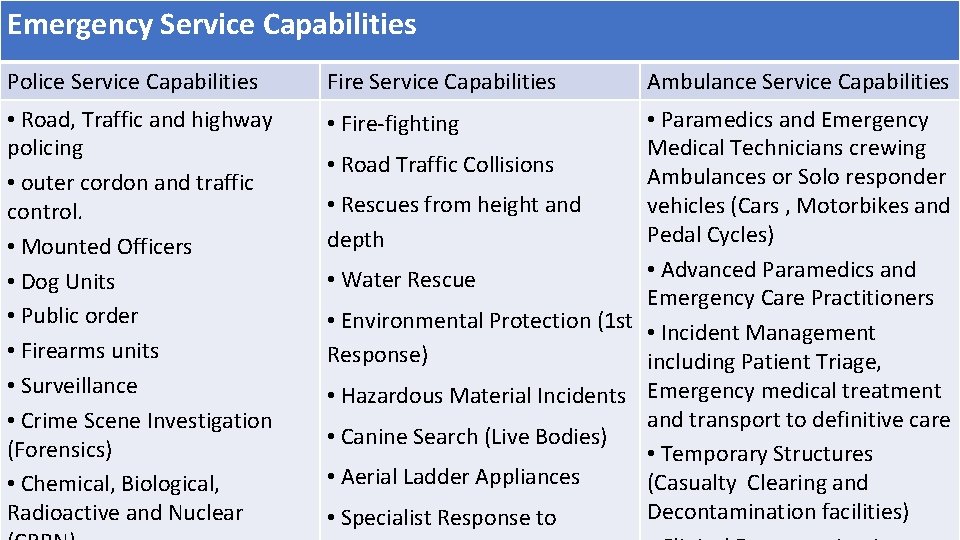
Emergency Service Capabilities Police Service Capabilities Fire Service Capabilities • Road, Traffic and highway policing • outer cordon and traffic control. • Mounted Officers • Dog Units • Public order • Firearms units • Surveillance • Crime Scene Investigation (Forensics) • Chemical, Biological, Radioactive and Nuclear • Fire-fighting Ambulance Service Capabilities • Paramedics and Emergency Medical Technicians crewing • Road Traffic Collisions Ambulances or Solo responder • Rescues from height and vehicles (Cars , Motorbikes and Pedal Cycles) depth • Advanced Paramedics and • Water Rescue Emergency Care Practitioners • Environmental Protection (1 st • Incident Management Response) including Patient Triage, • Hazardous Material Incidents Emergency medical treatment and transport to definitive care • Canine Search (Live Bodies) • Temporary Structures • Aerial Ladder Appliances (Casualty Clearing and Decontamination facilities) • Specialist Response to
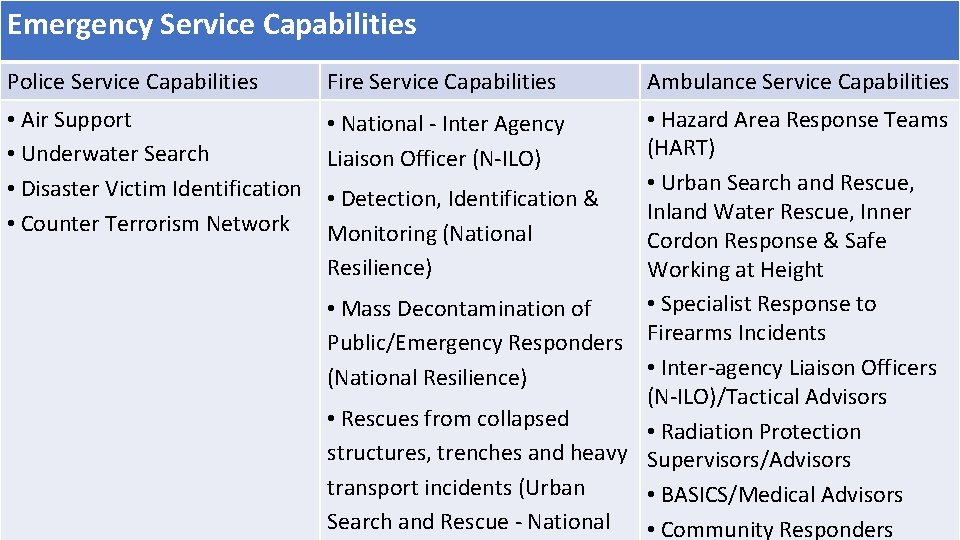
Emergency Service Capabilities Police Service Capabilities Fire Service Capabilities • Air Support • Underwater Search • Disaster Victim Identification • Counter Terrorism Network • National - Inter Agency Liaison Officer (N-ILO) Ambulance Service Capabilities • Hazard Area Response Teams (HART) • Urban Search and Rescue, • Detection, Identification & Inland Water Rescue, Inner Monitoring (National Cordon Response & Safe Resilience) Working at Height • Specialist Response to • Mass Decontamination of Public/Emergency Responders Firearms Incidents • Inter-agency Liaison Officers (National Resilience) (N-ILO)/Tactical Advisors • Rescues from collapsed • Radiation Protection structures, trenches and heavy Supervisors/Advisors transport incidents (Urban • BASICS/Medical Advisors Search and Rescue - National • Community Responders

Bronze Commander (Operational) Command Structures On Scene Command On Scene Risk Assessment Initial Response Manage front line operations at the scene Also known as Operational Implement safe systems of work Manage front line operations and tactical plan Assess need for further resources Identify and establish a dialogue with the on-scene commander from each Service Identify a suitable Forward Control Point for co-ordination of on scene activities Each service is required to identify hazards, assess risks and take action to eliminate or reduce risk. Each service has a different model, but Sharing information on hazards, risks and control measures will deliver a more robust outcome, and The shared risk assessment will require monitoring and review due to the dynamic nature of emergency incidents. Information must be shared and amendments made as necessary.
Risk assessment • Responders life v. protecting lives • Risk of doing nothing • Positive duty to act and not get caught in bureaucracy
Common Situational Awareness From Situational Awareness to Shared Situational Awareness. Activity What type of things do you think the emergency services need to be aware of to arrive at shared situational awareness; discuss
Common Situational Awareness (Continued) Establishing a common understanding of the situation understanding consequences is an early priority for Emergency Service commanders. This may be termed Shared Situational Awareness, or a Common Operating Picture C. H. A. L. E. T. S. is one system that can be used for common information messaging to and from the incident scene
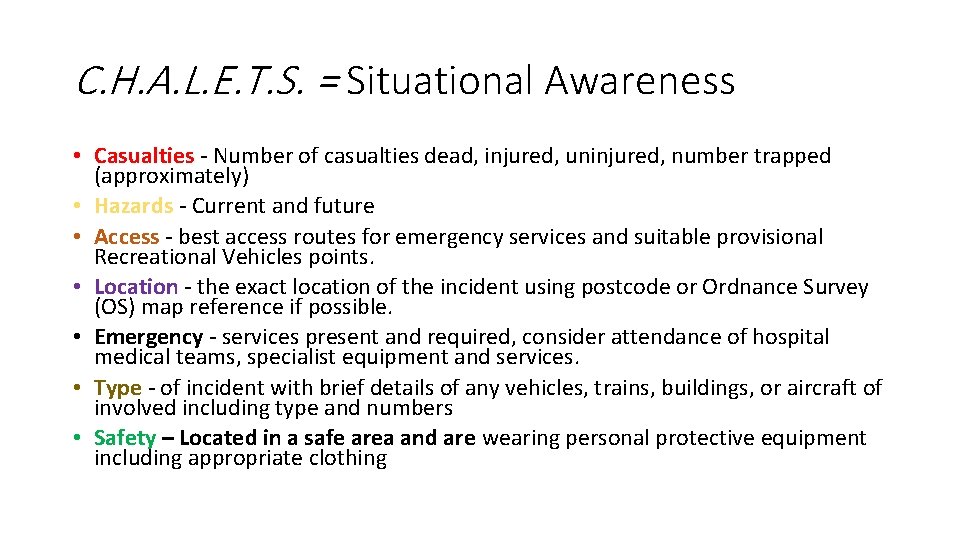
C. H. A. L. E. T. S. = Situational Awareness • Casualties - Number of casualties dead, injured, uninjured, number trapped (approximately) • Hazards - Current and future • Access - best access routes for emergency services and suitable provisional Recreational Vehicles points. • Location - the exact location of the incident using postcode or Ordnance Survey (OS) map reference if possible. • Emergency - services present and required, consider attendance of hospital medical teams, specialist equipment and services. • Type - of incident with brief details of any vehicles, trains, buildings, or aircraft of involved including type and numbers • Safety – Located in a safe area and are wearing personal protective equipment including appropriate clothing

Levels of Command The Big Picture Making it happen Doing it
- Slides: 26