
Roles and Functions of Project Manager Lecture 4
- Slides: 17
Roles and Functions of Project Manager Lecture 4
Project Manager The term and title 'project manager' is used to describe anyone given responsibility to complete a project. A project manager is the person responsible for accomplishing the stated project objectives. Key project management responsibilities include creating clear and attainable project objectives, building the project requirements, and managing the constraints of the project management triangle, which are cost, time, scope, and quality.
A project manager is a professional in the field of project management. Project managers can have the responsibility of the planning, execution and closing of any project. Managers just don't go out and haphazardly perform their responsibilities. Good managers discover how to master five basic functions: �planning, �organizing, � staffing, � leading, � controlling.
Planning �Planning defines where the organization wants to be in the future. �Planning means define goals for the future organization performance and deciding on the task and use of resources needed to attain them. �This step involves mapping out exactly how to achieve a particular goal.
Organizing �Organizing typically follow planning and reflects how the organization tries to accomplish the plan. �Organizing involves the assignments of tasks, the grouping of tasks into departments and the allocation of resource to departments. �Assigning work and granting authority are two important elements of organizing.
Leading �Leading means communicating goals to employees throughout the organization. �Leading is the use of influence to motivate employees to achieve organizational goals. �Leading involves motivating, communicating, guiding, and encouraging. � It requires the manager to coach, assist, and problem solve with employees.
Staffing �A manager in a large organization often works with the company's human resources department to accomplish this goal. �He involves in recruiting, selecting, and training of employees.
Controlling �Controlling means monitoring employees’ activities, determining whether the organization is on target towards its goals and making corrections as necessary. �After the other elements are in place, a manager's job is not finished. He needs to continuously check results against goals and take any corrective actions necessary to make sure that his area's plans remain on track.
Role of Project Manager A role is a set of expectations for a manager’s behavior. The project manager is responsible for managing the project’s scope, schedule, and cost to support the owner’s expectations for the successful completion of the project. Typical duties include: �Managing the development of the scope definition and project plans. �Providing team leadership for problem resolution by working with the lowest organizational levels possible and escalating, as necessary.
�Monitoring schedule and costs versus project progress to identify problems that could potentially extend the schedule or overrun costs. �Taking, directing, or recommending corrective action when scope, schedule, or cost variances threaten the project. �Communicating project status to the project owner and other stakeholders. �Providing input to the performance reviews of the project team members.
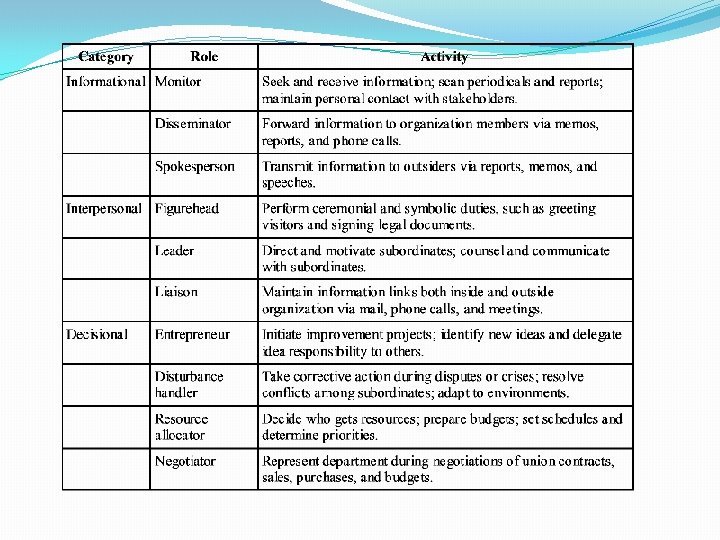
Roles of Manager The manager’s roles are divided into three categories: �Interpersonal Roles �Informational Roles �Decisional Roles
Skills of a Manager �Certain skills, or abilities of a manager are required to translate knowledge into action that results in desired performance, are required to help other employees become more productive. �These skills fall under the following categories: �Technical Skills �Human Skills �Conceptual Skills
�Human Skills: A manager with good human skills has a high degree of self-awareness and a capacity to understand or empathize with the feelings of others. Some managers are naturally born with great human skills, while others improve their skills through classes or experience. No matter how human skills are acquired, they're critical for all managers because of the highly interpersonal nature of managerial work.
Technical Skills �This skill requires the ability to use a special proficiency or expertise to perform particular tasks. � Accountants, engineers, market researchers, and computer scientists, as examples, possess technical skills. � Managers acquire these skills initially through formal education and then further develop them through training and job experience. �Technical skills are most important at lower levels of management.
Conceptual Skills �This skill calls for the ability to think analytically. �Analytical skills enable managers to break down problems into smaller parts, to see the relations among the parts, and to recognize the implications of any one problem for others. �As managers assume ever-higher responsibilities in organizations, they must deal with more ambiguous problems that have long-term consequences. �Again, managers may acquire these skills initially through formal education and then further develop them by training and job experience. �The higher the management level, the more important conceptual skills become.
Other Skills � �Leadership — ability to influence others to perform tasks �Self-objectivity — ability to evaluate yourself realistically �Analytic thinking — ability to interpret and explain patterns in information �Behavioral flexibility — ability to modify personal behavior to react objectively rather than subjectively to accomplish organizational goals �Oral communication — ability to express ideas clearly in words �Written communication — ability to express ideas clearly in writing �Personal impact — ability to create a good impression and instill confidence