
Role of the Father By Emma Campbell Amy

Role of the Father By: Emma Campbell, Amy Grasso, Amanda Roccia, Taylor Provax, and Elizabeth Stacey
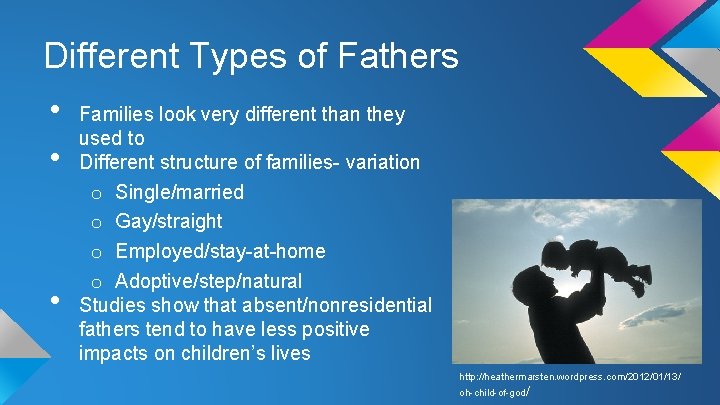
Different Types of Fathers • • • Families look very different than they used to Different structure of families- variation o Single/married o Gay/straight o Employed/stay-at-home o Adoptive/step/natural Studies show that absent/nonresidential fathers tend to have less positive impacts on children’s lives http: //heathermarsten. wordpress. com/2012/01/13/ oh-child-of-god/

Changing Role of Fathers • • • Fathers used to be the breadwinners and disciplinarian Today, fathers tend to be more involved, especially if: o They work fewer hours than mothers o They are well-adjusted psychologically (high self-esteem, low hostility) o Strong relationship between mother and father o Children are boys Children are benefitting from new type of relationship between child and father o Lower chance of behavioral and substance abuse problems http: //www. childcustodysupportvisitation. com/

The Father’s Influence on Cognitive Ability and Education • • • Fathers have a major impact on their children's educational wellbeing Children with active fathers have a higher likelihood of doing well in school Multiple studies have shown that children with involved dads are more likely to do better on standardized tests and have higher IQs

Positive Effects of Active Fathers on their Children’s Education • • Better at math and language arts Higher GPAs More likely to enjoy schools More likely to have a better attitude towards school

Support A main attribute of the father is to be supportive emotionally physically financially • • • http: //sensorysmartpare nt. files. wordpress. com http: //www. thelearningcommunity. us http: //www. collegecoachingservice s. com/images/grad_and_dad

Emotional Support • • Children need emotional support from their father. http: //www. lawonly. com A father should listen and support their children when they experience joy, fear, sadness, anger, and frustration. This will help to raise a child that is more in-tune with the needs of others. Statistics show that children with loving, involved fathers are significantly more likely to have a healthy self esteem, exhibit empathy and pro-social behavior, do well in school, and avoid high risk behaviors such as drug use and criminal activity.
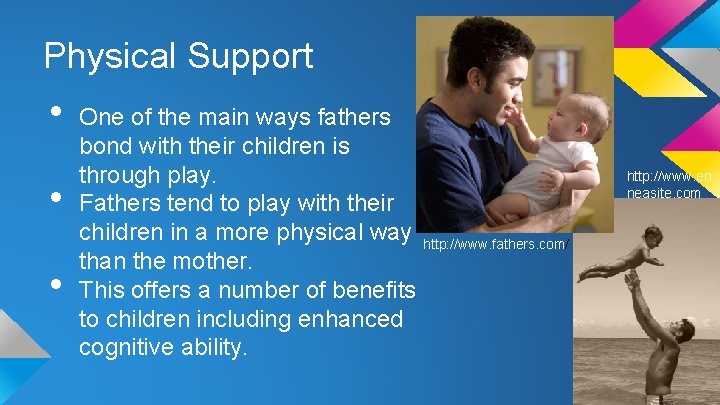
Physical Support • • • One of the main ways fathers bond with their children is through play. Fathers tend to play with their children in a more physical way http: //www. fathers. com/ than the mother. This offers a number of benefits to children including enhanced cognitive ability. http: //www. en neasite. com
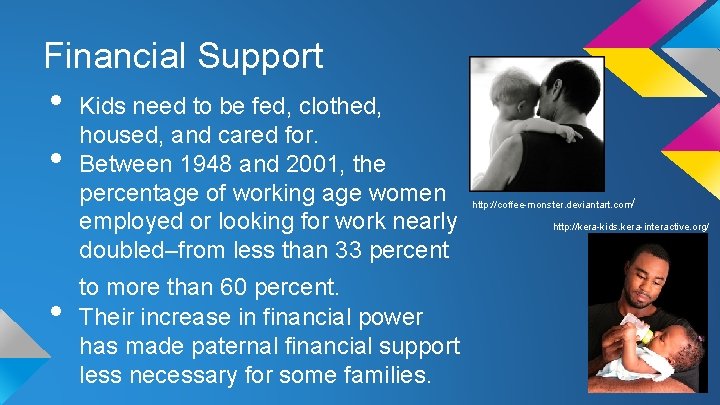
Financial Support • • • Kids need to be fed, clothed, housed, and cared for. Between 1948 and 2001, the percentage of working age women employed or looking for work nearly doubled–from less than 33 percent to more than 60 percent. Their increase in financial power has made paternal financial support less necessary for some families. http: //coffee-monster. deviantart. com/ http: //kera-kids. kera-interactive. org/

Poll Time! polleverywhere. com
- Slides: 10