
Role Of Sufi Movement And Educational Movement In








- Slides: 56
Role Of Sufi Movement And Educational Movement In Muslims Renaissance(revival) Prepared by Mufti Omer Rafique
• The Ulema and sufis played a dominant role in preservation of Islam in India. • In the cities the ulema were the custodians(protector) of the religion. • In the remote(far-off) places the sufis played an important role. • The sufis preserved the inner spirit of Islam among the Muslims. • They also mixed up with the masses of low caste Hindus.
• These masses were humiliated(shamed) by the upper caste Hindus and had no respect or status in the society. • These low caste Hindu masses were given love by the sufis and they embraced Islam in large number. • There were following main factors: – The evils of caste system among Hindus where low caste hindus were treated like slaves. – Sufis gave them Love. – The simple Life of Sufis portrayed by Islam attracted them.
Most Prominent Sufis • Most prominent sufis are: – Khwaja Moinuddin Chishti(1142 -1236) • He lived a life of a darwesh who had givenup the worldly life. He left his native town in sistan and started travelling from place to place. • He completed his studies in Bukhara and Samarqand went to Iraq.
• He spent time with many prominent sufis of his time viz(namely) Khwaja Usman of whom he became a disciple( ﻣﺮیﺪ ، )ﺷﺎگﺮﺩ. • Finally he came to India in 1192 and settled down in Ajmer.
• Khwaja Moinuddin was one of the early preachers of Islam who left his mark with whoever met him whether Muslims or Hindus. • At his hand 90, 000 Hindus embraced Islam. • Even today a large number of Muslims as well as Hindus gather every year on his tomb in Ajmer. • His highly respected disciples include Shaikh Qutubuddin Bakhtiar Kaki, Baba Farid Shakar ganj and Shaikh Hamiduddin Nagori.
– Shaikh Bahauddin Zakarya(1182 -1262) • Shaikh Bahauddin Zakarya was born in Multan. • After his early education he went to Khurasan and completed advance studies under well known scholars of Bukhara and Madina. • At Baghdad he became disciple of Shaikh Shahabuddin Soharwardi and became his Khalifa.
Services To Islam: • He setup a Khanqah in Multan and soon became a highly respected and popular figure. • He also helped people to promote agriculture, trade and digging of canals and wells.
• A large number of people both Muslims and Hindus were greatly impressed by him and the non-Muslims living in the area embraced Islam. • His disciples include the well known sufi Lal Shahabaz Qalandar.
– Shaikh Ahmad Sarhindi(1564 -1624) • He was commonly known Mujadid-e-Alfsani which means reformer of second millennium. • After receiving his early education from his father who himself was an eminent(famous) sufi he went to Lahore and Sialkot for higher studies. • He then went to Delhi where he met Shaikh Baqi Billah and became a sufi. • He died in 1624.
• • • reforms(improvements) Mughal emperor Akbar had promulgated(introduce) Deen-e-Illahi in place of Islam. After his death emperor Jehangir sat on the throne. Shaikh Ahmed Sarhindi wrote letters to Jehangir and his nobleman refuting (disproving) the Deene-Illahi and asking them to follow Islam. Jehangir was misguided by his advisers and he imprisoned the Shaikh. In jail all the fellow prisoners were grealty impressed by Shaikh Sarhindi and hundreds of non-Muslim prisoners embraced Islam.
• At last emperor Jehangir felt sorry and released Shaikh Ahmad. • He also requested the Shaikh to meet him after maghrib everyday. • The Shaikh in these meetings talked about religious affairs. • He was also asked by the emperor to remain with his army. • The Shaikh taught true Islamic ideology to the troops.
• The Shaikh took great efforts to teach the Muslims the true Islam and refrain( )ﺑﺎﺯﺭہﻨﺎ from distortions. ٹیﺮھ
Shah Waliullah(1703 -1762) • Shah Waliullahs father Shah Abdur Rahim was a saint and a great scholar. • He had opened a big Madrassah named Madrssah Rahimia. • Shah Waliullah was educated in this Madrassah where his father was teaching. • For higher studies he went to Madina.
• On his return to India he found condition of Muslims and the Muslim Govt very pathetic ﺧﺴﺘہ ﺣﺎﻝ. • He realised that decline of Muslim empire and Muslims in general was due to ignorance of Islam and teachings and practice.
Translation Of Holy Quran • He believed that by simply reading Quran in Arabic people cannot understand the message of Allah which is a complete code of life. • He therefore translated Quran in Persian which was the national language of India at that time. • His two sons translated the Quran in Urdu.
Efforts For Revival Of Islamic Ideology • He made efforts to educate and train the Muslims Society and believed that good relations between different sects ﻃﺒﻘے of society was the only remedy(medicine). • Similarly the different groups the producers, tradesmen and consumers should have good relations.
• He laid emphasis(highlighting) on the well being of craftsmen and peasants because they were the basis of sound economy. • His efforts were that every one should do productive work with honesty and efficiency. • He laid great emphasis on justice and equilibrium(balance).
Work Of Fiqah • He studied the Fiqah of all the four renowned Imams i. e. Hanafi, Shafai, Maliki and Hambli and advised people to formulate(make) a new legal system based on Quran and Sunnah and to adhere(stay) to one of the four schools of Fiqah. • He also tried to bring the Shias and Sunnis closer.
Efforts For Socio Political Integration(combination) • Shah Waliullah said that the health of an economy can be secured(safe) only by proper distribution of wealth. • He said that unequal distribution of wealth leads to concentration in a few hands pushing others to absolute(total) poverty. • He propagated that all forms of economic injustice be removed.
Syed Ahmad Shaheed • Syed Ahmad studied Quran and hadith and persian at Delhi. • Then he joined the army of Nawab Amin Khan who was always at war with Hinuds chiefs. • He was a religious minded and a powerful chieftain(chief). • Syed Ahmad Khan stayed with the army for 7 years and gained experience in warfare(war) and politics.
• Then he went to Mecca for hajj and stayed there for 2 years. • There he acquired knowledge of various movements in world of Islam. • On return to India he devoted himself to social and religious reform and prepared for jihad.
Political Aims Of His Movement • The sikhs in punjab had forbidden Azan in the two or three mosques and extinguished(finished) the religious freedom of Muslims in Punjab and Khyber Pakhtoonkhwa. • When Syed Ahmad Shaheed heard of this he decided to wage( )ﺟﺎﺭی ﺭکھﻨﺎ ﺟﻨگ ﻭﻏیﺮہ a jihad against the sikhs. • He and his party marched from Barely via Tong, Ajmer, Sind, Baluchistan, Afghanistan, Khyberpass Peshawar and Noshehra.
• Where ever he went the Muslims gave him a favourable response. • Following factors were favorable to the movement: – The leader possessed high spiritual , moral and physical qualities. – He was sincere, devoted to his cause. – His companions were sincere, faithful and brave. – In his team, were several very good scholars who could convince the people and win their sympathies( )ہﻤﺪﺭﺩی.
– Shah Waliullah and his family had already prepared the ground. – The whole subcontinent was full of sympathy for him and his movement. Even some Hindu rajas favored him with cash to finance jihad.
Capture Of Peshawar • Syed Ahmad Shaheed attacked the Sikh forces at Akora and defeated the forces of Budh Singh who was cousin of Ranjit singh. • At first Syed Ahmad forces attained a series of success but some chieftains apparently(actually) on the side of Syed Ahmad double crossed him and made secret links with Ranjit Singh. • One of the chieftain Yar Mohammad poisoned Syed Ahmad.
• In the next battle at saidu shareef Yar Mohammad and his team deserted ﺳﺎﺗھ چھﻮڑﻨﺎ Syed Ahmad in favor of Ranjit Singh and the success turned into defeat. • In the general slaughter by the Sikhs, six thousand mujahedeen were killed. • Yar Mohammad himself was killed. • His brother sultan Mohammad Khan in one night, when mujahedeen were sleeping , ambushed them and killed most of them.
• Syed Ahmad was forced to retreat(move back). He planned to concentrate his efforts against Sikhs in Hazara and Kashmir. • He setup his headquarters in Balakot but the local Muslims spied( )ﺟﺎﻭﺱ on him and brought the Sikh forces through a secret route. • As the Sikh army attacked stealthily(silently) and Syed Ahmad’s forces were not prepared, about six hundred soldiers were killed. • Syed Ahmad and his right hand man Syed Ismail also embraced shada’at while fighting till the last breath.
Educational Movements
Sir Syed Ahmed Khan(1817 -1898) • After the war of Independence in 1857 Muslims emerged(come in to view) as a backward, illiterate , ignorant, mostly poor and suspicious (doubtful). • They did not trust the Hindus, nor the British nor themselves. • They thought they had no future in India.
• Sir Syed from the early age was influenced by his maternal grandfather Khawaja Fariduddin who for 8 years had served as prime minister of Mughal Emperor Akbar Shah II. • Sir Syed was trained by him in affairs of the state and introduced him to western civilization. • He joined the East India Company as a “reader” in the court.
• Although Mughal Emperor Bahadur Shah Zafar had offered him a position in his court but Sir Syed prefferd in serving the British Company. • He was subsequently(later)given higher positions by the British. • During the war of Independce he remained loyal to the British and at a critical time risking his own life he saved the life of British officers and their families.
• He wrote several books and handouts saying that the Muslims participants of the war were mostly poor and ignorant people and Muslim intelligentia(qualified) remained loyal or neutral. • He also propagated that the British were ignorant(unaware )of the Muslims mind. • Sir Syed said that the causes of war between the Indian Muslims and the British were: – Absence of Indian Muslims representation in the administration. – Official interference in religion. – Social seperation between the rulers and the ruled.
• He wrote a pamphlet “The Loyal Mohammadans Of India”. • He defended the Muslims against the British but also saying that he was strictly against those Mohammadans who were against the British and were disloyal. • The British Govt gave him the title “Sir”.
Sir Syed Contributions For Education • Sir Syed set up two schools where English language was taught. • He also established a Scientific Society, where books of English literature were translated into urdu. • This Society published a weekly magazine containing articles in urdu and English which deal in social, religious and educational affairs.
• The British Govt sent Sir Syed’s son to England on a scholarship to England for higher studies. • Sir Syed also went with him and stayed for 17 months there. • In England Sir Syed studied the Oxford and Cambridge Universities Sytstem and was greatly impressed. • He resolved that he would open a similar University in India. • Back in India he travelled throughout India convincing people and collecting funds.
• A new Model school was setup which later was upgraded to Muslim Anglo Oriental College(MAO College) at Aligarh. • The MAO College had the following objects: – To impart(teach) western education System. – To reconcile(merge) oriental learning with western literature and science. – To make Muslims of India useful subjects( )ﻻﺋﻖ of British. – To prove to Muslims that loyalty comes from appreciation of the British Govt.
• Hindu students were larger in number than Muslims. • The highest paid professor was a Hindu(named Jadu Nath Chakarvarti). • Later on, 23 years after the death of Sir Syed this college was enhanced to University level called “Muslim Univeristy Of Aligarh”.
Religious Beliefs Of Sir Syed • He propagated views which were totally against Quran and Islam such as: – He rejected that miracles were possible as these were unnatural. – He said that Mairaj did not take place as it was unntaural. – He condemned ﻣﺬﻣﺖ ﺭﻧﺎ Jihad. – He believed that there is no Hell and Heaven. – He believed that there will be no punishment nor reward after death.
• He rejected the miracles of Moses(Hazrat Moosa A. S) and Jesus(Hazrat Eissa A. S). • He said that Jesus was neither raised to the sky as according to Islam nor was hanged as according to Chrsitians, but died a natural death. • He came out openly in favour of taking interest in business dealings. • He said that loyalty to the British rulers was obligatory(compulsary).
• In view of the above about 60 ulema of eminence (renown) issued a fatwa that he was a kafir(because he did not believe in what Allah had said in the Quran). • The leading Muftis of all four schools of thought (Hanafi, Maliki, Hambli and Shafai) in Mekka issued fatwas with their signatures and seals that Sir Syed was Dajjal.
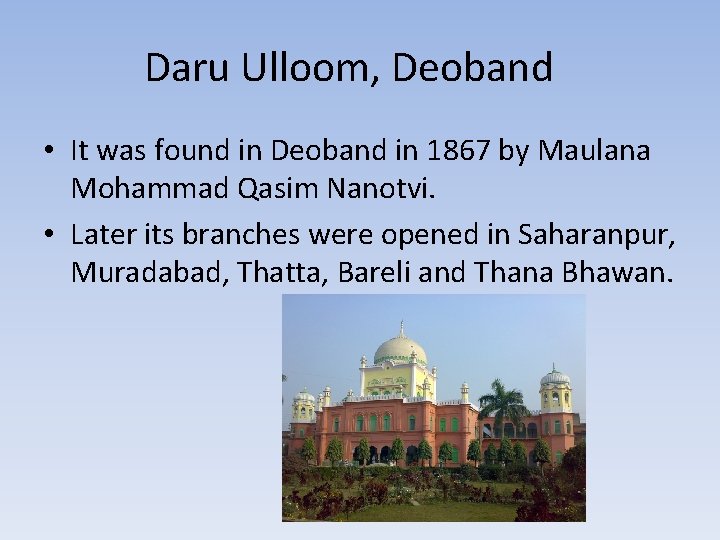
Daru Ulloom, Deoband • It was found in Deoband in 1867 by Maulana Mohammad Qasim Nanotvi. • Later its branches were opened in Saharanpur, Muradabad, Thatta, Bareli and Thana Bhawan.
• The social/political manifesto(program) of the darul-ullom was: – To make India a great country from all points of View. – To make India a Fedral State by uniting all local states. – To introduce uniform law in India to ensure socioeconomic justice.
• Religious Manifesto are as follows: – To defend Islamic customs and Islamic nationalism. – To protect religious and national rights of Muslims. – To establish good relations with non-Muslims to the extent laid down on shariyat. – To fight for the freedom of the country and Religion.
• The darul-ullom syllabus included medicine, caligraphy and a number of handicrafts besides teachings of Quran and Sunnah. • They were very particular that the students may learn to lead a life as laid down in the Quran and taught by the prophet Mohammad(S. A. W) and not to follow any kind of Bidah.
Nadwa-tul-Ullema • Maulana Shibli Naumani was a teacher in MAO college but he realised that it produced graduates for clerical jobs in British Govt and lacked intellectual enlightment ﺫہﻨی ﺗﺮﻗی. • He and some other religious scholars thought that the Aligarh college of Sir Syed and Darul. Ulloom Deoband were both on extreme ends and an educational institution should be setup which should teach both Islamic and modern science.
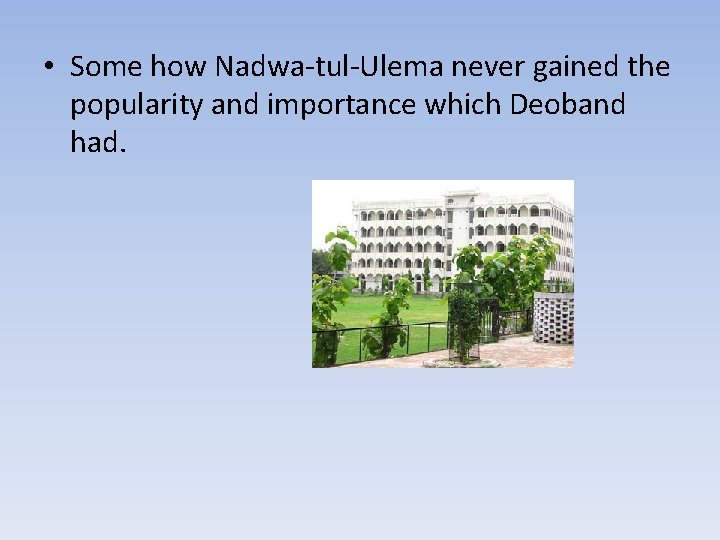
• Some how Nadwa-tul-Ulema never gained the popularity and importance which Deoband had.
Anjuman Himayat-e-Islam Lahore • British took control of Punjab in 1849 and sent Christian missionaries to propagate Christianity. • They were able to convert a number of people to Chrsitians. • Arya Samaj started a campaign against the Muslims and the Prophet Mohammad(S. A. W).
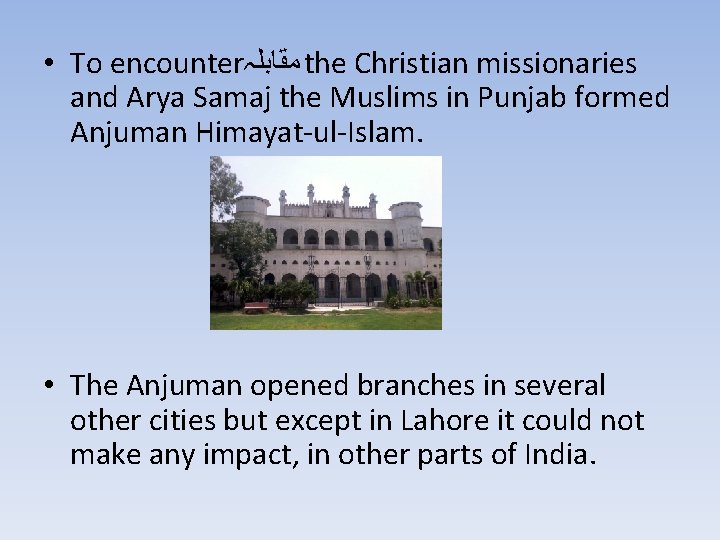
• To encounter ﻣﻘﺎﺑﻠہ the Christian missionaries and Arya Samaj the Muslims in Punjab formed Anjuman Himayat-ul-Islam. • The Anjuman opened branches in several other cities but except in Lahore it could not make any impact, in other parts of India.
• However, Anjuman Himayat-e-Islam organised regular annual meetings which were attended by thousands of Muslims. • These annual meetings were addressed by well known and eminent scholars like deputy Nazir Ahmed, Maulana Shibli Naumani, Nawab Mohsinul-mulk and Hali. • During these meetings national songs were sung and the glorius past of Muslims was brought to light. • In one of these meetings Allama Iqbal recited his poem Naala-e-yateem(Orphans Cry).
• It had a remarkable response and the participants started weeping and crying. • The Anjuman established Madrassat-ul. Ulloom which published many books which were introduced as text books in many Madrassas and in Govt schools. • The Christian missionaries were working hard on Muslim women and converting them to christians.
• Realising the gravity of the situation the Anjuman opened five schools for girls and within two years the number increased to fifteen where, apart from traditional education the teachings of Holy Quran and religious education was given special attention. • The Anjuman also opened Islamia college at Railway Road Lahore. • Islamia College at civil lines and Law College, civil lines all for boys.
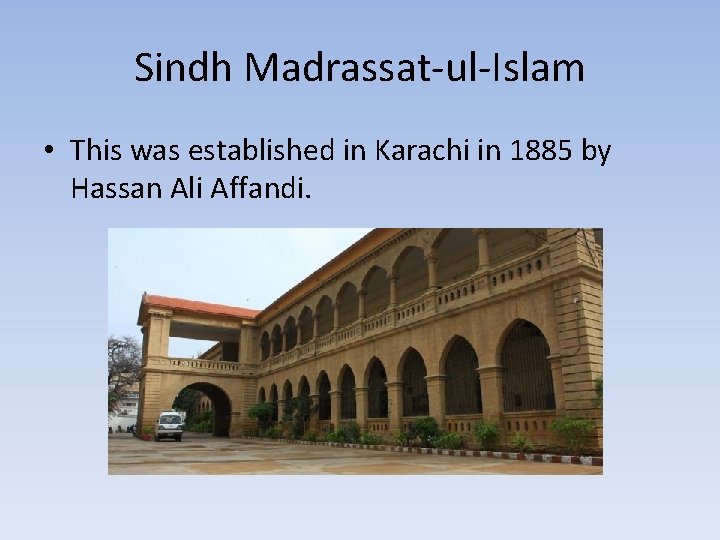
Sindh Madrassat-ul-Islam • This was established in Karachi in 1885 by Hassan Ali Affandi.
• An English principal was recruited from England his salary was paid by Nawab of Khairpur. • The Madrassah was run by English principals for more than 20 years. • It imparted education on modern Lines. • Quaid-e-Azam Mohammad Ali Jinnah also received his early eduaction from here.
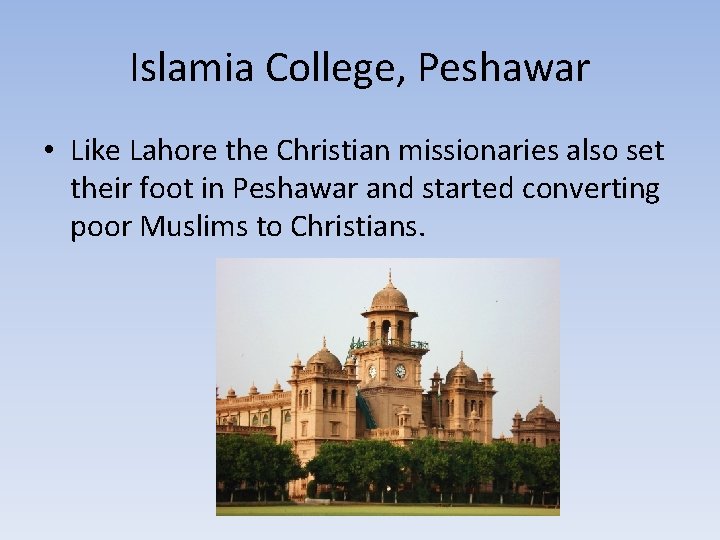
Islamia College, Peshawar • Like Lahore the Christian missionaries also set their foot in Peshawar and started converting poor Muslims to Christians.
• Some right thinking people in Peshawar asked Anjuman Himayat-e-Islam to setup an educational instituition there. • Consequently(so) Islamia College was established in Peshawar in 1912 on 200 acres of land.