
Role of Reviewing Courts in Administrative Decision Making
![Associated Provincial Picture Houses, Limited v Wednesbury Corporation [1948] 1 K. B. 223 Lord](https://slidetodoc.com/presentation_image_h/2bc6330e60790873fcf4e39ffb8ff915/image-13.jpg "Associated Provincial Picture Houses, Limited v Wednesbury Corporation [1948] 1 K. B. 223 Lord")
![Associated Provincial Picture Houses, Limited v Wednesbury Corporation [1948] 1 K. B. 223 Lord](https://slidetodoc.com/presentation_image_h/2bc6330e60790873fcf4e39ffb8ff915/image-14.jpg "Associated Provincial Picture Houses, Limited v Wednesbury Corporation [1948] 1 K. B. 223 Lord")
![Associated Provincial Picture Houses, Limited v Wednesbury Corporation [1948] 1 K. B. 223 Lord](https://slidetodoc.com/presentation_image_h/2bc6330e60790873fcf4e39ffb8ff915/image-15.jpg "Associated Provincial Picture Houses, Limited v Wednesbury Corporation [1948] 1 K. B. 223 Lord")
![Associated Provincial Picture Houses, Limited v Wednesbury Corporation [1948] 1 K. B. 223 16](https://slidetodoc.com/presentation_image_h/2bc6330e60790873fcf4e39ffb8ff915/image-16.jpg "Associated Provincial Picture Houses, Limited v Wednesbury Corporation [1948] 1 K. B. 223 16")
![Associated Provincial Picture Houses, Limited v Wednesbury Corporation [1948] 1 K. B. 223 Lord](https://slidetodoc.com/presentation_image_h/2bc6330e60790873fcf4e39ffb8ff915/image-18.jpg "Associated Provincial Picture Houses, Limited v Wednesbury Corporation [1948] 1 K. B. 223 Lord")
![Associated Provincial Picture Houses, Limited v Wednesbury Corporation [1948] 1 K. B. 223 Lord](https://slidetodoc.com/presentation_image_h/2bc6330e60790873fcf4e39ffb8ff915/image-19.jpg "Associated Provincial Picture Houses, Limited v Wednesbury Corporation [1948] 1 K. B. 223 Lord")
![CSR Ltd v Della Maddalena (2006) 224 ALR 1 Kirby J at [46]: 33](https://slidetodoc.com/presentation_image_h/2bc6330e60790873fcf4e39ffb8ff915/image-33.jpg "CSR Ltd v Della Maddalena (2006) 224 ALR 1 Kirby J at [46]: 33")
- Slides: 38
Role of Reviewing Courts in Administrative Decision Making Presentation by the Honourable Justice Buchanan 10 June 2016 1
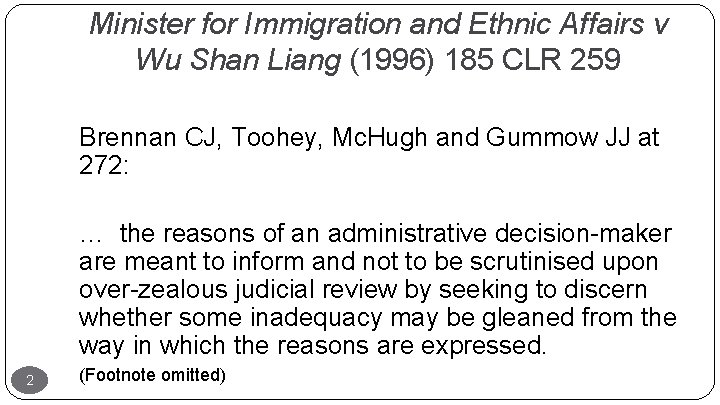
Minister for Immigration and Ethnic Affairs v Wu Shan Liang (1996) 185 CLR 259 Brennan CJ, Toohey, Mc. Hugh and Gummow JJ at 272: … the reasons of an administrative decision-maker are meant to inform and not to be scrutinised upon over-zealous judicial review by seeking to discern whether some inadequacy may be gleaned from the way in which the reasons are expressed. 2 (Footnote omitted)
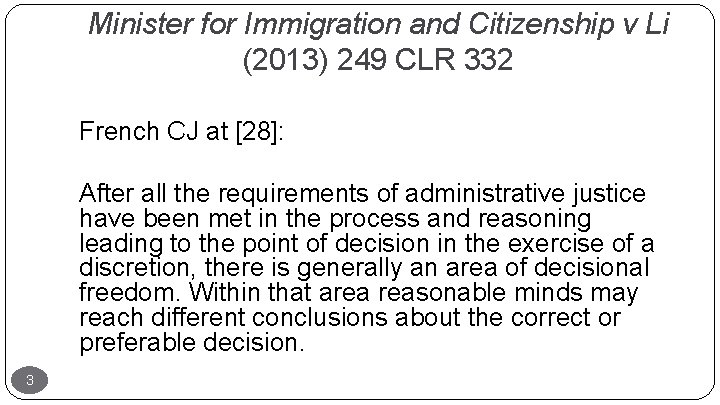
Minister for Immigration and Citizenship v Li (2013) 249 CLR 332 French CJ at [28]: After all the requirements of administrative justice have been met in the process and reasoning leading to the point of decision in the exercise of a discretion, there is generally an area of decisional freedom. Within that area reasonable minds may reach different conclusions about the correct or preferable decision. 3
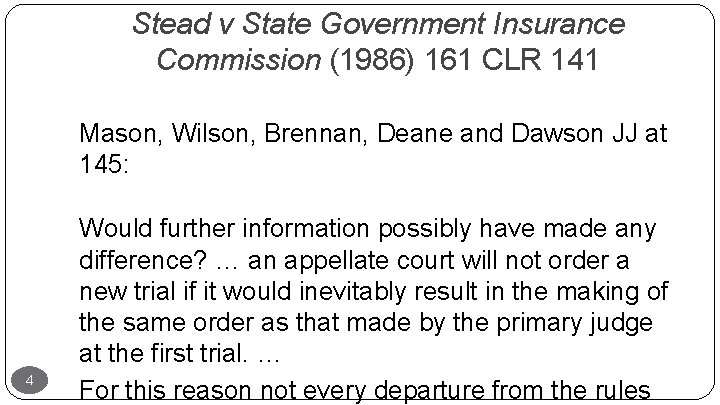
Stead v State Government Insurance Commission (1986) 161 CLR 141 Mason, Wilson, Brennan, Deane and Dawson JJ at 145: 4 Would further information possibly have made any difference? … an appellate court will not order a new trial if it would inevitably result in the making of the same order as that made by the primary judge at the first trial. … For this reason not every departure from the rules
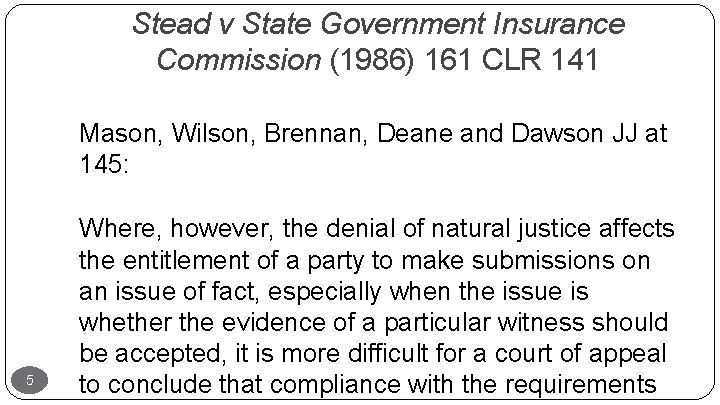
Stead v State Government Insurance Commission (1986) 161 CLR 141 Mason, Wilson, Brennan, Deane and Dawson JJ at 145: 5 Where, however, the denial of natural justice affects the entitlement of a party to make submissions on an issue of fact, especially when the issue is whether the evidence of a particular witness should be accepted, it is more difficult for a court of appeal to conclude that compliance with the requirements
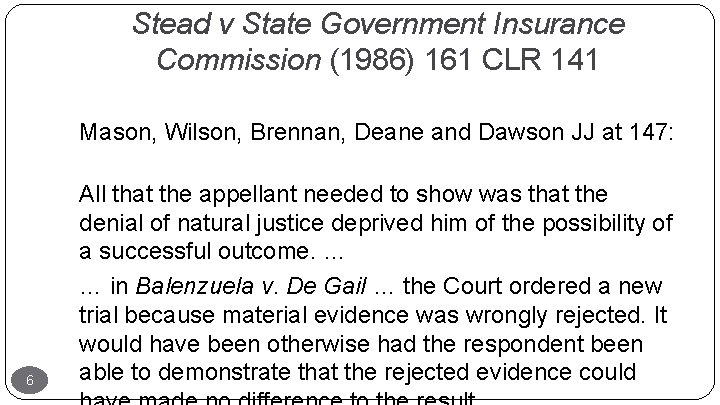
Stead v State Government Insurance Commission (1986) 161 CLR 141 Mason, Wilson, Brennan, Deane and Dawson JJ at 147: 6 All that the appellant needed to show was that the denial of natural justice deprived him of the possibility of a successful outcome. … … in Balenzuela v. De Gail … the Court ordered a new trial because material evidence was wrongly rejected. It would have been otherwise had the respondent been able to demonstrate that the rejected evidence could
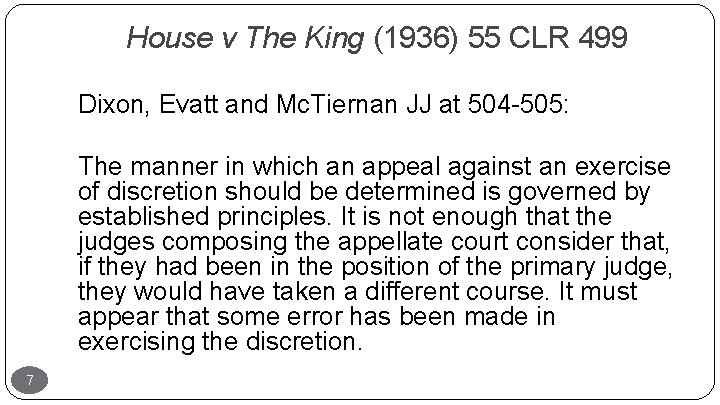
House v The King (1936) 55 CLR 499 Dixon, Evatt and Mc. Tiernan JJ at 504 -505: The manner in which an appeal against an exercise of discretion should be determined is governed by established principles. It is not enough that the judges composing the appellate court consider that, if they had been in the position of the primary judge, they would have taken a different course. It must appear that some error has been made in exercising the discretion. 7
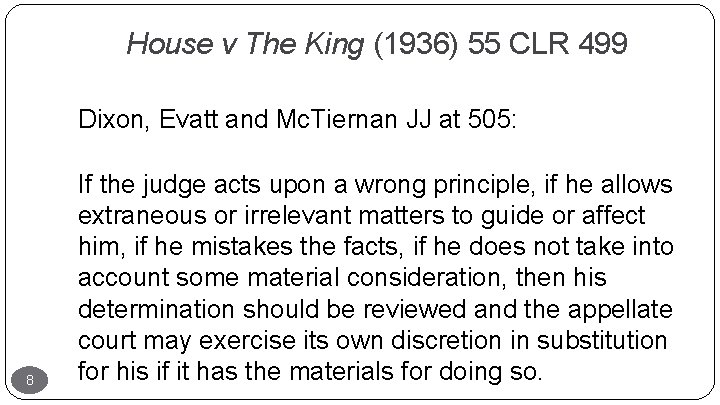
House v The King (1936) 55 CLR 499 Dixon, Evatt and Mc. Tiernan JJ at 505: 8 If the judge acts upon a wrong principle, if he allows extraneous or irrelevant matters to guide or affect him, if he mistakes the facts, if he does not take into account some material consideration, then his determination should be reviewed and the appellate court may exercise its own discretion in substitution for his if it has the materials for doing so.
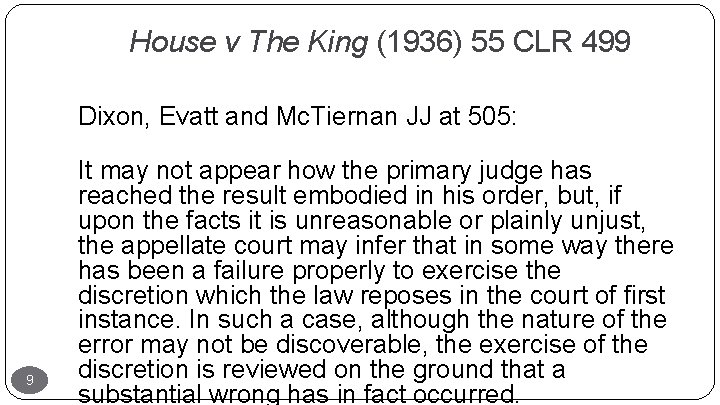
House v The King (1936) 55 CLR 499 Dixon, Evatt and Mc. Tiernan JJ at 505: 9 It may not appear how the primary judge has reached the result embodied in his order, but, if upon the facts it is unreasonable or plainly unjust, the appellate court may infer that in some way there has been a failure properly to exercise the discretion which the law reposes in the court of first instance. In such a case, although the nature of the error may not be discoverable, the exercise of the discretion is reviewed on the ground that a substantial wrong has in fact occurred.
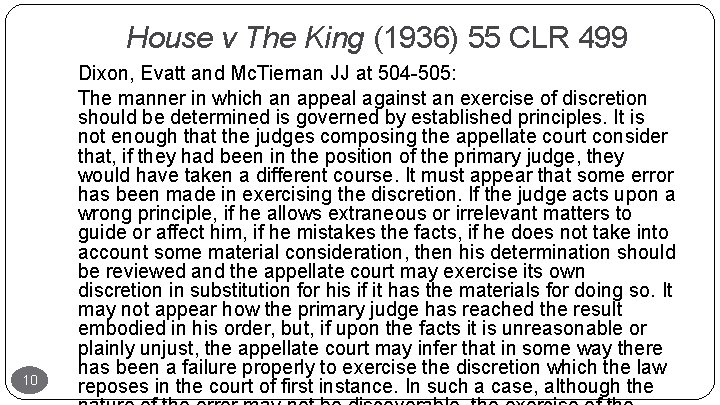
House v The King (1936) 55 CLR 499 10 Dixon, Evatt and Mc. Tiernan JJ at 504 -505: The manner in which an appeal against an exercise of discretion should be determined is governed by established principles. It is not enough that the judges composing the appellate court consider that, if they had been in the position of the primary judge, they would have taken a different course. It must appear that some error has been made in exercising the discretion. If the judge acts upon a wrong principle, if he allows extraneous or irrelevant matters to guide or affect him, if he mistakes the facts, if he does not take into account some material consideration, then his determination should be reviewed and the appellate court may exercise its own discretion in substitution for his if it has the materials for doing so. It may not appear how the primary judge has reached the result embodied in his order, but, if upon the facts it is unreasonable or plainly unjust, the appellate court may infer that in some way there has been a failure properly to exercise the discretion which the law reposes in the court of first instance. In such a case, although the
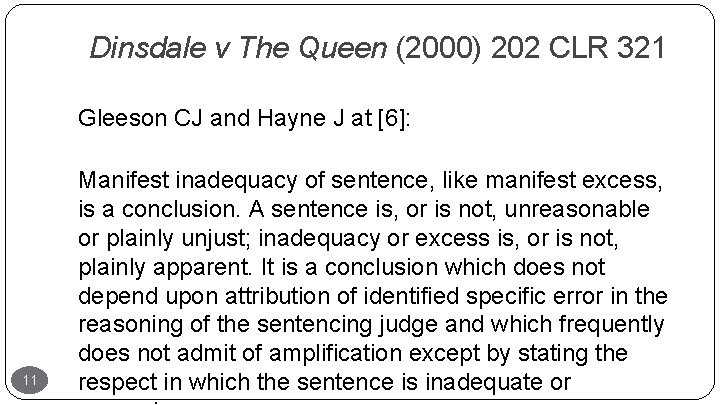
Dinsdale v The Queen (2000) 202 CLR 321 Gleeson CJ and Hayne J at [6]: 11 Manifest inadequacy of sentence, like manifest excess, is a conclusion. A sentence is, or is not, unreasonable or plainly unjust; inadequacy or excess is, or is not, plainly apparent. It is a conclusion which does not depend upon attribution of identified specific error in the reasoning of the sentencing judge and which frequently does not admit of amplification except by stating the respect in which the sentence is inadequate or
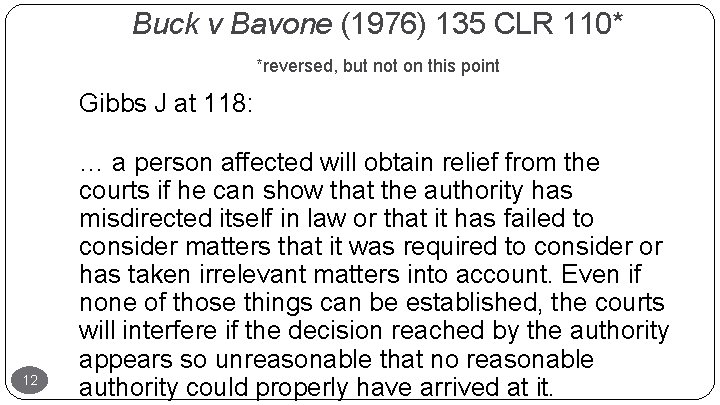
Buck v Bavone (1976) 135 CLR 110* *reversed, but not on this point Gibbs J at 118: 12 … a person affected will obtain relief from the courts if he can show that the authority has misdirected itself in law or that it has failed to consider matters that it was required to consider or has taken irrelevant matters into account. Even if none of those things can be established, the courts will interfere if the decision reached by the authority appears so unreasonable that no reasonable authority could properly have arrived at it.
Associated Provincial Picture Houses, Limited v Wednesbury Corporation [1948] 1 K. B. 223 Lord Greene M. R. at 229: 13 … a person entrusted with a discretion must, so to speak, direct himself properly in law. He must call his own attention to the matters which he is bound to consider. He must exclude from his consideration matters which are irrelevant to what he has to consider.
Associated Provincial Picture Houses, Limited v Wednesbury Corporation [1948] 1 K. B. 223 Lord Greene M. R. at 233 -234: 14 The court is entitled to investigate the action of the local authority with a view to seeing whether they have taken into account matters which they ought not to take into account, or, conversely, have refused to take into account or neglected to take into account matters which they ought to take into account.
Associated Provincial Picture Houses, Limited v Wednesbury Corporation [1948] 1 K. B. 223 Lord Greene M. R. at 234: 15 Once that question is answered in favour of the local authority, it may still be possible to say that, although the local authority have kept within the four corners of the matters which they ought to consider, they have nevertheless come to a conclusion so unreasonable that no reasonable authority could ever have come to it. In such a
Associated Provincial Picture Houses, Limited v Wednesbury Corporation [1948] 1 K. B. 223 16 Lord Greene M. R. at 233 -234: The court is entitled to investigate the action of the local authority with a view to seeing whether they have taken into account matters which they ought not to take into account, or, conversely, have refused to take into account or neglected to take into account matters which they ought to take into account. Once that question is answered in favour of the local authority, it may still be possible to say that, although the local authority have kept within the four corners of the matters which they ought to consider, they have nevertheless come to a conclusion so unreasonable that no reasonable authority could ever have come to it. In such a case, again, I
Minister for Aboriginal Affairs v Peko-Wallsend Limited (1986) 162 CLR 24 Mason J at 40 -41: (d) The limited role of a court reviewing the exercise of an administrative discretion must constantly be borne in mind. It is not the function of the court to substitute its own decision for that of the administrator by exercising a discretion which the legislature has vested in the administrator. Its role is to set limits on the exercise of that discretion, and a decision made within those boundaries cannot be impugned: Wednesbury Corporation. 17 (Footnote omitted)
Associated Provincial Picture Houses, Limited v Wednesbury Corporation [1948] 1 K. B. 223 Lord Greene M. R. at 230: It is not what the court considers unreasonable, a different thing altogether. If it is what the court considers unreasonable, the court may very well have different views to that of a local authority on matters of high public policy of this kind. 18
Associated Provincial Picture Houses, Limited v Wednesbury Corporation [1948] 1 K. B. 223 Lord Greene M. R. at 234: 19 The power of the court to interfere in each case is not as an appellate authority to override a decision of the local authority, but as a judicial authority which is concerned, and concerned only, to see whether the local authority have contravened the law by acting in excess of the powers which Parliament has confided in them.
Minister for Aboriginal Affairs v Peko-Wallsend Limited (1986) 162 CLR 24 Mason J at 39: 20 The failure of a decision-maker to take into account a relevant consideration in the making of an administrative decision is one instance of an abuse in discretion entitling a party with sufficient standing to seek judicial review of ultra vires administrative action. … Together with the related ground of taking into account irrelevant considerations, it has been discussed in a number of decided cases …
Minister for Aboriginal Affairs v Peko-Wallsend Limited (1986) 162 CLR 24 Mason J at 40: (c) Not every consideration that a decision-maker is bound to take into account but fails to take into account will justify the court setting aside the impugned decision and ordering that the discretion be re-exercised according to law. A factor might be so insignificant that the failure to take it into account could not have materially affected the decision: … 21
Craig v The State of South Australia (1995) 184 CLR 163 Brennan, Deane, Toohey, Gaudron and Mc. Hugh JJ at 179: 22 If such an administrative tribunal falls into an error of law which causes it to identify a wrong issue, to ask itself a wrong question, to ignore relevant material, to rely on irrelevant material or, at least in some circumstances, to make an erroneous finding or to reach a mistaken conclusion, and the tribunal’s exercise or purported exercise of power is thereby affected, it exceeds its authority or powers. Such an error of law is jurisdictional error which will invalidate any order or decision of the
Minister for Immigration and Multicultural Affairs v Yusuf (2001) 206 CLR 323 Mc. Hugh, Gummow and Hayne JJ at [82]: 23 What is important, however, is that identifying a wrong issue, asking a wrong question, ignoring relevant material or relying on irrelevant material in a way that affects the exercise of power is to make an error of law. Further, doing so results in the decision‑maker exceeding the authority or powers given by the relevant statute. In other words, if an error of those types is made, the decision‑maker did not have authority to
Minister for Immigration and Multicultural Affairs v Yusuf (2001) 206 CLR 323 Mc. Hugh, Gummow and Hayne JJ at [83]: 24 … it is important to recognise that, if the Tribunal identifies a wrong issue, asks a wrong question, ignores relevant material or relies on irrelevant material, it “exceeds its authority or powers”. If that is so, the person who purported to make the decision “did not have jurisdiction” to make the decision he or she made, and the decision “was not
Minister for Immigration and Multicultural Affairs v Yusuf (2001) 206 CLR 323 Mc. Hugh, Gummow and Hayne JJ at [84]: 25 If the Tribunal identifies a wrong issue, asks itself a wrong question, ignores relevant material or relies on irrelevant material in such a way as affects the exercise of its powers, that will very often reveal that it has made an error in its understanding of the applicable law or has failed to apply that law correctly to the facts it found.
Minister for Immigration and Citizenship v Li (2013) 249 CLR 332 French CJ at [28]: 26 After all the requirements of administrative justice have been met in the process and reasoning leading to the point of decision in the exercise of a discretion, there is generally an area of decisional freedom. Within that area reasonable minds may reach different conclusions about the correct or preferable decision. However, the freedom thus left by the statute cannot be construed as attracting a legislative sanction to be arbitrary or capricious or
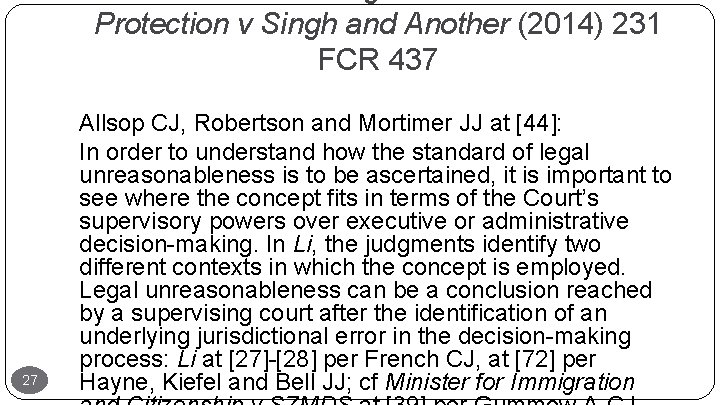
Protection v Singh and Another (2014) 231 FCR 437 27 Allsop CJ, Robertson and Mortimer JJ at [44]: In order to understand how the standard of legal unreasonableness is to be ascertained, it is important to see where the concept fits in terms of the Court’s supervisory powers over executive or administrative decision-making. In Li, the judgments identify two different contexts in which the concept is employed. Legal unreasonableness can be a conclusion reached by a supervising court after the identification of an underlying jurisdictional error in the decision-making process: Li at [27]-[28] per French CJ, at [72] per Hayne, Kiefel and Bell JJ; cf Minister for Immigration
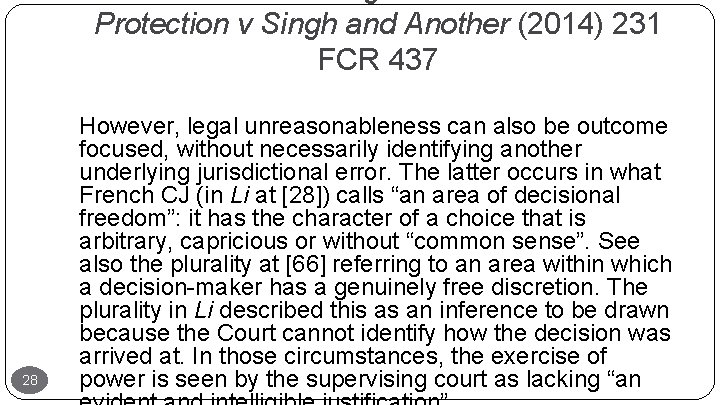
Protection v Singh and Another (2014) 231 FCR 437 28 However, legal unreasonableness can also be outcome focused, without necessarily identifying another underlying jurisdictional error. The latter occurs in what French CJ (in Li at [28]) calls “an area of decisional freedom”: it has the character of a choice that is arbitrary, capricious or without “common sense”. See also the plurality at [66] referring to an area within which a decision-maker has a genuinely free discretion. The plurality in Li described this as an inference to be drawn because the Court cannot identify how the decision was arrived at. In those circumstances, the exercise of power is seen by the supervising court as lacking “an
Role of Reviewing Courts in Administrative Decision Making Presentation by the Honourable Justice Buchanan 10 June 2016 29
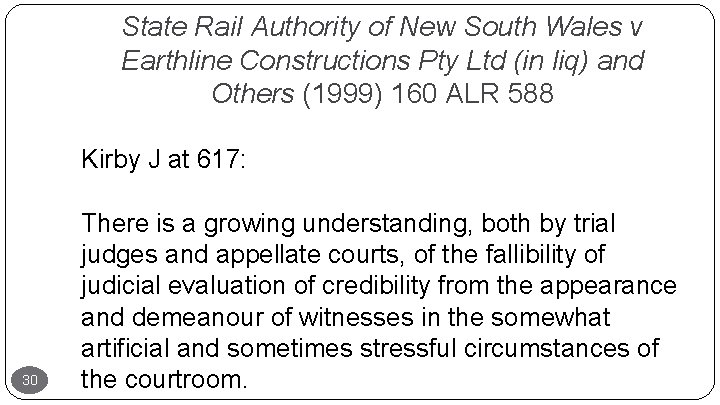
State Rail Authority of New South Wales v Earthline Constructions Pty Ltd (in liq) and Others (1999) 160 ALR 588 Kirby J at 617: 30 There is a growing understanding, both by trial judges and appellate courts, of the fallibility of judicial evaluation of credibility from the appearance and demeanour of witnesses in the somewhat artificial and sometimes stressful circumstances of the courtroom.
State Rail Authority of New South Wales v Earthline Constructions Pty Ltd (in liq) and Others (1999) 160 ALR 588 Kirby J at 618: Trial judges should strive, so far as they can, to decide cases without undue reliance on such fallible considerations as their assessment of witness credibility. 31
Fox v Percy (2003) 214 CLR 118 32 Gleeson CJ, Gummow and Kirby JJ at [31]: … in recent years, judges have become more aware of scientific research that has cast doubt on the ability of judges (or anyone else) to tell truth from falsehood accurately on the basis of appearances. Considerations such as these have encouraged judges, both at trial and on appeal, to limit their reliance on the appearances of witnesses and to reason to their conclusions, as far as possible, on the basis of contemporary materials, objectively established facts and the apparent logic of events. This does not eliminate the established principles about witness credibility; but it tends to reduce the occasions where those principles are seen as critical.
CSR Ltd v Della Maddalena (2006) 224 ALR 1 Kirby J at [46]: 33 … trial judges in Australia know the common disapproval of appellate courts of attempts to render trial conclusions appeal-proof by expressed reliance on the demeanour and appearance of witnesses where that is unnecessary or inappropriate. They also know the scientific unreliability of many such assessments. They are aware of the general desirability of founding judicial conclusions (as far as possible) on rationality and
Goodrich Aerospace Pty Ltd v Arsic (2006) 66 NSWLR 186 Ipp JA (Mason P and Tobias JA agreeing) at [21]: Another area where great care must be exercised in making demeanour findings is where a witness is from a different cultural and ethnic background to that with which the judge is familiar. 34
Goodrich Aerospace Pty Ltd v Arsic (2006) 66 NSWLR 186 Ipp JA (Mason P and Tobias JA agreeing) at [27]: 35 … problems and doubts about demeanour findings explain why trial judges are expected to weigh their impressions as to demeanour carefully against the probabilities and to examine whether the disputed evidence is consistent with incontrovertible facts, facts that are not in dispute and other relevant evidence in the case. Of course, demeanour may trump the probabilities, but it should be apparent from the judge’s
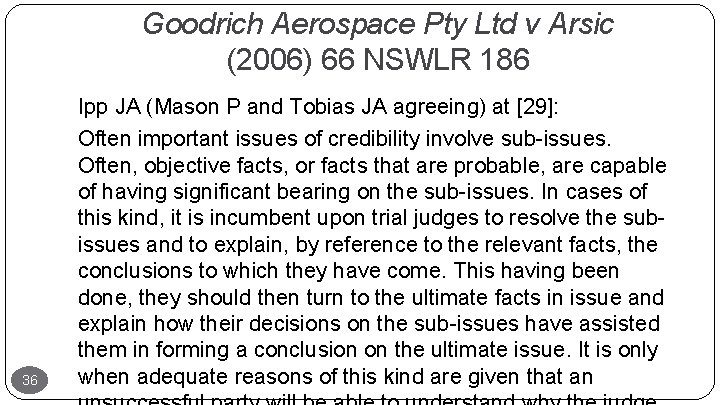
Goodrich Aerospace Pty Ltd v Arsic (2006) 66 NSWLR 186 36 Ipp JA (Mason P and Tobias JA agreeing) at [29]: Often important issues of credibility involve sub-issues. Often, objective facts, or facts that are probable, are capable of having significant bearing on the sub-issues. In cases of this kind, it is incumbent upon trial judges to resolve the subissues and to explain, by reference to the relevant facts, the conclusions to which they have come. This having been done, they should then turn to the ultimate facts in issue and explain how their decisions on the sub-issues have assisted them in forming a conclusion on the ultimate issue. It is only when adequate reasons of this kind are given that an
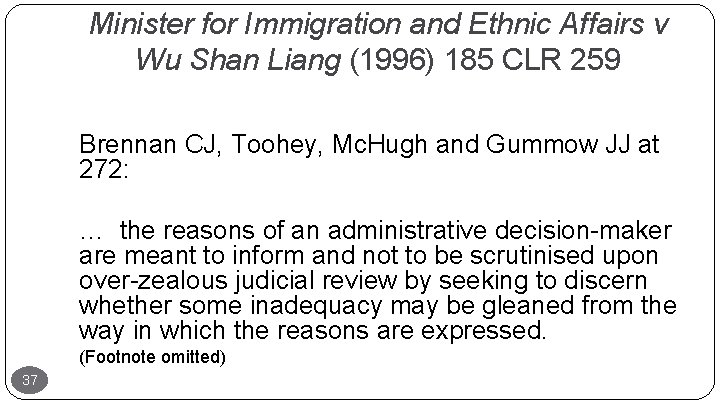
Minister for Immigration and Ethnic Affairs v Wu Shan Liang (1996) 185 CLR 259 Brennan CJ, Toohey, Mc. Hugh and Gummow JJ at 272: … the reasons of an administrative decision-maker are meant to inform and not to be scrutinised upon over-zealous judicial review by seeking to discern whether some inadequacy may be gleaned from the way in which the reasons are expressed. (Footnote omitted) 37
Role of Reviewing Courts in Administrative Decision Making Presentation by the Honourable Justice Buchanan 10 June 2016 38