
Role of Research Question Organizing principle for the






- Slides: 16
Role of Research Question • Organizing principle for the entire study – Target population – Sample – Data collection method – Measures – Analysis – Forum for reporting the results
Types of Research Questions • Like research goals – Descriptive – Association – Causal
Descriptive • • • How often…. How much… What number…. . What percentage…. . Was there a change… Has the incidence increased… Who is affected… When did it start… Where is it concentrated…
Descriptive: Childhood Type 2 Diabetes • Has the incidence of type 2 diabetes increased in children? – Increased from 0. 7 per 100, 000 in 1982 to 7. 2 per 100, 000 in 1994 in Cincinnati, OH (Pinhas-Hamiel et al. , 1996). • Who is affected? – Pima Indians in Arizona have an unusually high prevalence of Type 2 diabetes in childhood (Dabelea et al. , 1998).
Association/Causal • Association – risk factors • Causal – direct causes • Collectively known as determinants
Example: Obesity as a Cause or Risk Factor • Are obese individuals more likely than those who are not obese to have cardiovascular disease (CVD)? – Study of firefighters showed that extremely obese subjects had an average of 2. 1 risk factors for CVD compared to 1. 5 for normal weight firefighters (Soteriades et al. , 2005). • Is obesity associated with colorectal cancer? – Subjects with colorectal cancer had higher body mass indices (BMI) compared to those without cancer (Campbell et al. , 2010).
Causal/Evaluation • Evidence-based programs – If X causes or increases the risk for Y, then decreasing X should decrease Y. • Decreasing or preventing X is a deterrent for Y. • Types of questions: – Does Program Alpha have a desirable effect on X? – Is Program Alpha effective in preventing Y?
Example: Effect of Modest Weight Loss on Preventing Type 2 Diabetes • DPP -- Experimental Study of those at high risk for diabetes – Diet and exercise – Medication – Usual care • Outcome – Reduced incidence of diabetes
Sources for Research Questions • • • Everyday life Practical issues in the field of study Relevant research studies Clinical practice Theory
Questions from Everyday Life • Why do my daughter and her soccer teammates get so many concussions? • Is interactive screen time linked to incident ADHD? • Has the use of medication to treat ADHD in elementary school children increased in the past 10 years?
Questions from Issues in the Field of Study • Major questions that plague the field of public health. – What are the causes of the increasing prevalence of obesity in the U. S. ? Diabetes in the U. S. ? – What is an effective vaccine for HIV? – What is an effective cure for infection with hepatitis C virus?
Relevant Research Studies • Results of studies on the topic of interest can guide the more specific focus of research questions and hypotheses. – Replicate the results to provide more support – Test in a different population – Measure exposure and outcome using different techniques – self report, biomarker, physical measurement • Example – Are residents of food desert areas (i. e. , neighborhoods with no access to fresh produce) more likely than others to be obese?
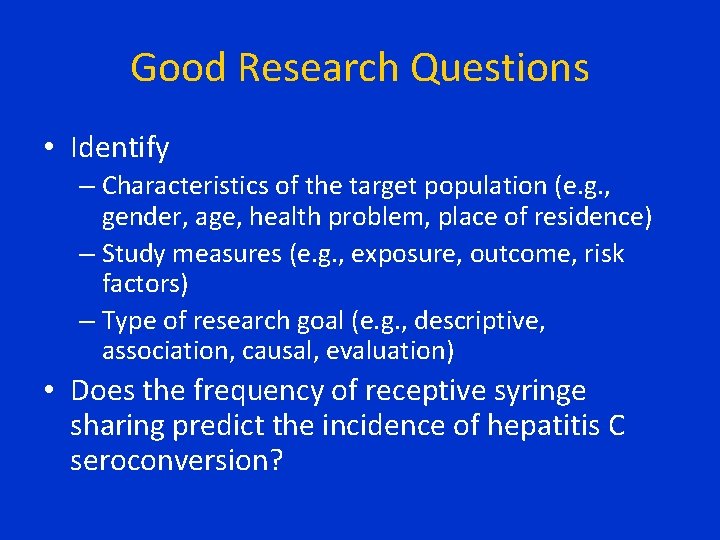
Good Research Questions • Identify – Characteristics of the target population (e. g. , gender, age, health problem, place of residence) – Study measures (e. g. , exposure, outcome, risk factors) – Type of research goal (e. g. , descriptive, association, causal, evaluation) • Does the frequency of receptive syringe sharing predict the incidence of hepatitis C seroconversion?
Key Study Components • Feasible – it must be possible to answer the question analytically (scientifically, time, resources) • Interesting – the question should generate interest among the consumers of the research • Novel – the question should add something new to the field of research • Ethical – procedures needed to answer the question must not compromise the protection of human subjects • Relevant – the question should address issues that are timely, have an impact on the study population, and make a contribution to the field of study
For This Class • No Randomized Clinical Trials • No Secondary Data Analysis
Group Assignements • Jennifer Dulin and Katherine Mc. Collough • Christina Faulk and Amanda Jones • Carly Fecio and Scarlett C Johnson • Jeremy Pasteris and Chun-Che Wen • Nicholas Shungu and Ciera Jones • Phayvanh Sjogren, Megan Stover and Eden Mekonnen