
Role of Pheromones in Reproductive Behavior Pheromones are
Role of Pheromones in Reproductive Behavior • Pheromones are chemicals released externally into environment to produce special effect. • Pheromone is a substance secreted by an animal that influences the behavior of other animal of the same species. • Used as chemical signals in intraspecific communication. • Also referred as “ectohormones”.
• A pheromone is secreted or exerted chemical factor that triggers a social response in members of the same species. • These are the chemicals capable of acting like hormones outside the body of the secreting individual (ectohormones), to impact the behavior of the receiving individual. • Animals communicate with help of pheromones. • Alarm Pheromones • Food trail pheromones • Sex pheromones • Pheromones are well documented in Insects than other group of animals.
• • Pheromones acts by chemoreception. Can helps in sensing various things by… Olfaction Detection of Hazards Detection of Food Alarming Reproductive behavior
• Releaser pheromones: • These induce immediate and reversible behavioral responses mediated directly by CNS. • These are used in recognition of the species members, sexual status, aggregation. • Primer pheromones: • These evoke a prolonged or long term endocrine responses through direct effect on target organs. • Pheromones involved in suppression and induction of estrous cycle, termination of pregnancy and sexual maturation. • Imprinting pheromones: act at a critical period of the development & cause permanent effect in adult behaviour, found in some rodents.
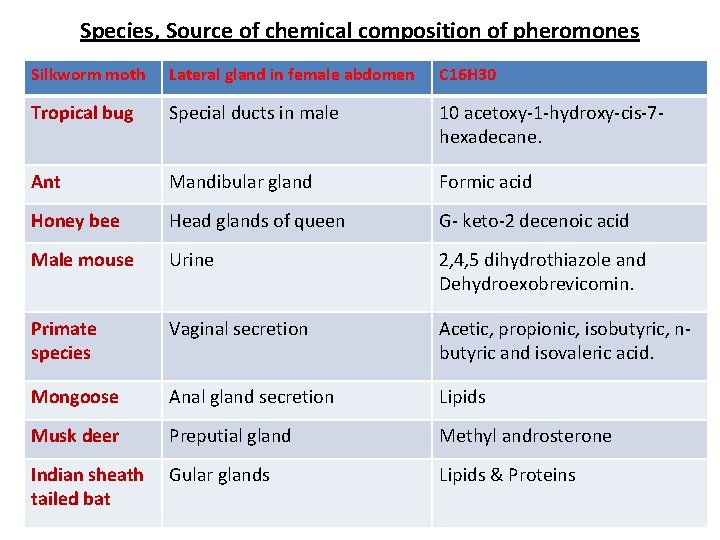
Species, Source of chemical composition of pheromones Silkworm moth Lateral gland in female abdomen C 16 H 30 Tropical bug Special ducts in male 10 acetoxy-1 -hydroxy-cis-7 hexadecane. Ant Mandibular gland Formic acid Honey bee Head glands of queen G- keto-2 decenoic acid Male mouse Urine 2, 4, 5 dihydrothiazole and Dehydroexobrevicomin. Primate species Vaginal secretion Acetic, propionic, isobutyric, nbutyric and isovaleric acid. Mongoose Anal gland secretion Lipids Musk deer Preputial gland Methyl androsterone Indian sheath tailed bat Gular glands Lipids & Proteins
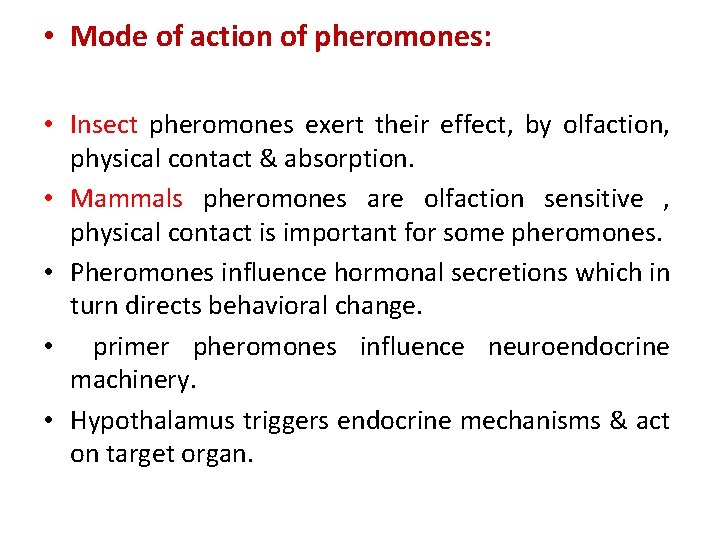
• Mode of action of pheromones: • Insect pheromones exert their effect, by olfaction, physical contact & absorption. • Mammals pheromones are olfaction sensitive , physical contact is important for some pheromones. • Pheromones influence hormonal secretions which in turn directs behavioral change. • primer pheromones influence neuroendocrine machinery. • Hypothalamus triggers endocrine mechanisms & act on target organ.
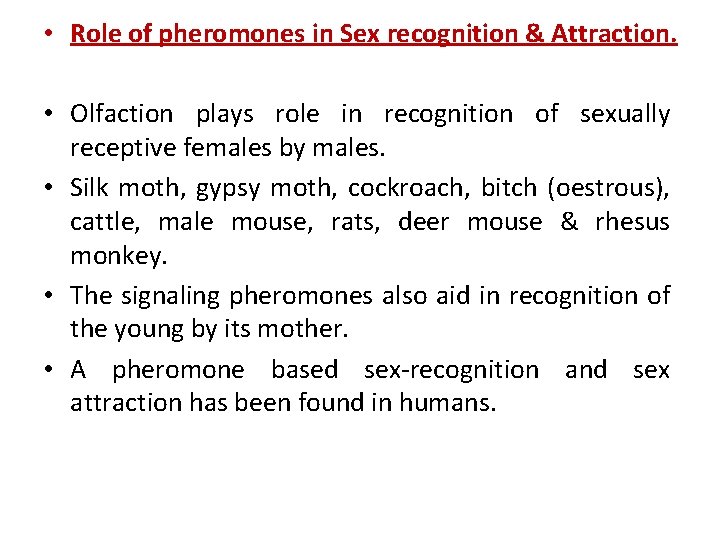
• Role of pheromones in Sex recognition & Attraction. • Olfaction plays role in recognition of sexually receptive females by males. • Silk moth, gypsy moth, cockroach, bitch (oestrous), cattle, male mouse, rats, deer mouse & rhesus monkey. • The signaling pheromones also aid in recognition of the young by its mother. • A pheromone based sex-recognition and sex attraction has been found in humans.
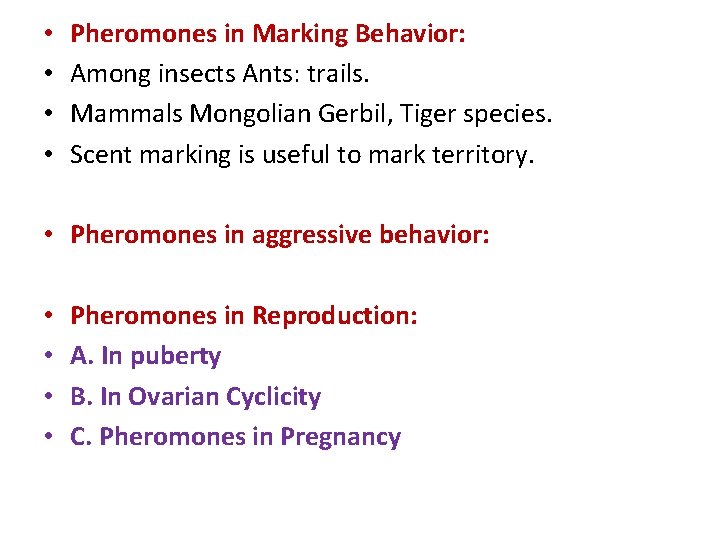
• • Pheromones in Marking Behavior: Among insects Ants: trails. Mammals Mongolian Gerbil, Tiger species. Scent marking is useful to mark territory. • Pheromones in aggressive behavior: • • Pheromones in Reproduction: A. In puberty B. In Ovarian Cyclicity C. Pheromones in Pregnancy
• A. In Puberty: • A female mice attains puberty some twenty days earlier in company of an adult male than if reared among females. • Pheromones interact with hormones to bring out an effect on puberty. • The pheromone present in the urine of male mouse facilitate gonadotropin to induce ovulation faster in female mouse.
B. In Ovarian Cyclicity: • Whitten (1966) & Bronson (1970) observed for the first time the effect of pheromonal effects on ovarian cyclicity in adult female mouse. 1) The Lee-Boot effect: a house mouse has regular estrous cyclicity with normal period of 4 -5 days. • All female grouping of normal animals causes cessation of regular cyclicity and thus display a state of pseuopregnancy. This is k/as Lee-boot effect. • The female pheromones supposed to have negative effect on regular cycling in other females are present in urine of the intact adult female. • Olfactory bulbectomy causes disappearance of Lee. Boot effect.
2. Whitten effect: • Whitten observed that introduction of a male or his excretion into a cage containing pseudo pregnant or anestrous female mice causes initiation of synchronized estrous cycle. • this type of initiation and synchronization of estrous activity in acyclic females has been called as Whitten -effect. • The male pheromones inducing oestrous are found in the urine of the adult male.
C. Pheromones in Pregnancy: • Pheromones are involved in gestational process in mammals. • Bruce (1959) noticed that about 80% of newly inseminated female mice, pregnancy was blocked if they were exposed to a strange male or odour of strange male. • The affected females if mated with a second familiar male returned to regular cycling. • This phenomenon is termed as Bruce- effect or pregnancy block effect.
- Slides: 12