
ROLE OF HR PROFESSIONALS IN PERFORMANCE MANAGEMENT HR

- Slides: 52
ROLE OF HR PROFESSIONALS IN PERFORMANCE MANAGEMENT �HR Professionals have to ensure that performance management is: �Consistent with organization’s mission, objectives and strategy �Beneficial as a strategic and developmental tool �Useful as an administrative tool �Legally defensible and role based and �Viewed as generally fair and enabling by employees Performance Management © Oxford University Press 2008 All rights reserved
ROLE OF HR PROFESSIONAL’S IN IMPROVING ORGANIZATIONAL PERFORMANCE � HR Professionals have to: �Become competency builder �Link work goals to performance expectations �Become change agent �Organizational rejuvenation initiator �Customer relationship management trainer �Effective communication facilitator �Talent farmer �Strategic recruiter �Strategic outsourcer �Ethics custodian and �Internal Systems Critic Performance Management © Oxford University Press 2008 All rights reserved
HR PROFESSIONALS AND PERFORMANCE MANAGEMENT SYSTEM: AN OVERVIEW OF CURRENT COMPETENCIES, ROLES, AND PROBLEMS �Three conditions appear critical for HR professionals: �Business Focus �Competitive advantage �Customer value �Stakeholder wealth Performance Management © Oxford University Press 2008 All rights reserved
HR PROFESSIONALS AND PERFORMANCE MANAGEMENT SYSTEM: AN OVERVIEW OF CURRENT COMPETENCIES, ROLES, AND PROBLEMS �Contemporary expertise �Systems knowledge �Line Competencies �HR competencies �People orientation �Building an inspiring culture �Ensuring corporate social responsibility Performance Management © Oxford University Press 2008 All rights reserved
SEVEN SINS OF HR PROFESSIONALS �Decision making is prerogative of CEO �Tunnel vision �Fault finding �Never Trust Anybody �Role Model �Not cost savvy �Move Alone Performance Management © Oxford University Press 2008 All rights reserved
EFFECTIVE STRATEGIC ROLES FOR HR PROFESSIONALS � Creating an information sharing culture � Training managers to conduct performance management effectively � Training employees to participate effectively in the performance management system and � Acting as ‘Internal Consultant’ for managers and employees when the inevitable problems occur Performance Management © Oxford University Press 2008 All rights reserved
JOB PROFILE OF HR PROFESSIONALS: AN ADVERTISEMENT A recent job advertisement for “Senior Management Position” of a well known Company reads like this (excerpt): HUMAN RESOURCE The role will encompass handling the entire gamut of human resource function which includes devising Recruitment strategies to attract best talent, organization wide HRD strategies, comprehensive Performance management and Compensation management, Culture building and communication, HR planning in line with the business strategies and benchmarking with the global best practices …… Adapted from Guha, 2007 “Times Ascent”, The Times of India, Wednesday, 06/06/2007, New Delhi Performance Management © Oxford University Press 2008 All rights reserved
APPRAISING HR FUNCTION: ENERGIZING FOR CORPORATE SUCCESS �Operations Perspective �What are the problems inflicting the business of the organization? �How solving the problem will affect the business �Is the problem affecting quality? �Is it pushing up costs? �Is it increasing rework? �What price is the organization paying for this problem? Performance Management © Oxford University Press 2008 All rights reserved
APPRAISING HR FUNCTION: ENERGIZING FOR CORPORATE SUCCESS �Financial Perspective �What is the total cost of compensation and benefits? �What is the optimal level as per industry norms? �What is the organization’s ability to pay? �What is business strategy, and growth prospects of the organization? Performance Management © Oxford University Press 2008 All rights reserved
APPRAISING HR FUNCTION: ENERGIZING FOR CORPORATE SUCCESS �HR Perspective �What is the total training mandays being invested? �What is the management attitude towards employee development? �What is the present competence of human resources? �What is status of organization’s talent pool? Performance Management © Oxford University Press 2008 All rights reserved
APPRAISING HR FUNCTION: ENERGIZING FOR CORPORATE SUCCESS �Customer Perspective �Are the customers of the organization satisfied? �Are employees happy, satisfied and committed? �Is HR making employees as goodwill ambassadors for the organization? �Is HR responsive to customer’s (internal & external) needs and aspirations? Performance Management © Oxford University Press 2008 All rights reserved
FUTURE ROLES OF HR PROFESSIONALS IN PERFORMANCE MANAGEMENT IN THE KNOWLEDGE MILLENIUM � HR Professional shall be responsible for building competency of the organization � HR Professional should be able to pre-empt performance problems in advance and ensure its speedy and reliable rectification � HR Professional shall act as ‘Performance Counselor’ � HR Professional’s Entrepreneurship Skills shall be critical to improve organizational performance Performance Management © Oxford University Press 2008 All rights reserved
PERFORMANCE PLANNING �Performance Planning: �Systematic outlining of the activities that the manager is expected to undertake during a specified period �Skills, knowledge, expertise and capabilities required to attain these activities successfully �Employee is able to make his best contribution to developmental and organizational outcomes Performance Management © Oxford University Press 2008 All rights reserved
THEORIES OF GOAL SETTING �Goal Setting Theory �Goals pursued by employees can play an important role in motivating superior performance �Behaviour modification is a result of goal setting �Objective performance measures have been shown to be better motivators Performance Management © Oxford University Press 2008 All rights reserved
Expectancy Theory �Anticipated satisfaction of valued goals causes individuals to adjust their behaviour in a way which is most likely to their attaining them �An employee shall be motivated to perform if he knows that effort shall lead to better performance and better performance shall, in turn, lead to better rewards Performance Management © Oxford University Press 2008 All rights reserved
SETTING PERFORMANCE CRITERIA �Joint process of listing competencies and behaviours of employees by managers �Needed to accomplish pre-determined job goals, targets and expectations �Aligned with organizational objectives and strategy Performance Management © Oxford University Press 2008 All rights reserved
PROCESS OF SETTING PERFORMANCE CRITERIA �Specify tasks and results �Set standards or targets �Determine the measures �Outline time scale �Prioritize goals �Rate goal performance �Support goal achievement Performance Management © Oxford University Press 2008 All rights reserved
METHODOLOGIES OF PERFORMANCE PLANNING �Key Performance Areas �Key Result Areas �Task and Target Identification and �Goal Setting Exercises Performance Management © Oxford University Press 2008 All rights reserved
PROCESS OF PERFORMANCE PLANNING �Business Planning �Key Success Factors �Departmental objectives and strategies �Individual’s objectives and action plan �Individual performance expectations Performance Management © Oxford University Press 2008 All rights reserved
BARRIERS TO PERFORMANCE PLANNING � Organizational barriers: � � � Performance planning does not find favour Assumption of excellent implementation strategy Individual barriers: � � Sometimes managers or employees or both have no commitment towards goals and objectives of the organization They refrain from taking responsibility and contribute marginal performance to their organizations Performance Management © Oxford University Press 2008 All rights reserved
COMPETENCY MAPPING �Process of identifying key competencies for an organization and the jobs and functions within it �Competencies that are the most critical to success in a work situation or work role Performance Management © Oxford University Press 2008 All rights reserved
COMPETENCY MAPPING AND ITS LINKAGE TO PERFORMANCE PLANNING � It provides structured and documented procedures which aids in recruitment of competent personnel with desired skill sets, attributes and training thereby reducing cost and time of subsequent performance failures � It reduces cost of performance development programmes as the organization has ready inventory of requisite skill sets � It helps in benchmarking higher levels of performance � It helps in creating individual learning plans � It helps in assignment of right job to right person for better performance as the employee with required skill sets and training shall be handling it � It provides management input for gap analysis for improving performance of the employee in the requisite business areas Performance Management © Oxford University Press 2008 All rights reserved
PERFORMANCE MANAGING �Process of working towards the performance expectations established in the performance planning stage �Analyzing progress achieved on continual basis and �Counseling for improving results Performance Management © Oxford University Press 2008 All rights reserved
PROCESS OF PERFORMANCE MANAGING �Analyzing Performance �Reinforcing Right Efforts �Removing Performance Deficiencies �Improvement Plans Performance Management © Oxford University Press 2008 All rights reserved
PERFORMANCE APPRAISAL or PERFORMANCE REVIEW �Performance Appraisal/Review is a procedure that involves: �Setting work standards �Assessing the employee’s actual performance relative to these standards and �Providing feedback to the employee with the aim of motivating that person to eliminate performance deficiencies or to continue to perform above par Performance Management © Oxford University Press 2008 All rights reserved
OBJECTIVES OF PERFORMANCE APPRAISAL �Making Development Decisions �Motivate and guide the employees towards purposeful personal development of skills and competencies �Providing feedback �Making Administrative Decisions �Support administrative decisions such as promotions, transfers, demotions, terminations, pay increases, etc. Performance Management © Oxford University Press 2008 All rights reserved
PRINCIPLES OF APPRAISING PERFORMANCE �T = Technical Phase �E = Extended Phase �A = Appraisal Phase �M = Maintenance Phase Performance Management © Oxford University Press 2008 All rights reserved
PROCESS OF PERFORMANCE APPRAISAL �Defining Objectives of Performance Appraisal �Defining Performance Expectations �Designing Performance Appraisal System �Implementing Performance Appraisal System �Performance Appraisal Interview �Post Performance Appraisal Actions Performance Management © Oxford University Press 2008 All rights reserved
APPROACHES TO PERFORMANCE APPRAISAL �Behaviour-Based Approaches �Rating Scale �Behaviourally Anchored Rating Scale �Weighted checklist �Forced choice method �Results-Focused Approaches �Management By Object Approach �Accountabilities and Measures Approach Performance Management © Oxford University Press 2008 All rights reserved
METHODS OF PERFORMANCE APPRAISAL �PAST ORIENTED APPRAISAL METHODS: �Essay appraisal �Graphic rating scale appraisal �Field review appraisal �Forced-choice rating appraisal �Critical incident appraisal �Work-standards approach �Ranking methods appraisal Performance Management © Oxford University Press 2008 All rights reserved
METHODS OF PERFORMANCE APPRAISAL �FUTURE ORIENTED APPRAISAL METHODS: �Management-by-objectives appraisal �Assessment centers �Behaviourally Anchored Rating Scale � 360–Degree appraisal �Balanced Scorecard Performance Management © Oxford University Press 2008 All rights reserved
COMMON RATING ERRORS � � � � Halo Effect Horn Effect Central Tendency Strict Rating Lenient Rating Status Effect Spillover Effect Initial Impression Latest Behaviour Same as Me Different from Me Performance Factor Order Contrast Effect Sympathy Effect Performance Management © Oxford University Press 2008 All rights reserved
COMMON PITFALLS OF PERFORMANCE APPRAISAL �Time and resource constraint of managers �Wide variation in standards and ratings �Personal values and bias �Lack of communication �Limitation of performance appraisal technique �Managerial resistance �Negative feedback Performance Management © Oxford University Press 2008 All rights reserved
ELEMENTS OF A GOOD PERFORMANCE APPRAISAL SYSTEM �Aligning individual performance expectations with the organization’s vision and values �Measuring key results and competencies �Appraising against clearly defined performance expectations �Working together to develop performance expectations �Providing frequent and timely feedback Performance Management © Oxford University Press 2008 All rights reserved
ELEMENTS OF A GOOD PERFORMANCE APPRAISAL SYSTEM �Conducting performance appraisals as scheduled �Encouraging employees to conduct a self– appraisal �Evaluating employee performance against established performance standards �Scheduling training on the appraisal process �Demonstrating organizational commitment Performance Management © Oxford University Press 2008 All rights reserved
ADVANTAGES AND DISADVANTAGES OF PERFORMANCE APPRAISAL Advantages: � Increased motivation to perform effectively � Increased self-esteem � Better defined and clarified job � Better communication � Clarified and acceptable organizational � Fair and credible rewards distribution and � Valuable appraisal information can allow the organization to do better human resource planning, test validation, and development of training programmes Performance Management © Oxford University Press 2008 All rights reserved
ADVANTAGES AND DISADVANTAGES OF PERFORMANCE APPRAISAL Disadvantages: �Damage to self-esteem appraiser and appraisee �Time may be wasted �The relationship among individuals may be permanently worsened thereby creating organizational conflicts �Performance motivation may be lowered and �Money may be wasted on forms, training, and a host of support services Performance Management © Oxford University Press 2008 All rights reserved
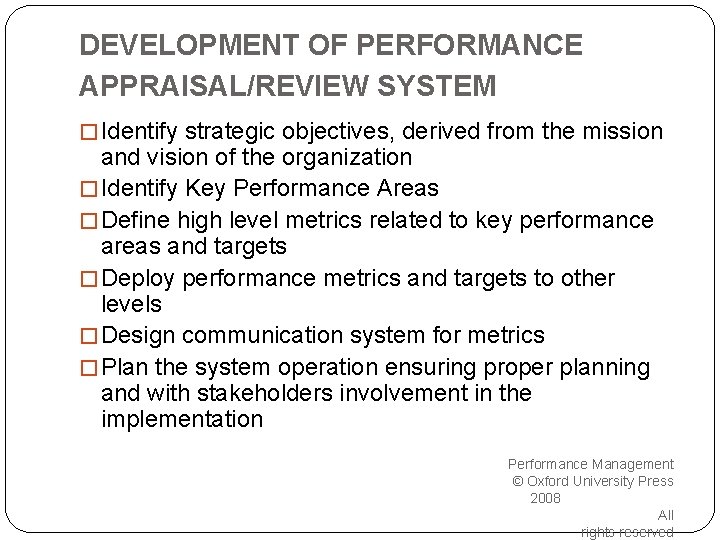
DEVELOPMENT OF PERFORMANCE APPRAISAL/REVIEW SYSTEM � Identify strategic objectives, derived from the mission and vision of the organization � Identify Key Performance Areas � Define high level metrics related to key performance areas and targets � Deploy performance metrics and targets to other levels � Design communication system for metrics � Plan the system operation ensuring proper planning and with stakeholders involvement in the implementation Performance Management © Oxford University Press 2008 All rights reserved
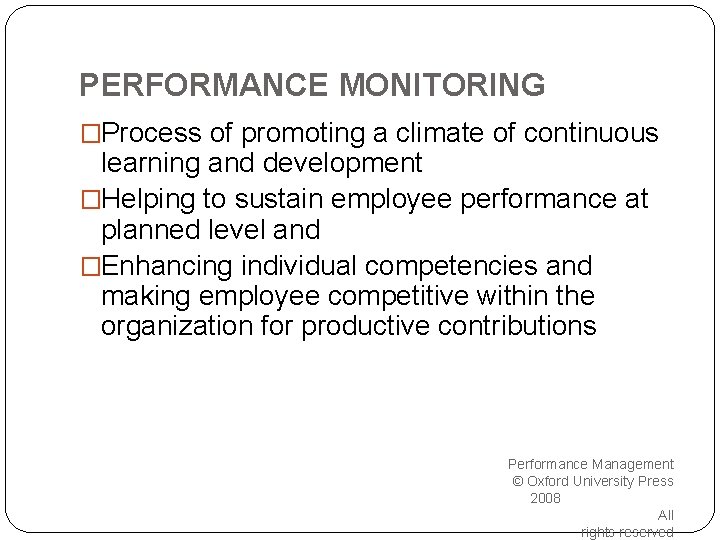
PERFORMANCE MONITORING �Process of promoting a climate of continuous learning and development �Helping to sustain employee performance at planned level and �Enhancing individual competencies and making employee competitive within the organization for productive contributions Performance Management © Oxford University Press 2008 All rights reserved
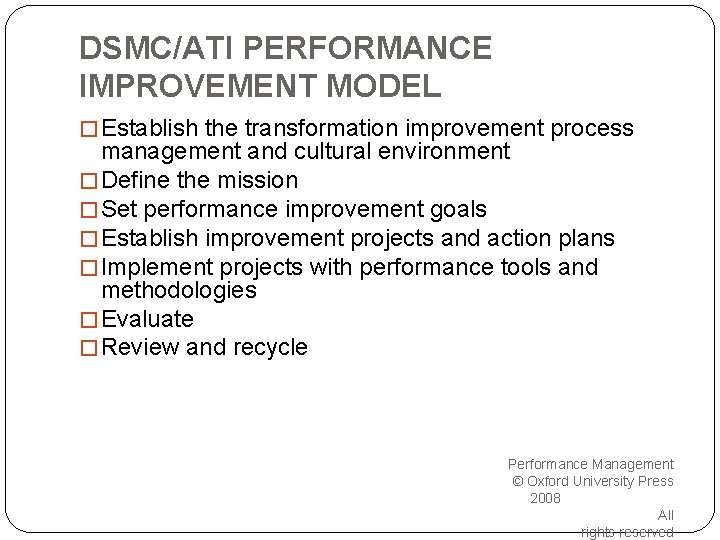
DSMC/ATI PERFORMANCE IMPROVEMENT MODEL � Establish the transformation improvement process management and cultural environment � Define the mission � Set performance improvement goals � Establish improvement projects and action plans � Implement projects with performance tools and methodologies � Evaluate � Review and recycle Performance Management © Oxford University Press 2008 All rights reserved
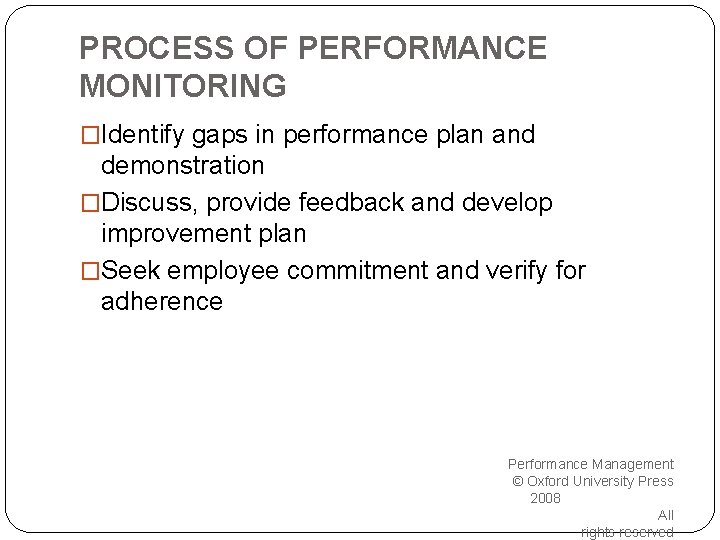
PROCESS OF PERFORMANCE MONITORING �Identify gaps in performance plan and demonstration �Discuss, provide feedback and develop improvement plan �Seek employee commitment and verify for adherence Performance Management © Oxford University Press 2008 All rights reserved
ONGOING MENTORING AND PROTÉGÉ DEVELOPMENT �A mentor is an experienced manager who provides guidance to the junior manager or professional and facilitates his/her personal development �Mentoring is linking an experienced person (mentor) with a less experienced person (mentoree) to help their personal and professional growth Performance Management © Oxford University Press 2008 All rights reserved
INSTITUTIONALIZING MENTORING PROGRAMME � Design � Ideation � Re-Design � Validation � Adjustment � Identification of Mentors � Training for Mentors � Matching Process � Building Understanding � Mapping Needs � Development Plans � Mentor Appraisal � Management Review Performance Management © Oxford University Press 2008 All rights reserved
BENEFITS OF MENTORING TO MANAGERS �Enhancement of skills �Developing and retaining talented employees �Building a legacy Performance Management © Oxford University Press 2008 All rights reserved
BOTTLENECKS IN IMPLEMENTATION OF PERFORMANCE MANAGEMENT � It refers to those inherent inhibiting factors existing within an organization which prevents implementation of performance management in its true sense Some such factors are: �Lack of management commitment towards performance management system �Absence of performance oriented work culture �Unavailability of proper tools and techniques for facilitating effective implementation �Lack of ownership of performance management amongst managers and employees and �Lack of flexibility of performance management system to respond effectively to internal and external demands of the customers Performance Management © Oxford University Press 2008 All rights reserved
STRATEGIES FOR EFFECTIVE IMPLEMENTATION OF PERFORMANCE MANAGEMENT � Building a performance oriented work culture : It refers to an organizational culture where performance is one of the core values It encompasses: �Quality of work: challenge, interest, achievement, freedom & autonomy, workload, quality of work relationships �Work life balance: supportive environment, recognition of life cycle needs/flexibility, security of income, social environment �Future growth opportunities: learning & development beyond current job, career advancement opportunities, performance improvement & feedback �Tangible rewards: competitive pay, good benefits, incentives for higher performance, ownership potential, recognition awards, fairness of reward �Enabling environment: caring attitude, encouragement for risk taking and acknowledgement of failure without fear, knowledge sharing, instilling ownership Management �Inspiration/Values: transparency in Performance dealings, free © Oxford University Press communications, high ethical standards, growth linked to 2008 performance, healthy competition, and managerial All effectiveness rights reserved
STRATEGIES FOR EFFECTIVE IMPLEMENTATION OF PERFORMANCE MANAGEMENT �Benchmarking best practices �De-linking reward administration system �Communicating performance objectives �Organizational behaviour improvement Performance Management © Oxford University Press 2008 All rights reserved
OPERATIONALIZING CHANGE THROUGH PERFORMANCE MANAGEMENT �Aligning systems of reward and recognition �Feeding back performance results to employees �Achieving some quick wins �Celebrating achievements �Creating meaning through introducing symbols of the new culture �Ensuring managers walk the talk and �Aligning recruitment and selection criteria Performance Management © Oxford University Press 2008 All rights reserved
HIGH PERFORMANCE TEAMS �A team is said to be a high performance team if it satisfies the following criteria: �Highly adaptive �Difficult to build �Expensive to maintain and �Glorious to behold Performance Management © Oxford University Press 2008 All rights reserved
BUILDING AND LEADING HIGH PERFORMANCE TEAM � Building High Performance Team involves: �Plant is usually the team member who is very creative and always brings in new and unconventional ideas �Shaper is the dynamic person who doesn’t give up and has a knack of finding ways around obstacles �Co-ordinator is the person in the group who facilitates contributions from everyone and keeps everyone informed �Implementer is the person who is a good organizer with common sense and is good at implementing once the idea is fully developed �Team worker is the silent worker, a relationship builder who avoids conflict Performance Management © Oxford University Press 2008 All rights reserved
BUILDING AND LEADING HIGH PERFORMANCE TEAM �Resource Investigator is the extrovert who finds outside support and resources for the group and is typically good at networking �Specialist is the person with expertise in a particular subject �Evaluator is the person who is able to comfortably evaluate various options and makes decisions and �Completer is the person who is efficient in making final corrections, putting the group work in a presentable manner and delivering the things on time Performance Management © Oxford University Press 2008 All rights reserved
BUILDING AND LEADING HIGH PERFORMANCE TEAM �Leading High Performance Team involves: �Building commitment �Making people stakeholders �Risks and results �Getting job done �Getting the team Performance Management © Oxford University Press 2008 All rights reserved