
Role of Health promotion Populationwide Interventions settings based
Role of Health promotion, Population-wide Interventions & settings based approaches in health promotion 03 -03 -2021 1

Synopsis 1. Health promotion 2. Strategies for health promotion 3. Approaches of health promotion 4. Population wide health promotion 5. Settings based Approaches 6. Opportunities and challenges 2
HEALTH PROMOTION The process of enabling people to increase control over and to improve their health Health is a social responsibility Asking people to change without changing social policies is not practical Success depends on individual and community empowerment Health promotion differs from health education 3
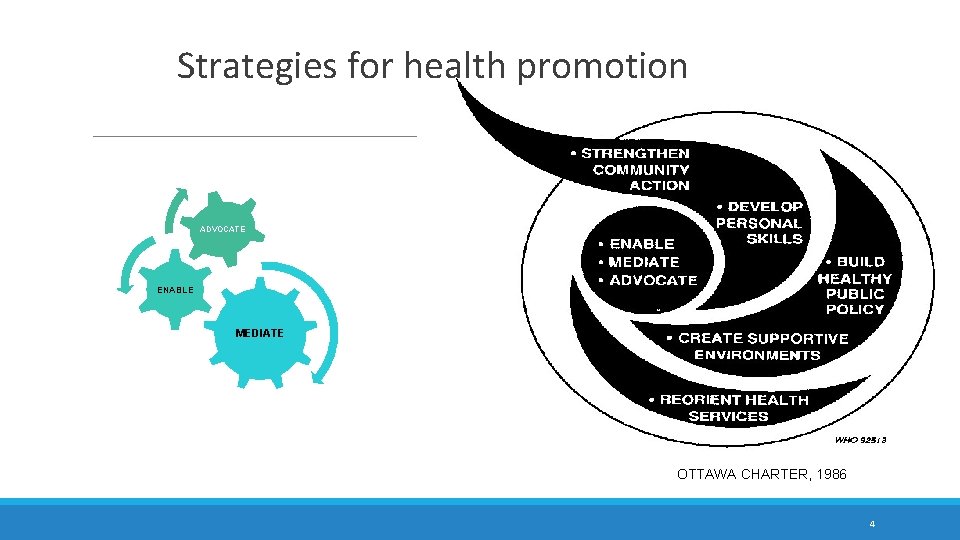
Strategies for health promotion ADVOCATE ENABLE MEDIATE OTTAWA CHARTER, 1986 4

APPROACHES TO HEALTH PROMOTION Issue-based health promotion Population-based health promotion Settings-based health promotion • addresses specific issues and promotes healthy practices. • promotes health among • promotes establishment of healthy settings Unhealthy diet, tobacco use, harmful use of alcohol, physical inactivity, injuries, unsafe sex, Children, adolescents, women, elderly, workers and other population groups Healthy workplaces, schools, villages, districts, cities, markets, hospitals 5

Population wide interventions § From a narrow model of acute care targeted at the individual patient, to one that focuses on the health and overall wellness of the broader population it serves § Complement clinical care in order to provide populations with a comprehensive set of promotive, preventive and curative health services, thereby promoting overall population health § Cross-sectoral collaboration as a key feature of the population health approach Shahzad, M. , Upshur, R. , Donnelly, P. et al. A population-based approach to integrated healthcare delivery: a scoping review of clinical care and public health collaboration. BMC Public Health 19, 708 (2019). 6

Population based approaches in India The National Rural Health Mission (NRHM) called for a synergistic approach by relating health to determinants of good health such as segments of nutrition, sanitation, hygiene and safe drinking water Legislative Measures: § Cigarettes and Other Tobacco Products Act (COTPA) 2003 § Motor Vehicles Act (Drunk and Drive, Rash driving etc) § Food Safety and Standards Act (2006) § The Infant Milk Substitutes, Feeding Bottles and Infant Foods (Regulation of Production, Supply and Distribution) Act, 1993 § Maternity Benefit Act, 1961 7
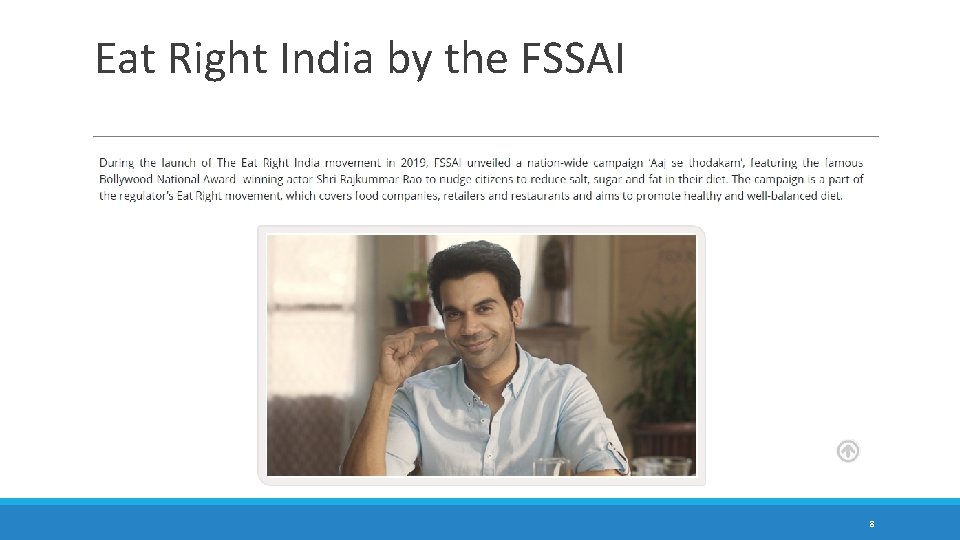
Eat Right India by the FSSAI 8
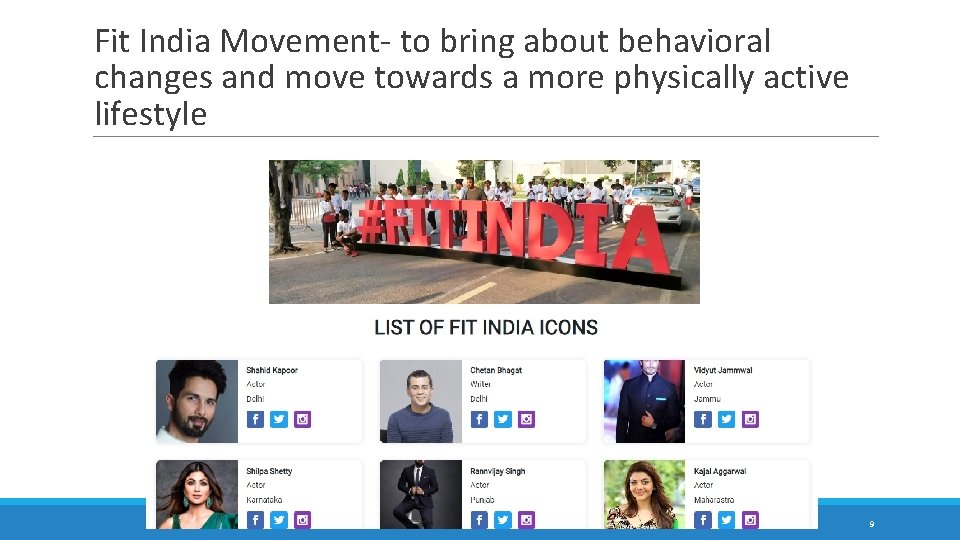
Fit India Movement- to bring about behavioral changes and move towards a more physically active lifestyle 9
§ Labeling of food products with nutrient values, trans fats %, and other contents § Traffic light labelling system for food products § Increasing the Excise duty on Alcohol § Clean India campaigns under the Swacchh Bharat to promote use of sanitary latrine & achieving ODF status 10
Principles and perspectives in Setting-based approach ◦ A holistic and socio-ecological understanding of health ◦ Focus on populations, policy and environments ◦ Equity and Social Justice ◦ Sustainability ◦ Community participation ◦ Enablement and Empowerment ◦ Cooperation, consensus and mediation ◦ Advocacy 11
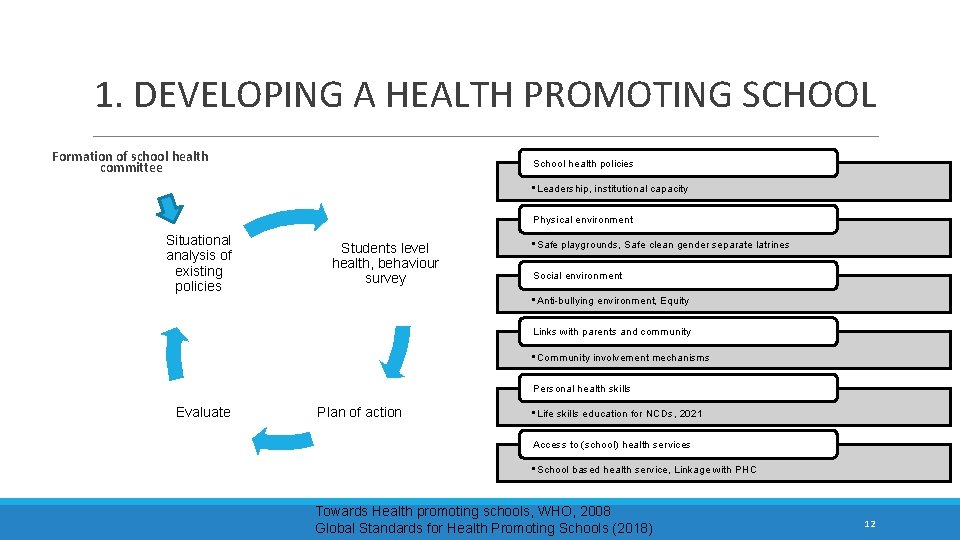
1. DEVELOPING A HEALTH PROMOTING SCHOOL Formation of school health committee School health policies • Leadership, institutional capacity Physical environment Situational analysis of existing policies Students level health, behaviour survey • Safe playgrounds, Safe clean gender separate latrines Social environment • Anti-bullying environment, Equity Links with parents and community • Community involvement mechanisms Personal health skills Evaluate Plan of action • Life skills education for NCDs, 2021 Access to (school) health services • School based health service, Linkage with PHC Towards Health promoting schools, WHO, 2008 Global Standards for Health Promoting Schools (2018) 12
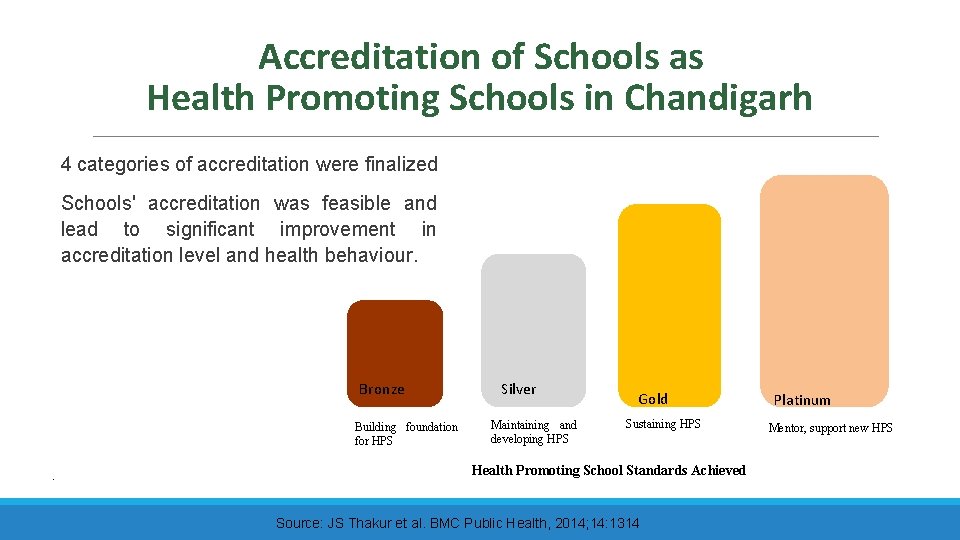
Accreditation of Schools as Health Promoting Schools in Chandigarh 4 categories of accreditation were finalized Schools' accreditation was feasible and lead to significant improvement in accreditation level and health behaviour. Bronze Building foundation for HPS . Silver Maintaining and developing HPS Gold Sustaining HPS Health Promoting School Standards Achieved Source: JS Thakur et al. BMC Public Health, 2014; 14: 1314 Platinum Mentor, support new HPS
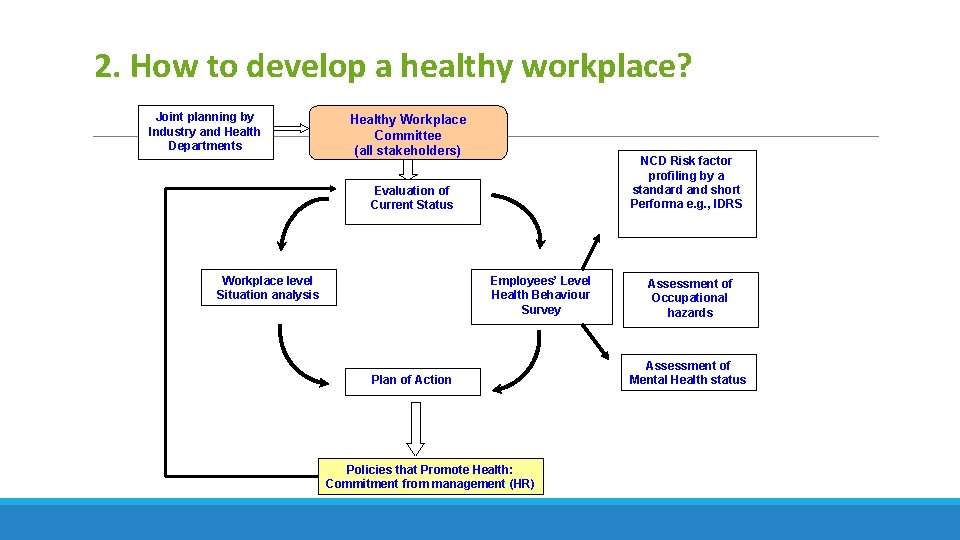
2. How to develop a healthy workplace? Joint planning by Industry and Health Departments Healthy Workplace Committee (all stakeholders) NCD Risk factor profiling by a standard and short Performa e. g. , IDRS Evaluation of Current Status Workplace level Situation analysis Employees’ Level Health Behaviour Survey Plan of Action Policies that Promote Health: Commitment from management (HR) Assessment of Occupational hazards Assessment of Mental Health status
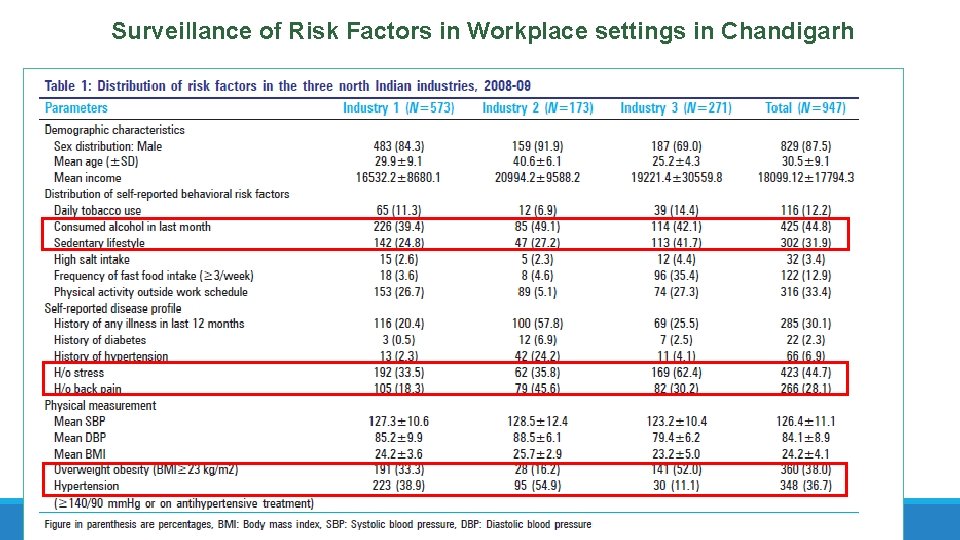
Surveillance of Risk Factors in Workplace settings in Chandigarh 15
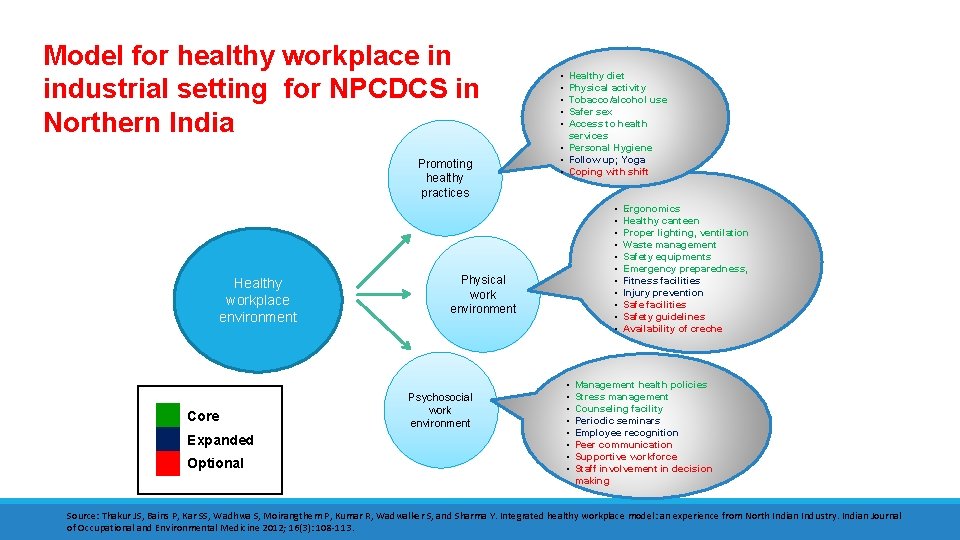
Model for healthy workplace in industrial setting for NPCDCS in Northern India Promoting healthy practices Healthy workplace environment • • • Healthy diet Physical activity Tobacco/alcohol use Safer sex Access to health services • Personal Hygiene • Follow up; Yoga • Coping with shift • • • Physical work environment . Ergonomics Healthy canteen Proper lighting, ventilation Waste management Safety equipments Emergency preparedness, Fitness facilities Injury prevention Safe facilities Safety guidelines Availability of creche. Core Expanded Optional Psychosocial work environment • • Management health policies Stress management Counseling facility Periodic seminars Employee recognition Peer communication Supportive workforce Staff involvement in decision making Source: Thakur JS, Bains P, Kar SS, Wadhwa S, Moirangthem P, Kumar R, Wadwalker S, and Sharma Y. Integrated healthy workplace model: . an experience from North Indian Industry. Indian Journal of Occupational and Environmental Medicine 2012; 16(3): 108 -113.
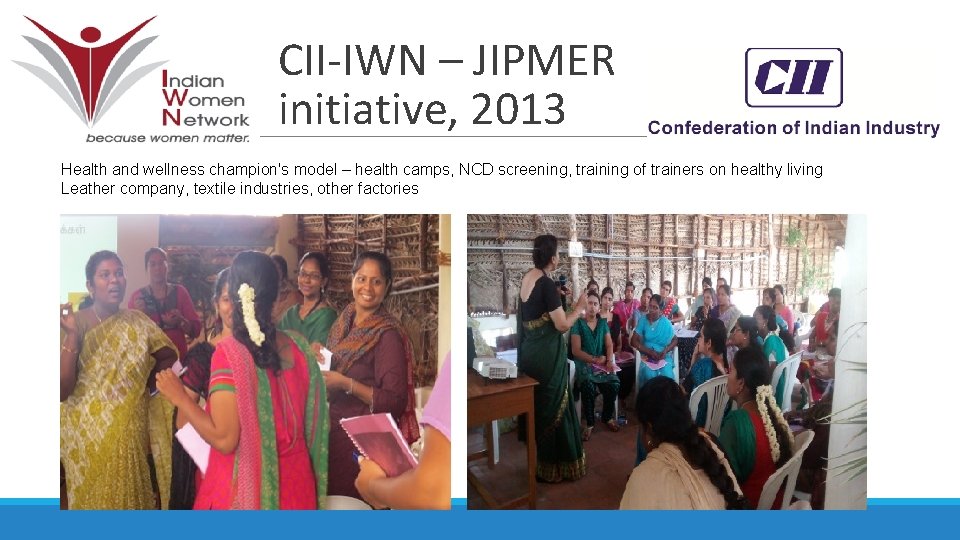
CII-IWN – JIPMER initiative, 2013 Health and wellness champion's model – health camps, NCD screening, training of trainers on healthy living Leather company, textile industries, other factories
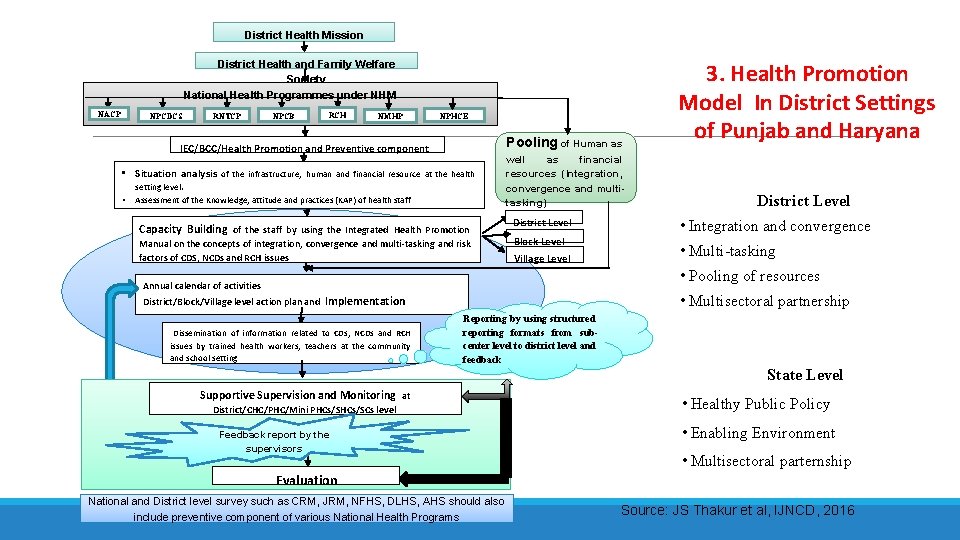
District Health Mission District Health and Family Welfare Society National Health Programmes under NHM NACP NPCDCS RNTCP NPCB RCH NMHP NPHCE Pooling of Human as IEC/BCC/Health Promotion and Preventive component • Situation analysis • of the infrastructure, human and financial resource at the health setting level. Assessment of the Knowledge, attitude and practices (KAP) of health staff Capacity Building of the staff by using the Integrated Health Promotion Manual on the concepts of integration, convergence and multi-tasking and risk factors of CDS, NCDs and RCH issues well as financial resources (Integration, convergence and multitasking) District Level Block Level Village Level 3. Health Promotion Model In District Settings of Punjab and Haryana District Level • Integration and convergence • Multi-tasking • Pooling of resources Annual calendar of activities District/Block/Village level action plan and • Multisectoral partnership Implementation Dissemination of information related to CDs, NCDs and RCH issues by trained health workers, teachers at the community and school setting Reporting by using structured reporting formats from subcenter level to district level and feedback State Level Supportive Supervision and Monitoring at District/CHC/PHC/Mini PHCs/SCs level Feedback report by the supervisors • Healthy Public Policy • Enabling Environment • Multisectoral parternship Evaluation National and District level survey such as CRM, JRM, NFHS, DLHS, AHS should also include preventive component of various National Health Programs Source: JS Thakur et al, IJNCD, 2016
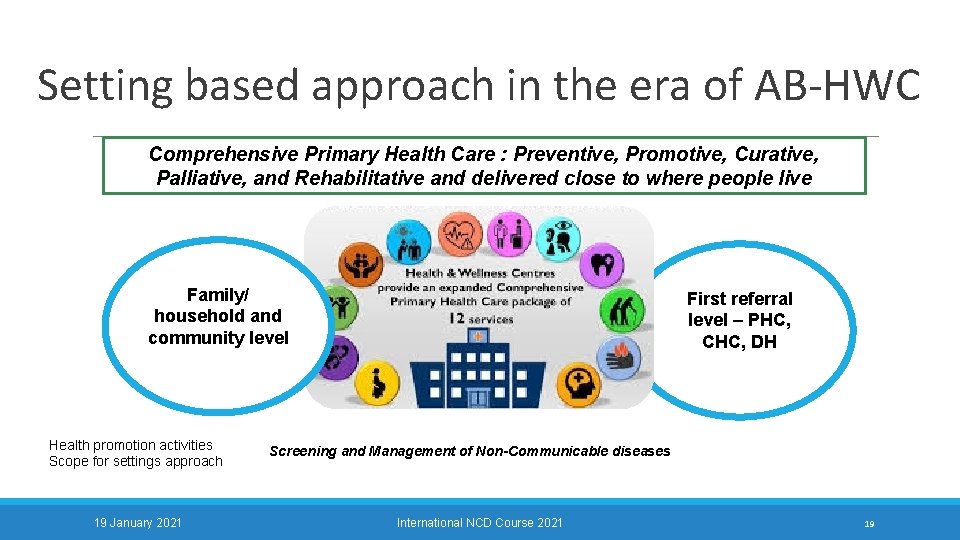
Setting based approach in the era of AB-HWC Comprehensive Primary Health Care : Preventive, Promotive, Curative, Palliative, and Rehabilitative and delivered close to where people live Family/ household and community level Health promotion activities Scope for settings approach 19 January 2021 First referral level – PHC, CHC, DH Screening and Management of Non-Communicable diseases International NCD Course 2021 19
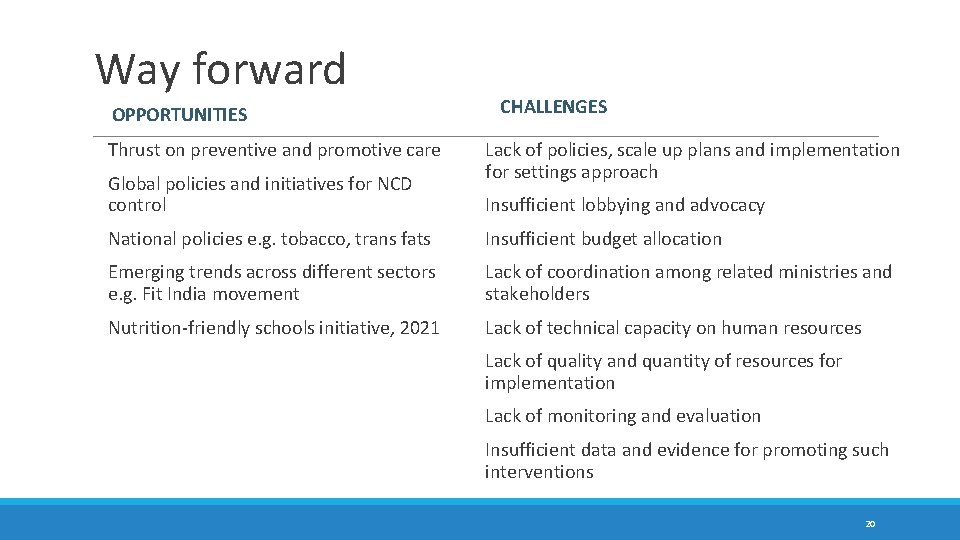
Way forward OPPORTUNITIES Thrust on preventive and promotive care Global policies and initiatives for NCD control CHALLENGES Lack of policies, scale up plans and implementation for settings approach Insufficient lobbying and advocacy National policies e. g. tobacco, trans fats Insufficient budget allocation Emerging trends across different sectors e. g. Fit India movement Lack of coordination among related ministries and stakeholders Nutrition-friendly schools initiative, 2021 Lack of technical capacity on human resources Lack of quality and quantity of resources for implementation Lack of monitoring and evaluation Insufficient data and evidence for promoting such interventions 20
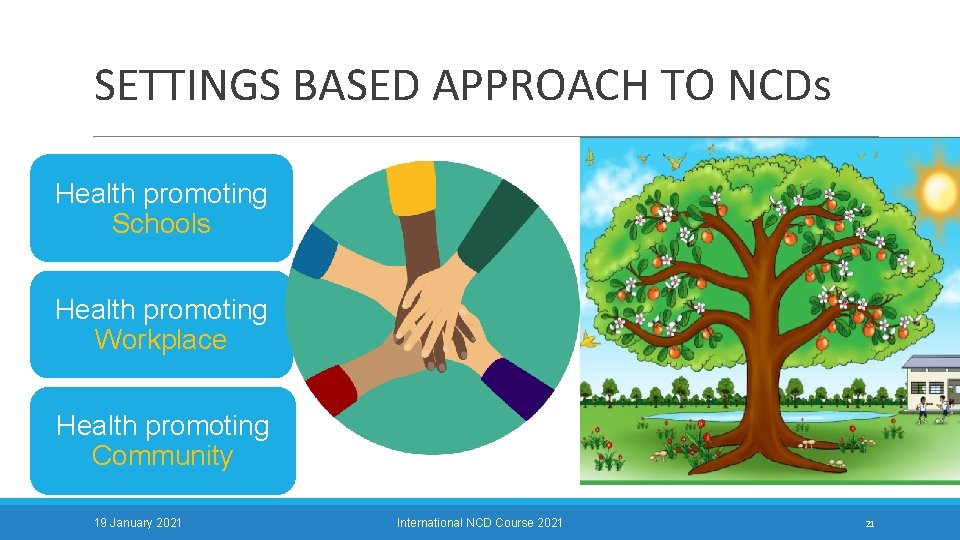
SETTINGS BASED APPROACH TO NCDs Health promoting Schools Health promoting Workplace Health promoting Community 19 January 2021 International NCD Course 2021 21
- Slides: 21