
Role of Government The role of government is
- Slides: 12
Role of Government The role of government is to protect the lives, liberties and property of members of the community and to provide those services that individuals cannot otherwise provide on their own. To exercise authority, governments are given power – the authority to use force.
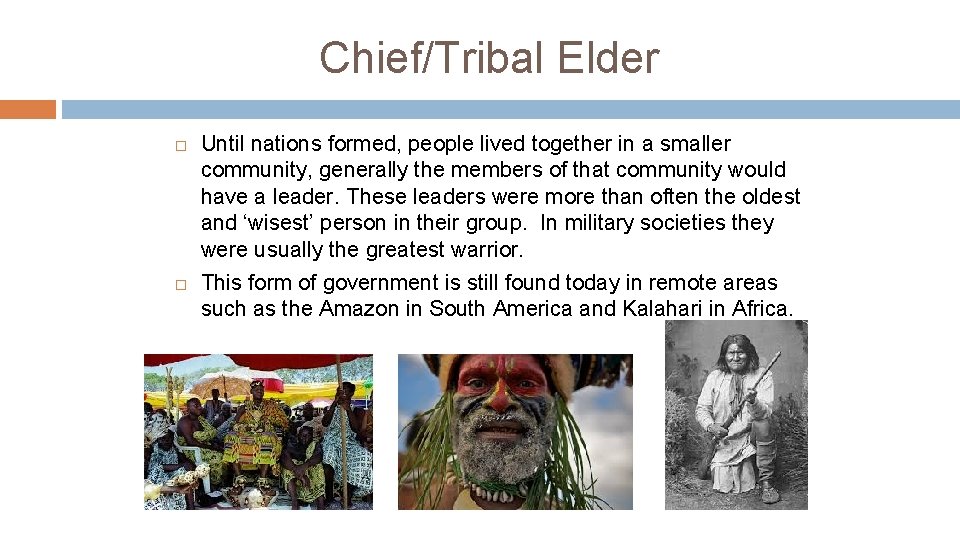
Chief/Tribal Elder Until nations formed, people lived together in a smaller community, generally the members of that community would have a leader. These leaders were more than often the oldest and ‘wisest’ person in their group. In military societies they were usually the greatest warrior. This form of government is still found today in remote areas such as the Amazon in South America and Kalahari in Africa.
MONARCHY Oldest official form of government The main characteristic is that the ruler inherits power When the ruler dies, authority passes to a child or a close relative. Ex. Kings, Queens The ruler has control over their entire population In many older forms of monarchies they claimed absolute power, complete control and authority. In Ancient Civilizations many of these monarchs ‘claimed’ to be God or a God. In Europe from the Dark Ages until the Enlightenment many monarchs
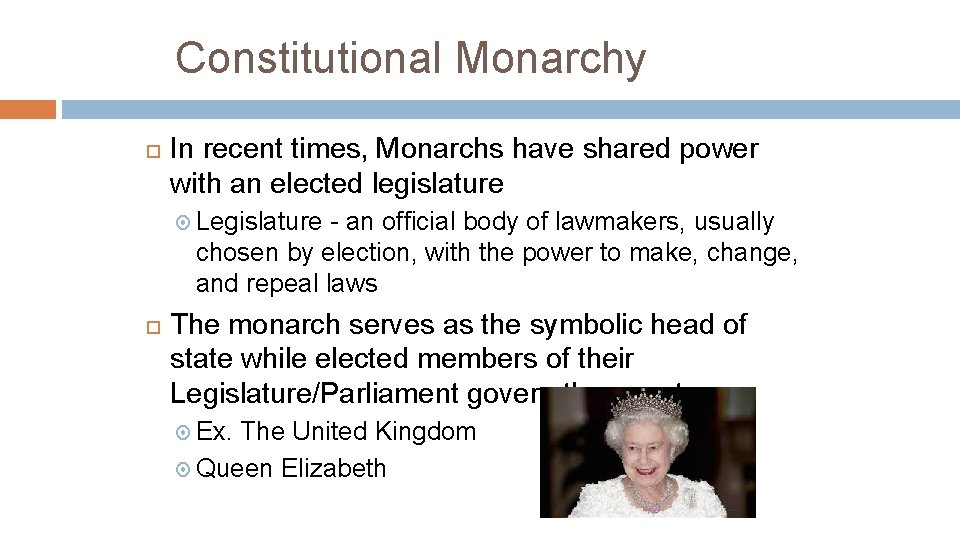
Constitutional Monarchy In recent times, Monarchs have shared power with an elected legislature Legislature - an official body of lawmakers, usually chosen by election, with the power to make, change, and repeal laws The monarch serves as the symbolic head of state while elected members of their Legislature/Parliament govern the country. Ex. The United Kingdom Queen Elizabeth
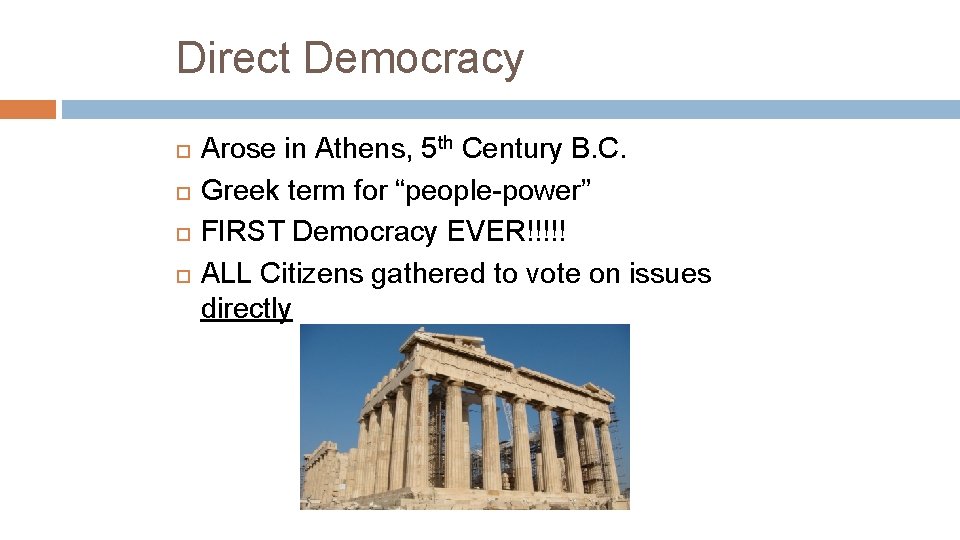
Direct Democracy Arose in Athens, 5 th Century B. C. Greek term for “people-power” FIRST Democracy EVER!!!!! ALL Citizens gathered to vote on issues directly
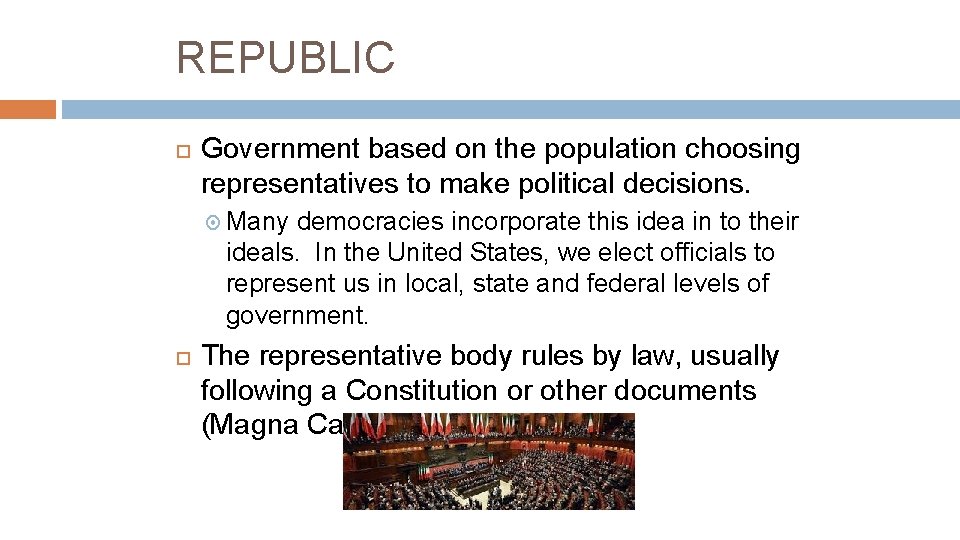
REPUBLIC Government based on the population choosing representatives to make political decisions. Many democracies incorporate this idea in to their ideals. In the United States, we elect officials to represent us in local, state and federal levels of government. The representative body rules by law, usually following a Constitution or other documents (Magna Carta).
DEMOCRACY Government authority is based on the will of the people, this is know as popular sovereignty. Citizens in a democracy enjoy basic rights, including criticism of their own government. A Constitution or other official document(s) will be the guidelines for how these governments function. Many Democracies include forms of a Republic where they elect officials to represent them in government.
Representative Democracy Governmental power divided between two branches Later Democracies followed Rome’s lead and have these representatives in the Legislative portion of their government. Generally, these legislatures make laws. English Parliament – House of Commons, House of Lords U. S. Congress – House of Representatives, Senate
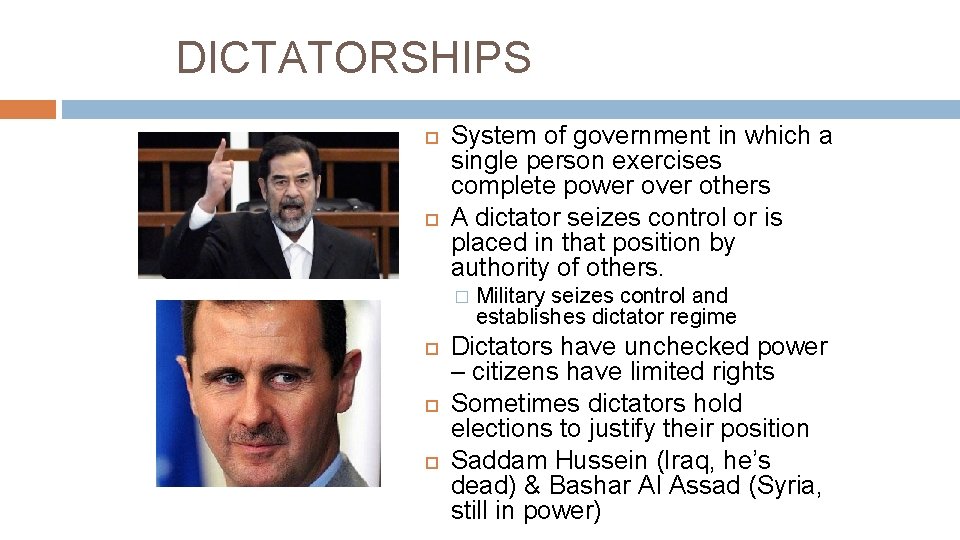
DICTATORSHIPS System of government in which a single person exercises complete power over others A dictator seizes control or is placed in that position by authority of others. � Military seizes control and establishes dictator regime Dictators have unchecked power – citizens have limited rights Sometimes dictators hold elections to justify their position Saddam Hussein (Iraq, he’s dead) & Bashar Al Assad (Syria, still in power)
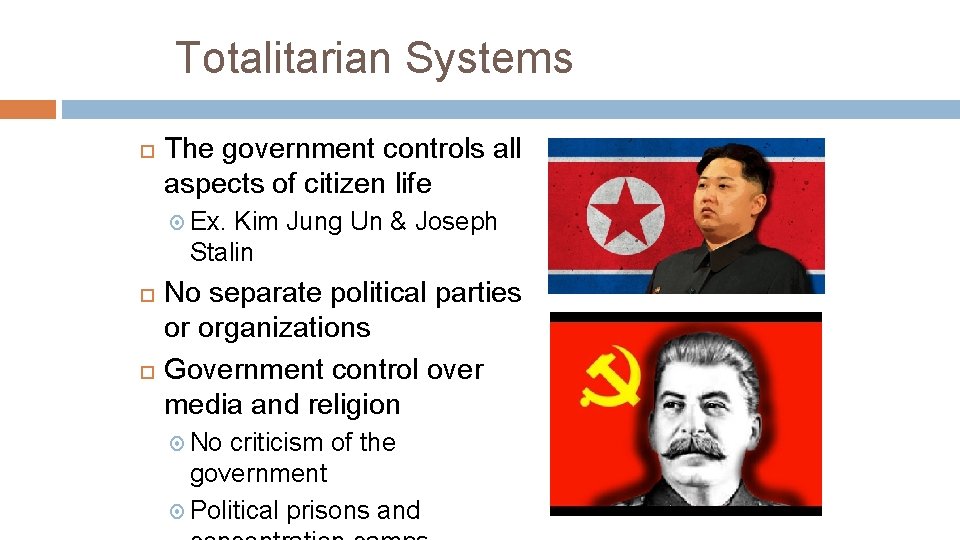
Totalitarian Systems The government controls all aspects of citizen life Ex. Kim Jung Un & Joseph Stalin No separate political parties or organizations Government control over media and religion No criticism of the government Political prisons and
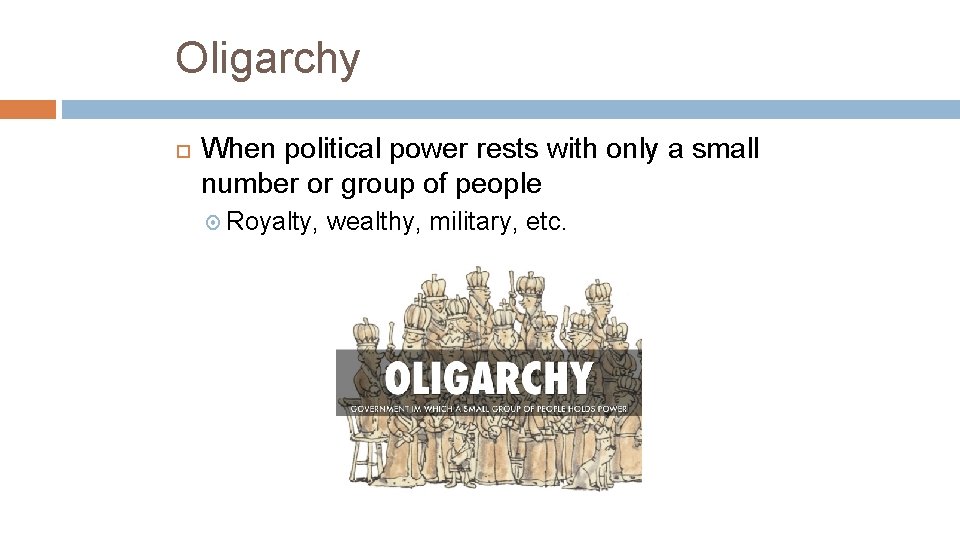
Oligarchy When political power rests with only a small number or group of people Royalty, wealthy, military, etc.
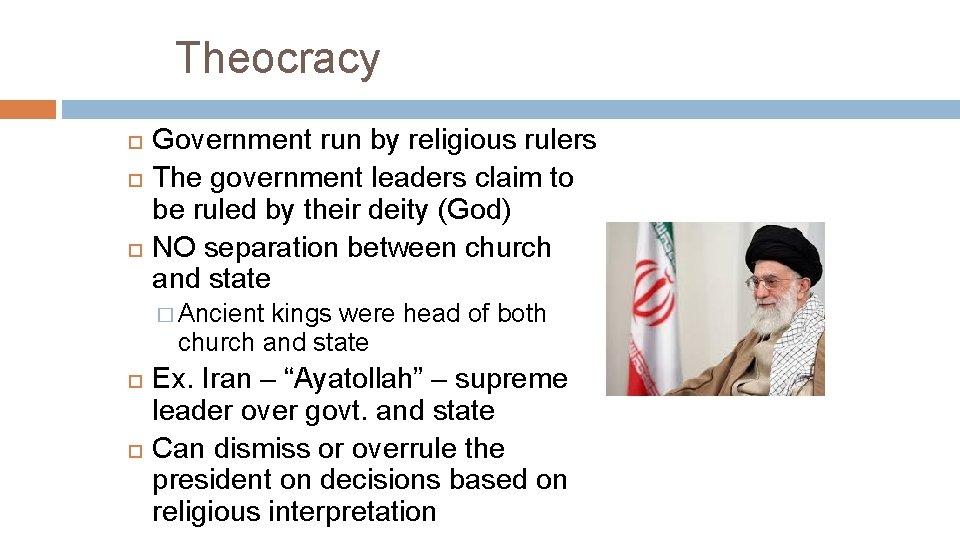
Theocracy Government run by religious rulers The government leaders claim to be ruled by their deity (God) NO separation between church and state � Ancient kings were head of both church and state Ex. Iran – “Ayatollah” – supreme leader over govt. and state Can dismiss or overrule the president on decisions based on religious interpretation