
Role of fungi in biotechnology Biotechnology is a

§ Role of fungi in biotechnology Biotechnology is a relatively new term meaning "the use of organisms for the production of biomass or metabolites on an industrial scale". Biotechnology involves and interconnects the fields of biology (the organisms involved), economics (costs), kinetic s (physical/chemical influences on biotechnological processes) and process management fungi have been important in both ancient and modern biotechnological processes.
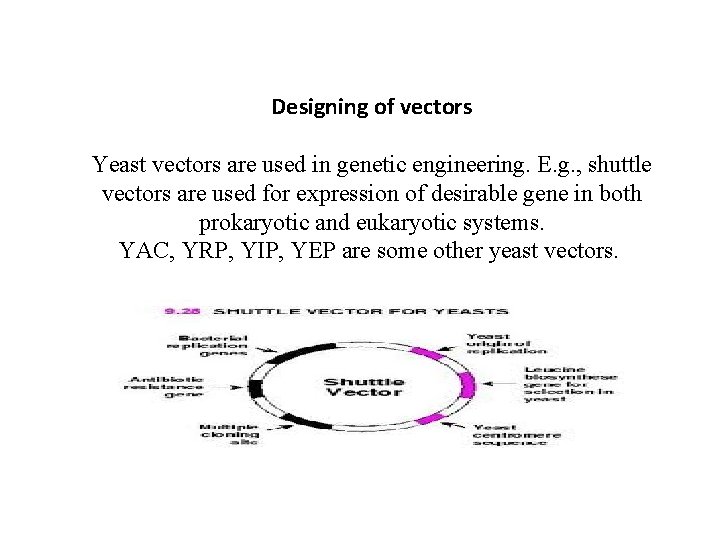
Designing of vectors Yeast vectors are used in genetic engineering. E. g. , shuttle vectors are used for expression of desirable gene in both prokaryotic and eukaryotic systems. YAC, YRP, YIP, YEP are some other yeast vectors.
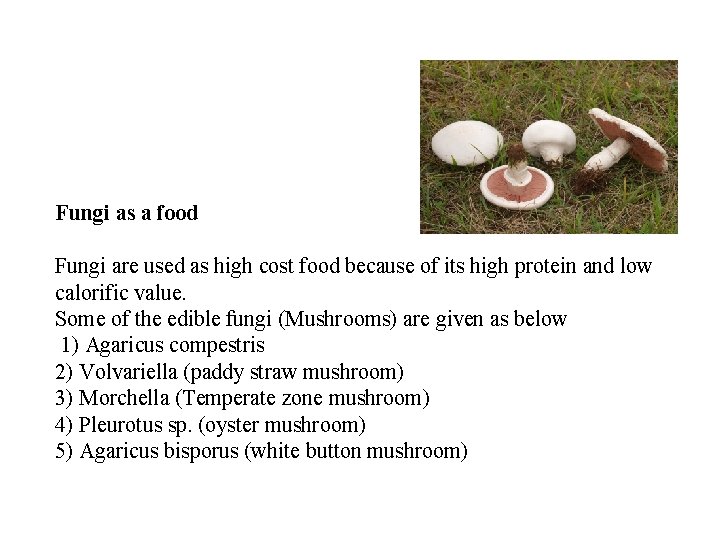
Fungi as a food Fungi are used as high cost food because of its high protein and low calorific value. Some of the edible fungi (Mushrooms) are given as below 1) Agaricus compestris 2) Volvariella (paddy straw mushroom) 3) Morchella (Temperate zone mushroom) 4) Pleurotus sp. (oyster mushroom) 5) Agaricus bisporus (white button mushroom)
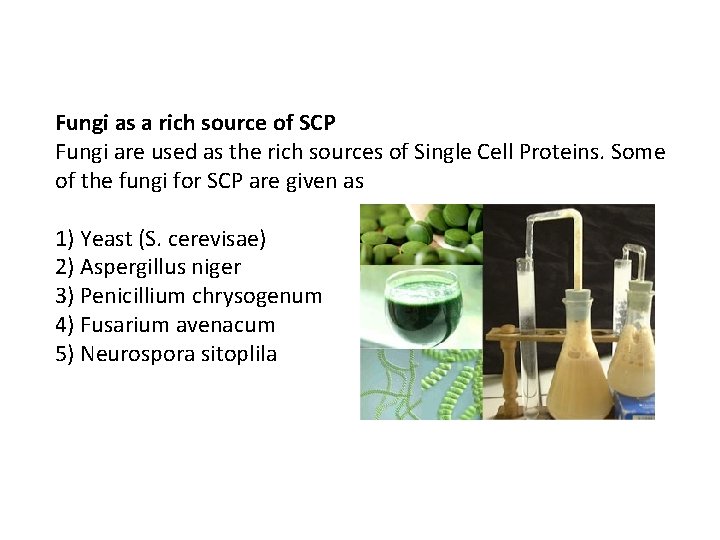
Fungi as a rich source of SCP Fungi are used as the rich sources of Single Cell Proteins. Some of the fungi for SCP are given as 1) Yeast (S. cerevisae) 2) Aspergillus niger 3) Penicillium chrysogenum 4) Fusarium avenacum 5) Neurospora sitoplila
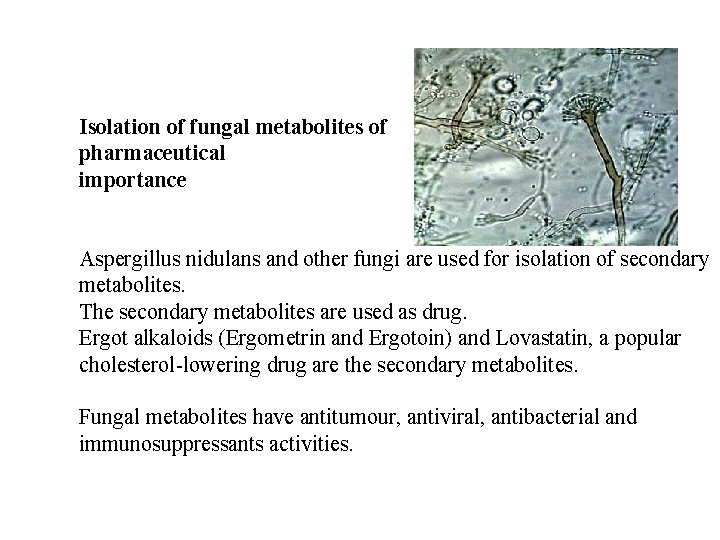
Isolation of fungal metabolites of pharmaceutical importance Aspergillus nidulans and other fungi are used for isolation of secondary metabolites. The secondary metabolites are used as drug. Ergot alkaloids (Ergometrin and Ergotoin) and Lovastatin, a popular cholesterol-lowering drug are the secondary metabolites. Fungal metabolites have antitumour, antiviral, antibacterial and immunosuppressants activities.
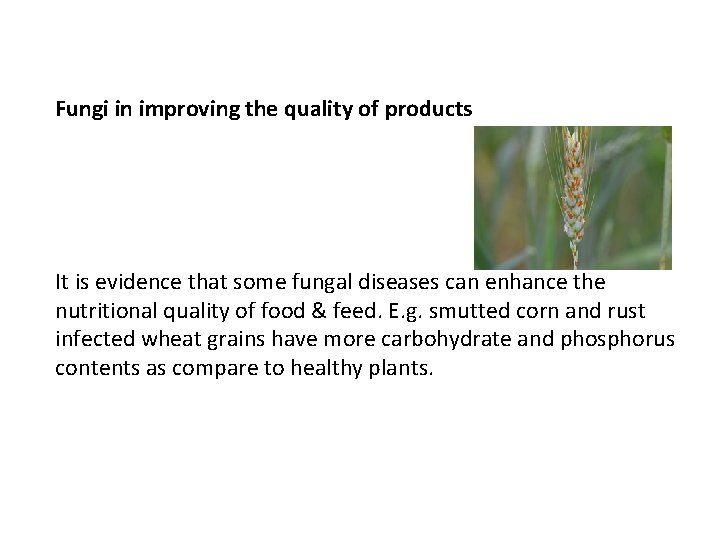
Fungi in improving the quality of products It is evidence that some fungal diseases can enhance the nutritional quality of food & feed. E. g. smutted corn and rust infected wheat grains have more carbohydrate and phosphorus contents as compare to healthy plants.
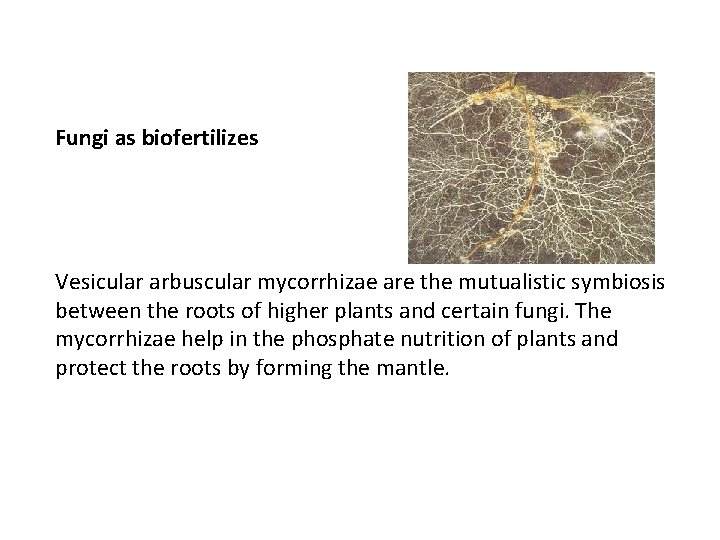
Fungi as biofertilizes Vesicular arbuscular mycorrhizae are the mutualistic symbiosis between the roots of higher plants and certain fungi. The mycorrhizae help in the phosphate nutrition of plants and protect the roots by forming the mantle.
Fungi as "Microbial weed killer "(Bioherbicides) Fungi are used as bioherbicides, some examples with their targets are given in brackets. These are: Septagloeum gillis (Mistletoes) Wallrothiella arecuthobii (Mistletoes) Colletotrichum gloeosporiordes(Mistletoes) Phyllosticta (Glycosmis) Leptosphaerulina trifolia(Passiflora) Puccinia chondrillina(Rush weed) Cercospora ageratinae(Pamakani weed)
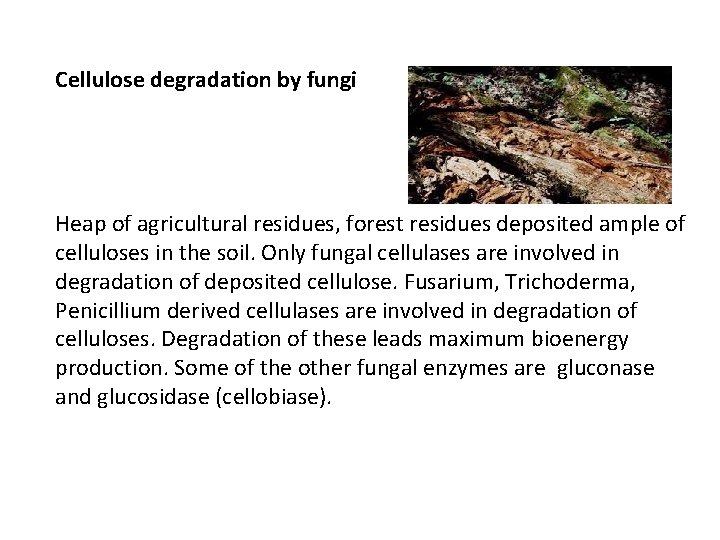
Cellulose degradation by fungi Heap of agricultural residues, forest residues deposited ample of celluloses in the soil. Only fungal cellulases are involved in degradation of deposited cellulose. Fusarium, Trichoderma, Penicillium derived cellulases are involved in degradation of celluloses. Degradation of these leads maximum bioenergy production. Some of the other fungal enzymes are gluconase and glucosidase (cellobiase).
Bioconversion of lignin White Rot fungi such as Coriolus versicolor, Polyporus ance and Brown Rot fungi like Poria monticola, Lenzitis trabea are used in depolymerization and degradation of lignin to low molecular weight Petroleum products. These fungi are also used in softening of wood in paper making industries.
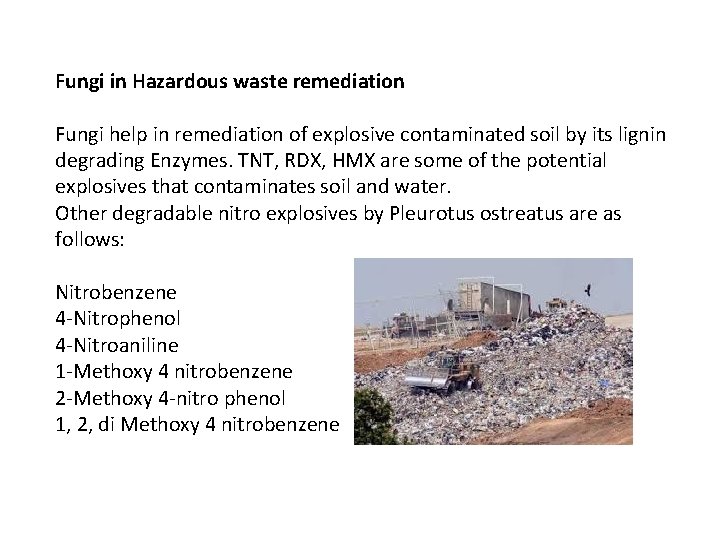
Fungi in Hazardous waste remediation Fungi help in remediation of explosive contaminated soil by its lignin degrading Enzymes. TNT, RDX, HMX are some of the potential explosives that contaminates soil and water. Other degradable nitro explosives by Pleurotus ostreatus are as follows: Nitrobenzene 4 -Nitrophenol 4 -Nitroaniline 1 -Methoxy 4 nitrobenzene 2 -Methoxy 4 -nitro phenol 1, 2, di Methoxy 4 nitrobenzene
Production of food and fodder Presently about 25% of our food is already produced by biotechnological processes and fungi play an important part in it.
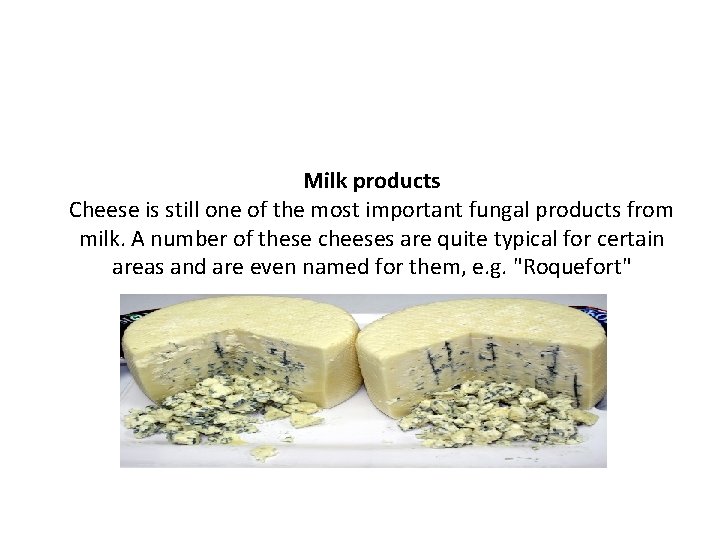
Milk products Cheese is still one of the most important fungal products from milk. A number of these cheeses are quite typical for certain areas and are even named for them, e. g. "Roquefort"
Metabolic products One of the main areas where fungi are used today in biotechnology, is in the production of certain metabolites.
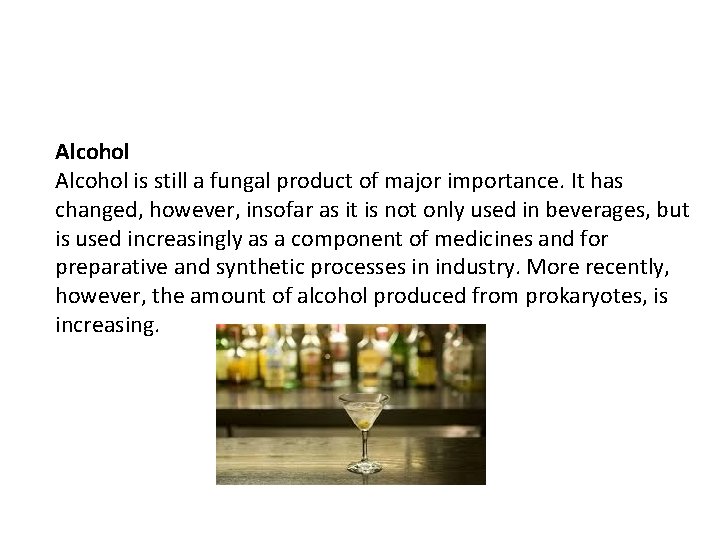
Alcohol is still a fungal product of major importance. It has changed, however, insofar as it is not only used in beverages, but is used increasingly as a component of medicines and for preparative and synthetic processes in industry. More recently, however, the amount of alcohol produced from prokaryotes, is increasing.
Steroids Fungi such as several Penicillium as Aspergillus strains by virtue of their ability to catalyse very specific one- or few-step transformations in steroids became essential in the production of these drugs.
Antibiotics Since Alexander Fleming in 1928 discovered the production of the first antibiotic, Penicillin, from the imperfect fungus Penicillium notatum, everyone knows about the importance of these metabolites in medicine. About 6000 antibiotics are known today, at least by their formula, but only about 400 of them, for various reasons, are used i n human medicine. Fungi produce about a quarter of them.
Enzymes Quite a number of fungal enzymes are produced commercially and have become indispensable tools in industry and research. They are used for a wide variety of applications from biochemical analysis, over medical diagnosis to food processing. Organic acids, amino acids, nucleic acids Among the organic acids of fungal origin, citric acid is leading with an annual production of over 600. 000 tons. It is mainly used in the food and beverage industry. B ut also amino acids and nucleic acids are commercially produced from fungi and find wide application.
Ergot alkaloids These alkaloids find now wide medicinal application e. g. in gynaecology, against migraine and in the treatment of heart and circulatory diseases.
Pollution control Biological control measures using fungi in turn help in reducing the need for chemicals in pest and pathogen control. They therefore are one new and important aspects in the involvement of fungi in the ever more necessary measures for the protection of our environment
References http: //epub. uni-regensburg. de/16960/1/ubr 06980_ocr. pdf http: //www. streetdirectory. com/travel_guide/119227/science/ potential_applications_of_fungi_a_biotechnological_aproach. ht ml
- Slides: 21