
Role of Forensic Pharmacist Forensic Drug Toxin Measurements







- Slides: 16
Role of Forensic Pharmacist
Forensic Drug & Toxin Measurements Need. To ensure the accuracy and reliability of forensic results and measurements To create improved methods in forensic analysis Objectives • Improving Analytical Capabilities in Three Forensic Science Program Areas • Drugs and Toxins • Trace Evidence • Human Identity (DNA) • Develop measurement toolset • Methods, Reference Materials and Data for Forensics • Enable quantifiable uncertainty of measurements • Improved efficiency/cost effectiveness
Drugs & Toxins Mass Spectrometry of Drugs • Improved reference data and approaches to uncertainty of identification NMR of Drugs • Develop approaches to reliable identification of drugs • Testing benchtop NMR Rapid Identification of Emerging Synthetic Drugs • Synthetic drugs are constantly changing and their structures must be measured
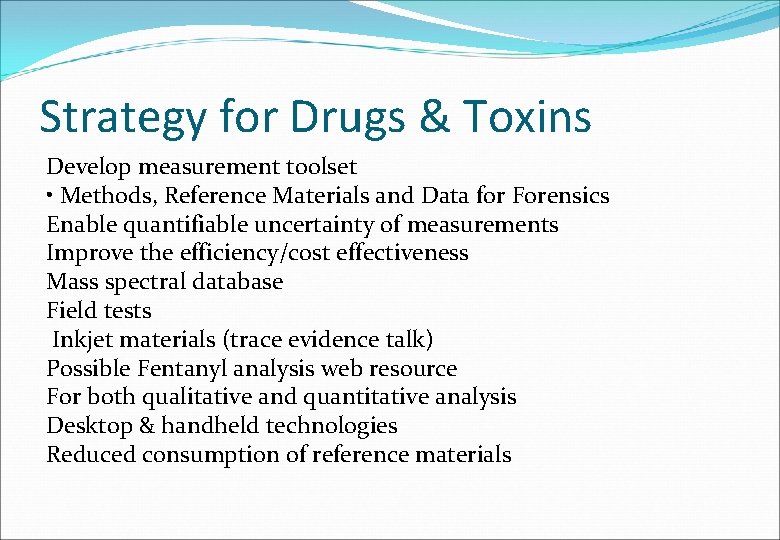
Strategy for Drugs & Toxins Develop measurement toolset • Methods, Reference Materials and Data for Forensics Enable quantifiable uncertainty of measurements Improve the efficiency/cost effectiveness Mass spectral database Field tests Inkjet materials (trace evidence talk) Possible Fentanyl analysis web resource For both qualitative and quantitative analysis Desktop & handheld technologies Reduced consumption of reference materials
Postmortem Redistribution (PMR) Postmortem drug concentrations in blood may not always reflect antemortem drug concentrations in blood due to the movement of the drugs after death. The phenomenon is referred to as Postmortem Redistribution (PMR). Mechanisms involved in postmortem redistribution are both complicated and poorly understood. However, postmortem drug concentrations in blood do follow some generally accepted trends that aid with interpretation; the characteristics of the drug itself can be used to indicate if a drug is subject to PMR.
Large changes in blood drug concentrations are predicted for basic, lipophilic drugs with a high volume of distribution (>3 L/kg). When PMR occurs, blood specimens drawn from the central body cavity and heart generally will have higher drug concentrations postmortem than specimens drawn from peripheral areas, most commonly the femoral vein
The diffusion of drugs from organ tissue into the blood may explain the observed phenomenon. To compensate for PMR, postmortem blood specimens are recommended to be collected from at least two areas of the body at autopsy; a peripheral area and a central area (often the heart), so that a comparison can be made.
While antemortem blood specimens are especially helpful in interpreting postmortem blood drug concentrations, relevant specimens are only very rarely available.
Prescription Forgery Bearing fake signatures or forged signatures Is a prescriber suddenly writing many orders or in large amounts for a drug? Do patients present to a clinic or pharmacy claiming the need for a refill or new order because they lost or wasted their current medication? Be careful for numbers on prescription orders 0 s, 1 s, 4 s, 3 s and others in combination that can be modified. Do they look altered? Is the prescribing practitioner signature legible and readable? Do dates or refill amounts seem not to match the handwriting of other portions of the order?
Product Tampering can refer to many forms of sabotage but the term is often used to mean intentional modification of products in a way that would make them harmful to the consumer. Product tampering is the deliberate contamination of goods after they have been manufactured. It is often done to alarm consumers or to blackmail a company. The individual involved may have mental health problems or be politically motivated.
Product tampering is intriguing from a criminological perspective because motives behind tampering span such a diverse spectrum – from terrorism, corporate sabotage and extortion, to petty theft and malicious mischief.
Sometimes tampering can be motivated by the desperation of a drug addict. In 1998, a cardiac intensive care unit in the United Arab Emirates saw an outbreak of Serratia marcescens bacteria. Investigators traced the bacteria to vials of fentanyl, a potent narcotic. A respiratory therapist addicted to the drug had extracted the fentanyl for himself and replaced the liquid with water, which had been contaminated with the bacteria. Cases such as this one regularly surface: in 2009, a nurse at a plastic surgery clinic in Washington State broke open ampoules of Demerol and consumed the contents, then superglued the ampoules back together after refilling them with saline solution. She was sentenced to a year in prison.
2. Tylenol, U. S. A. , 1982 It was the case that changed the way drugs are packaged and led to new product tampering laws. Seven people died in the Chicago area after taking extrastrength Tylenol that had been laced with cyanide. And it remains one of the biggest unsolved murder cases in the U. S. , a case that has had more than 100 police investigators, more than 6, 500 leads and 400 possible suspects. But there's no known crime scene and no known motive. Tylenol was recalled and its market share plummeted, but after a few years it was the No. 1 analgesic in the U. S.
Insurance fraud Common pharmacy fraud schemes include: Prescription drug switching – substituting a more expensive drug for a cheaper one Billing for a false or nonexistent prescription Billing multiple payors for the same prescription Billing for brand name drugs when generic drugs are dispensed Filling less than the prescribed quantity of a drug
Strategies of Prosecution 1) Billing/Insurance Fraud (Violations of False Claims Act): Provide evidence of inflated, doubling, or unbundled billing, or arrangement between patient and physician to receive free services for Medicaid/Medicare insurance number. Proof of feigned injuries or treatment by secondary medical reviewer for insurance claim. 2) Proving Fraud in a Medical Malpractice suit: Provide evidence that physician had intentionally concealed prior malpractice or made factual misrepresentations regarding a previous malpractice, leading to faulty therapy or cure that patient justifiably relied upon, leading to patient damages. Must be separate and distinct from damages from the current malpractice case in question. (Simcuski v. Saeli)
3) Anti-kickback Law Violations: Provide evidence of any compensation a physician may have received in exchange for recommending a product – in the form of financial incentive, paid “vacation” conferences, “consulting fees, ” etc. 4) Off-Label Marketing (Violations of Food Drug and Cosmetic Act): Pharmaceutical products not approved by the FDA for an intended use may be prescribed for a primary or secondary use by physicians, but are not eligible for reimbursement and are prohibited to be marketed by pharmaceutical companies. Any evidence otherwise would suggest fraud.